Homer, Odyssey, Book 10: Aeolus, the Laestrygonians and Circe
Introduction
The Odyssey, composed around 700 BCE and attributed to Homer, tells of Odysseus' ten-year journey home from Troy and his return to Ithaca. Book 10 (573 lines): Aeolus, the Laestrygonians and Circe.
The page photographs are from Florence, Biblioteca Medicea Laurenziana, Plut. 32.24 (parchment, 10th century, 234 folios; the oldest manuscript of the Odyssey with published images), in the Biblioteca Medicea Laurenziana's Teca Digitale. This book is on fol. 92v-103v; each section below is one page, with its first and last line as read on the photograph. Many pages carry interlinear glosses and a few marginal notes in later hands.
The Greek is A. T. Murray's Loeb text (1919) via Perseus, not a transcription of this manuscript, whose wording differs in places. The English is Murray's prose translation (1919), divided every five lines; at a page break a five-line block goes with the page holding most of it, except at the page breaks where a section's note says the English is cut at the end of Murray's sentence. Each section's note gives its English line range.
Where the scribe left out a line, wrote one in the margin, changed the order or added a line not in Murray's text, the section's note on the photograph says so; the Greek and English shown are Murray's full text for the page's range.
How was this verified? (Provenance)
Where on the image
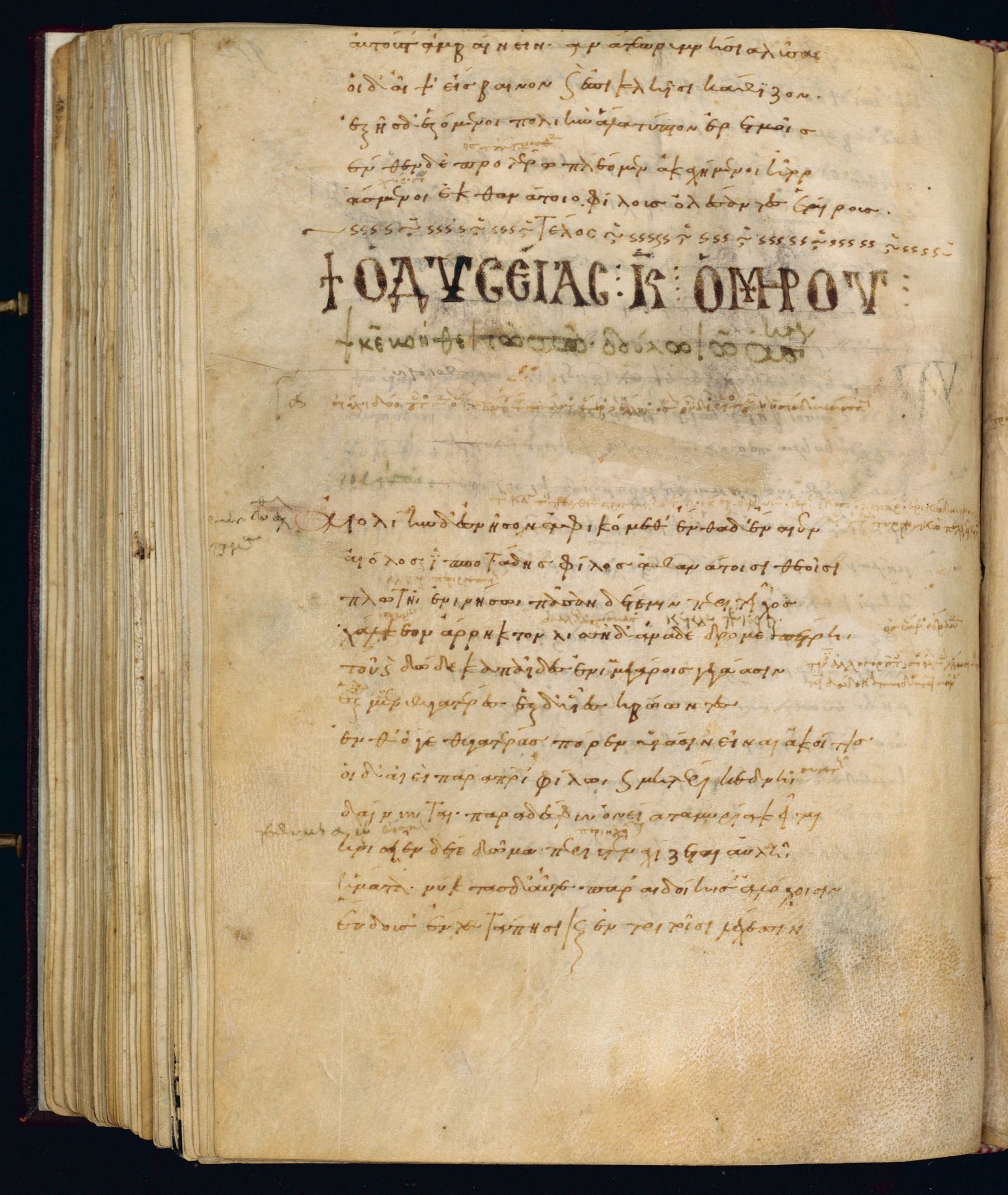
Laur. Plut. 32.24, fol. 92v: Odyssey 10.1-12, begins ‹Αἰολίην δʼ ἐς νῆσον›, ends ‹καὶ ἐν τρητοῖσι λέχεσσι.›. Checked on the image: first and last lines read and matched to the Greek. Fol. 93r begins with 10.13. The page holds 9.562-566, 10.1-12. Book 9 ends with 9.566, followed by a line of ornament with τέλος; the heading + ὀδυσσείας κ ὁμήρου follows in capitals, then one or two faded lines in red, and book 10 begins with an enlarged initial. English blocks here: 1-4, 5-9, 10-14.
1Αἰολίην δʼ ἐς νῆσον ἀφικόμεθʼ· ἔνθα δʼ ἔναιεν
2Αἴολος Ἱπποτάδης, φίλος ἀθανάτοισι θεοῖσιν,
3πλωτῇ ἐνὶ νήσῳ· πᾶσαν δέ τέ μιν πέρι τεῖχος
4χάλκεον ἄρρηκτον, λισσὴ δʼ ἀναδέδρομε πέτρη.
5τοῦ καὶ δώδεκα παῖδες ἐνὶ μεγάροις γεγάασιν,
6ἓξ μὲν θυγατέρες, ἓξ δʼ υἱέες ἡβώοντες·
7ἔνθʼ ὅ γε θυγατέρας πόρεν υἱάσιν εἶναι ἀκοίτις.
8οἱ δʼ αἰεὶ παρὰ πατρὶ φίλῳ καὶ μητέρι κεδνῇ
9δαίνυνται, παρὰ δέ σφιν ὀνείατα μυρία κεῖται,
10κνισῆεν δέ τε δῶμα περιστεναχίζεται αὐλῇ
11ἤματα· νύκτας δʼ αὖτε παρʼ αἰδοίῃς ἀλόχοισιν
12εὕδουσʼ ἔν τε τάπησι καὶ ἐν τρητοῖσι λέχεσσι.
1“Then to the Aeolian isle we came, where dwelt Aeolus, son of Hippotas, dear to the immortal gods, in a floating island, and all around it is a wall of unbreakable bronze, and the cliff runs up sheer. 5Twelve children of his, too, there are in the halls, six daughters and six sturdy sons, and he gave his daughters to his sons to wife. These, then, feast continually by their dear father and good mother, and before them lies boundless good cheer. 10And the house, filled with the savour of feasting, resounds all about even in the outer court by day, and by night again they sleep beside their chaste wives on blankets and on corded bedsteads. To their city, then, and fair palace did we come, and for a full month he made me welcome and questioned me about each thing,
Where on the image
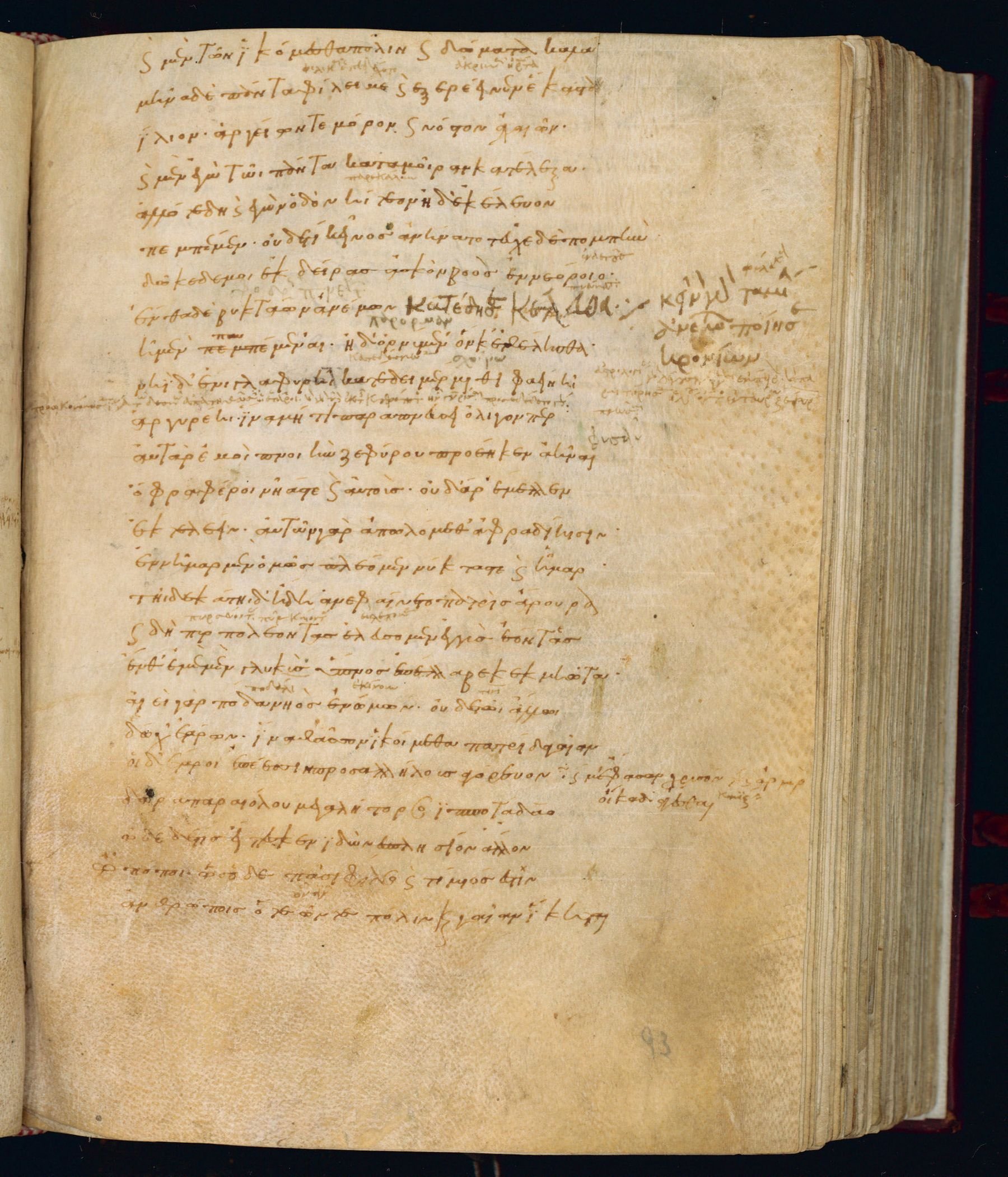
Laur. Plut. 32.24, fol. 93r: Odyssey 10.13-39, begins ‹καὶ μὲν τῶν ἱκόμεσθα›, ends ‹πόλιν καὶ γαῖαν ἵκηται.›. Checked on the image: first and last lines read and matched to the Greek. Fol. 92v ends with 10.12. Fol. 93v begins with 10.40. 10.21 and 10.35 are not in the text column; each is written in the right margin, beside 10.20 and 10.34 (the column has 25 lines). English blocks here: 15-19, 20-24, 25-29, 30-34, 35-39.
13καὶ μὲν τῶν ἱκόμεσθα πόλιν καὶ δώματα καλά.
14μῆνα δὲ πάντα φίλει με καὶ ἐξερέεινεν ἕκαστα,
15Ἴλιον Ἀργείων τε νέας καὶ νόστον Ἀχαιῶν·
16καὶ μὲν ἐγὼ τῷ πάντα κατὰ μοῖραν κατέλεξα.
17ἀλλʼ ὅτε δὴ καὶ ἐγὼν ὁδὸν ᾔτεον ἠδʼ ἐκέλευον
18πεμπέμεν, οὐδέ τι κεῖνος ἀνήνατο, τεῦχε δὲ πομπήν.
19δῶκε δέ μʼ ἐκδείρας ἀσκὸν βοὸς ἐννεώροιο,
20ἔνθα δὲ βυκτάων ἀνέμων κατέδησε κέλευθα·
21κεῖνον γὰρ ταμίην ἀνέμων ποίησε Κρονίων,
22ἠμὲν παυέμεναι ἠδʼ ὀρνύμεν, ὅν κʼ ἐθέλῃσι.
23νηὶ δʼ ἐνὶ γλαφυρῇ κατέδει μέρμιθι φαεινῇ
24ἀργυρέῃ, ἵνα μή τι παραπνεύσῃ ὀλίγον περ·
25αὐτὰρ ἐμοὶ πνοιὴν Ζεφύρου προέηκεν ἀῆναι,
26ὄφρα φέροι νῆάς τε καὶ αὐτούς· οὐδʼ ἄρʼ ἔμελλεν
27ἐκτελέειν· αὐτῶν γὰρ ἀπωλόμεθʼ ἀφραδίῃσιν.
28ἐννῆμαρ μὲν ὁμῶς πλέομεν νύκτας τε καὶ ἦμαρ,
29τῇ δεκάτῃ δʼ ἤδη ἀνεφαίνετο πατρὶς ἄρουρα,
30καὶ δὴ πυρπολέοντας ἐλεύσσομεν ἐγγὺς ἐόντες·
31ἔνθʼ ἐμὲ μὲν γλυκὺς ὕπνος ἐπήλυθε κεκμηῶτα,
32αἰεὶ γὰρ πόδα νηὸς ἐνώμων, οὐδέ τῳ ἄλλῳ
33δῶχʼ ἑτάρων, ἵνα θᾶσσον ἱκοίμεθα πατρίδα γαῖαν·
34οἱ δʼ ἕταροι ἐπέεσσι πρὸς ἀλλήλους ἀγόρευον,
35καί μʼ ἔφασαν χρυσόν τε καὶ ἄργυρον οἴκαδʼ ἄγεσθαι
36δῶρα παρʼ Αἰόλου μεγαλήτορος Ἱπποτάδαο.
37ὧδε δέ τις εἴπεσκεν ἰδὼν ἐς πλησίον ἄλλον·
38ὦ πόποι, ὡς ὅδε πᾶσι φίλος καὶ τίμιός ἐστιν
39ἀνθρώποις, ὅτεών τε πόλιν καὶ γαῖαν ἵκηται.
15about Ilios, and the ships of the Argives, and the return of the Achaeans. And I told him all the tale in due order. But when I, on my part, asked him that I might depart and bade him send me on my way, he, too, denied me nothing, but furthered my sending. He gave me a wallet, made of the hide of an ox nine years old, which he flayed, 20and therein he bound the paths of the blustering winds; for the son of Cronos had made him keeper of the winds, both to still and to rouse whatever one he will. And in my hollow ship he bound it fast with a bright cord of silver, that not a breath might escape, were it never so slight. 25But for my furtherance he sent forth the breath of the West Wind to blow, that it might bear on their way both ships and men. Yet this he was not to bring to pass, for we were lost through our own folly. “For nine days we sailed, night and day alike, and now on the tenth our native land came in sight, 30and lo, we were so near that we saw men tending the beacon fires. Then upon me came sweet sleep in my weariness, for I had ever kept in hand the sheet of the ship, and had yielded it to none other of my comrades, that we might the sooner come to our native land. But my comrades meanwhile began to speak one to another, 35and said that I was bringing home for myself gold and silver as gifts from Aeolus, the great-hearted son of Hippotas. And thus would one speak, with a glance at his neighbor: “‘Out on it, how beloved and honored this man is by all men, to whose city and land soever he comes!
Where on the image
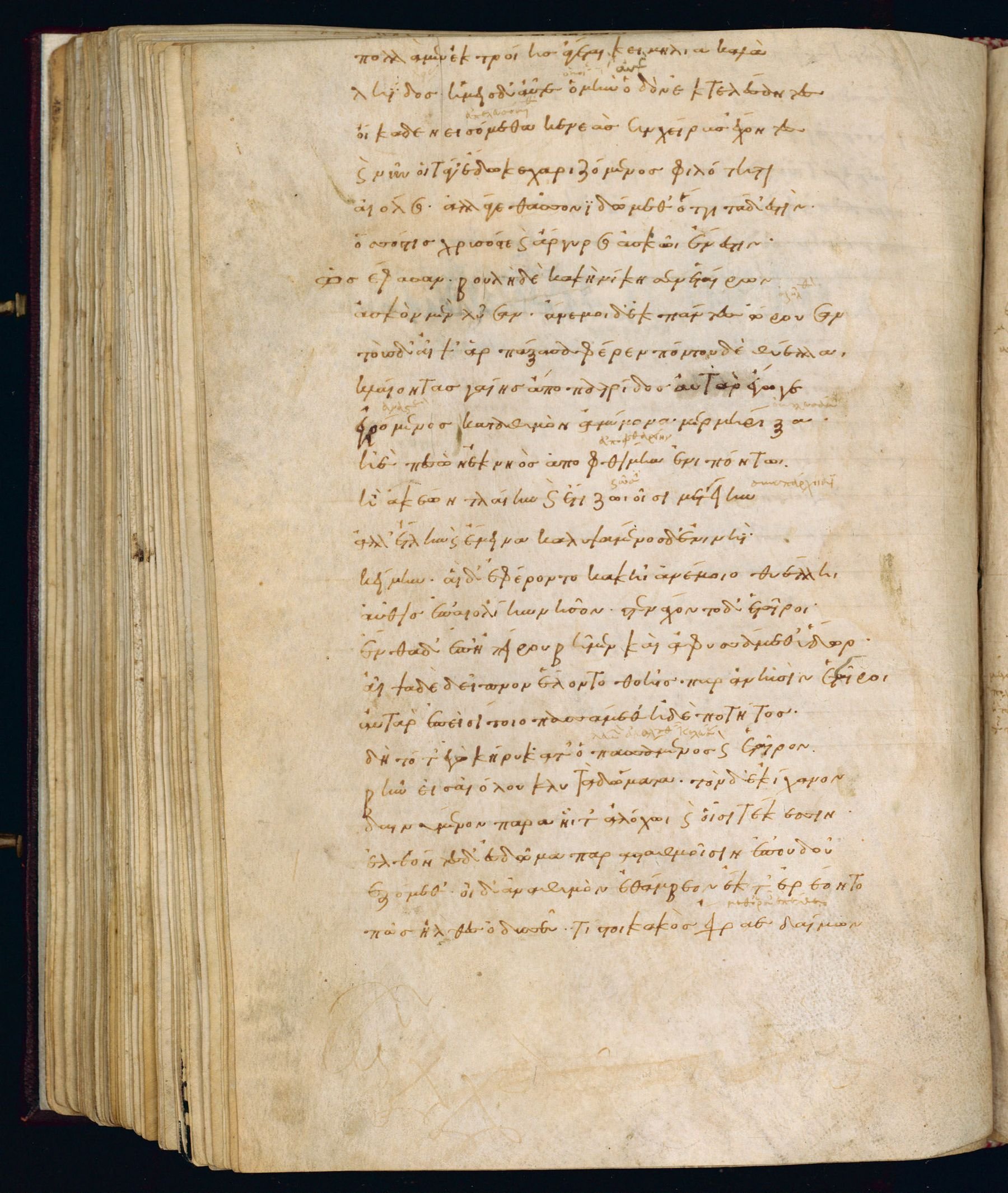
Laur. Plut. 32.24, fol. 93v: Odyssey 10.40-64, begins ‹πολλὰ μὲν ἐκ Τροίης›, ends ‹τοι κακὸς ἔχραε δαίμων;›. Checked on the image: first and last lines read and matched to the Greek. Fol. 93r ends with 10.39. Fol. 94r begins with 10.65. English blocks here: 40-44, 45-45, 46-49, 50-54, 55-59, 60-64.
40πολλὰ μὲν ἐκ Τροίης ἄγεται κειμήλια καλὰ
41ληίδος, ἡμεῖς δʼ αὖτε ὁμὴν ὁδὸν ἐκτελέσαντες
42οἴκαδε νισσόμεθα κενεὰς σὺν χεῖρας ἔχοντες·
43καὶ νῦν οἱ τάδʼ ἔδωκε χαριζόμενος φιλότητι
44Αἴολος. ἀλλʼ ἄγε θᾶσσον ἰδώμεθα ὅττι τάδʼ ἐστίν,
45ὅσσος τις χρυσός τε καὶ ἄργυρος ἀσκῷ ἔνεστιν.
46ὣς ἔφασαν, βουλὴ δὲ κακὴ νίκησεν ἑταίρων·
47ἀσκὸν μὲν λῦσαν, ἄνεμοι δʼ ἐκ πάντες ὄρουσαν.
48τοὺς δʼ αἶψʼ ἁρπάξασα φέρεν πόντονδε θύελλα
49κλαίοντας, γαίης ἄπο πατρίδος. αὐτὰρ ἐγώ γε
50ἐγρόμενος κατὰ θυμὸν ἀμύμονα μερμήριξα,
51ἠὲ πεσὼν ἐκ νηὸς ἀποφθίμην ἐνὶ πόντῳ,
52ἦ ἀκέων τλαίην καὶ ἔτι ζωοῖσι μετείην.
53ἀλλʼ ἔτλην καὶ ἔμεινα, καλυψάμενος δʼ ἐνὶ νηὶ
54κείμην. αἱ δʼ ἐφέροντο κακῇ ἀνέμοιο θυέλλῃ
55αὖτις ἐπʼ Αἰολίην νῆσον, στενάχοντο δʼ ἑταῖροι.
56ἔνθα δʼ ἐπʼ ἠπείρου βῆμεν καὶ ἀφυσσάμεθʼ ὕδωρ,
57αἶψα δὲ δεῖπνον ἕλοντο θοῇς παρὰ νηυσὶν ἑταῖροι.
58αὐτὰρ ἐπεὶ σίτοιό τʼ ἐπασσάμεθʼ ἠδὲ ποτῆτος,
59δὴ τότʼ ἐγὼ κήρυκά τʼ ὀπασσάμενος καὶ ἑταῖρον
60βῆν εἰς Αἰόλου κλυτὰ δώματα· τὸν δʼ ἐκίχανον
61δαινύμενον παρὰ ᾗ τʼ ἀλόχῳ καὶ οἷσι τέκεσσιν.
62ἐλθόντες δʼ ἐς δῶμα παρὰ σταθμοῖσιν ἐπʼ οὐδοῦ
63ἑζόμεθʼ· οἱ δʼ ἀνὰ θυμὸν ἐθάμβεον ἔκ τʼ ἐρέοντο·
64πῶς ἦλθες, Ὀδυσεῦ; τίς τοι κακὸς ἔχραε δαίμων;
40Much goodly treasure is he carrying with him from the land of Troy from out the spoil, while we, who have accomplished the same journey as he, are returning, bearing with us empty hands. And now Aeolus has given him these gifts, granting them freely of his love. Nay, come, let us quickly see what is here, 45what store of gold and silver is in the wallet.’ 46“So they spoke, and the evil counsel of my comrades prevailed. They loosed the wallet, and all the winds leapt forth, and swiftly the storm-wind seized them and bore them weeping out to sea away from their native land; but as for me, 50I awoke, and pondered in my goodly heart whether I should fling myself from the ship and perish in the sea, or endure in silence and still remain among the living. However, I endured and abode, and covering my head lay down in the ship. But the ships were borne by an evil blast of wind 55back to the Aeolian isle; and my comrades groaned. “There we went ashore and drew water, and straightway my comrades took their meal by the swift ships. But when we had tasted of food and drink, I took with me a herald and one companion 60and went to the glorious palace of Aeolus, and I found him feasting beside his wife and his children. So we entered the house and sat down by the doorposts on the threshold, and they were amazed at heart, and questioned us: “‘How hast thou come hither, Odysseus? What cruel god assailed thee?
Where on the image
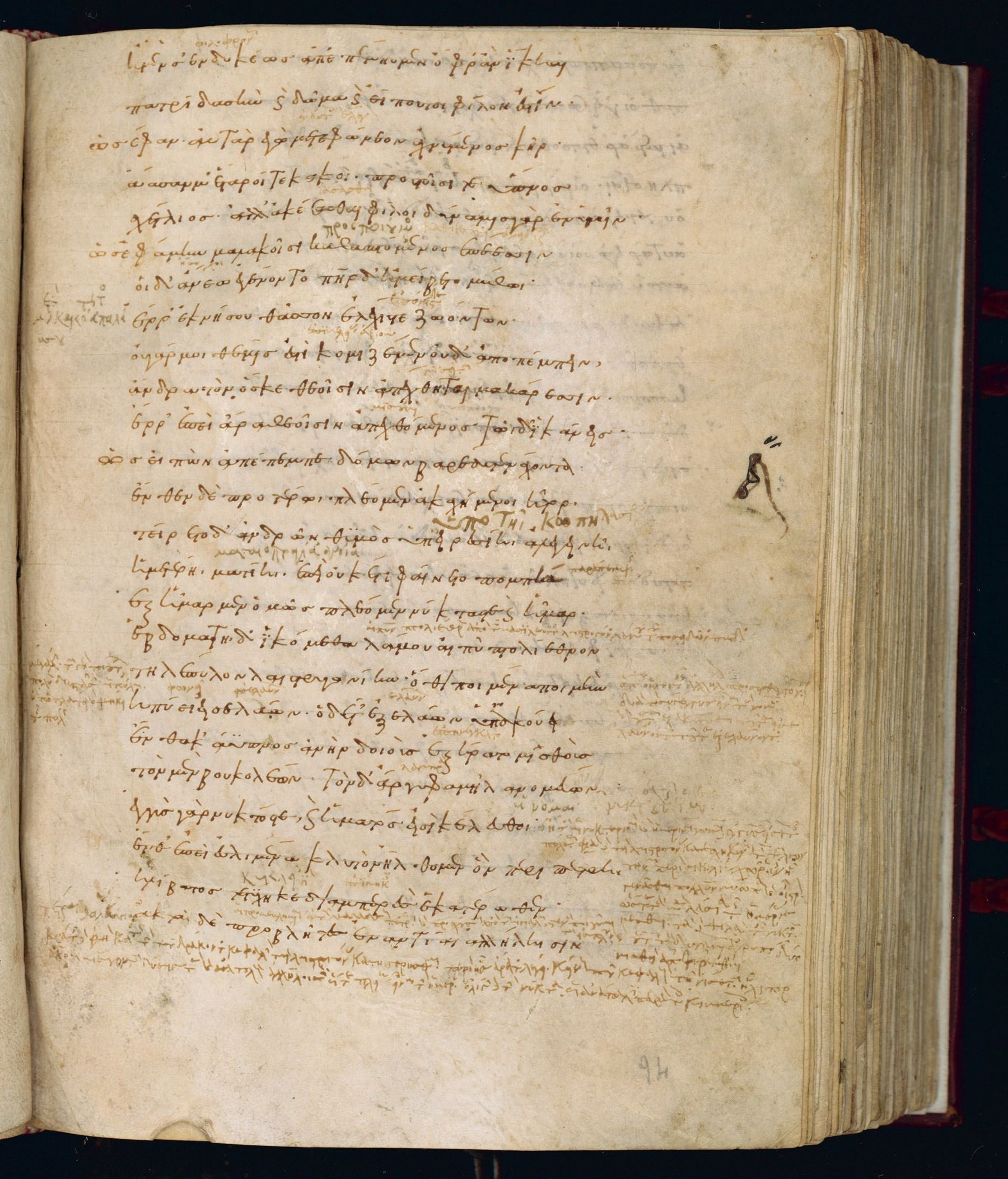
Laur. Plut. 32.24, fol. 94r: Odyssey 10.65-89, begins ‹ἦ μέν σʼ ἐνδυκέως›, ends ‹δὲ προβλῆτες ἐναντίαι ἀλλήλῃσιν›. Checked on the image: first and last lines read and matched to the Greek. Fol. 93v ends with 10.64. Fol. 94v begins with 10.90. The last verse is written among the lines of a long marginal scholium that fills the foot of the page. English blocks here: 65-69, 70-74, 75-79, 80-84, 85-86, 87-89.
65ἦ μέν σʼ ἐνδυκέως ἀπεπέμπομεν, ὄφρʼ ἀφίκοιο
66πατρίδα σὴν καὶ δῶμα καὶ εἴ πού τοι φίλον ἐστίν.
67ὣς φάσαν, αὐτὰρ ἐγὼ μετεφώνεον ἀχνύμενος κῆρ·
68ἄασάν μʼ ἕταροί τε κακοὶ πρὸς τοῖσί τε ὕπνος
69σχέτλιος. ἀλλʼ ἀκέσασθε, φίλοι· δύναμις γὰρ ἐν ὑμῖν.
70ὣς ἐφάμην μαλακοῖσι καθαπτόμενος ἐπέεσσιν,
71οἱ δʼ ἄνεῳ ἐγένοντο· πατὴρ δʼ ἠμείβετο μύθῳ·
72ἔρρʼ ἐκ νήσου θᾶσσον, ἐλέγχιστε ζωόντων·
73οὐ γάρ μοι θέμις ἐστὶ κομιζέμεν οὐδʼ ἀποπέμπειν
74ἄνδρα τόν, ὅς κε θεοῖσιν ἀπέχθηται μακάρεσσιν·
75ἔρρε, ἐπεὶ ἄρα θεοῖσιν ἀπεχθόμενος τόδʼ ἱκάνεις.
76ὣς εἰπὼν ἀπέπεμπε δόμων βαρέα στενάχοντα.
77ἔνθεν δὲ προτέρω πλέομεν ἀκαχήμενοι ἦτορ.
78τείρετο δʼ ἀνδρῶν θυμὸς ὑπʼ εἰρεσίης ἀλεγεινῆς
79ἡμετέρῃ ματίῃ, ἐπεὶ οὐκέτι φαίνετο πομπή.
80ἑξῆμαρ μὲν ὁμῶς πλέομεν νύκτας τε καὶ ἦμαρ,
81ἑβδομάτῃ δʼ ἱκόμεσθα Λάμου αἰπὺ πτολίεθρον,
82Τηλέπυλον Λαιστρυγονίην, ὅθι ποιμένα ποιμὴν
83ἠπύει εἰσελάων, ὁ δέ τʼ ἐξελάων ὑπακούει.
84ἔνθα κʼ ἄυπνος ἀνὴρ δοιοὺς ἐξήρατο μισθούς,
85τὸν μὲν βουκολέων, τὸν δʼ ἄργυφα μῆλα νομεύων·
86ἐγγὺς γὰρ νυκτός τε καὶ ἤματός εἰσι κέλευθοι.
87ἔνθʼ ἐπεὶ ἐς λιμένα κλυτὸν ἤλθομεν, ὃν πέρι πέτρη
88ἠλίβατος τετύχηκε διαμπερὲς ἀμφοτέρωθεν,
89ἀκταὶ δὲ προβλῆτες ἐναντίαι ἀλλήλῃσιν
65Surely we sent thee forth with kindly care, that thou mightest reach thy native land and thy home, and whatever place thou wouldest.’ “So said they, but I with a sorrowing heart spoke among them and said: ‘Bane did my evil comrades work me, and therewith sleep accursed; but bring ye healing, my friends, for with you is the power.’ 70“So I spoke and addressed them with gentle words, but they were silent. Then their father answered and said: “‘Begone from our island with speed, thou vilest of all that live. In no wise may I help or send upon his way that man who is hated of the blessed gods. 75Begone, for thou comest hither as one hated of the immortals.’ “So saying, he sent me forth from the house, groaning heavily. Thence we sailed on, grieved at heart. And worn was the spirit of the men by the grievous rowing, because of our own folly, for no longer appeared any breeze to bear us on our way. 80So for six days we sailed, night and day alike, and on the seventh we came to the lofty citadel of Lamus, even to Telepylus of the Laestrygonians, where herdsman calls to herdsman as he drives in his flock, and the other answers as he drives his forth. There a man who never slept could have earned a double wage, 85one by herding cattle, and one by pasturing white sheep; for the out goings of the night and of the day are close together. 87When we had come thither into the goodly harbor, about which on both sides a sheer cliff runs continuously, and projecting headlands opposite to one another
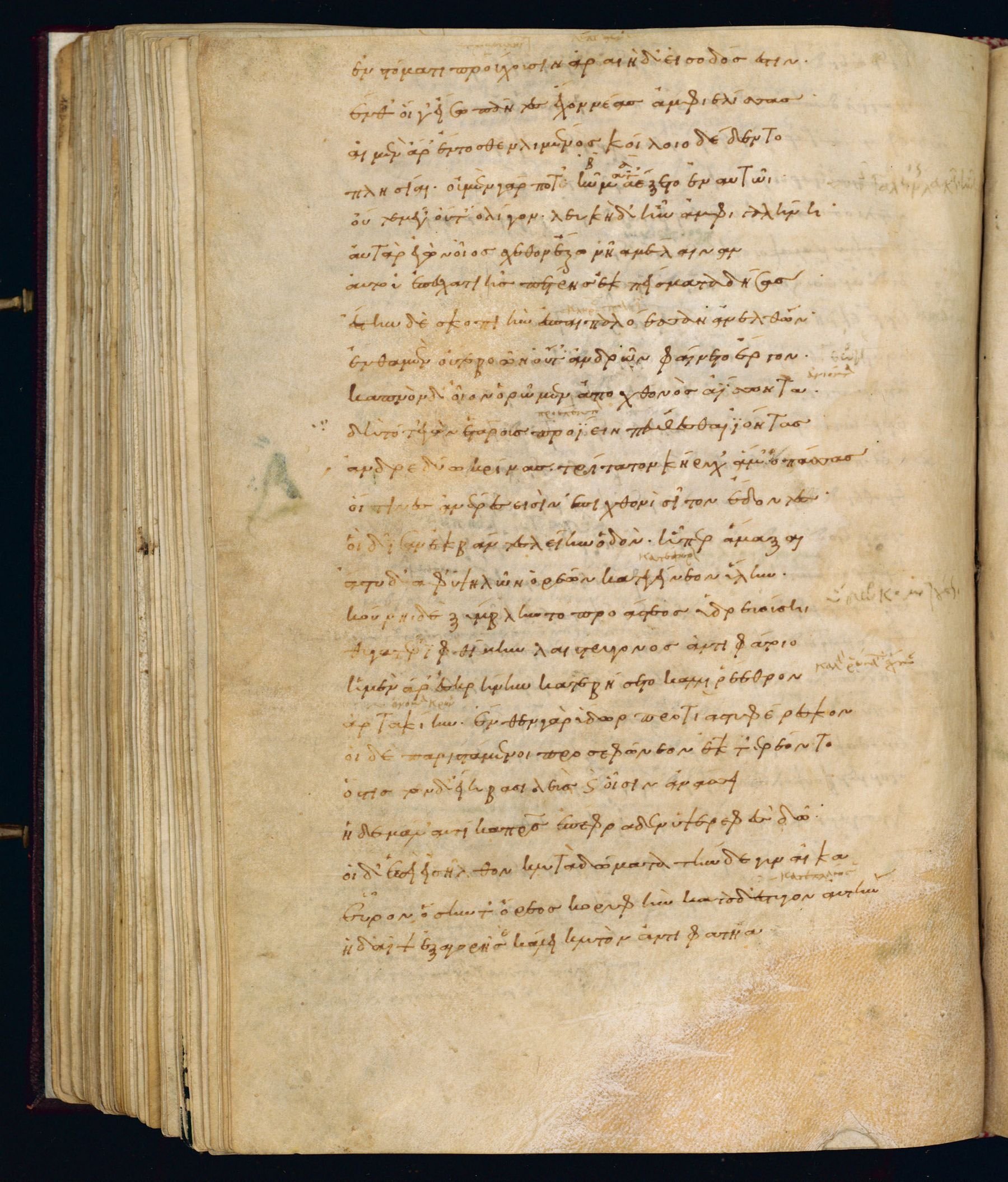
Where on the image
Laur. Plut. 32.24, fol. 94v: Odyssey 10.90-114, begins ‹ἐν στόματι προύχουσιν, ἀραιὴ›, ends ‹ἀγορῆς ἐκάλει κλυτὸν Ἀντιφατῆα,›. Checked on the image: first and last lines read and matched to the Greek. Fol. 94r ends with 10.89. Fol. 95r begins with 10.115. English blocks here: 90-94, 95-99, 100-104, 105-109, 110-114.
90ἐν στόματι προύχουσιν, ἀραιὴ δʼ εἴσοδός ἐστιν,
91ἔνθʼ οἵ γʼ εἴσω πάντες ἔχον νέας ἀμφιελίσσας.
92αἱ μὲν ἄρʼ ἔντοσθεν λιμένος κοίλοιο δέδεντο
93πλησίαι· οὐ μὲν γάρ ποτʼ ἀέξετο κῦμά γʼ ἐν αὐτῷ,
94οὔτε μέγʼ οὔτʼ ὀλίγον, λευκὴ δʼ ἦν ἀμφὶ γαλήνη·
95αὐτὰρ ἐγὼν οἶος σχέθον ἔξω νῆα μέλαιναν,
96αὐτοῦ ἐπʼ ἐσχατιῇ, πέτρης ἐκ πείσματα δήσας·
97ἔστην δὲ σκοπιὴν ἐς παιπαλόεσσαν ἀνελθών.
98ἔνθα μὲν οὔτε βοῶν οὔτʼ ἀνδρῶν φαίνετο ἔργα,
99καπνὸν δʼ οἶον ὁρῶμεν ἀπὸ χθονὸς ἀίσσοντα.
100δὴ τότʼ ἐγὼν ἑτάρους προΐειν πεύθεσθαι ἰόντας,
101οἵ τινες ἀνέρες εἶεν ἐπὶ χθονὶ σῖτον ἔδοντες,
102ἄνδρε δύω κρίνας, τρίτατον κήρυχʼ ἅμʼ ὀπάσσας.
103οἱ δʼ ἴσαν ἐκβάντες λείην ὁδόν, ᾗ περ ἄμαξαι
104ἄστυδʼ ἀφʼ ὑψηλῶν ὀρέων καταγίνεον ὕλην,
105κούρῃ δὲ ξύμβληντο πρὸ ἄστεος ὑδρευούσῃ,
106θυγατέρʼ ἰφθίμῃ Λαιστρυγόνος Ἀντιφάταο.
107ἡ μὲν ἄρʼ ἐς κρήνην κατεβήσετο καλλιρέεθρον
108Ἀρτακίην· ἔνθεν γὰρ ὕδωρ προτὶ ἄστυ φέρεσκον·
109οἱ δὲ παριστάμενοι προσεφώνεον ἔκ τʼ ἐρέοντο
110ὅς τις τῶνδʼ εἴη βασιλεὺς καὶ οἷσιν ἀνάσσοι·
111ἡ δὲ μάλʼ αὐτίκα πατρὸς ἐπέφραδεν ὑψερεφὲς δῶ.
112οἱ δʼ ἐπεὶ εἰσῆλθον κλυτὰ δώματα, τὴν δὲ γυναῖκα
113εὗρον, ὅσην τʼ ὄρεος κορυφήν, κατὰ δʼ ἔστυγον αὐτήν.
114ἡ δʼ αἶψʼ ἐξ ἀγορῆς ἐκάλει κλυτὸν Ἀντιφατῆα,
90stretch out at the mouth, and the entrance is narrow, then all the rest steered their curved ships in, and the ships were moored within the hollow harbor close together; for therein no wave ever swelled, great or small, but all about was a bright calm. 95But I alone moored my black ship outside, there on the border of the land, making the cables fast to the rock. Then I climbed to a rugged height, a point of outlook, and there took my stand; from thence no works of oxen or of men appeared; smoke alone we saw springing up from the land. 100So then I sent forth some of my comrades to go and learn who the men were, who here ate bread upon the earth—two men I chose, and sent with them a third as a herald. Now when they had gone ashore, they went along a smooth road by which wagons were wont to bring wood down to the city from the high mountains. 105And before the city they met a maiden drawing water, the goodly daughter of Laestrygonian Antiphates, who had come down to the fair-flowing spring Artacia, from whence they were wont to bear water to the town. So they came up to her and spoke to her, 110and asked her who was king of this folk, and who they were of whom he was lord. And she showed them forth with the high-roofed house of her father. Now when they had entered the glorious house, they found there his wife, huge as the peak of a mountain, and they were aghast at her. At once she called from the place of assembly the glorious Antiphates,
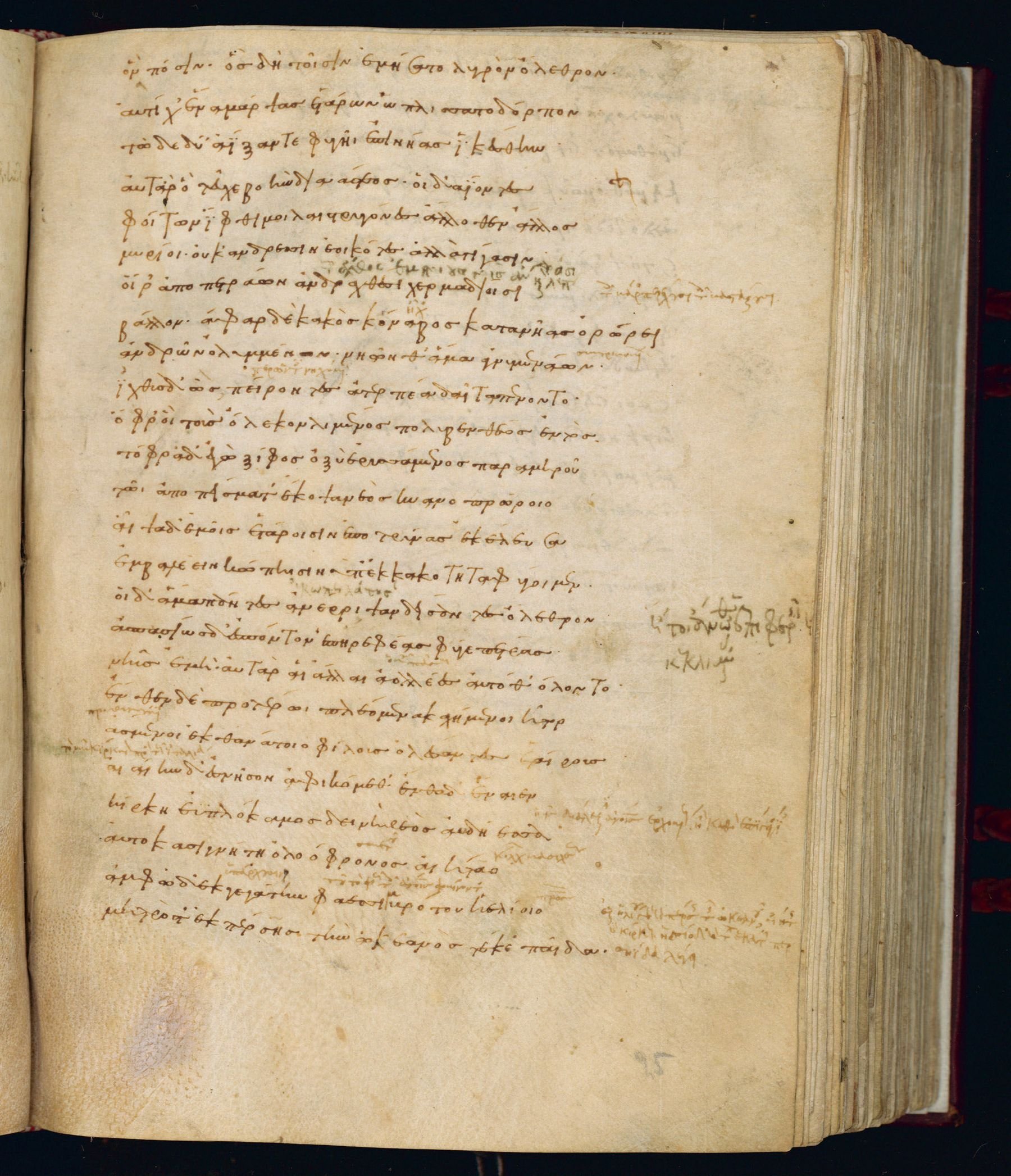
Where on the image
Laur. Plut. 32.24, fol. 95r: Odyssey 10.115-139, begins ‹ὃν πόσιν, ὃς δὴ›, ends ‹τὴν Ὠκεανὸς τέκε παῖδα.›. Checked on the image: first and last lines read and matched to the Greek. Fol. 94v ends with 10.114. Fol. 95v begins with 10.140. English blocks here: 115-119, 120-124, 125-129, 130-132, 133-134, 135-139.
115ὃν πόσιν, ὃς δὴ τοῖσιν ἐμήσατο λυγρὸν ὄλεθρον.
116αὐτίχʼ ἕνα μάρψας ἑτάρων ὡπλίσσατο δεῖπνον·
117τὼ δὲ δύʼ ἀίξαντε φυγῇ ἐπὶ νῆας ἱκέσθην.
118αὐτὰρ ὁ τεῦχε βοὴν διὰ ἄστεος· οἱ δʼ ἀίοντες
119φοίτων ἴφθιμοι Λαιστρυγόνες ἄλλοθεν ἄλλος,
120μυρίοι, οὐκ ἄνδρεσσιν ἐοικότες, ἀλλὰ Γίγασιν.
121οἵ ῥʼ ἀπὸ πετράων ἀνδραχθέσι χερμαδίοισιν
122βάλλον· ἄφαρ δὲ κακὸς κόναβος κατὰ νῆας ὀρώρει
123ἀνδρῶν τʼ ὀλλυμένων νηῶν θʼ ἅμα ἀγνυμενάων·
124ἰχθῦς δʼ ὣς πείροντες ἀτερπέα δαῖτα φέροντο.
125ὄφρʼ οἱ τοὺς ὄλεκον λιμένος πολυβενθέος ἐντός,
126τόφρα δʼ ἐγὼ ξίφος ὀξὺ ἐρυσσάμενος παρὰ μηροῦ
127τῷ ἀπὸ πείσματʼ ἔκοψα νεὸς κυανοπρῴροιο.
128αἶψα δʼ ἐμοῖς ἑτάροισιν ἐποτρύνας ἐκέλευσα
129ἐμβαλέειν κώπῃς, ἵνʼ ὑπὲκ κακότητα φύγοιμεν·
130οἱ δʼ ἅλα πάντες ἀνέρριψαν, δείσαντες ὄλεθρον.
131ἀσπασίως δʼ ἐς πόντον ἐπηρεφέας φύγε πέτρας
132νηῦς ἐμή· αὐτὰρ αἱ ἄλλαι ἀολλέες αὐτόθʼ ὄλοντο.
133ἔνθεν δὲ προτέρω πλέομεν ἀκαχήμενοι ἦτορ,
134ἄσμενοι ἐκ θανάτοιο, φίλους ὀλέσαντες ἑταίρους.
135Αἰαίην δʼ ἐς νῆσον ἀφικόμεθʼ· ἔνθα δʼ ἔναιε
136Κίρκη ἐυπλόκαμος, δεινὴ θεὸς αὐδήεσσα,
137αὐτοκασιγνήτη ὀλοόφρονος Αἰήταο·
138ἄμφω δʼ ἐκγεγάτην φαεσιμβρότου Ἠελίοιο
139μητρός τʼ ἐκ Πέρσης, τὴν Ὠκεανὸς τέκε παῖδα.
115her husband, and he devised for them woeful destruction. Straightway he seized one of my comrades and made ready his meal, but the other two sprang up and came in flight to the ships. Then he raised a cry throughout the city, and as they heard it the mighty Laestrygonians came thronging from all sides, 120a host past counting, not like men but like the Giants. They hurled at us from the cliffs with rocks huge as a man could lift, and at once there rose throughout the ships a dreadful din, alike from men that were dying and from ships that were being crushed. And spearing them like fishes they bore them home, a loathly meal. 125Now while they were slaying those within the deep harbor, I meanwhile drew my sharp sword from beside my thigh, and cut therewith the cables of my dark-prowed ship; and quickly calling to my comrades bade them fall to their oars, that we might escape from out our evil plight. 130And they all tossed the sea with their oar-blades in fear of death, and joyfully seaward, away from the beetling cliffs, my ship sped on; but all those other ships were lost together there. 133“Thence we sailed on, grieved at heart, glad to have escaped death, though we had lost our dear comrades; 135and we came to the isle of Aeaea, where dwelt fair-tressed Circe, a dread goddess of human speech, own sister to Aeetes of baneful mind; and both are sprung from Helius, who gives light to mortals, and from Perse, their mother, whom Oceanus begot.
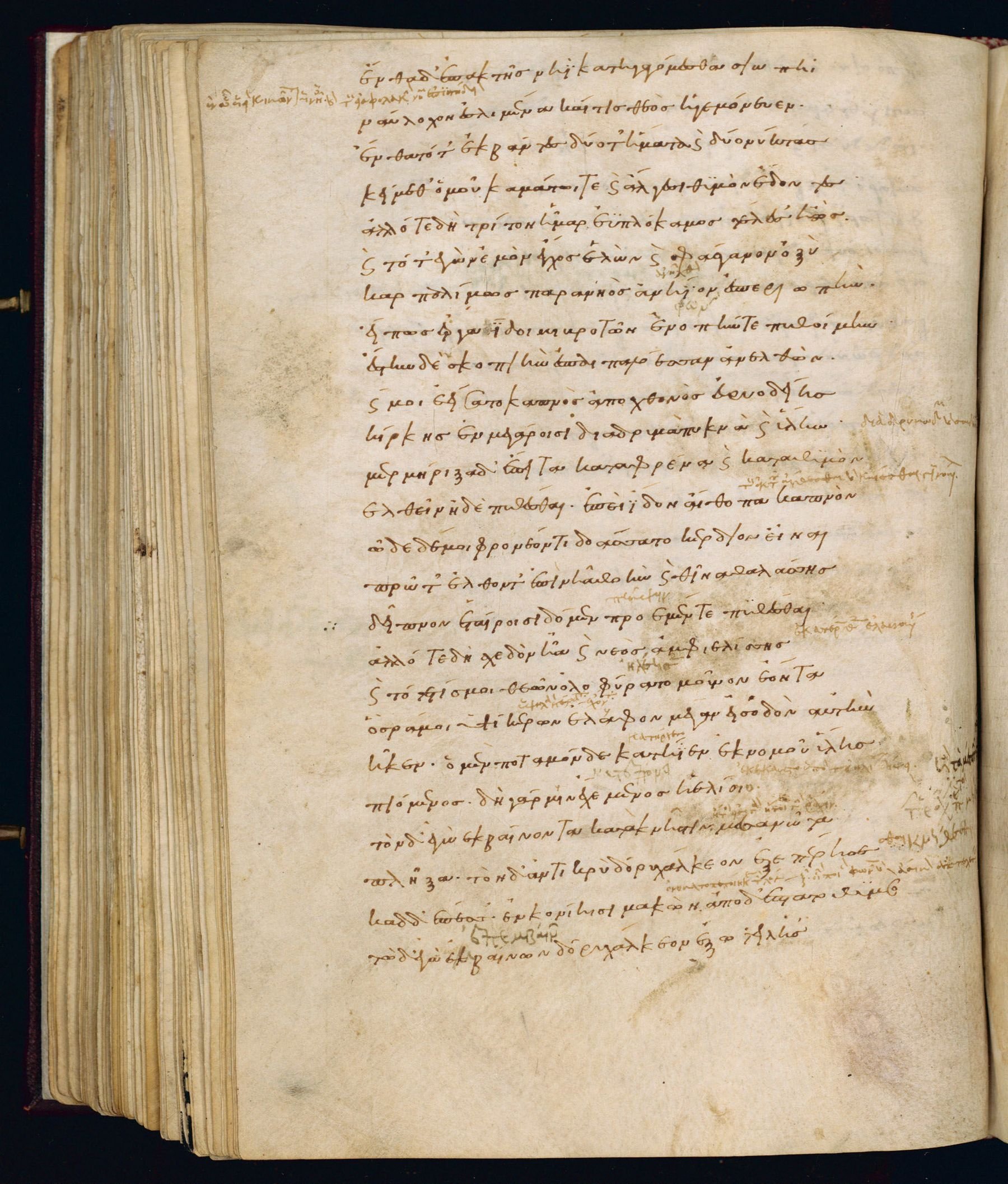
Where on the image
Laur. Plut. 32.24, fol. 95v: Odyssey 10.140-164, begins ‹ἔνθα δʼ ἐπʼ ἀκτῆς›, ends ‹δόρυ χάλκεον ἐξ ὠτειλῆς›. Checked on the image: first and last lines read and matched to the Greek. Fol. 95r ends with 10.139. Fol. 96r begins with 10.165. English blocks here: 140-144, 145-149, 150-154, 155-159, 160-164.
140ἔνθα δʼ ἐπʼ ἀκτῆς νηὶ κατηγαγόμεσθα σιωπῇ
141ναύλοχον ἐς λιμένα, καί τις θεὸς ἡγεμόνευεν.
142ἔνθα τότʼ ἐκβάντες δύο τʼ ἤματα καὶ δύο νύκτας
143κείμεθʼ ὁμοῦ καμάτῳ τε καὶ ἄλγεσι θυμὸν ἔδοντες.
144ἀλλʼ ὅτε δὴ τρίτον ἦμαρ ἐυπλόκαμος τέλεσʼ Ἠώς,
145καὶ τότʼ ἐγὼν ἐμὸν ἔγχος ἑλὼν καὶ φάσγανον ὀξὺ
146καρπαλίμως παρὰ νηὸς ἀνήιον ἐς περιωπήν,
147εἴ πως ἔργα ἴδοιμι βροτῶν ἐνοπήν τε πυθοίμην.
148ἔστην δὲ σκοπιὴν ἐς παιπαλόεσσαν ἀνελθών,
149καί μοι ἐείσατο καπνὸς ἀπὸ χθονὸς εὐρυοδείης,
150Κίρκης ἐν μεγάροισι, διὰ δρυμὰ πυκνὰ καὶ ὕλην.
151μερμήριξα δʼ ἔπειτα κατὰ φρένα καὶ κατὰ θυμὸν
152ἐλθεῖν ἠδὲ πυθέσθαι, ἐπεὶ ἴδον αἴθοπα καπνόν.
153ὧδε δέ μοι φρονέοντι δοάσσατο κέρδιον εἶναι,
154πρῶτʼ ἐλθόντʼ ἐπὶ νῆα θοὴν καὶ θῖνα θαλάσσης
155δεῖπνον ἑταίροισιν δόμεναι προέμεν τε πυθέσθαι.
156ἀλλʼ ὅτε δὴ σχεδὸν ἦα κιὼν νεὸς ἀμφιελίσσης,
157καὶ τότε τίς με θεῶν ὀλοφύρατο μοῦνον ἐόντα,
158ὅς ῥά μοι ὑψίκερων ἔλαφον μέγαν εἰς ὁδὸν αὐτὴν
159ἧκεν. ὁ μὲν ποταμόνδε κατήιεν ἐκ νομοῦ ὕλης
160πιόμενος· δὴ γάρ μιν ἔχεν μένος ἠελίοιο.
161τὸν δʼ ἐγὼ ἐκβαίνοντα κατʼ ἄκνηστιν μέσα νῶτα
162πλῆξα· τὸ δʼ ἀντικρὺ δόρυ χάλκεον ἐξεπέρησε,
163κὰδ δʼ ἔπεσʼ ἐν κονίῃσι μακών, ἀπὸ δʼ ἔπτατο θυμός.
164τῷ δʼ ἐγὼ ἐμβαίνων δόρυ χάλκεον ἐξ ὠτειλῆς
140Here we put in to shore with our ship in silence, into a harbor where ships may lie, and some god guided us. Then we disembarked, and lay there for two days and two nights, eating our hearts for weariness and sorrow. But when fair-tressed Dawn brought to its birth the third day, 145then I took my spear and my sharp sword, and quickly went up from the ship to a place of wide prospect, in the hope that I might see the works of men, and hear their voice. So I climbed to a rugged height, a place of outlook, and there took my stand, and I saw smoke rising from the broad-wayed earth 150in the halls of Circe, through the thick brush and the wood. And I debated in mind and heart, whether I should go and make search, when I had seen the flaming smoke. And as I pondered, this seemed to me to be the better way, to go first to the swift ship and the shore of the sea, 155and give my comrades their meal, and send them forth to make search. But when, as I went, I was near to the curved ship, then some god took pity on me in my loneliness, and sent a great, high-horned stag into my very path. He was coming down to the river from his pasture in the wood 160to drink, for the might of the sun oppressed him; and as he came out I struck him on the spine in the middle of the back, and the bronze spear passed right through him, and down he fell in the dust with a moan, and his spirit flew from him. Then I planted my foot upon him,
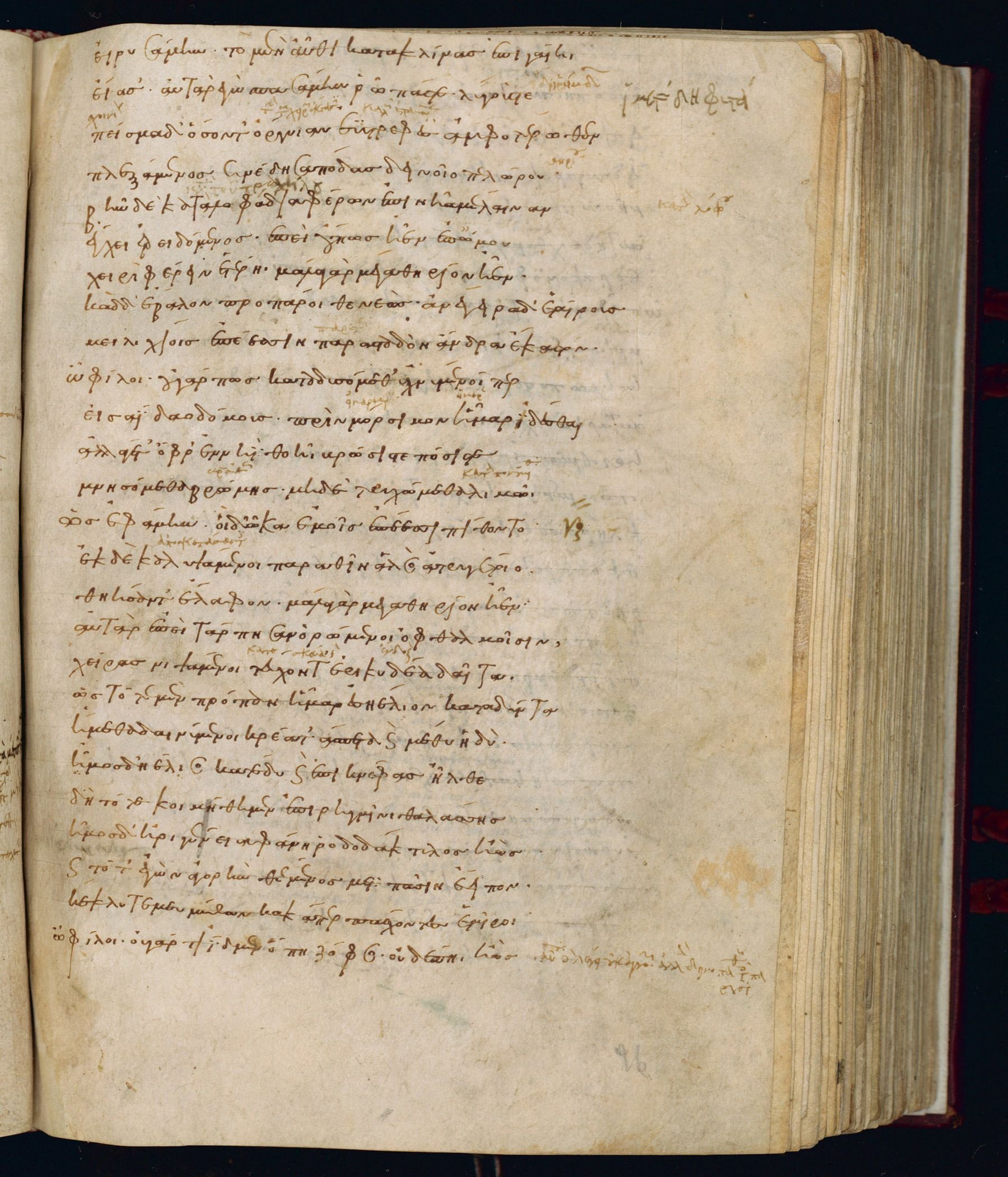
Where on the image
Laur. Plut. 32.24, fol. 96r: Odyssey 10.165-190, begins ‹εἰρυσάμην· τὸ μὲν αὖθι›, ends ‹ζόφος οὐδʼ ὅπῃ ἠώς,›. Checked on the image: first and last lines read and matched to the Greek. Fol. 95v ends with 10.164. Fol. 96v begins with 10.191. English blocks here: 165-169, 170-174, 175-177, 178-179, 180-184, 185-189.
165εἰρυσάμην· τὸ μὲν αὖθι κατακλίνας ἐπὶ γαίῃ
166εἴασʼ· αὐτὰρ ἐγὼ σπασάμην ῥῶπάς τε λύγους τε,
167πεῖσμα δʼ, ὅσον τʼ ὄργυιαν, ἐυστρεφὲς ἀμφοτέρωθεν
168πλεξάμενος συνέδησα πόδας δεινοῖο πελώρου,
169βῆν δὲ καταλοφάδεια φέρων ἐπὶ νῆα μέλαιναν
170ἔγχει ἐρειδόμενος, ἐπεὶ οὔ πως ἦεν ἐπʼ ὤμου
171χειρὶ φέρειν ἑτέρῃ· μάλα γὰρ μέγα θηρίον ἦεν.
172κὰδʼ δʼ ἔβαλον προπάροιθε νεός, ἀνέγειρα δʼ ἑταίρους
173μειλιχίοις ἐπέεσσι παρασταδὸν ἄνδρα ἕκαστον·
174ὦ φίλοι, οὐ γάρ πω καταδυσόμεθʼ ἀχνύμενοί περ
175εἰς Ἀίδαο δόμους, πρὶν μόρσιμον ἦμαρ ἐπέλθῃ·
176ἀλλʼ ἄγετʼ, ὄφρʼ ἐν νηὶ θοῇ βρῶσίς τε πόσις τε,
177μνησόμεθα βρώμης, μηδὲ τρυχώμεθα λιμῷ.
178ὣς ἐφάμην, οἱ δʼ ὦκα ἐμοῖς ἐπέεσσι πίθοντο,
179ἐκ δὲ καλυψάμενοι παρὰ θῖνʼ ἁλὸς ἀτρυγέτοιο
180θηήσαντʼ ἔλαφον· μάλα γὰρ μέγα θηρίον ἦεν.
181αὐτὰρ ἐπεὶ τάρπησαν ὁρώμενοι ὀφθαλμοῖσιν,
182χεῖρας νιψάμενοι τεύχοντʼ ἐρικυδέα δαῖτα.
183ὣς τότε μὲν πρόπαν ἦμαρ ἐς ἠέλιον καταδύντα
184ἥμεθα δαινύμενοι κρέα τʼ ἄσπετα καὶ μέθυ ἡδύ·
185ἦμος δʼ ἠέλιος κατέδυ καὶ ἐπὶ κνέφας ἦλθε,
186δὴ τότε κοιμήθημεν ἐπὶ ῥηγμῖνι θαλάσσης.
187ἦμος δʼ ἠριγένεια φάνη ῥοδοδάκτυλος Ἠώς,
188καὶ τότʼ ἐγὼν ἀγορὴν θέμενος μετὰ πᾶσιν ἔειπον·
189κέκλυτέ μευ μύθων, κακά περ πάσχοντες ἑταῖροι·
190ὦ φίλοι, οὐ γάρ τʼ ἴδμεν, ὅπῃ ζόφος οὐδʼ ὅπῃ ἠώς,
165and drew the bronze spear forth from the wound, and left it there to lie on the ground. But for myself, I plucked twigs and osiers, and weaving a rope as it were a fathom in length, well twisted from end to end, I bound together the feet of the monstrous beast, and went my way to the black ship, bearing him across my back and 170leaning on my spear, since in no wise could I hold him on my shoulder with one hand, for he was a very mighty beast. Down I flung him before the ship, and heartened my comrades with gentle words, coming up to each man in turn: “‘Friends, not yet shall we go down 175to the house of Hades, despite our sorrows, before the day of fate comes upon us. Nay, come, while there is yet food and drink in our swift ship, let us bethink us of food, that we pine not with hunger.’ 178“So I spoke, and they quickly hearkened to my words. From their faces they drew their cloaks, 180and marvelled at the stag on the shore of the unresting sea, for he was a very mighty beast. But when they had satisfied their eyes with gazing, they washed their hands, and made ready a glorious feast. So then all day long till set of sun we sat feasting on abundant flesh and sweet wine. 185But when the sun set and darkness came on, then we lay down to rest on the shore of the sea. And as soon as early Dawn appeared, the rosy-fingered, I called my men together, and spoke among them all: “‘Hearken to my words, comrades, for all your evil plight.
Where on the image
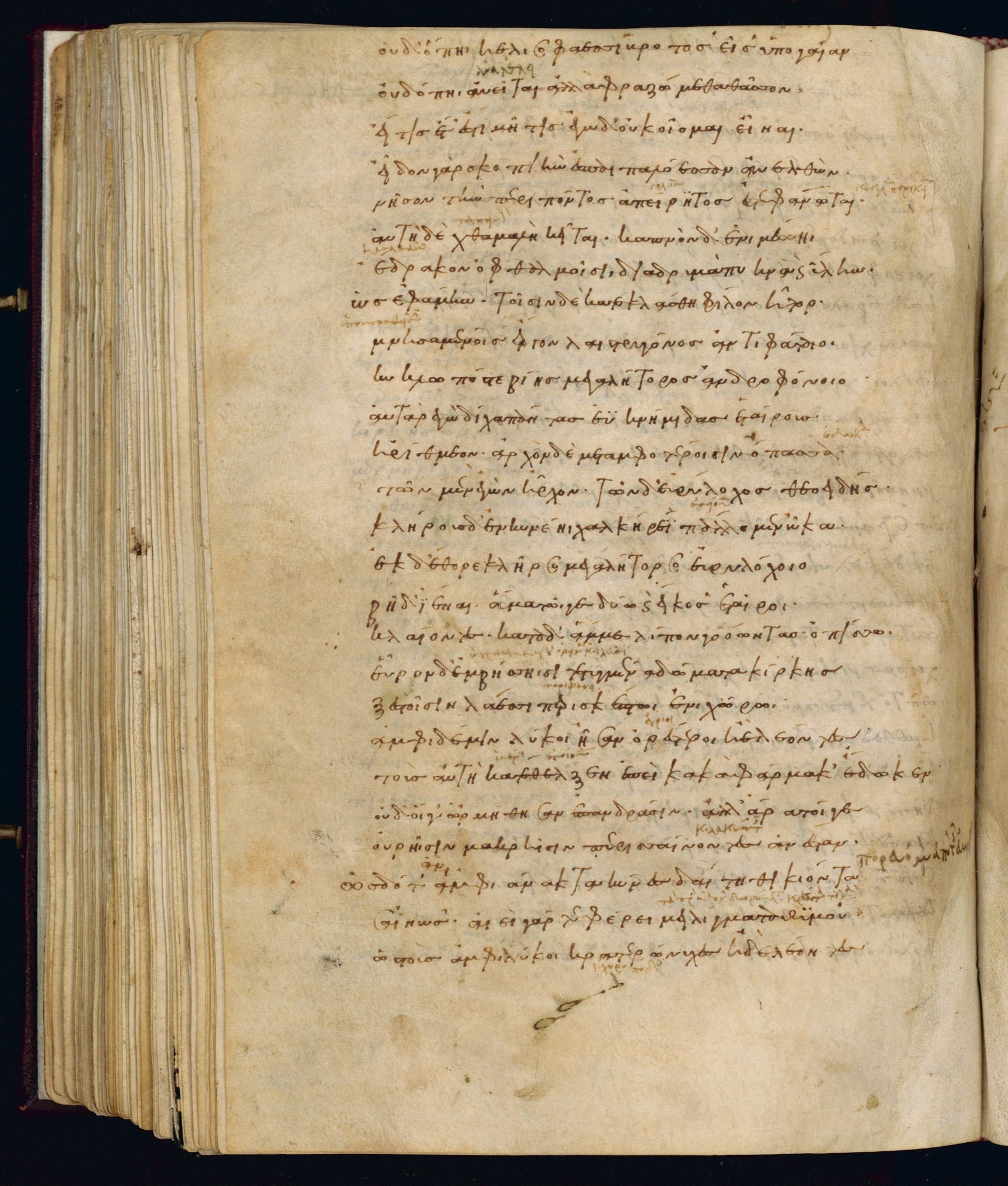
Laur. Plut. 32.24, fol. 96v: Odyssey 10.191-218, begins ‹οὐδʼ ὅπῃ ἠέλιος φαεσίμβροτος›, ends ‹λύκοι κρατερώνυχες ἠδὲ λέοντες›. Checked on the image: first and last lines read and matched to the Greek. Fol. 96r ends with 10.190. Fol. 97r begins with 10.219. 10.201-202 (κλαῖον δὲ λιγέως ... and ἀλλʼ οὐ γάρ τις πρῆξις ...) are not on the page: the scribe passes from 10.200 to 10.203 (26 lines). English blocks here: 190-194, 195-199, 200-204, 205-207, 208-209, 210-214, 215-219.
191οὐδʼ ὅπῃ ἠέλιος φαεσίμβροτος εἶσʼ ὑπὸ γαῖαν,
192οὐδʼ ὅπῃ ἀννεῖται· ἀλλὰ φραζώμεθα θᾶσσον
193εἴ τις ἔτʼ ἔσται μῆτις. ἐγὼ δʼ οὐκ οἴομαι εἶναι.
194εἶδον γὰρ σκοπιὴν ἐς παιπαλόεσσαν ἀνελθὼν
195νῆσον, τὴν πέρι πόντος ἀπείριτος ἐστεφάνωται·
196αὐτὴ δὲ χθαμαλὴ κεῖται· καπνὸν δʼ ἐνὶ μέσσῃ
197ἔδρακον ὀφθαλμοῖσι διὰ δρυμὰ πυκνὰ καὶ ὕλην.
198ὣς ἐφάμην, τοῖσιν δὲ κατεκλάσθη φίλον ἦτορ
199μνησαμένοις ἔργων Λαιστρυγόνος Ἀντιφάταο
200Κύκλωπός τε βίης μεγαλήτορος, ἀνδροφάγοιο.
201κλαῖον δὲ λιγέως θαλερὸν κατὰ δάκρυ χέοντες·
202ἀλλʼ οὐ γάρ τις πρῆξις ἐγίγνετο μυρομένοισιν.
203αὐτὰρ ἐγὼ δίχα πάντας ἐυκνήμιδας ἑταίρους
204ἠρίθμεον, ἀρχὸν δὲ μετʼ ἀμφοτέροισιν ὄπασσα·
205τῶν μὲν ἐγὼν ἦρχον, τῶν δʼ Εὐρύλοχος θεοειδής.
206κλήρους δʼ ἐν κυνέῃ χαλκήρεϊ πάλλομεν ὦκα·
207ἐκ δʼ ἔθορε κλῆρος μεγαλήτορος Εὐρυλόχοιο.
208βῆ δʼ ἰέναι, ἅμα τῷ γε δύω καὶ εἴκοσʼ ἑταῖροι
209κλαίοντες· κατὰ δʼ ἄμμε λίπον γοόωντας ὄπισθεν.
210εὗρον δʼ ἐν βήσσῃσι τετυγμένα δώματα Κίρκης
211ξεστοῖσιν λάεσσι, περισκέπτῳ ἐνὶ χώρῳ·
212ἀμφὶ δέ μιν λύκοι ἦσαν ὀρέστεροι ἠδὲ λέοντες,
213τοὺς αὐτὴ κατέθελξεν, ἐπεὶ κακὰ φάρμακʼ ἔδωκεν.
214οὐδʼ οἵ γʼ ὡρμήθησαν ἐπʼ ἀνδράσιν, ἀλλʼ ἄρα τοί γε
215οὐρῇσιν μακρῇσι περισσαίνοντες ἀνέσταν.
216ὡς δʼ ὅτʼ ἂν ἀμφὶ ἄνακτα κύνες δαίτηθεν ἰόντα
217σαίνωσʼ, αἰεὶ γάρ τε φέρει μειλίγματα θυμοῦ,
218ὣς τοὺς ἀμφὶ λύκοι κρατερώνυχες ἠδὲ λέοντες
190My friends, we know not where the darkness is or where the dawn, neither where the sun, who give light to mortals, goes beneath the earth, nor where he rises; but let us straightway take thought if any device be still left us. As for me I think not that there is. For I climbed to a rugged point of outlook, and beheld 195the island, about which is set as a crown the boundless deep. The isle itself lies low, and in the midst of it my eyes saw smoke through the thick brush and the wood.’ “So I spoke, and their spirit was broken within them, as they remembered the deeds of the Laestrygonian, Antiphates, 200and the violence of the great-hearted Cyclops, the man-eater. And they wailed aloud, and shed big tears. But no good came of their mourning. “Then I told off in two bands all my well-greaved comrades, and appointed a leader for each band. 205Of the one I took command, and of the other godlike Eurylochus. Quickly then we shook lots in a brazen helmet, and out leapt the lot of great-hearted Eurylochus. 208So he set out, and with him went two-and-twenty comrades, all weeping; and they left us behind, lamenting. 210Within the forest glades they found the house of Circe, built of polished stone in a place of wide outlook, and round about it were mountain wolves and lions, whom Circe herself had bewitched; for she gave them evil drugs. Yet these beasts did not rush upon my men, 215but pranced about them fawningly, wagging their long tails. And as when hounds fawn around their master as he comes from a feast, for he ever brings them bits to soothe their temper, so about them fawned the stout-clawed wolves and lions; but they were seized with fear, as they saw the dread monsters.
Where on the image
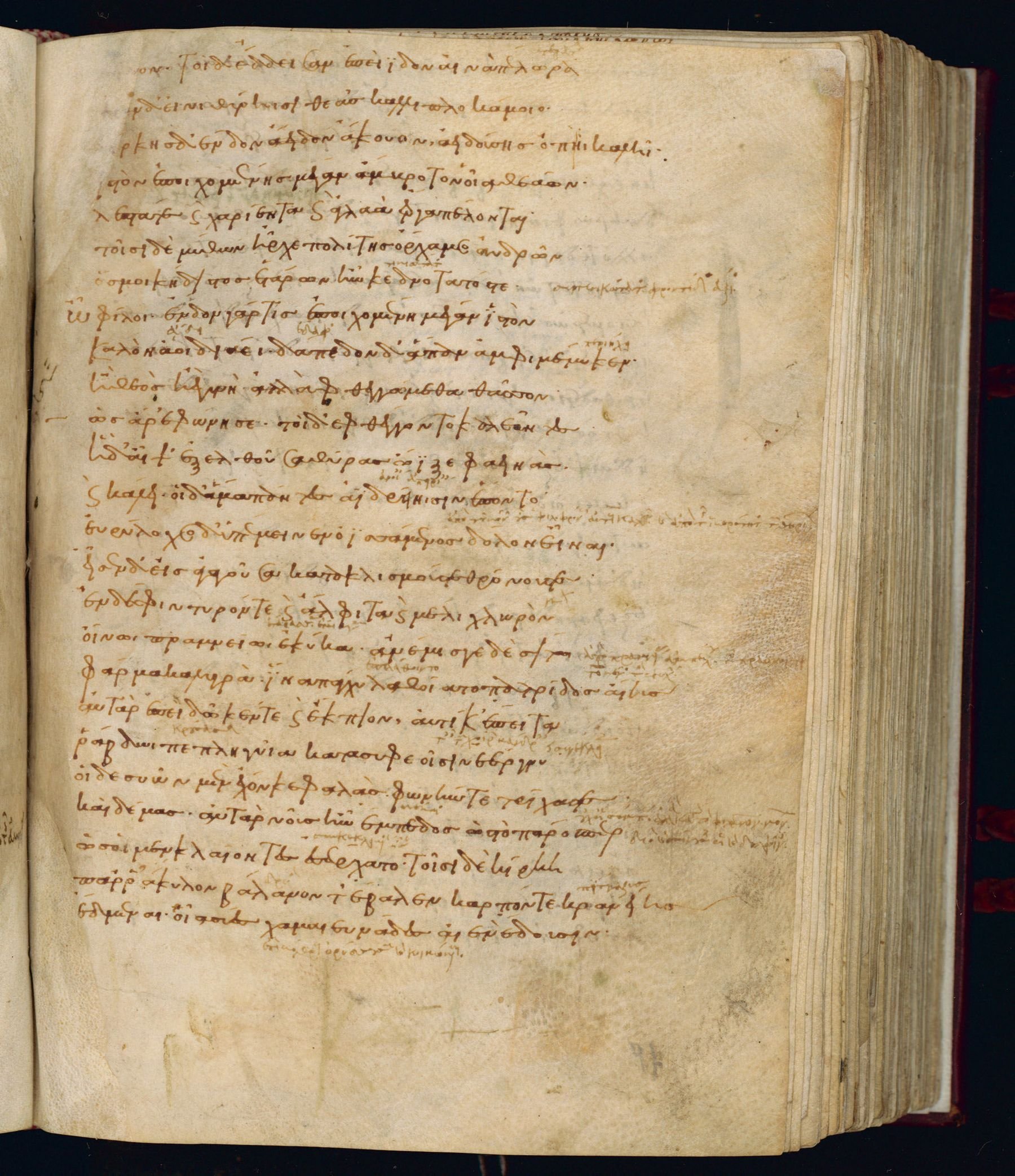
Laur. Plut. 32.24, fol. 97r: Odyssey 10.219-243, begins ‹σαῖνον· τοὶ δʼ ἔδεισαν,›, ends ‹σύες χαμαιευνάδες αἰὲν ἔδουσιν.›. Checked on the image: first and last lines read and matched to the Greek. Fol. 96v ends with 10.218. Fol. 97v begins with 10.244. English blocks here: 220-224, 225-229, 230-234, 235-239, 240-244.
219σαῖνον· τοὶ δʼ ἔδεισαν, ἐπεὶ ἴδον αἰνὰ πέλωρα.
220ἔσταν δʼ ἐν προθύροισι θεᾶς καλλιπλοκάμοιο,
221Κίρκης δʼ ἔνδον ἄκουον ἀειδούσης ὀπὶ καλῇ,
222ἱστὸν ἐποιχομένης μέγαν ἄμβροτον, οἷα θεάων
223λεπτά τε καὶ χαρίεντα καὶ ἀγλαὰ ἔργα πέλονται.
224τοῖσι δὲ μύθων ἦρχε Πολίτης ὄρχαμος ἀνδρῶν,
225ὅς μοι κήδιστος ἑτάρων ἦν κεδνότατός τε·
226ὦ φίλοι, ἔνδον γάρ τις ἐποιχομένη μέγαν ἱστὸν
227καλὸν ἀοιδιάει, δάπεδον δʼ ἅπαν ἀμφιμέμυκεν,
228ἢ θεὸς ἠὲ γυνή· ἀλλὰ φθεγγώμεθα θᾶσσον.
229ὣς ἄρʼ ἐφώνησεν, τοὶ δὲ φθέγγοντο καλεῦντες.
230ἡ δʼ αἶψʼ ἐξελθοῦσα θύρας ὤιξε φαεινὰς
231καὶ κάλει· οἱ δʼ ἅμα πάντες ἀιδρείῃσιν ἕποντο·
232Εὐρύλοχος δʼ ὑπέμεινεν, ὀισάμενος δόλον εἶναι.
233εἷσεν δʼ εἰσαγαγοῦσα κατὰ κλισμούς τε θρόνους τε,
234ἐν δέ σφιν τυρόν τε καὶ ἄλφιτα καὶ μέλι χλωρὸν
235οἴνῳ Πραμνείῳ ἐκύκα· ἀνέμισγε δὲ σίτῳ
236φάρμακα λύγρʼ, ἵνα πάγχυ λαθοίατο πατρίδος αἴης.
237αὐτὰρ ἐπεὶ δῶκέν τε καὶ ἔκπιον, αὐτίκʼ ἔπειτα
238ῥάβδῳ πεπληγυῖα κατὰ συφεοῖσιν ἐέργνυ.
239οἱ δὲ συῶν μὲν ἔχον κεφαλὰς φωνήν τε τρίχας τε
240καὶ δέμας, αὐτὰρ νοῦς ἦν ἔμπεδος, ὡς τὸ πάρος περ.
241ὣς οἱ μὲν κλαίοντες ἐέρχατο, τοῖσι δὲ Κίρκη
242πάρ ῥʼ ἄκυλον βάλανόν τε βάλεν καρπόν τε κρανείης
243ἔδμεναι, οἷα σύες χαμαιευνάδες αἰὲν ἔδουσιν.
220So they stood in the gateway of the fair-tressed goddess, and within they heard Circe singing with sweet voice, as she went to and fro before a great imperishable web, such as is the handiwork of goddesses, finely-woven and beautiful, and glorious. Then among them spoke Polites, a leader of men, 225dearest to me of my comrades, and trustiest: “‘Friends, within someone goes to and fro before a great web, singing sweetly, so that all the floor echoes; some goddess it is, or some woman. Come, let us quickly call to her.’ “So he spoke, and they cried aloud, and called to her. 230And she straightway came forth and opened the bright doors, and bade them in; and all went with her in their folly. Only Eurylochus remained behind, for he suspected that there was a snare. She brought them in and made them sit on chairs and seats, and made for them a potion of cheese and barley meal and yellow honey 235with Pramnian wine; but in the food she mixed baneful drugs, that they might utterly forget their native land. Now when she had given them the potion, and they had drunk it off, then she presently smote them with her wand, and penned them in the sties. And they had the heads, and voice, and bristles, 240and shape of swine, but their minds remained unchanged even as before. So they were penned there weeping, and before them Circe flung mast and acorns, and the fruit of the cornel tree, to eat, such things as wallowing swine are wont to feed upon. “But Eurylochus came back straightway to the swift, black ship,
Where on the image
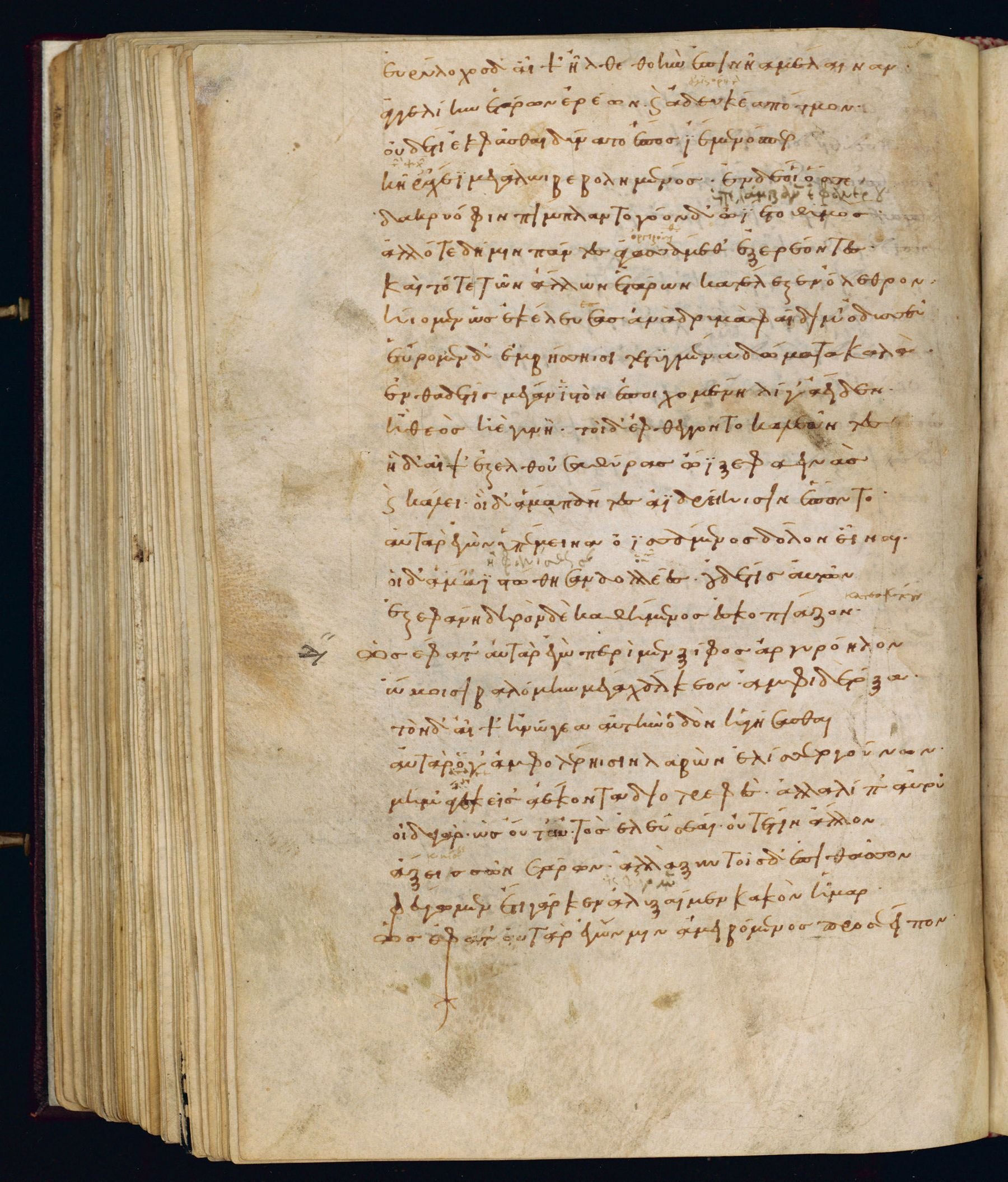
Laur. Plut. 32.24, fol. 97v: Odyssey 10.244-270, begins ‹Εὐρύλοχος δʼ αἶψʼ ἦλθε›, ends ‹ἐγώ μιν ἀμειβόμενος προσέειπον·›. Checked on the image: first and last lines read and matched to the Greek. Fol. 97r ends with 10.243. Fol. 98r begins with 10.271. 10.253 (ξεστοῖσιν λάεσσι ...) and 10.265 (καί μʼ ὀλοφυρόμενος ...) are not on the page: the scribe passes from 10.252 to 10.254 and from 10.264 to 10.266 (25 lines). English blocks here: 245-249, 250-254, 255-259, 260-260, 261-264, 265-269.
244Εὐρύλοχος δʼ αἶψʼ ἦλθε θοὴν ἐπὶ νῆα μέλαιναν
245ἀγγελίην ἑτάρων ἐρέων καὶ ἀδευκέα πότμον.
246οὐδέ τι ἐκφάσθαι δύνατο ἔπος ἱέμενός περ,
247κῆρ ἄχεϊ μεγάλῳ βεβολημένος· ἐν δέ οἱ ὄσσε
248δακρυόφιν πίμπλαντο, γόον δʼ ὠίετο θυμός.
249ἀλλʼ ὅτε δή μιν πάντες ἀγασσάμεθʼ ἐξερέοντες,
250καὶ τότε τῶν ἄλλων ἑτάρων κατέλεξεν ὄλεθρον·
251ἤιομεν, ὡς ἐκέλευες, ἀνὰ δρυμά, φαίδιμʼ Ὀδυσσεῦ·
252εὕρομεν ἐν βήσσῃσι τετυγμένα δώματα καλὰ
253ξεστοῖσιν λάεσσι, περισκέπτῳ ἐνὶ χώρῳ.
254ἔνθα δέ τις μέγαν ἱστὸν ἐποιχομένη λίγʼ ἄειδεν,
255ἢ θεὸς ἠὲ γυνή· τοὶ δὲ φθέγγοντο καλεῦντες.
256ἡ δʼ αἶψʼ ἐξελθοῦσα θύρας ὤιξε φαεινὰς
257καὶ κάλει· οἱ δʼ ἅμα πάντες ἀιδρείῃσιν ἕποντο·
258αὐτὰρ ἐγὼν ὑπέμεινα, ὀισάμενος δόλον εἶναι.
259οἱ δʼ ἅμʼ ἀιστώθησαν ἀολλέες, οὐδέ τις αὐτῶν
260ἐξεφάνη· δηρὸν δὲ καθήμενος ἐσκοπίαζον.
261ὣς ἔφατʼ, αὐτὰρ ἐγὼ περὶ μὲν ξίφος ἀργυρόηλον
262ὤμοιιν βαλόμην, μέγα χάλκεον, ἀμφὶ δὲ τόξα·
263τὸν δʼ ἂψ ἠνώγεα αὐτὴν ὁδὸν ἡγήσασθαι.
264αὐτὰρ ὅ γʼ ἀμφοτέρῃσι λαβὼν ἐλλίσσετο γούνων
265καί μʼ ὀλοφυρόμενος ἔπεα πτερόεντα προσηύδα·
266μή μʼ ἄγε κεῖσʼ ἀέκοντα, διοτρεφές, ἀλλὰ λίπʼ αὐτοῦ.
267οἶδα γάρ, ὡς οὔτʼ αὐτὸς ἐλεύσεαι οὔτε τινʼ ἄλλον
268ἄξεις σῶν ἑτάρων. ἀλλὰ ξὺν τοίσδεσι θᾶσσον
269φεύγωμεν· ἔτι γάρ κεν ἀλύξαιμεν κακὸν ἦμαρ.
270ὣς ἔφατʼ, αὐτὰρ ἐγώ μιν ἀμειβόμενος προσέειπον·
245to bring tiding of his comrades and their shameful doom. Not a word could he utter, for all his desire, so stricken to the heart was he with great distress, and his eyes were filled with tears, and his spirit was set on lamentation. But when we questioned him in amazement, 250then he told the fate of the others, his comrades. “‘We went through the thickets, as thou badest, noble Odysseus. We found in the forest glades a fair palace, built of polished stones, in a place of wide outlook. There someone was going to and fro before a great web, and singing with clear voice, 255some goddess or some woman, and they cried aloud, and called to her. And she came forth straightway, and opened the bright doors, and bade them in; and they all went with her in their folly. But I remained behind, for I suspected that there was a snare. Then they all vanished together, nor did one of them 260appear again, though I sat long and watched.’ 261“So he spoke, and I cast my silver-studded sword about my shoulders, a great sword of bronze, and slung my bow about me, and bade him lead me back by the self-same road. But he clasped me with both hands, and be sought me by my knees, 265and with wailing he spoke to me winged words: “‘Lead me not thither against my will, O thou fostered of Zeus, but leave me here. For I know that thou wilt neither come back thyself, nor bring anyone of thy comrades. Nay, with these that are here let us flee with all speed, for still we may haply escape the evil day.’
Where on the image
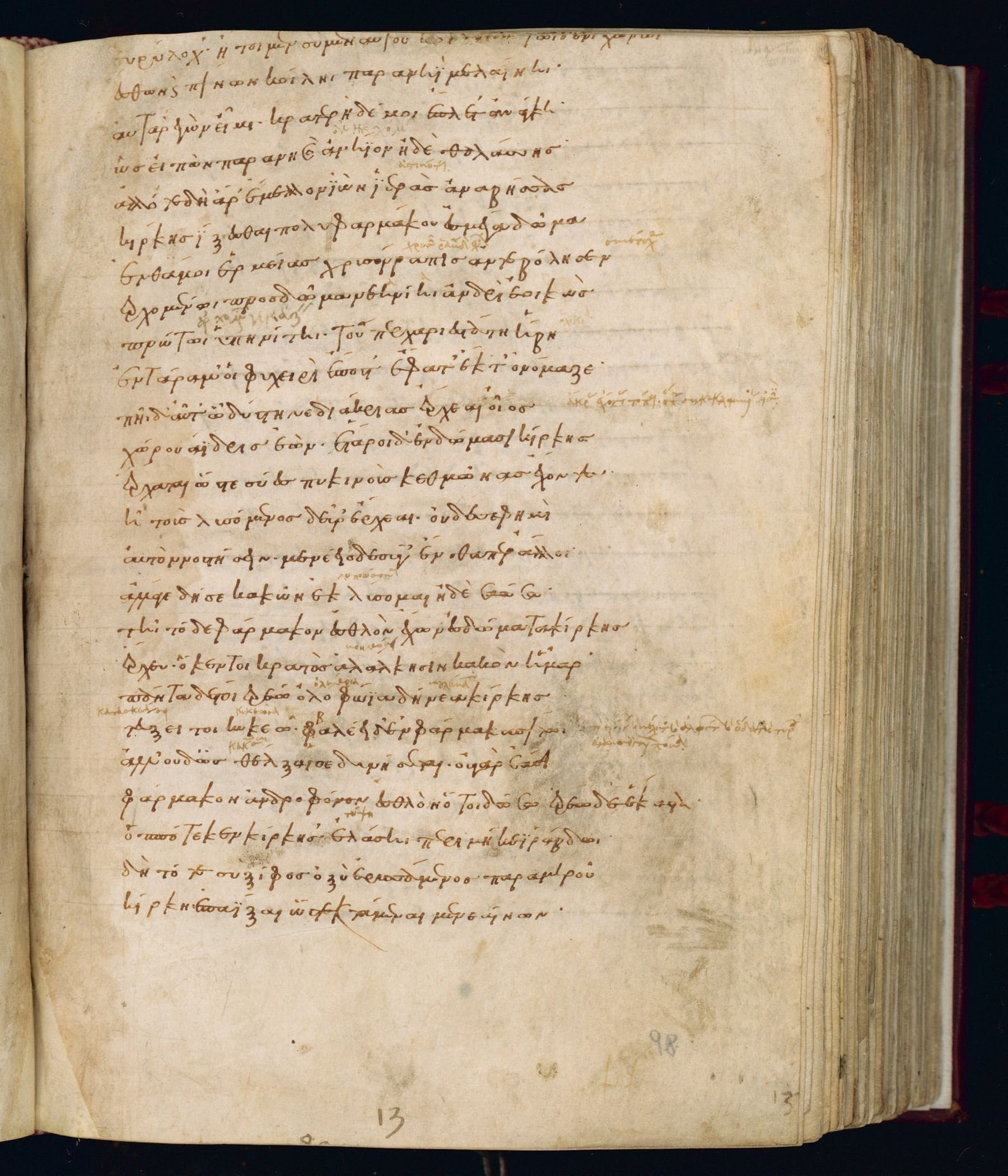
Laur. Plut. 32.24, fol. 98r: Odyssey 10.271-295, begins ‹Εὐρύλοχʼ, ἦ τοι μὲν›, ends ‹ὥς τε κτάμεναι μενεαίνων.›. Checked on the image: first and last lines read and matched to the Greek. Fol. 97v ends with 10.270. Fol. 98v begins with 10.296. English blocks here: 270-274, 275-279, 280-284, 285-289, 290-294.
271Εὐρύλοχʼ, ἦ τοι μὲν σὺ μένʼ αὐτοῦ τῷδʼ ἐνὶ χώρῳ
272ἔσθων καὶ πίνων κοίλῃ παρὰ νηὶ μελαίνῃ·
273αὐτὰρ ἐγὼν εἶμι, κρατερὴ δέ μοι ἔπλετʼ ἀνάγκη.
274ὣς εἰπὼν παρὰ νηὸς ἀνήιον ἠδὲ θαλάσσης.
275ἀλλʼ ὅτε δὴ ἄρʼ ἔμελλον ἰὼν ἱερὰς ἀνὰ βήσσας
276Κίρκης ἵξεσθαι πολυφαρμάκου ἐς μέγα δῶμα,
277ἔνθα μοι Ἑρμείας χρυσόρραπις ἀντεβόλησεν
278ἐρχομένῳ πρὸς δῶμα, νεηνίῃ ἀνδρὶ ἐοικώς,
279πρῶτον ὑπηνήτῃ, τοῦ περ χαριεστάτη ἥβη·
280ἔν τʼ ἄρα μοι φῦ χειρί, ἔπος τʼ ἔφατʼ ἔκ τʼ ὀνόμαζε·
281πῇ δὴ αὖτʼ, ὦ δύστηνε, διʼ ἄκριας ἔρχεαι οἶος,
282χώρου ἄιδρις ἐών; ἕταροι δέ τοι οἵδʼ ἐνὶ Κίρκης
283ἔρχαται ὥς τε σύες πυκινοὺς κευθμῶνας ἔχοντες.
284ἦ τοὺς λυσόμενος δεῦρʼ ἔρχεαι; οὐδέ σέ φημι
285αὐτὸν νοστήσειν, μενέεις δὲ σύ γʼ, ἔνθα περ ἄλλοι.
286ἀλλʼ ἄγε δή σε κακῶν ἐκλύσομαι ἠδὲ σαώσω.
287τῆ, τόδε φάρμακον ἐσθλὸν ἔχων ἐς δώματα Κίρκης
288ἔρχευ, ὅ κέν τοι κρατὸς ἀλάλκῃσιν κακὸν ἦμαρ.
289πάντα δέ τοι ἐρέω ὀλοφώια δήνεα Κίρκης.
290τεύξει τοι κυκεῶ, βαλέει δʼ ἐν φάρμακα σίτῳ.
291ἀλλʼ οὐδʼ ὣς θέλξαι σε δυνήσεται· οὐ γὰρ ἐάσει
292φάρμακον ἐσθλόν, ὅ τοι δώσω, ἐρέω δὲ ἕκαστα.
293ὁππότε κεν Κίρκη σʼ ἐλάσῃ περιμήκεϊ ῥάβδῳ,
294δὴ τότε σὺ ξίφος ὀξὺ ἐρυσσάμενος παρὰ μηροῦ
295Κίρκῃ ἐπαῖξαι, ὥς τε κτάμεναι μενεαίνων.
270“So he spoke, but I answered him, and said:‘Eurylochus, do thou stay here in this place, eating and drinking by the hollow, black ship; but I will go, for strong necessity is laid upon me.’ “So saying, I went up from the ship and the sea. 275But when, as I went through the sacred glades, I was about to come to the great house of the sorceress, Circe, then Hermes, of the golden wand, met me as I went toward the house, in the likeness of a young man with the first down upon his lip, in whom the charm of youth is fairest. 280He clasped my hand, and spoke, and addressed me: “‘Whither now again, hapless man, dost thou go alone through the hills, knowing naught of the country? Lo, thy comrades yonder in the house of Circe are penned like swine in close-barred sties. And art thou come to release them? Nay, I tell thee, thou shalt not 285thyself return, but shalt remain there with the others. But come, I will free thee from harm, and save thee. Here, take this potent herb, and go to the house of Circe, and it shall ward off from thy head the evil day. And I will tell thee all the baneful wiles of Circe. 290She will mix thee a potion, and cast drugs into the food; but even so she shall not be able to bewitch thee, for the potent herb that I shall give thee will not suffer it. And I will tell thee all. When Circe shall smite thee with her long wand, then do thou draw thy sharp sword from beside thy thigh,
Where on the image
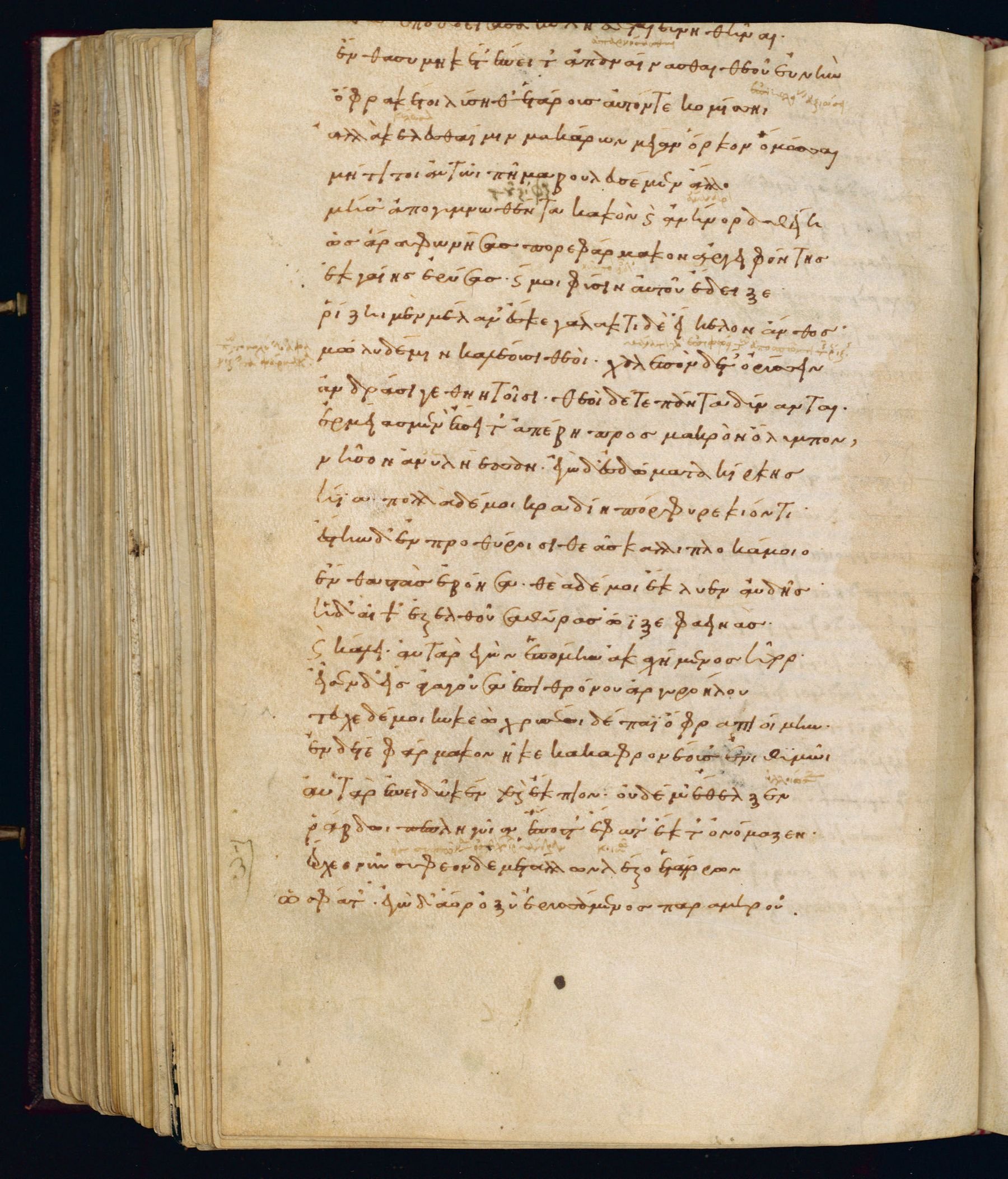
Laur. Plut. 32.24, fol. 98v: Odyssey 10.296-321, begins ‹ἡ δέ σʼ ὑποδείσασα›, ends ‹ὀξὺ ἐρυσσάμενος παρὰ μηροῦ›. Checked on the image: first and last lines read and matched to the Greek. Fol. 98r ends with 10.295. Fol. 99r begins with 10.322. The top edge is curled in the photograph and the first line (10.296) is only partly visible. 10.315 (καλοῦ δαιδαλέου ...) is not on the page: the scribe passes from 10.314 to 10.316 (25 lines). English blocks here: 295-299, 300-301, 302-304, 305-309, 310-314, 315-319.
296ἡ δέ σʼ ὑποδείσασα κελήσεται εὐνηθῆναι·
297ἔνθα σὺ μηκέτʼ ἔπειτʼ ἀπανήνασθαι θεοῦ εὐνήν,
298ὄφρα κέ τοι λύσῃ θʼ ἑτάρους αὐτόν τε κομίσσῃ·
299ἀλλὰ κέλεσθαί μιν μακάρων μέγαν ὅρκον ὀμόσσαι,
300μή τί τοι αὐτῷ πῆμα κακὸν βουλευσέμεν ἄλλο,
301μή σʼ ἀπογυμνωθέντα κακὸν καὶ ἀνήνορα θήῃ.
302ὣς ἄρα φωνήσας πόρε φάρμακον ἀργεϊφόντης
303ἐκ γαίης ἐρύσας, καί μοι φύσιν αὐτοῦ ἔδειξε.
304ῥίζῃ μὲν μέλαν ἔσκε, γάλακτι δὲ εἴκελον ἄνθος·
305μῶλυ δέ μιν καλέουσι θεοί· χαλεπὸν δέ τʼ ὀρύσσειν
306ἀνδράσι γε θνητοῖσι, θεοὶ δέ τε πάντα δύνανται.
307Ἑρμείας μὲν ἔπειτʼ ἀπέβη πρὸς μακρὸν Ὄλυμπον
308νῆσον ἀνʼ ὑλήεσσαν, ἐγὼ δʼ ἐς δώματα Κίρκης
309ἤια, πολλὰ δέ μοι κραδίη πόρφυρε κιόντι.
310ἔστην δʼ εἰνὶ θύρῃσι θεᾶς καλλιπλοκάμοιο·
311ἔνθα στὰς ἐβόησα, θεὰ δέ μευ ἔκλυεν αὐδῆς.
312ἡ δʼ αἶψʼ ἐξελθοῦσα θύρας ὤιξε φαεινὰς
313καὶ κάλει· αὐτὰρ ἐγὼν ἑπόμην ἀκαχήμενος ἦτορ.
314εἷσε δέ μʼ εἰσαγαγοῦσα ἐπὶ θρόνου ἀργυροήλου
315καλοῦ δαιδαλέου· ὑπὸ δὲ θρῆνυς ποσὶν ἦεν·
316τεῦχε δέ μοι κυκεῶ χρυσέῳ δέπαι, ὄφρα πίοιμι,
317ἐν δέ τε φάρμακον ἧκε, κακὰ φρονέουσʼ ἐνὶ θυμῷ.
318αὐτὰρ ἐπεὶ δῶκέν τε καὶ ἔκπιον, οὐδέ μʼ ἔθελξε,
319ῥάβδῳ πεπληγυῖα ἔπος τʼ ἔφατʼ ἔκ τʼ ὀνόμαζεν·
320ἔρχεο νῦν συφεόνδε, μετʼ ἄλλων λέξο ἑταίρων.
321ὣς φάτʼ, ἐγὼ δʼ ἄορ ὀξὺ ἐρυσσάμενος παρὰ μηροῦ
295and rush upon Circe, as though thou wouldst slay her. And she will be seized with fear, and will bid thee lie with her. Then do not thou thereafter refuse the couch of the goddess, that she may set free thy comrades, and give entertainment to thee. But bid her swear a great oath by the blessed gods, 300that she will not plot against thee any fresh mischief to thy hurt, lest when she has thee stripped she may render thee a weakling and unmanned.’ 302“So saying, Argeiphontes gave me the herb, drawing it from the ground, and showed me its nature. At the root it was black, but its flower was like milk. 305Moly the gods call it, and it is hard for mortal men to dig; but with the gods all things are possible. Hermes then departed to high Olympus through the wooded isle, and I went my way to the house of Circe, and many things did my heart darkly ponder as I went. 310So I stood at the gates of the fair-tressed goddess. There I stood and called, and the goddess heard my voice. Straightway then she came forth, and opened the bright doors, and bade me in; and I went with her, my heart sore troubled. She brought me in and made me sit on a silver-studded chair, 315a beautiful chair, richly wrought, and beneath was a foot-stool for the feet. And she prepared me a potion in a golden cup, that I might drink, and put therein a drug, with evil purpose in her heart. But when she had given it me, and I had drunk it off, yet was not bewitched, she smote me with her wand, and spoke, and addressed me:
Where on the image
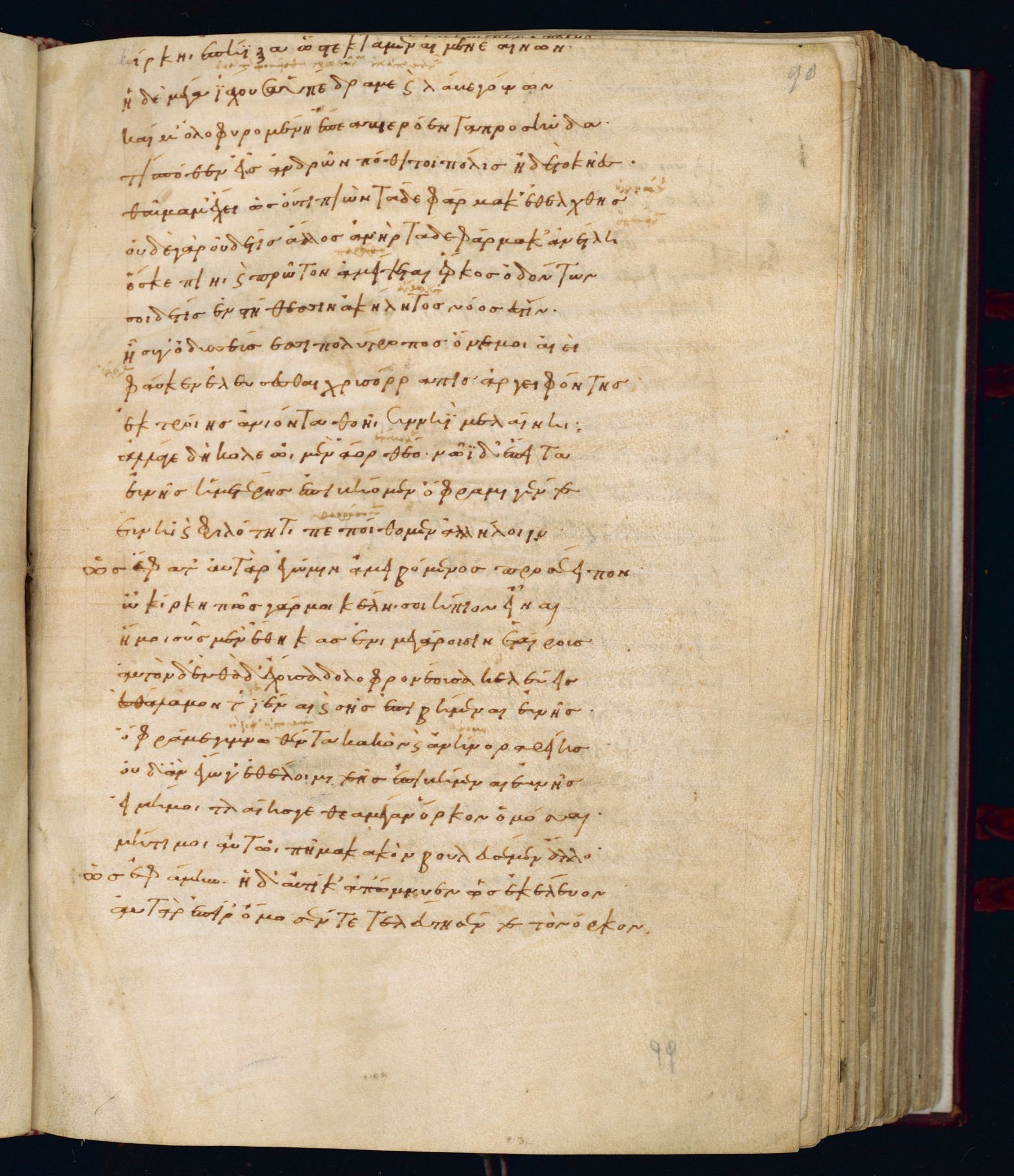
Laur. Plut. 32.24, fol. 99r: Odyssey 10.322-346, begins ‹Κίρκῃ ἐπήιξα ὥς τε›, ends ‹τελεύτησέν τε τὸν ὅρκον,›. Checked on the image: first and last lines read and matched to the Greek. Fol. 98v ends with 10.321. Fol. 99v begins with 10.347. English blocks here: 320-324, 325-329, 330-334, 335-339, 340-344.
322Κίρκῃ ἐπήιξα ὥς τε κτάμεναι μενεαίνων.
323ἡ δὲ μέγα ἰάχουσα ὑπέδραμε καὶ λάβε γούνων,
324καί μʼ ὀλοφυρομένη ἔπεα πτερόεντα προσηύδα·
325τίς πόθεν εἰς ἀνδρῶν; πόθι τοι πόλις ἠδὲ τοκῆες;
326θαῦμά μʼ ἔχει ὡς οὔ τι πιὼν τάδε φάρμακʼ ἐθέλχθης·
327οὐδὲ γὰρ οὐδέ τις ἄλλος ἀνὴρ τάδε φάρμακʼ ἀνέτλη,
328ὅς κε πίῃ καὶ πρῶτον ἀμείψεται ἕρκος ὀδόντων.
329σοὶ δέ τις ἐν στήθεσσιν ἀκήλητος νόος ἐστίν.
330ἦ σύ γʼ Ὀδυσσεύς ἐσσι πολύτροπος, ὅν τέ μοι αἰεὶ
331φάσκεν ἐλεύσεσθαι χρυσόρραπις ἀργεϊφόντης,
332ἐκ Τροίης ἀνιόντα θοῇ σὺν νηὶ μελαίνῃ.
333ἀλλʼ ἄγε δὴ κολεῷ μὲν ἄορ θέο, νῶι δʼ ἔπειτα
334εὐνῆς ἡμετέρης ἐπιβείομεν, ὄφρα μιγέντε
335εὐνῇ καὶ φιλότητι πεποίθομεν ἀλλήλοισιν.
336ὣς ἔφατʼ, αὐτὰρ ἐγώ μιν ἀμειβόμενος προσέειπον·
337ὦ Κίρκη, πῶς γάρ με κέλεαι σοὶ ἤπιον εἶναι,
338ἥ μοι σῦς μὲν ἔθηκας ἐνὶ μεγάροισιν ἑταίρους,
339αὐτὸν δʼ ἐνθάδʼ ἔχουσα δολοφρονέουσα κελεύεις
340ἐς θάλαμόν τʼ ἰέναι καὶ σῆς ἐπιβήμεναι εὐνῆς,
341ὄφρα με γυμνωθέντα κακὸν καὶ ἀνήνορα θήῃς.
342οὐδʼ ἂν ἐγώ γʼ ἐθέλοιμι τεῆς ἐπιβήμεναι εὐνῆς,
343εἰ μή μοι τλαίης γε, θεά, μέγαν ὅρκον ὀμόσσαι
344μή τί μοι αὐτῷ πῆμα κακὸν βουλευσέμεν ἄλλο.
345ὣς ἐφάμην, ἡ δʼ αὐτίκʼ ἀπώμνυεν, ὡς ἐκέλευον.
346αὐτὰρ ἐπεί ῥʼ ὄμοσέν τε τελεύτησέν τε τὸν ὅρκον,
320‘Begone now to the sty, and lie with the rest of thy comrades.’ “So she spoke, but I, drawing my sharp sword from beside my thigh, rushed upon Circe, as though I would slay her. But she, with a loud cry, ran beneath, and clasped my knees, and with wailing she spoke to me winged words: 325“‘Who art thou among men, and from whence? Where is thy city, and where thy parents? Amazement holds me that thou hast drunk this charm and wast in no wise bewitched. For no man else soever hath withstood this charm, when once he has drunk it, and it has passed the barrier of his teeth. Nay, but the mind in thy breast is one not to be beguiled. 330Surely thou art Odysseus, the man of ready device, who Argeiphontes of the golden wand ever said to me would come hither on his way home from Troy with his swift, black ship. Nay, come, put up thy sword in its sheath, and let us two then go up into my bed, that couched together 335in love we may put trust in each other.’ “So she spoke, but I answered her, and said:‘Circe, how canst thou bid me be gentle to thee, who hast turned my comrades into swine in thy halls, and now keepest me here, and with guileful purpose biddest me 340go to thy chamber, and go up into thy bed, that when thou hast me stripped thou mayest render me a weakling and unmanned? Nay, verily, it is not I that shall be fain to go up into thy bed, unless thou, goddess, wilt consent to swear a mighty oath that thou wilt not plot against me any fresh mischief to my hurt.’
Where on the image
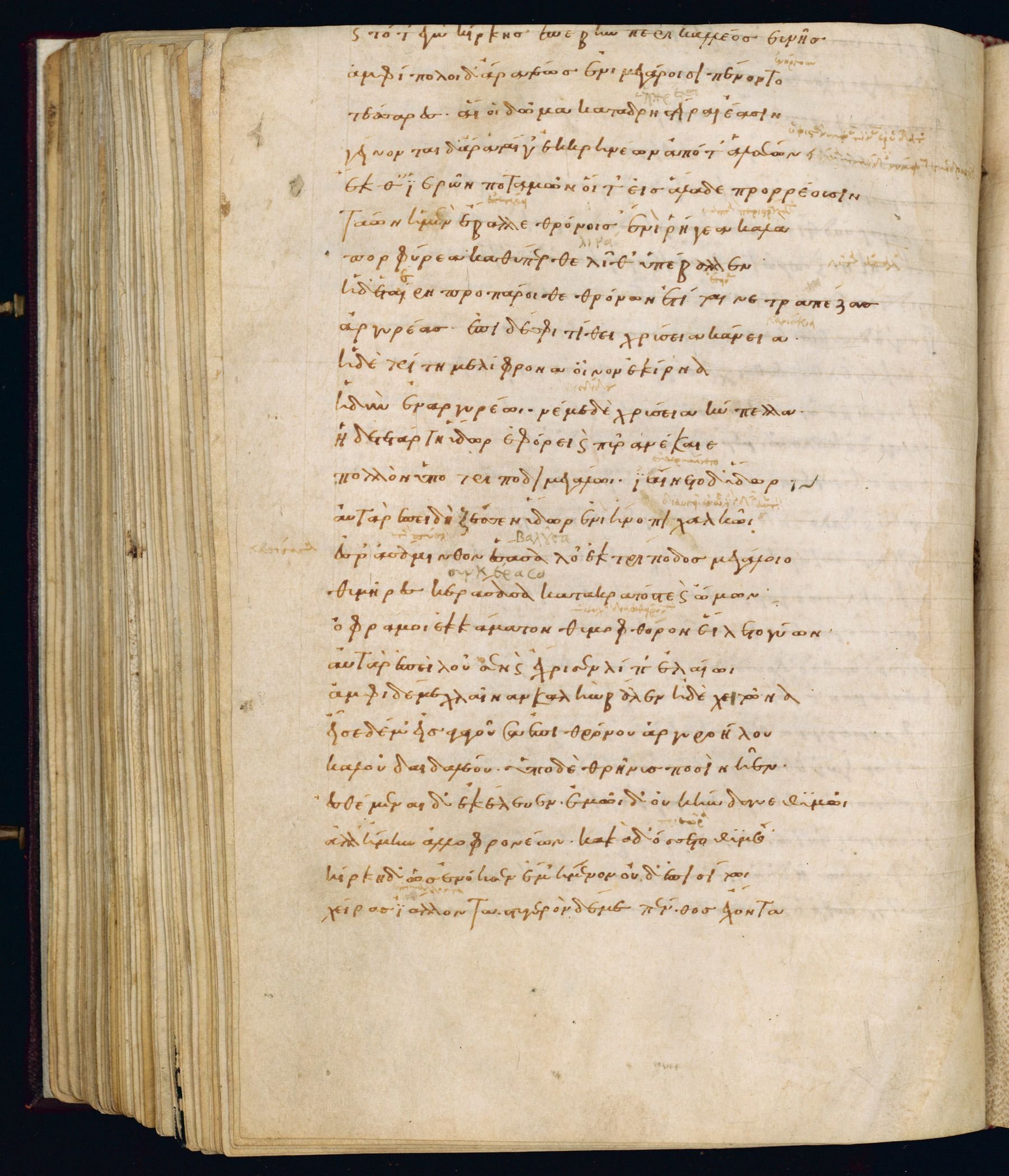
Laur. Plut. 32.24, fol. 99v: Odyssey 10.347-376, begins ‹καὶ τότʼ ἐγὼ Κίρκης›, ends ‹δέ με πένθος ἔχοντα,›. Checked on the image: first and last lines read and matched to the Greek. Fol. 99r ends with 10.346. Fol. 100r begins with 10.377. 10.368-372 (χέρνιβα δʼ ἀμφίπολος ... χαριζομένη παρεόντων) are not on the page: the scribe passes from 10.367 to 10.373 (25 lines). English blocks here: 345-349, 350-354, 355-359, 360-364, 365-369, 370-374.
347καὶ τότʼ ἐγὼ Κίρκης ἐπέβην περικαλλέος εὐνῆς.
348ἀμφίπολοι δʼ ἄρα τέως μὲν ἐνὶ μεγάροισι πένοντο
349τέσσαρες, αἵ οἱ δῶμα κάτα δρήστειραι ἔασι·
350γίγνονται δʼ ἄρα ταί γʼ ἔκ τε κρηνέων ἀπό τʼ ἀλσέων
351ἔκ θʼ ἱερῶν ποταμῶν, οἵ τʼ εἰς ἅλαδε προρέουσι.
352τάων ἡ μὲν ἔβαλλε θρόνοις ἔνι ῥήγεα καλὰ
353πορφύρεα καθύπερθʼ, ὑπένερθε δὲ λῖθʼ ὑπέβαλλεν·
354ἡ δʼ ἑτέρη προπάροιθε θρόνων ἐτίταινε τραπέζας
355ἀργυρέας, ἐπὶ δέ σφι τίθει χρύσεια κάνεια·
356ἡ δὲ τρίτη κρητῆρι μελίφρονα οἶνον ἐκίρνα
357ἡδὺν ἐν ἀργυρέῳ, νέμε δὲ χρύσεια κύπελλα·
358ἡ δὲ τετάρτη ὕδωρ ἐφόρει καὶ πῦρ ἀνέκαιε
359πολλὸν ὑπὸ τρίποδι μεγάλῳ· ἰαίνετο δʼ ὕδωρ.
360αὐτὰρ ἐπεὶ δὴ ζέσσεν ὕδωρ ἐνὶ ἤνοπι χαλκῷ,
361ἔς ῥʼ ἀσάμινθον ἕσασα λόʼ ἐκ τρίποδος μεγάλοιο,
362θυμῆρες κεράσασα, κατὰ κρατός τε καὶ ὤμων,
363ὄφρα μοι ἐκ κάματον θυμοφθόρον εἵλετο γυίων.
364αὐτὰρ ἐπεὶ λοῦσέν τε καὶ ἔχρισεν λίπʼ ἐλαίῳ,
365ἀμφὶ δέ με χλαῖναν καλὴν βάλεν ἠδὲ χιτῶνα,
366εἷσε δέ μʼ εἰσαγαγοῦσα ἐπὶ θρόνου ἀργυροήλου
367καλοῦ δαιδαλέου, ὑπὸ δὲ θρῆνυς ποσὶν ἦεν·
368χέρνιβα δʼ ἀμφίπολος προχόῳ ἐπέχευε φέρουσα
369καλῇ χρυσείῃ, ὑπὲρ ἀργυρέοιο λέβητος,
370νίψασθαι· παρὰ δὲ ξεστὴν ἐτάνυσσε τράπεζαν.
371σῖτον δʼ αἰδοίη ταμίη παρέθηκε φέρουσα,
372εἴδατα πόλλʼ ἐπιθεῖσα, χαριζομένη παρεόντων.
373ἐσθέμεναι δʼ ἐκέλευεν· ἐμῷ δʼ οὐχ ἥνδανε θυμῷ,
374ἀλλʼ ἥμην ἀλλοφρονέων, κακὰ δʼ ὄσσετο θυμός.
375Κίρκη δʼ ὡς ἐνόησεν ἔμʼ ἥμενον οὐδʼ ἐπὶ σίτῳ
376χεῖρας ἰάλλοντα, κρατερὸν δέ με πένθος ἔχοντα,
345“So I spoke, and she straightway swore the oath to do me no harm, as I bade her. But when she had sworn, and made an end of the oath, then I went up to the beautiful bed of Circe. “But her handmaids meanwhile were busied in the halls, four maidens who are her serving-women in the house. 350Children are they of the springs and groves, and of the sacred rivers that flow forth to the sea, and of them one threw upon chairs fair rugs of purple above, and spread beneath them a linen cloth; another drew up before the chairs tables 355of silver, and set upon them golden baskets; and the third mixed sweet, honey-hearted wine in a bowl of silver, and served out golden cups; and the fourth brought water, and kindled a great fire beneath a large cauldron, and the water grew warm. 360But when the water boiled in the bright bronze, she set me in a bath, and bathed me with water from out the great cauldron, mixing it to my liking, and pouring it over my head and shoulders, till she took from my limbs soul-consuming weariness. But when she had bathed me, and anointed me richly with oil, 365and had cast about me a fair cloak and a tunic, she brought me into the hall, and made me sit upon a silver-studded chair—a beautiful chair, richly wrought, and beneath was a foot-stool for the feet. Then a handmaid brought water for the hands in a fair pitcher of gold, and poured it over a silver basin 370for me to wash, and beside me drew up a polished table. And the grave housewife brought and set before me bread, and therewith meats in abundance, granting freely of her store. Then she bade me eat, but my heart inclined not thereto. Rather, I sat with other thoughts, and my spirit boded ill.
Where on the image
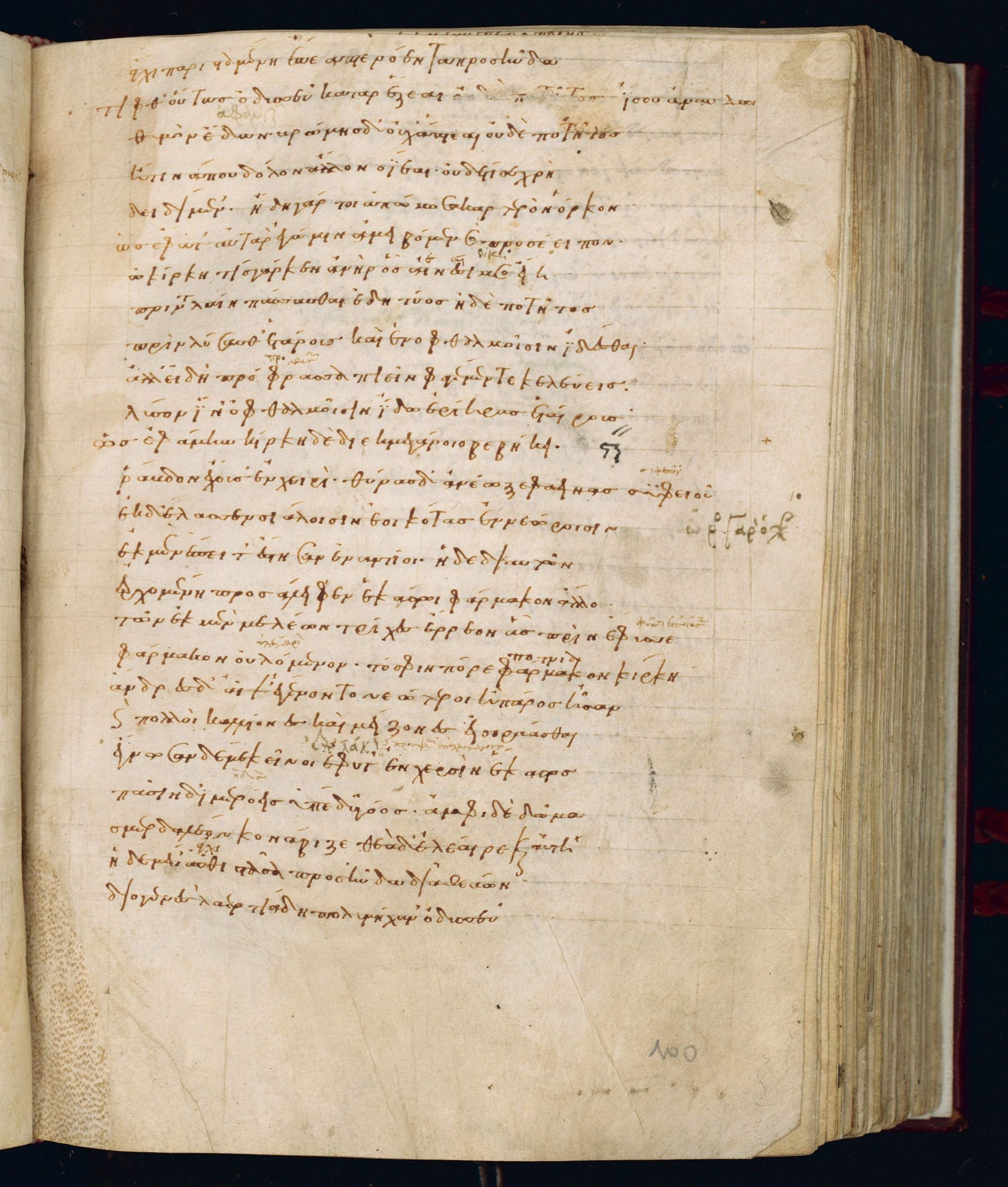
Laur. Plut. 32.24, fol. 100r: Odyssey 10.377-401, begins ‹ἄγχι παρισταμένη ἔπεα πτερόεντα›, ends ‹διογενὲς Λαερτιάδη, πολυμήχανʼ Ὀδυσσεῦ,›. Checked on the image: first and last lines read and matched to the Greek. Fol. 99v ends with 10.376. Fol. 100v begins with 10.402. English blocks here: 375-379, 380-384, 385-387, 388-389, 390-394, 395-399.
377ἄγχι παρισταμένη ἔπεα πτερόεντα προσηύδα·
378τίφθʼ οὕτως, Ὀδυσεῦ, κατʼ ἄρʼ ἕζεαι ἶσος ἀναύδῳ,
379θυμὸν ἔδων, βρώμης δʼ οὐχ ἅπτεαι οὐδὲ ποτῆτος;
380ἦ τινά που δόλον ἄλλον ὀίεαι· οὐδέ τί σε χρὴ
381δειδίμεν· ἤδη γάρ τοι ἀπώμοσα καρτερὸν ὅρκον.
382ὣς ἔφατʼ, αὐτὰρ ἐγώ μιν ἀμειβόμενος προσέειπον·
383ὦ Κίρκη, τίς γάρ κεν ἀνήρ, ὃς ἐναίσιμος εἴη,
384πρὶν τλαίη πάσσασθαι ἐδητύος ἠδὲ ποτῆτος,
385πρὶν λύσασθʼ ἑτάρους καὶ ἐν ὀφθαλμοῖσιν ἰδέσθαι;
386ἀλλʼ εἰ δὴ πρόφρασσα πιεῖν φαγέμεν τε κελεύεις,
387λῦσον, ἵνʼ ὀφθαλμοῖσιν ἴδω ἐρίηρας ἑταίρους.
388ὣς ἐφάμην, Κίρκη δὲ διὲκ μεγάροιο βεβήκει
389ῥάβδον ἔχουσʼ ἐν χειρί, θύρας δʼ ἀνέῳξε συφειοῦ,
390ἐκ δʼ ἔλασεν σιάλοισιν ἐοικότας ἐννεώροισιν.
391οἱ μὲν ἔπειτʼ ἔστησαν ἐναντίοι, ἡ δὲ διʼ αὐτῶν
392ἐρχομένη προσάλειφεν ἑκάστῳ φάρμακον ἄλλο.
393τῶν δʼ ἐκ μὲν μελέων τρίχες ἔρρεον, ἃς πρὶν ἔφυσε
394φάρμακον οὐλόμενον, τό σφιν πόρε πότνια Κίρκη·
395ἄνδρες δʼ ἂψ ἐγένοντο νεώτεροι ἢ πάρος ἦσαν,
396καὶ πολὺ καλλίονες καὶ μείζονες εἰσοράασθαι.
397ἔγνωσαν δέ μʼ ἐκεῖνοι ἔφυν τʼ ἐν χερσὶν ἕκαστος.
398πᾶσιν δʼ ἱμερόεις ὑπέδυ γόος, ἀμφὶ δὲ δῶμα
399σμερδαλέον κονάβιζε· θεὰ δʼ ἐλέαιρε καὶ αὐτή.
400ἡ δέ μευ ἄγχι στᾶσα προσηύδα δῖα θεάων·
401διογενὲς Λαερτιάδη, πολυμήχανʼ Ὀδυσσεῦ,
375“Now when Circe noted that I sat thus, and did not put forth my hands to the food, but was burdened with sore grief, she came close to me, and spoke winged words: “‘Why, Odysseus, dost thou sit thus like one that is dumb, eating thy heart, and dost not touch food or drink? 380Dost thou haply forbode some other guile? Nay, thou needest in no wise fear, for already have I sworn a mighty oath to do thee no harm.’ “So she spoke, but I answered her, and said:‘Circe, what man that is right-minded could bring himself to taste of food or drink, 385ere yet he had won freedom for his comrades, and beheld them before his face? But if thou of a ready heart dost bid me eat and drink, set them free, that mine eyes may behold my trusty comrades.’ 388“So I spoke, and Circe went forth through the hall holding her wand in her hand, and opened the doors of the sty, 390and drove them out in the form of swine of nine years old. So they stood there before her, and she went through the midst of them, and anointed each man with another charm. Then from their limbs the bristles fell away which the baneful drug that queenly Circe gave them had before made to grow, 395and they became men again, younger than they were before, and far comelier and taller to look upon. They knew me, and clung to my hands, each man of them, and upon them all came a passionate sobbing, and the house about them rang wondrously, and the goddess herself was moved to pity.
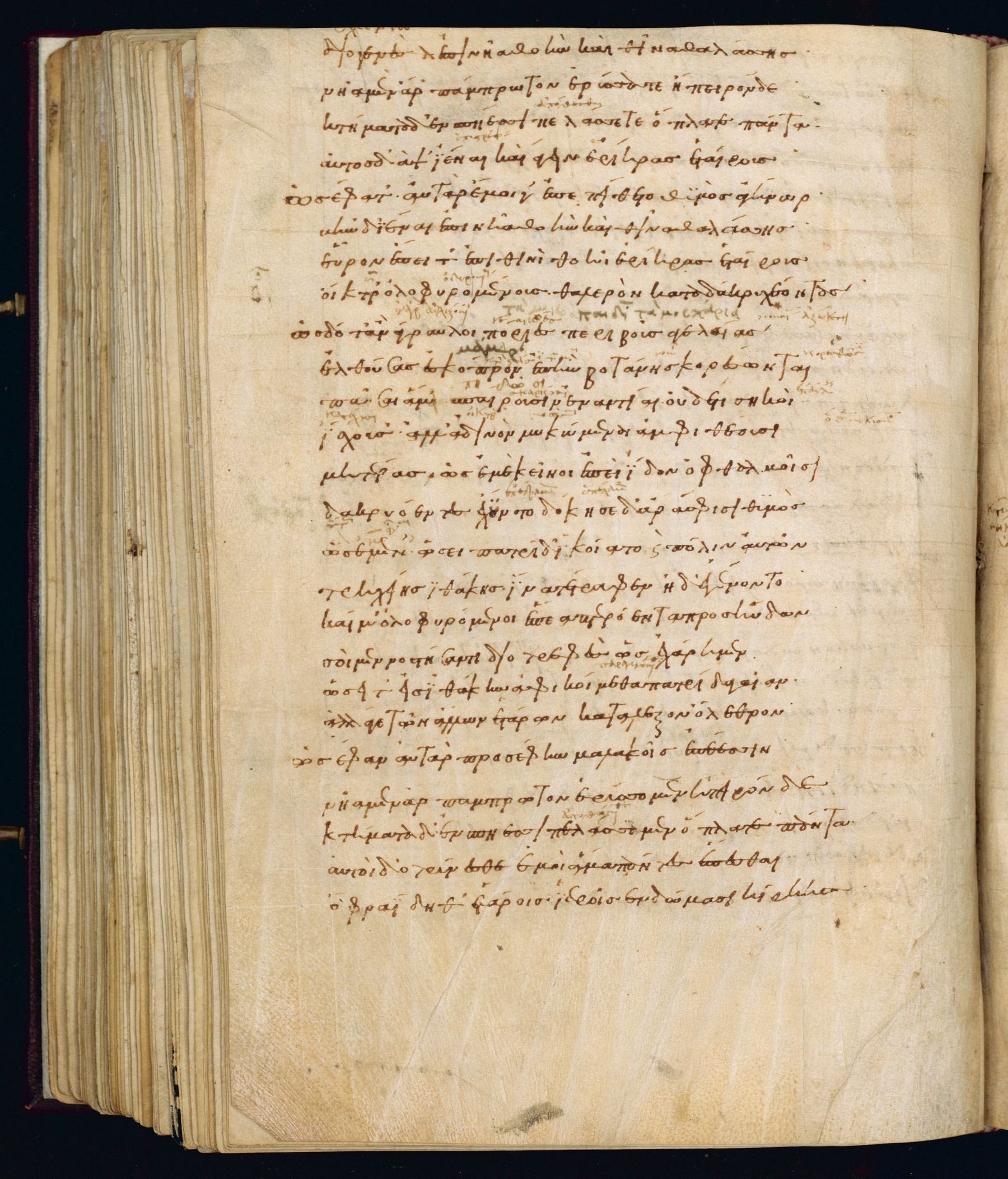
Where on the image
Laur. Plut. 32.24, fol. 100v: Odyssey 10.402-426, begins ‹ἔρχεο νῦν ἐπὶ νῆα›, ends ‹ἱεροῖς ἐν δώμασι Κίρκης›. Checked on the image: first and last lines read and matched to the Greek. Fol. 100r ends with 10.401. Fol. 101r begins with 10.427. English blocks here: 400-404, 405-409, 410-414, 415-419, 420-424, 425-427.
402ἔρχεο νῦν ἐπὶ νῆα θοὴν καὶ θῖνα θαλάσσης.
403νῆα μὲν ἂρ πάμπρωτον ἐρύσσατε ἤπειρόνδε,
404κτήματα δʼ ἐν σπήεσσι πελάσσατε ὅπλα τε πάντα·
405αὐτὸς δʼ ἂψ ἰέναι καὶ ἄγειν ἐρίηρας ἑταίρους.
406ὣς ἔφατʼ, αὐτὰρ ἐμοί γʼ ἐπεπείθετο θυμὸς ἀγήνωρ,
407βῆν δʼ ἰέναι ἐπὶ νῆα θοὴν καὶ θῖνα θαλάσσης.
408εὗρον ἔπειτʼ ἐπὶ νηὶ θοῇ ἐρίηρας ἑταίρους
409οἴκτρʼ ὀλοφυρομένους, θαλερὸν κατὰ δάκρυ χέοντας.
410ὡς δʼ ὅτʼ ἂν ἄγραυλοι πόριες περὶ βοῦς ἀγελαίας,
411ἐλθούσας ἐς κόπρον, ἐπὴν βοτάνης κορέσωνται,
412πᾶσαι ἅμα σκαίρουσιν ἐναντίαι· οὐδʼ ἔτι σηκοὶ
413ἴσχουσʼ, ἀλλʼ ἁδινὸν μυκώμεναι ἀμφιθέουσι·
414μητέρας· ὣς ἔμʼ ἐκεῖνοι ἐπεὶ ἴδον ὀφθαλμοῖσι,
415δακρυόεντες ἔχυντο· δόκησε δʼ ἄρα σφίσι θυμὸς
416ὣς ἔμεν, ὡς εἰ πατρίδʼ ἱκοίατο καὶ πόλιν αὐτὴν
417τρηχείης Ἰθάκης, ἵνα τʼ ἔτραφεν ἠδʼ ἐγένοντο.
418καί μʼ ὀλοφυρόμενοι ἔπεα πτερόεντα προσηύδων·
419σοὶ μὲν νοστήσαντι, διοτρεφές, ὣς ἐχάρημεν,
420ὡς εἴ τʼ εἰς Ἰθάκην ἀφικοίμεθα πατρίδα γαῖαν·
421ἀλλʼ ἄγε, τῶν ἄλλων ἑτάρων κατάλεξον ὄλεθρον.
422ὣς ἔφαν, αὐτὰρ ἐγὼ προσέφην μαλακοῖς ἐπέεσσι·
423νῆα μὲν ἂρ πάμπρωτον ἐρύσσομεν ἤπειρόνδε,
424κτήματα δʼ ἐν σπήεσσι πελάσσομεν ὅπλα τε πάντα·
425αὐτοὶ δʼ ὀτρύνεσθε ἐμοὶ ἅμα πάντες ἕπεσθαι,
426ὄφρα ἴδηθʼ ἑτάρους ἱεροῖς ἐν δώμασι Κίρκης
400“Then the beautiful goddess drew near me, and said: ‘Son of Laertes, sprung from Zeus, Odysseus of many devices, go now to thy swift ship and to the shore of the sea. First of all do ye draw the ship up on the land, and store your goods and all the tackling in caves. 405Then come back thyself, and bring thy trusty comrades.’ “So she spoke, and my proud heart consented. I went my way to the swift ship and the shore of the sea, and there I found my trusty comrades by the swift ship, wailing piteously, shedding big tears. 410And as when calves in a farmstead sport about the droves of cows returning to the yard, when they have had their fill of grazing—all together they frisk before them, and the pens no longer hold them, but with constant lowing they run about their mothers—so those men, when their eyes beheld me, 415thronged about me weeping, and it seemed to their hearts as though they had got to their native land, and the very city of rugged Ithaca, where they were bred and born. And with wailing they spoke to me winged words: “‘At thy return, O thou fostered of Zeus, we are as glad 420as though we had returned to Ithaca, our native land. But come, tell the fate of the others, our comrades.’ “So they spoke, and I answered them with gentle words: ‘First of all let us draw the ship up on the land, and store our goods and all the tackling in caves. 425Then haste you, one and all, to go with me that you may see your comrades in the sacred halls of Circe, drinking and eating, for they have unfailing store.’
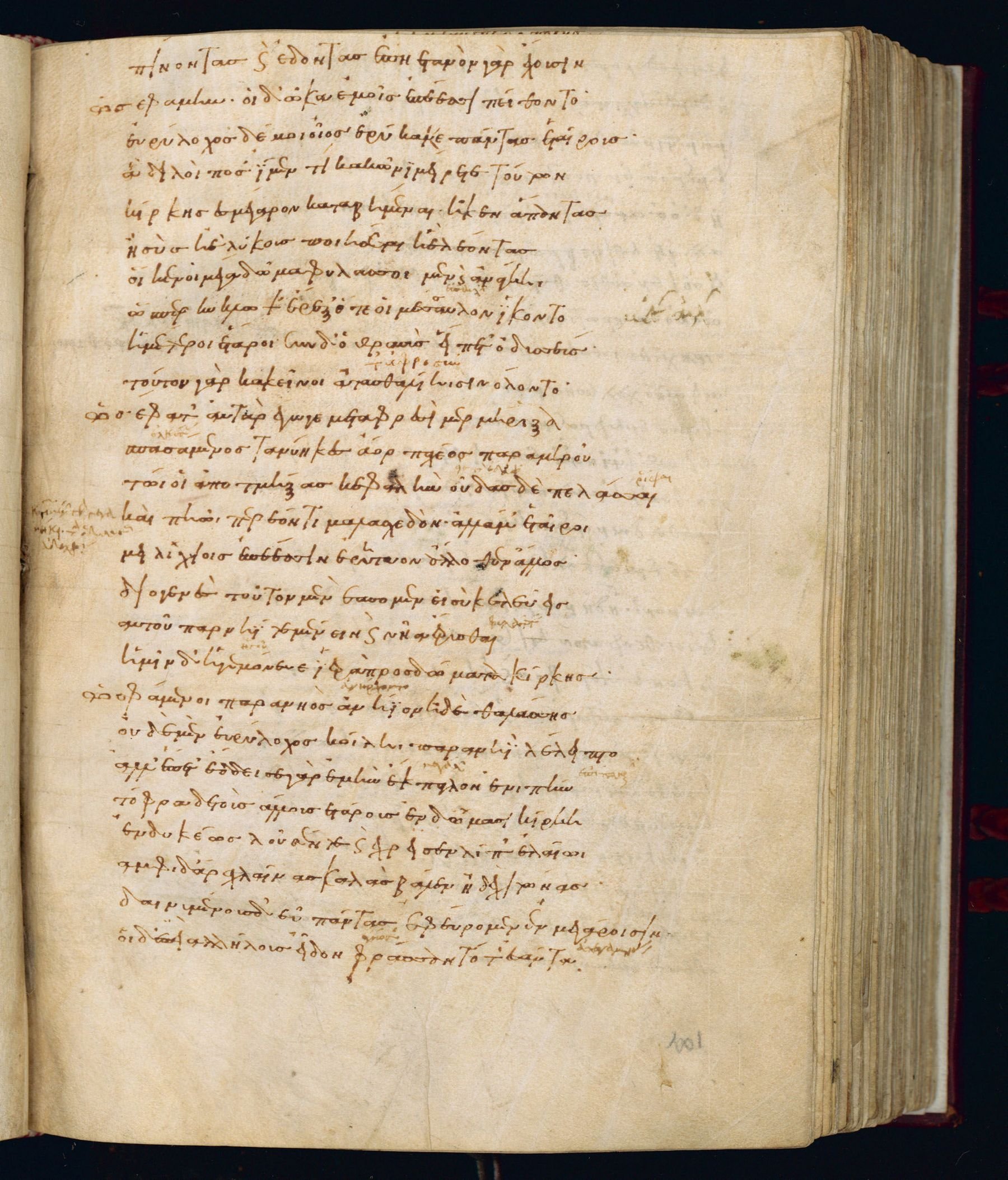
Where on the image
Laur. Plut. 32.24, fol. 101r: Odyssey 10.427-453, begins ‹πίνοντας καὶ ἔδοντας· ἐπηετανὸν›, ends ‹εἶδον φράσσαντό τʼ ἐσάντα,›. Checked on the image: first and last lines read and matched to the Greek. Fol. 100v ends with 10.426. Fol. 101v begins with 10.454. 10.430 (καί σφεας φωνήσας ...) is not on the page: the scribe passes from 10.429 to 10.431 (26 lines). English blocks here: 428-429, 430-434, 435-439, 440-444, 445-449, 450-454.
427πίνοντας καὶ ἔδοντας· ἐπηετανὸν γὰρ ἔχουσιν.
428ὣς ἐφάμην, οἱ δʼ ὦκα ἐμοῖς ἐπέεσσι πίθοντο.
429Εὐρύλοχος δέ μοι οἶος ἐρύκανε πάντας ἑταίρους·
430καί σφεας φωνήσας ἔπεα πτερόεντα προσηύδα·
431ἆ δειλοί, πόσʼ ἴμεν; τί κακῶν ἱμείρετε τούτων;
432Κίρκης ἐς μέγαρον καταβήμεναι, ἥ κεν ἅπαντας
433ἢ σῦς ἠὲ λύκους ποιήσεται ἠὲ λέοντας,
434οἵ κέν οἱ μέγα δῶμα φυλάσσοιμεν καὶ ἀνάγκῃ,
435ὥς περ Κύκλωψ ἔρξʼ, ὅτε οἱ μέσσαυλον ἵκοντο
436ἡμέτεροι ἕταροι, σὺν δʼ ὁ θρασὺς εἵπετʼ Ὀδυσσεύς·
437τούτου γὰρ καὶ κεῖνοι ἀτασθαλίῃσιν ὄλοντο.
438ὣς ἔφατʼ, αὐτὰρ ἐγώ γε μετὰ φρεσὶ μερμήριξα,
439σπασσάμενος τανύηκες ἄορ παχέος παρὰ μηροῦ,
440τῷ οἱ ἀποπλήξας κεφαλὴν οὖδάσδε πελάσσαι,
441καὶ πηῷ περ ἐόντι μάλα σχεδόν· ἀλλά μʼ ἑταῖροι
442μειλιχίοις ἐπέεσσιν ἐρήτυον ἄλλοθεν ἄλλος·
443διογενές, τοῦτον μὲν ἐάσομεν, εἰ σὺ κελεύεις,
444αὐτοῦ πὰρ νηί τε μένειν καὶ νῆα ἔρυσθαι·
445ἡμῖν δʼ ἡγεμόνευʼ ἱερὰ πρὸς δώματα Κίρκης.
446ὣς φάμενοι παρὰ νηὸς ἀνήιον ἠδὲ θαλάσσης.
447οὐδὲ μὲν Εὐρύλοχος κοίλῃ παρὰ νηὶ λέλειπτο,
448ἀλλʼ ἕπετʼ· ἔδεισεν γὰρ ἐμὴν ἔκπαγλον ἐνιπήν.
449τόφρα δὲ τοὺς ἄλλους ἑτάρους ἐν δώμασι Κίρκη
450ἐνδυκέως λοῦσέν τε καὶ ἔχρισεν λίπʼ ἐλαίῳ,
451ἀμφὶ δʼ ἄρα χλαίνας οὔλας βάλεν ἠδὲ χιτῶνας·
452δαινυμένους δʼ ἐὺ πάντας ἐφεύρομεν ἐν μεγάροισιν.
453οἱ δʼ ἐπεὶ ἀλλήλους εἶδον φράσσαντό τʼ ἐσάντα,
428“So I spoke, and they quickly hearkened to my words. Eurylochus alone sought to hold back all my comrades, 430and he spoke, and addressed them with winged words: “‘Ah, wretched men, whither are we going? Why are you so enamoured of these woes, as to go down to the house of Circe, who will change us all to swine, or wolves, or lions, that so we may guard her great house perforce? 435Even so did the Cyclops, when our comrades went to his fold, and with them went this reckless Odysseus. For it was through this man's folly that they too perished.’ “So he spoke, and I pondered in heart, whether to draw my long sword from beside my stout thigh, 440and therewith strike off his head, and bring it to the ground, near kinsman of mine by marriage though he was; but my comrades one after another sought to check me with gentle words: “‘O thou sprung from Zeus, as for this man, we will leave him, if thou so biddest, to abide here by the ship, and to guard the ship, 445but as for us, do thou lead us to the sacred house of Circe.’ “So saying, they went up from the ship and the sea. Nor was Eurylochus left beside the hollow ship, but he went with us, for he feared my dread reproof. “Meanwhile in her halls Circe 450bathed the rest of my comrades with kindly care, and anointed them richly with oil, and cast about them fleecy cloaks and tunics; and we found them all feasting bountifully in the halls. But when they saw and recognized one another, face to face, they wept and wailed, and the house rang around.
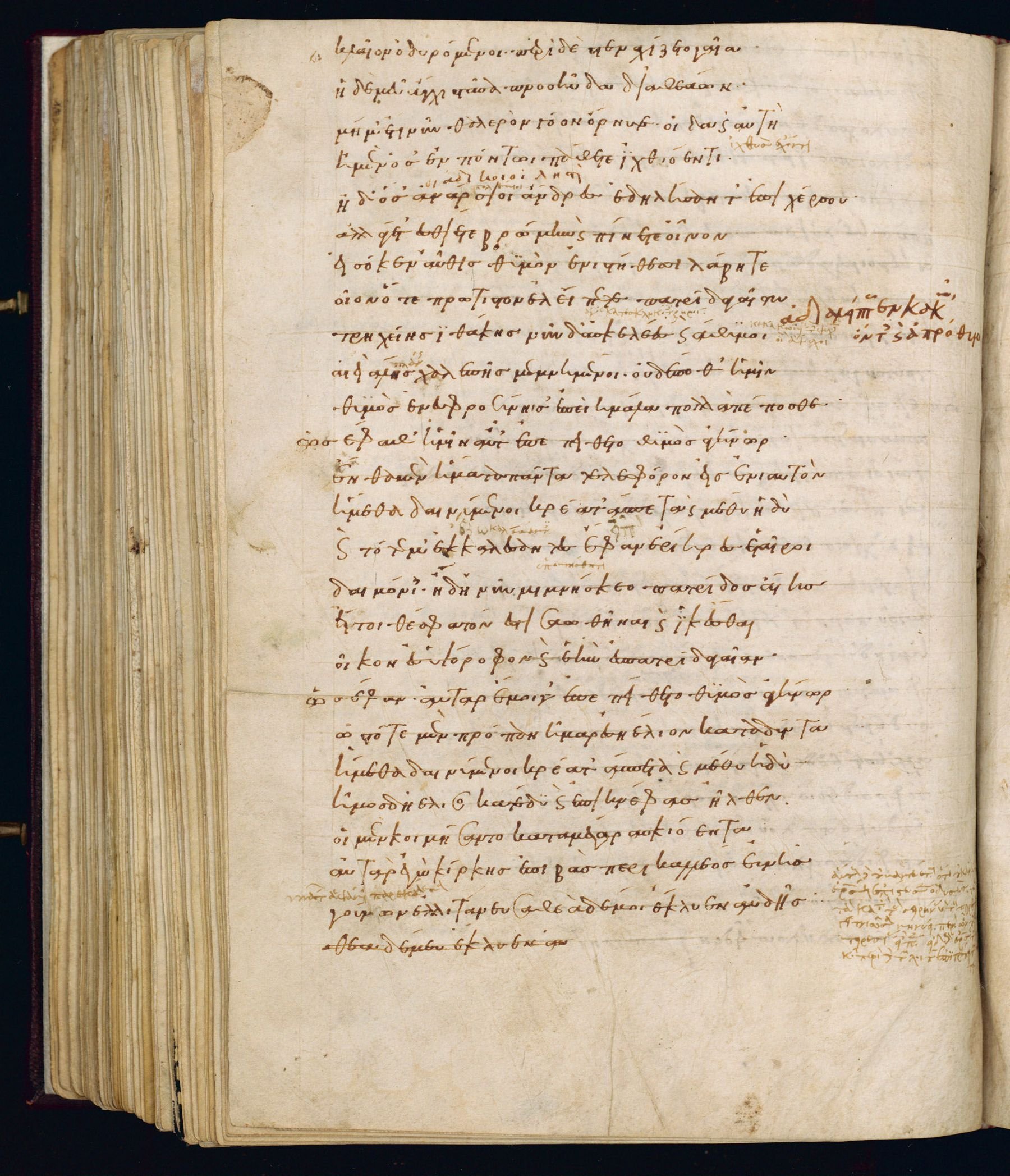
Where on the image
Laur. Plut. 32.24, fol. 101v: Odyssey 10.454-482, begins ‹κλαῖον ὀδυρόμενοι, περὶ δὲ›, ends ‹δέ μευ ἔκλυεν αὐδῆς·› (the last line written on the page is 10.481). Checked on the image: first and last lines read and matched to the Greek. Fol. 101r ends with 10.453. Fol. 102r begins with 10.483. 10.469-470 (ἀλλʼ ὅτε δή ῥʼ ἐνιαυτὸς ἔην ... τελέσθη) are not on the page: the scribe passes from 10.468 to 10.471. 10.482 is not on the page either: the last line repeats the end of 10.481 (θεὰ δʼ ἐμεῦ ἔκλυεν αὐ...) and breaks off; fol. 102r begins with 10.483. (Murray's text has no line 456.) English blocks here: 455-459, 460-464, 465-469, 470-474, 475-479, 480-484.
454κλαῖον ὀδυρόμενοι, περὶ δὲ στεναχίζετο δῶμα.
455ἡ δέ μευ ἄγχι στᾶσα προσηύδα δῖα θεάων·
457μηκέτι νῦν θαλερὸν γόον ὄρνυτε· οἶδα καὶ αὐτὴ
458ἠμὲν ὅσʼ ἐν πόντῳ πάθετʼ ἄλγεα ἰχθυόεντι,
459ἠδʼ ὅσʼ ἀνάρσιοι ἄνδρες ἐδηλήσαντʼ ἐπὶ χέρσου.
460ἀλλʼ ἄγετʼ ἐσθίετε βρώμην καὶ πίνετε οἶνον,
461εἰς ὅ κεν αὖτις θυμὸν ἐνὶ στήθεσσι λάβητε,
462οἷον ὅτε πρώτιστον ἐλείπετε πατρίδα γαῖαν
463τρηχείης Ἰθάκης. νῦν δʼ ἀσκελέες καὶ ἄθυμοι,
464αἰὲν ἄλης χαλεπῆς μεμνημένοι, οὐδέ ποθʼ ὕμιν
465θυμὸς ἐν εὐφροσύνῃ, ἐπεὶ ἦ μάλα πολλὰ πέποσθε.
466ὣς ἔφαθʼ, ἡμῖν δʼ αὖτʼ ἐπεπείθετο θυμὸς ἀγήνωρ.
467ἔνθα μὲν ἤματα πάντα τελεσφόρον εἰς ἐνιαυτὸν
468ἥμεθα δαινύμενοι κρέα τʼ ἄσπετα καὶ μέθυ ἡδύ·
469ἀλλʼ ὅτε δή ῥʼ ἐνιαυτὸς ἔην, περὶ δʼ ἔτραπον ὧραι
470μηνῶν φθινόντων, περὶ δʼ ἤματα μακρὰ τελέσθη,
471καὶ τότε μʼ ἐκκαλέσαντες ἔφαν ἐρίηρες ἑταῖροι·
472δαιμόνιʼ, ἤδη νῦν μιμνήσκεο πατρίδος αἴης,
473εἴ τοι θέσφατόν ἐστι σαωθῆναι καὶ ἱκέσθαι
474οἶκον ἐς ὑψόροφον καὶ σὴν ἐς πατρίδα γαῖαν.
475ὣς ἔφαν, αὐτὰρ ἐμοί γʼ ἐπεπείθετο θυμὸς ἀγήνωρ.
476ὣς τότε μὲν πρόπαν ἦμαρ ἐς ἠέλιον καταδύντα
477ἥμεθα, δαινύμενοι κρέα τʼ ἄσπετα καὶ μέθυ ἡδύ·
478ἦμος δʼ ἠέλιος κατέδυ καὶ ἐπὶ κνέφας ἦλθεν,
479οἱ μὲν κοιμήσαντο κατὰ μέγαρα σκιόεντα.
480αὐτὰρ ἐγὼ Κίρκης ἐπιβὰς περικαλλέος εὐνῆς
481γούνων ἐλλιτάνευσα, θεὰ δέ μευ ἔκλυεν αὐδῆς·
482καί μιν φωνήσας ἔπεα πτερόεντα προσηύδων·
455Then the beautiful goddess drew near me, and said: “‘No longer now do ye rouse this plenteous lamenting. Of myself I know both all the woes you have suffered on the teeming deep, and all the wrong that cruel men have done you on the land. 460Nay, come, eat food and drink wine, until you once more get spirit in your breasts such as when at the first you left your native land of rugged Ithaca; but now ye are withered and spiritless, ever thinking of your weary wanderings, nor are your 465hearts ever joyful, for verily ye have suffered much.’ “So she spoke, and our proud hearts consented. So there day after day for a full year we abode, feasting on abundant flesh and sweet wine. But when a year was gone and the seasons turned, 470as the months waned and the long days were brought in their course, then my trusty comrades called me forth, and said: “‘Strange man, bethink thee now at last of thy native land, if it is fated for thee to be saved, and to reach thy high-roofed house and thy native land.’ 475“So they spoke, and my proud heart consented. So then all day long till set of sun we sat feasting on abundant flesh and sweet wine. But when the sun set and darkness came on, they lay down to sleep throughout the shadowy halls, 480but I went up to the beautiful bed of Circe, and besought her by her knees; and the goddess heard my voice, and I spoke, and addressed her with winged words: “‘Circe, fulfil for me the promise which thou gavest to send me home; for my spirit is now eager to be gone,
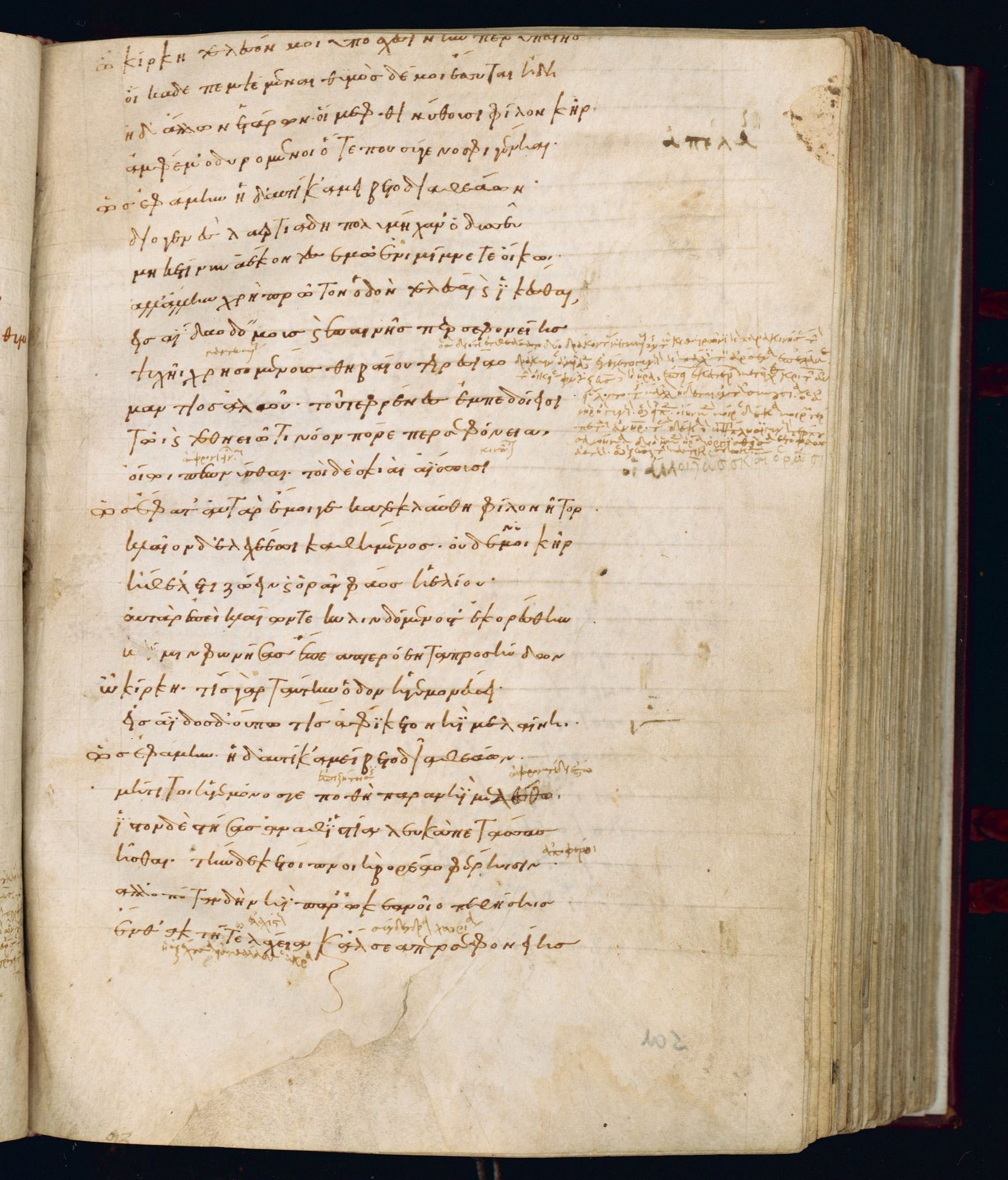
Where on the image
Laur. Plut. 32.24, fol. 102r: Odyssey 10.483-509, begins ‹ὢ Κίρκη, τέλεσόν μοι›, ends ‹λάχεια καὶ ἄλσεα Περσεφονείης,›. Checked on the image: first and last lines read and matched to the Greek. Fol. 101v ends with 10.482. Fol. 102v begins with 10.510. 10.504 (διογενὲς Λαερτιάδη ...) is not on the page: the scribe passes from 10.503 to 10.505 (26 lines). English blocks here: 485-489, 490-494, 495-499, 500-502, 503-504, 505-509.
483ὢ Κίρκη, τέλεσόν μοι ὑπόσχεσιν ἥν περ ὑπέστης,
484οἴκαδε πεμψέμεναι· θυμὸς δέ μοι ἔσσυται ἤδη,
485ἠδʼ ἄλλων ἑτάρων, οἵ μευ φθινύθουσι φίλον κῆρ
486ἀμφʼ ἔμʼ ὀδυρόμενοι, ὅτε που σύ γε νόσφι γένηαι.
487ὣς ἐφάμην, ἡ δʼ αὐτίκʼ ἀμείβετο δῖα θεάων·
488διογενὲς Λαερτιάδη, πολυμήχανʼ Ὀδυσσεῦ,
489μηκέτι νῦν ἀέκοντες ἐμῷ ἐνὶ μίμνετε οἴκῳ.
490ἀλλʼ ἄλλην χρὴ πρῶτον ὁδὸν τελέσαι καὶ ἱκέσθαι
491εἰς Ἀίδαο δόμους καὶ ἐπαινῆς Περσεφονείης,
492ψυχῇ χρησομένους Θηβαίου Τειρεσίαο,
493μάντηος ἀλαοῦ, τοῦ τε φρένες ἔμπεδοί εἰσι·
494τῷ καὶ τεθνηῶτι νόον πόρε Περσεφόνεια,
495οἴῳ πεπνῦσθαι, τοὶ δὲ σκιαὶ ἀίσσουσιν.
496ὣς ἔφατʼ, αὐτὰρ ἐμοί γε κατεκλάσθη φίλον ἦτορ·
497κλαῖον δʼ ἐν λεχέεσσι καθήμενος, οὐδέ νύ μοι κῆρ
498ἤθελʼ ἔτι ζώειν καὶ ὁρᾶν φάος ἠελίοιο.
499αὐτὰρ ἐπεὶ κλαίων τε κυλινδόμενος τʼ ἐκορέσθην,
500καὶ τότε δή μιν ἔπεσσιν ἀμειβόμενος προσέειπον·
501ὢ Κίρκη, τίς γὰρ ταύτην ὁδὸν ἡγεμονεύσει;
502εἰς Ἄϊδος δʼ οὔ πώ τις ἀφίκετο νηὶ μελαίνῃ.
503ὣς ἐφάμην, ἡ δʼ αὐτίκʼ ἀμείβετο δῖα θεάων·
504διογενὲς Λαερτιάδη, πολυμήχανʼ Ὀδυσσεῦ,
505μή τί τοι ἡγεμόνος γε ποθὴ παρὰ νηὶ μελέσθω,
506ἱστὸν δὲ στήσας, ἀνά θʼ ἱστία λευκὰ πετάσσας
507ἧσθαι· τὴν δέ κέ τοι πνοιὴ Βορέαο φέρῃσιν.
508ἀλλʼ ὁπότʼ ἂν δὴ νηὶ διʼ Ὠκεανοῖο περήσῃς,
509ἔνθʼ ἀκτή τε λάχεια καὶ ἄλσεα Περσεφονείης,
485and the spirit of my comrades, who make my heart to pine, as they sit about me mourning, whensoever thou haply art not at hand.’ “So I spoke, and the beautiful goddess straightway made answer: ‘Son of Laertes, sprung from Zeus, Odysseus of many devices, abide ye now no longer in my house against your will; 490but you must first complete another journey, and come to the house of Hades and dread Persephone, to seek soothsaying of the spirit of Theban Teiresias, the blind seer, whose mind abides steadfast. To him even in death Persephone has granted reason, 495that he alone should have understanding; but the others flit about as shadows.’ “So she spoke, and my spirit was broken within me, and I wept as I sat on the bed, nor had my heart any longer desire to live and behold the light of the sun. But when I had my fill of weeping and writhing, 500then I made answer, and addressed her, saying: “‘O Circe, who will guide us on this journey? To Hades no man ever yet went in a black ship.’ 503“So I spoke, and the beautiful goddess straightway made answer: ‘Son of Laertes, sprung from Zeus, Odysseus of many devices, 505let there be in thy mind no concern for a pilot to guide thy ship, but set up thy mast, and spread the white sail, and sit thee down; and the breath of the North Wind will bear her onward. But when in thy ship thou hast now crossed the stream of Oceanus, where is a level shore and the groves of Persephone—
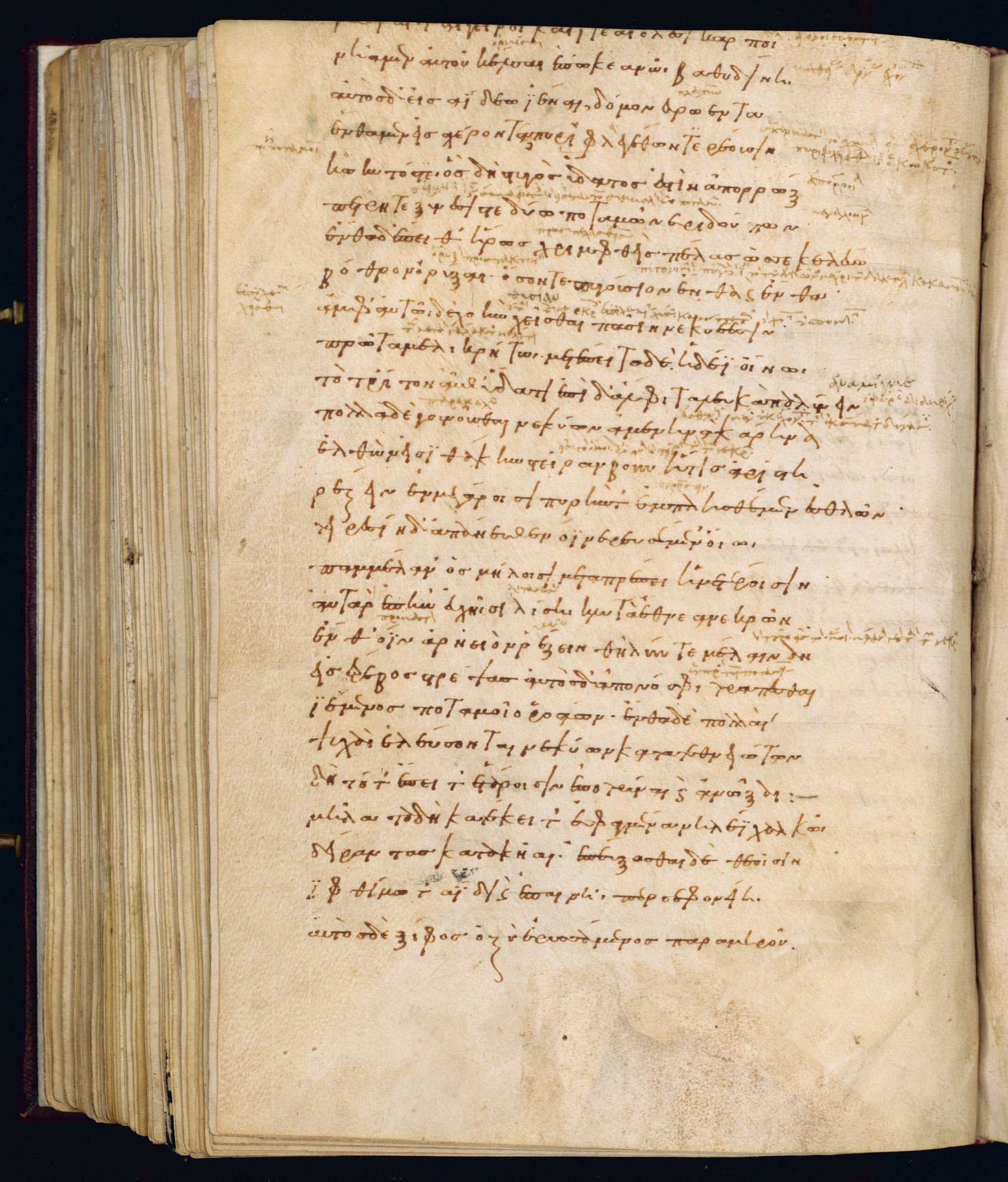
Where on the image
Laur. Plut. 32.24, fol. 102v: Odyssey 10.510-535, begins ‹μακραί τʼ αἴγειροι καὶ›, ends ‹ὀξὺ ἐρυσσάμενος παρὰ μηροῦ›. Checked on the image: first and last lines read and matched to the Greek. Fol. 102r ends with 10.509. Fol. 103r begins with 10.536. English blocks here: 510-514, 515-519, 520-524, 525-529, 530-534.
510μακραί τʼ αἴγειροι καὶ ἰτέαι ὠλεσίκαρποι,
511νῆα μὲν αὐτοῦ κέλσαι ἐπʼ Ὠκεανῷ βαθυδίνῃ,
512αὐτὸς δʼ εἰς Ἀίδεω ἰέναι δόμον εὐρώεντα.
513ἔνθα μὲν εἰς Ἀχέροντα Πυριφλεγέθων τε ῥέουσιν
514Κώκυτός θʼ, ὃς δὴ Στυγὸς ὕδατός ἐστιν ἀπορρώξ,
515πέτρη τε ξύνεσίς τε δύω ποταμῶν ἐριδούπων·
516ἔνθα δʼ ἔπειθʼ, ἥρως, χριμφθεὶς πέλας, ὥς σε κελεύω,
517βόθρον ὀρύξαι, ὅσον τε πυγούσιον ἔνθα καὶ ἔνθα,
518ἀμφʼ αὐτῷ δὲ χοὴν χεῖσθαι πᾶσιν νεκύεσσιν,
519πρῶτα μελικρήτῳ, μετέπειτα δὲ ἡδέι οἴνῳ,
520τὸ τρίτον αὖθʼ ὕδατι· ἐπὶ δʼ ἄλφιτα λευκὰ παλύνειν.
521πολλὰ δὲ γουνοῦσθαι νεκύων ἀμενηνὰ κάρηνα,
522ἐλθὼν εἰς Ἰθάκην στεῖραν βοῦν, ἥ τις ἀρίστη,
523ῥέξειν ἐν μεγάροισι πυρήν τʼ ἐμπλησέμεν ἐσθλῶν,
524Τειρεσίῃ δʼ ἀπάνευθεν ὄιν ἱερευσέμεν οἴῳ
525παμμέλανʼ, ὃς μήλοισι μεταπρέπει ὑμετέροισιν.
526αὐτὰρ ἐπὴν εὐχῇσι λίσῃ κλυτὰ ἔθνεα νεκρῶν,
527ἔνθʼ ὄιν ἀρνειὸν ῥέζειν θῆλύν τε μέλαιναν
528εἰς Ἔρεβος στρέψας, αὐτὸς δʼ ἀπονόσφι τραπέσθαι
529ἱέμενος ποταμοῖο ῥοάων· ἔνθα δὲ πολλαὶ
530ψυχαὶ ἐλεύσονται νεκύων κατατεθνηώτων.
531δὴ τότʼ ἔπειθʼ ἑτάροισιν ἐποτρῦναι καὶ ἀνῶξαι
532μῆλα, τὰ δὴ κατάκειτʼ ἐσφαγμένα νηλέι χαλκῷ,
533δείραντας κατακῆαι, ἐπεύξασθαι δὲ θεοῖσιν,
534ἰφθίμῳ τʼ Ἀίδῃ καὶ ἐπαινῇ Περσεφονείῃ·
535αὐτὸς δὲ ξίφος ὀξὺ ἐρυσσάμενος παρὰ μηροῦ
510tall poplars, and willows that shed their fruit—there do thou beach thy ship by the deep eddying Oceanus, but go thyself to the dank house of Hades. There into Acheron flow Periphlegethon and Cocytus, which is a branch of the water of the Styx; 515and there is a rock, and the meeting place of the two roaring rivers. Thither, prince, do thou draw nigh, as I bid thee, and dig a pit of a cubit's length this way and that, and around it pour a libation to all the dead, first with milk and honey, thereafter with sweet wine, 520and in the third place with water, and sprinkle thereon white barley meal. And do thou earnestly entreat the powerless heads of the dead, vowing that when thou comest to Ithaca thou wilt sacrifice in thy halls a barren heifer, the best thou hast, and wilt fill the altar with rich gifts; and that to Teiresias alone thou wilt sacrifice separately a ram, 525wholly black, the goodliest of thy flock. But when with prayers thou hast made supplication to the glorious tribes of the dead, then sacrifice a ram and a black ewe, turning their heads toward Erebus but thyself turning backward, and setting thy face towards the streams of the river. Then many 530ghosts of men that are dead will come forth. But do thou thereafter call to thy comrades, and bid them flay and burn the sheep that lie there, slain by the pitiless bronze, and make prayer to the gods, to mighty Hades and to dread Persephone.
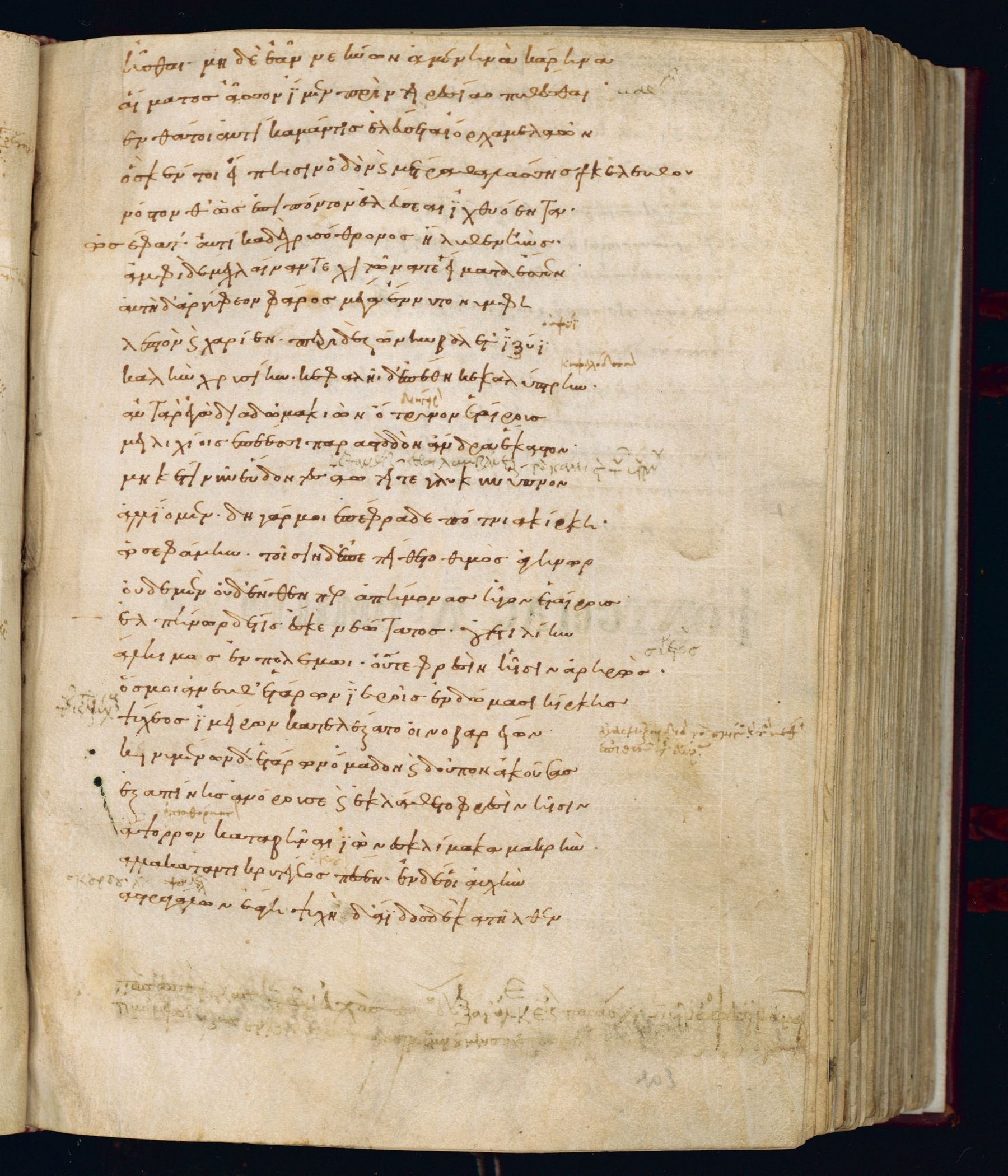
Where on the image
Laur. Plut. 32.24, fol. 103r: Odyssey 10.536-560, begins ‹ἧσθαι, μηδὲ ἐᾶν νεκύων›, ends ‹ψυχὴ δʼ Ἄϊδόσδε κατῆλθεν.›. Checked on the image: first and last lines read and matched to the Greek. Fol. 102v ends with 10.535. Fol. 103v begins with 10.561. English blocks here: 535-539, 540-544, 545-545, 546-549, 550-554, 555-559.
536ἧσθαι, μηδὲ ἐᾶν νεκύων ἀμενηνὰ κάρηνα
537αἵματος ἆσσον ἴμεν, πρὶν Τειρεσίαο πυθέσθαι.
538ἔνθα τοι αὐτίκα μάντις ἐλεύσεται, ὄρχαμε λαῶν,
539ὅς κέν τοι εἴπῃσιν ὁδὸν καὶ μέτρα κελεύθου
540νόστον θʼ, ὡς ἐπὶ πόντον ἐλεύσεαι ἰχθυόεντα.
541ὣς ἔφατʼ, αὐτίκα δὲ χρυσόθρονος ἤλυθεν Ἠώς.
542ἀμφὶ δέ με χλαῖνάν τε χιτῶνά τε εἵματα ἕσσεν·
543αὐτὴ δʼ ἀργύφεον φᾶρος μέγα ἕννυτο νύμφη,
544λεπτὸν καὶ χαρίεν, περὶ δὲ ζώνην βάλετʼ ἰξυῖ
545καλὴν χρυσείην, κεφαλῇ δʼ ἐπέθηκε καλύπτρην.
546αὐτὰρ ἐγὼ διὰ δώματʼ ἰὼν ὤτρυνον ἑταίρους
547μειλιχίοις ἐπέεσσι παρασταδὸν ἄνδρα ἕκαστον·
548μηκέτι νῦν εὕδοντες ἀωτεῖτε γλυκὺν ὕπνον,
549ἀλλʼ ἴομεν· δὴ γάρ μοι ἐπέφραδε πότνια Κίρκη.
550ὣς ἐφάμην, τοῖσιν δʼ ἐπεπείθετο θυμὸς ἀγήνωρ.
551οὐδὲ μὲν οὐδʼ ἔνθεν περ ἀπήμονας ἦγον ἑταίρους.
552Ἐλπήνωρ δέ τις ἔσκε νεώτατος, οὔτε τι λίην
553ἄλκιμος ἐν πολέμῳ οὔτε φρεσὶν ᾗσιν ἀρηρώς·
554ὅς μοι ἄνευθʼ ἑτάρων ἱεροῖς ἐν δώμασι Κίρκης,
555ψύχεος ἱμείρων, κατελέξατο οἰνοβαρείων.
556κινυμένων δʼ ἑτάρων ὅμαδον καὶ δοῦπον ἀκούσας
557ἐξαπίνης ἀνόρουσε καὶ ἐκλάθετο φρεσὶν ᾗσιν
558ἄψορρον καταβῆναι ἰὼν ἐς κλίμακα μακρήν,
559ἀλλὰ καταντικρὺ τέγεος πέσεν· ἐκ δέ οἱ αὐχὴν
560ἀστραγάλων ἐάγη, ψυχὴ δʼ Ἄϊδόσδε κατῆλθεν.
535And do thou thyself draw thy sharp sword from beside thy thigh, and sit there, not suffering the powerless heads of the dead to draw near to the blood, till thou hast enquired of Teiresias. Then the seer will presently come to thee, leader of men, and he will tell thee thy way and the measures of thy path, 540and of thy return, how thou mayest go over the teeming deep.’ “So she spoke, and straightway came golden-throned Dawn. Round about me then she cast a cloak and tunic as raiment, and the nymph clothed herself in a long white robe, finely-woven and beautiful, and about her waist she cast 545a fair girdle of gold, and upon her head she put a veil. 546But I went through the halls, and roused my men with gentle words, coming up to each man in turn. “‘No longer now sleep ye, and drowse in sweet slumber, but let us go; lo! queenly Circe has told me all.’ 550“So I spoke, and their proud hearts consented. But not even from thence could I lead my men unscathed. There was one, Elpenor, the youngest of all, not over valiant in war nor sound of understanding, who had laid him down apart from his comrades in the sacred house of Circe, 555seeking the cool air, for he was heavy with wine. He heard the noise and the bustle of his comrades as they moved about, and suddenly sprang up, and forgot to go to the long ladder that he might come down again, but fell headlong from the roof, and his neck
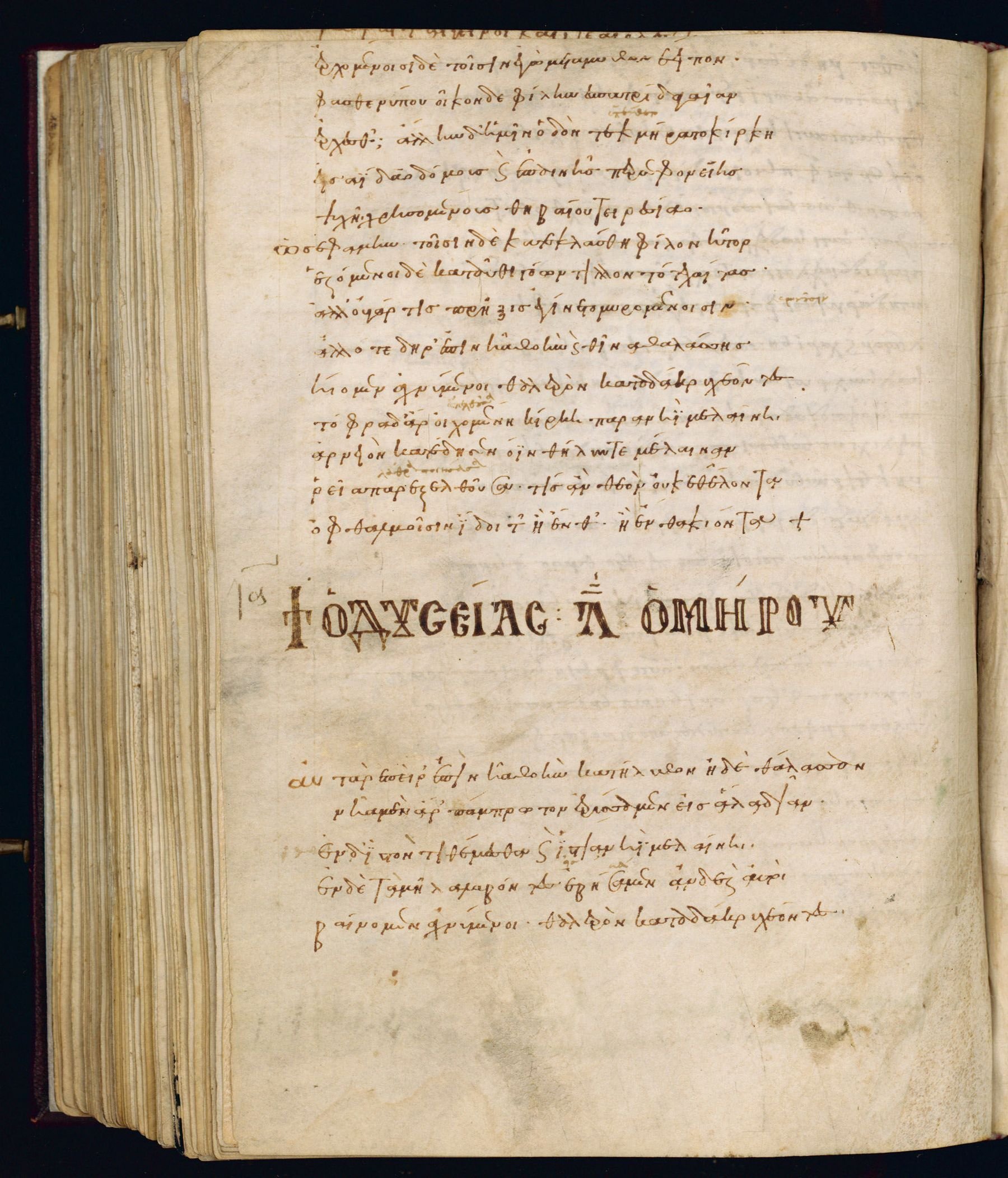
Where on the image
Laur. Plut. 32.24, fol. 103v: Odyssey 10.561-574, begins ‹ἐρχομένοισι δὲ τοῖσιν ἐγὼ›, ends ‹ἔνθʼ ἢ ἔνθα κιόντα;›. Checked on the image: first and last lines read and matched to the Greek. Fol. 103r ends with 10.560. The page holds 10.561-574, 11.1-5. Above 10.561 the curled top edge hides most of a further line of writing, which cannot be read (fol. 103r ends with 10.560). Book 10 ends with 10.574; the heading + ὀδυσσείας λ ὁμήρου follows in large capitals with space around it, and book 11 begins with 11.1. English blocks here: 560-564, 565-569, 570-574.
561ἐρχομένοισι δὲ τοῖσιν ἐγὼ μετὰ μῦθον ἔειπον·
562φάσθε νύ που οἶκόνδε φίλην ἐς πατρίδα γαῖαν
563ἔρχεσθʼ· ἄλλην δʼ ἧμιν ὁδὸν τεκμήρατο Κίρκη,
564εἰς Ἀίδαο δόμους καὶ ἐπαινῆς Περσεφονείης
565ψυχῇ χρησομένους Θηβαίου Τειρεσίαο.
566ὣς ἐφάμην, τοῖσιν δὲ κατεκλάσθη φίλον ἦτορ,
567ἑζόμενοι δὲ κατʼ αὖθι γόων τίλλοντό τε χαίτας·
568ἀλλʼ οὐ γάρ τις πρῆξις ἐγίγνετο μυρομένοισιν.
569ἀλλʼ ὅτε δή ῥʼ ἐπὶ νῆα θοὴν καὶ θῖνα θαλάσσης
570ᾔομεν ἀχνύμενοι θαλερὸν κατὰ δάκρυ χέοντες,
571τόφρα δʼ ἄρʼ οἰχομένη Κίρκη παρὰ νηὶ μελαίνῃ
572ἀρνειὸν κατέδησεν ὄιν θῆλύν τε μέλαιναν,
573ῥεῖα παρεξελθοῦσα· τίς ἂν θεὸν οὐκ ἐθέλοντα
574ὀφθαλμοῖσιν ἴδοιτʼ ἢ ἔνθʼ ἢ ἔνθα κιόντα;
560was broken away from the spine, and his spirit went down to the house of Hades. “But as my men were going on their way I spoke among them, saying: ‘Ye think, forsooth, that ye are going to your dear native land; but Circe has pointed out for us another journey, even to the house of Hades and dread Persephone, 565to consult the spirit of Theban Teiresias.’ “So I spoke, and their spirit was broken within them, and sitting down right where they were, they wept and tore their hair. But no good came of their lamenting. “But when we were on our way to the swift ship and the shore of the sea, 570sorrowing and shedding big tears, meanwhile Circe had gone forth and made fast beside the black ship a ram and a black ewe, for easily had she passed us by. Who with his eyes could behold a god against his will, whether going to or fro?
Notes
- Greek: A. T. Murray, Homer: The Odyssey (Loeb Classical Library, 1919), via Perseus.
- English: A. T. Murray's translation in the same edition; his footnotes are omitted.
Cite
Sources
- Source: Laur. Plut. 32.24 (BML Teca Digitale IIIF) + Murray Greek (Loeb 1919, Perseus) + Murray English (Loeb 1919, Perseus) (holding institution)
- Critical edition: Murray, Loeb 1919, via Perseus
← previous · → next · v cycle view · l back to library