Orphic gold tablet from Petelia: the springs of Forgetfulness and Memory
Introduction
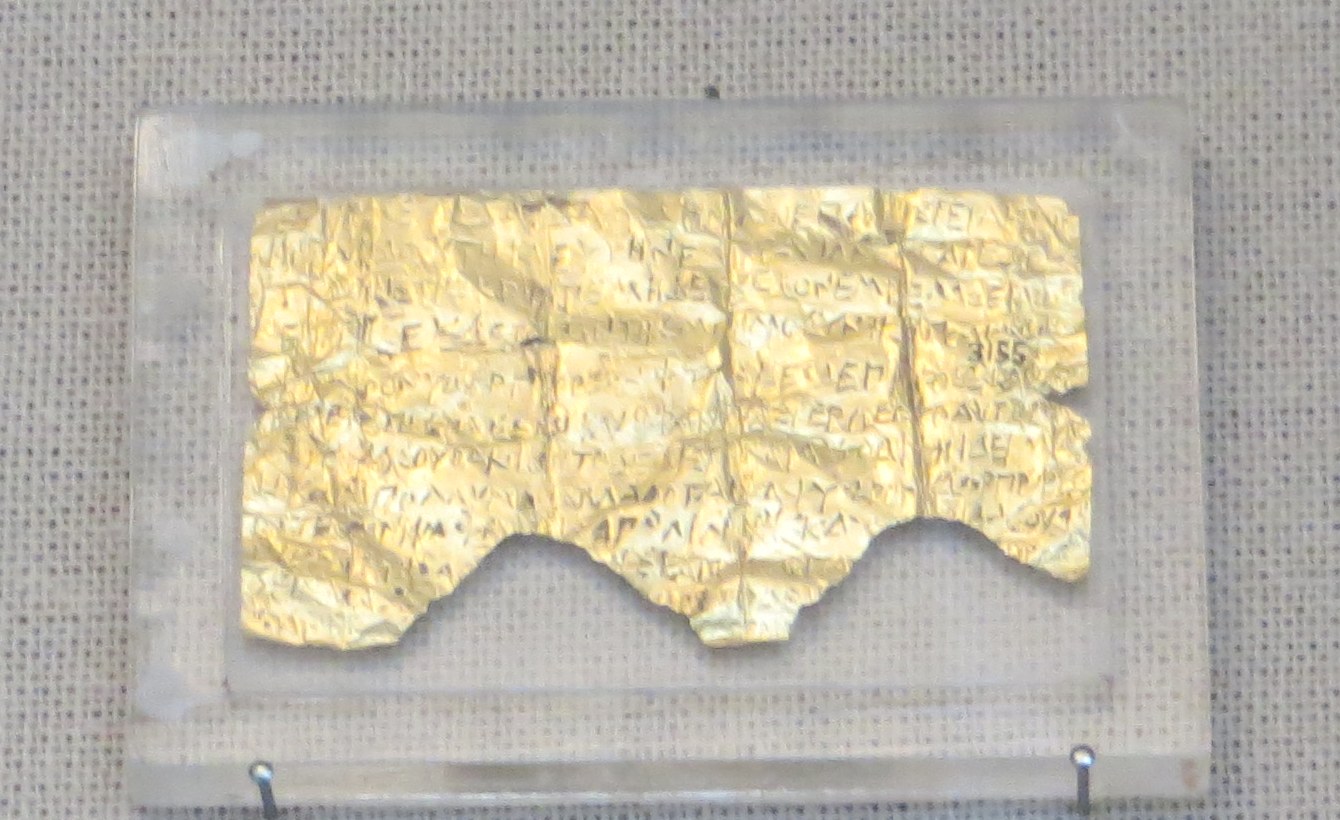
The Orphic or Bacchic gold tablets are thin sheets of gold, inscribed with short hexameter texts and buried with the dead in Greek graves in southern Italy, Thessaly and Crete from the late 5th century BCE to the 2nd century AD. They give the soul directions for the journey in the underworld and the words it must say. The tablet from Petelia (near Strongoli in Calabria), in the British Museum since 1843, is one of the earliest and fullest. It tells the soul that it will find a spring on the left of the house of Hades, with a white cypress beside it, and must not go near it; it should go on to the cold water flowing from the Lake of Memory (Mnemosyne) and say to the guardians: 'I am a child of Earth and of Starry Heaven; but my race is of Heaven (alone)'. Then they will let it drink, and it will rule among the other heroes (in Gilbert Murray's translation). The tablet had been rolled up and kept in a gold cylinder hung on a chain, worn as an amulet.
The photograph shows the tablet on its clear display mount in the British Museum (registration number 1843,0816.1); it is cropped from a wider photograph that also shows the chain and case, which are outside the crop. The letters are very small and the gold is crumpled, so only parts can be made out on the photograph; the text is divided here into three groups of lines, all on the one tablet. The Greek is the reading of Cecil Smith of the British Museum as printed by Jane Ellen Harrison in 1903; the English is Gilbert Murray's translation from his appendix to the same book. Lines 12-14 survive only in fragments, the last written along the right edge.
How was this verified? (Provenance)
Where on the image
The whole text stands on one small sheet of gold, shown in the photograph (cropped from the Wikimedia Commons image of the British Museum display). Checked on the image: the tablet's outline with its two curved lower cut-outs and the number 3155 painted on the gold at the right identify it; in line 3 the letters 'ΕΔΟΝ ΕΜΠΕΛΑΣΕΙ' (σχεδὸν ἐμπελάσειας) can be read in the upper right half. Lines 1-3 of the Greek, numbered as in Cecil Smith's reading printed by Harrison.
1Εὑρήσσεις δ’ Ἀίδαο δόμων ἐπ’ ἀριστερὰ κρήνην
2πὰρ δ’ αὐτῆι λευκὴν ἑστηκυῖαν κυπάρισσον·
3ταύτης τῆς κρήνης μηδὲ σχεδὸν ἐμπελάσειας.
1‘Thou shalt find to the left of the House of Hades a Well-spring,
2And by the side thereof standing a white cypress.
3To this Well-spring approach not near.
Where on the image
The whole text stands on one small sheet of gold, shown in the photograph (cropped from the Wikimedia Commons image of the British Museum display). Checked on the image: the tablet's outline with its two curved lower cut-outs and the number 3155 painted on the gold at the right identify it; in line 3 the letters 'ΕΔΟΝ ΕΜΠΕΛΑΣΕΙ' (σχεδὸν ἐμπελάσειας) can be read in the upper right half. Lines 4-9 of the Greek, numbered as in Cecil Smith's reading printed by Harrison.
4Εὑρήσεις δ’ ἑτέραν τῆς Μνημοσύνης ἀπὸ λίμνης
5ψυχρὸν ὕδωρ προρέον· φύλακες δ’ ἐπίπροσθεν ἔασιν.
6Εἰπεῖν· γῆς παῖς εἰμι καὶ οὐρανοῦ ἀστερόεντος,
7αὐτὰρ ἐμοὶ γένος οὐράνιον· τόδε δ’ ἴστε καὶ αὐτοί·
8δίψηι δ’ εἰμὶ αὔη καὶ ἀπόλλυμαι· ἀλλὰ δότ’ αἶψα
9ψυχρὸν ὕδωρ προρέον τῆς Μνημοσύνης ἀπὸ λίμνης·
4But thou shalt find another by the Lake of Memory,
5Cold water flowing forth, and there are Guardians before it.
6Say: “I am a child of Earth and of Starry Heaven;
7But my race is of Heaven (alone). This ye know yourselves.
8And lo, I am parched with thirst and I perish. Give me quickly
9The cold water flowing forth from the Lake of Memory.”
Where on the image
The whole text stands on one small sheet of gold, shown in the photograph (cropped from the Wikimedia Commons image of the British Museum display). Checked on the image: the tablet's outline with its two curved lower cut-outs and the number 3155 painted on the gold at the right identify it; in line 3 the letters 'ΕΔΟΝ ΕΜΠΕΛΑΣΕΙ' (σχεδὸν ἐμπελάσειας) can be read in the upper right half. Lines 10-14 of the Greek, numbered as in Cecil Smith's reading printed by Harrison. Lines 12-14 are fragments; line 14 is written along the right edge of the tablet (Harrison p. 574). Murray's translation stops after line 11.
10καὐ[τοί σο]ι δώσουσι πιεῖν θείης ἀπ[ὸ κρήν]ης
11καὶ τότ’ ἔπειτ’ ἄ[λλοισι μεθ’] ἡρώεσσιν ἀνάξει[ς]
12............ιης τόδε.................................θανεῖ[σ]θαι
13......................τοδ’ ἔγραψ[εν ?]...
14..............................σκότος ἀμφικαλύψας.
10And of themselves they will give thee to drink from the holy Well-spring,
11And thereafter among the other Heroes thou shalt have lordship....’
Notes
- Greek: reading of Cecil Smith, printed in J. E. Harrison, Prolegomena to the Study of Greek Religion (Cambridge 1903), p. 574 note 1. Square brackets mark letters restored where the gold is damaged; dots mark illegible letters.
- English: Gilbert Murray, 'Critical Appendix on the Orphic Tablets', in Harrison 1903, pp. 660-661. Murray's words in round brackets are his own.
Cite
Sources
- Source: British Museum 1843,0816.1 (photograph Wikimedia Commons, CC BY-SA 3.0) + Greek and English from J. E. Harrison, Prolegomena to the Study of Greek Religion (1903) (holding institution)
- Critical edition: Cecil Smith's reading in Harrison, Prolegomena (1903)
← previous · → next · v cycle view · l back to library