Ovid, Metamorphoses 1.1-415: creation, the four ages, Lycaon and the flood
Introduction
Ovid (43 BCE-17 CE) finished the fifteen books of the Metamorphoses around 8 CE, a poem of transformations that runs 'from the first origin of the world to my own times'. Book 1 begins with creation: a mass called chaos, in which hot fought with cold and wet with dry, is set in order by 'a god, or a kinder nature'; the elements take their places, the earth is shaped, and finally man is made, 'a creature more holy, more able to take in high thoughts', perhaps from divine seed, perhaps by Prometheus from earth and rain water, and given an upright face to look at the stars. There follow the four ages of mankind, from the golden age without laws or labour to the iron age of greed and war, when Justice (Astraea) leaves the earth; the war of the giants; and the crime of Lycaon, king of Arcadia, who tests Jupiter by serving him human flesh and is turned into a wolf. Jupiter resolves to destroy the human race by water. The flood covers everything except the two peaks of Parnassus, where a small boat brings Deucalion and Pyrrha, the most just man and the most god-fearing woman. When the waters withdraw, the oracle of Themis tells them to throw behind them 'the bones of the great mother'; they understand the stones of the earth, and the stones become men and women.
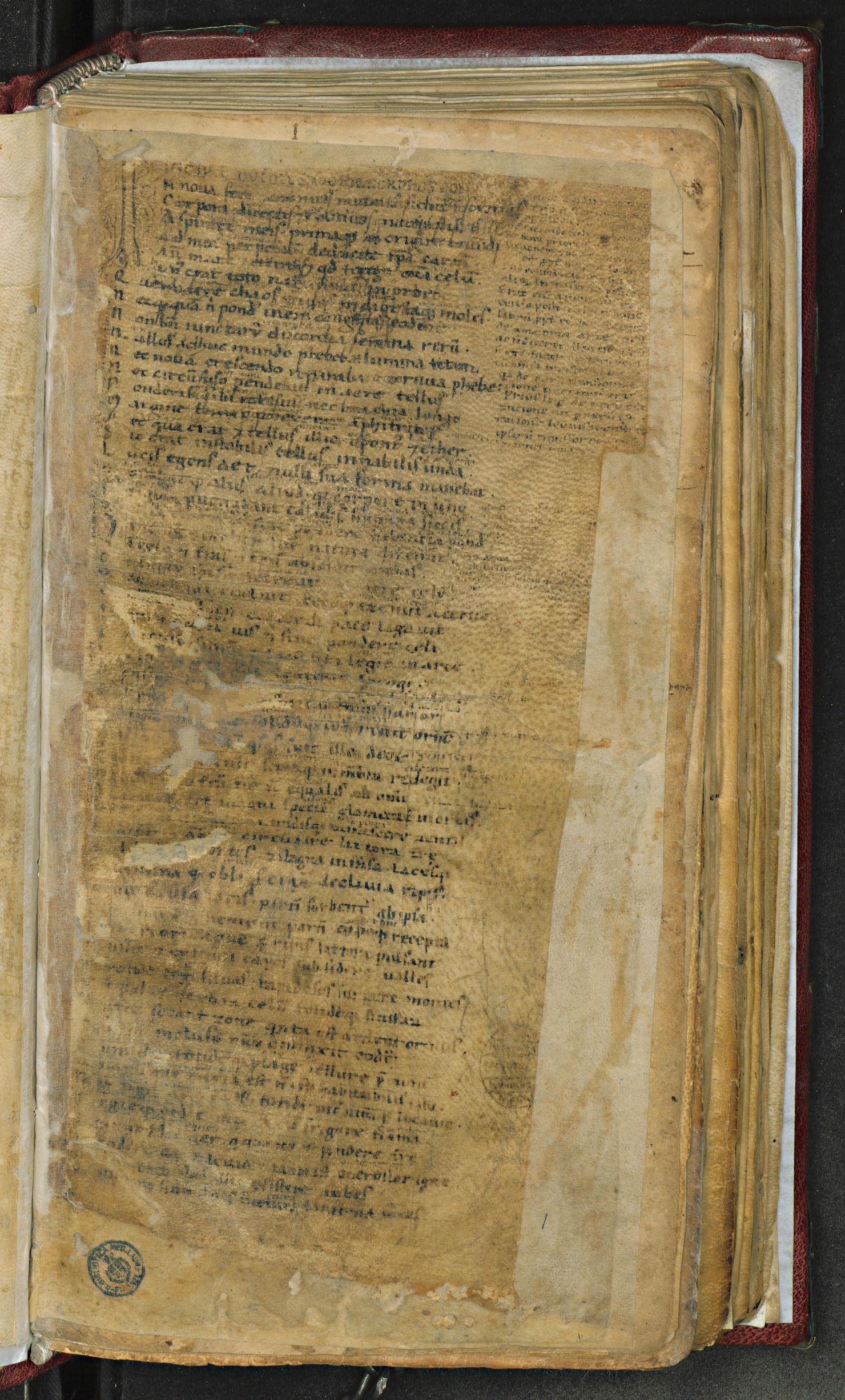
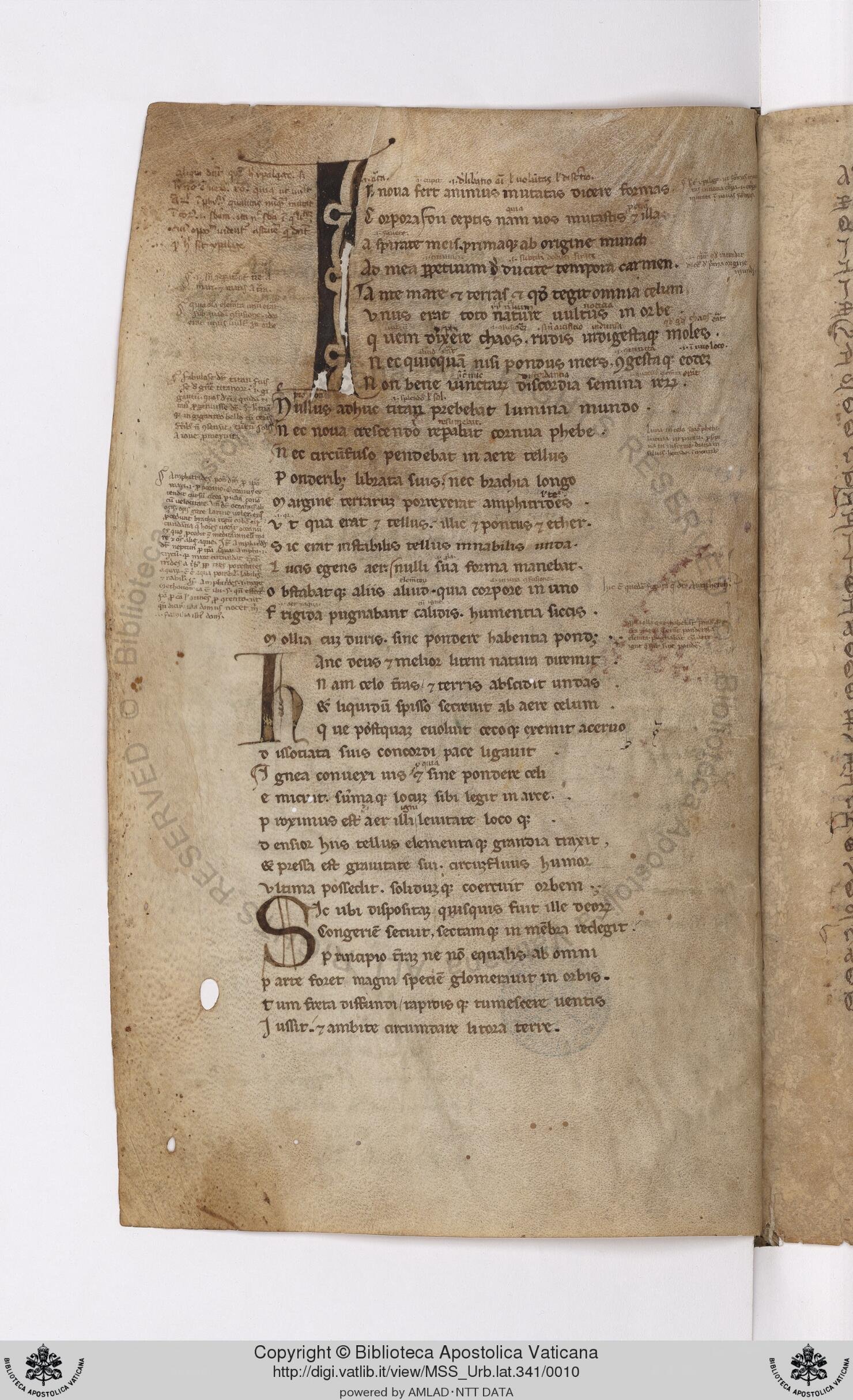
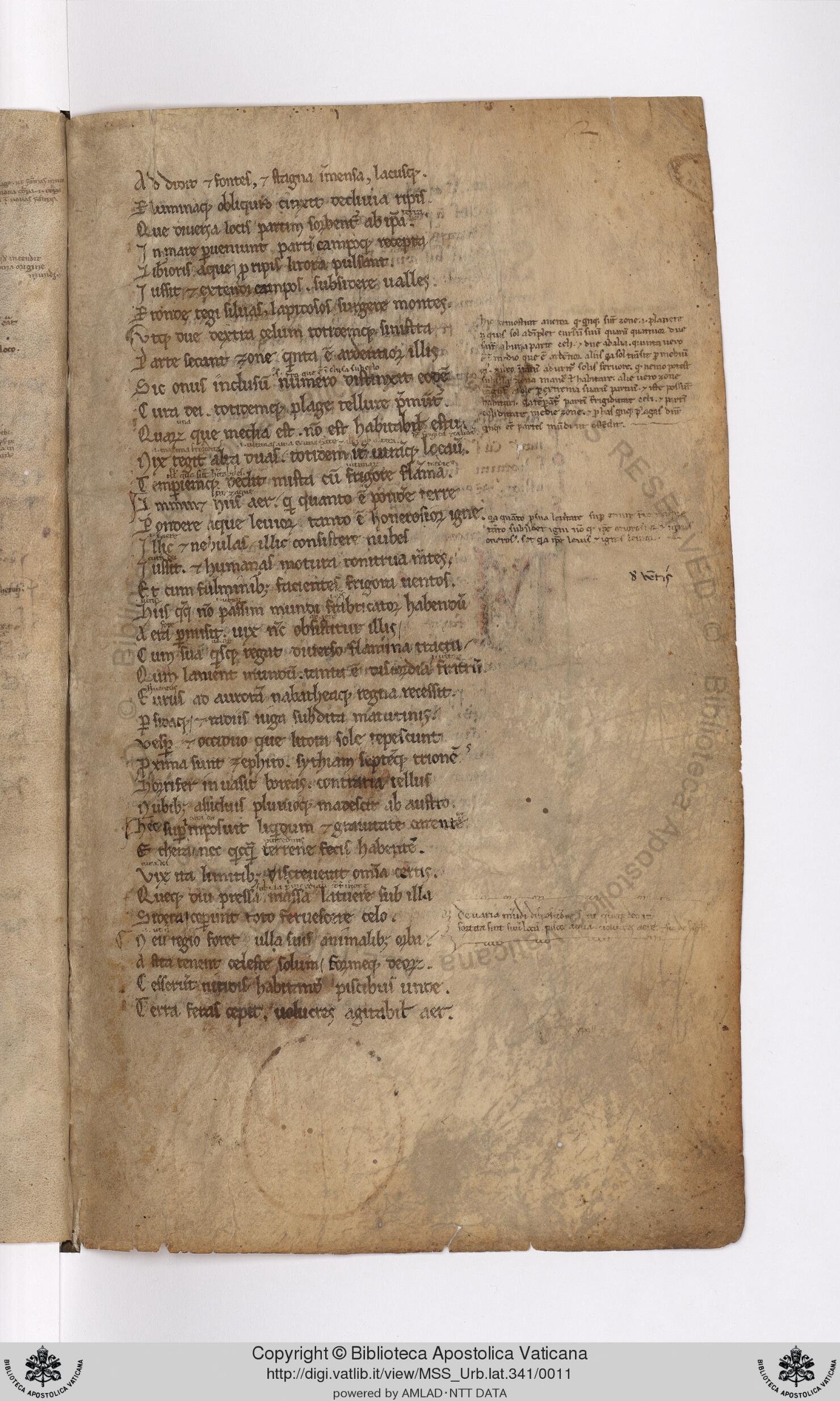
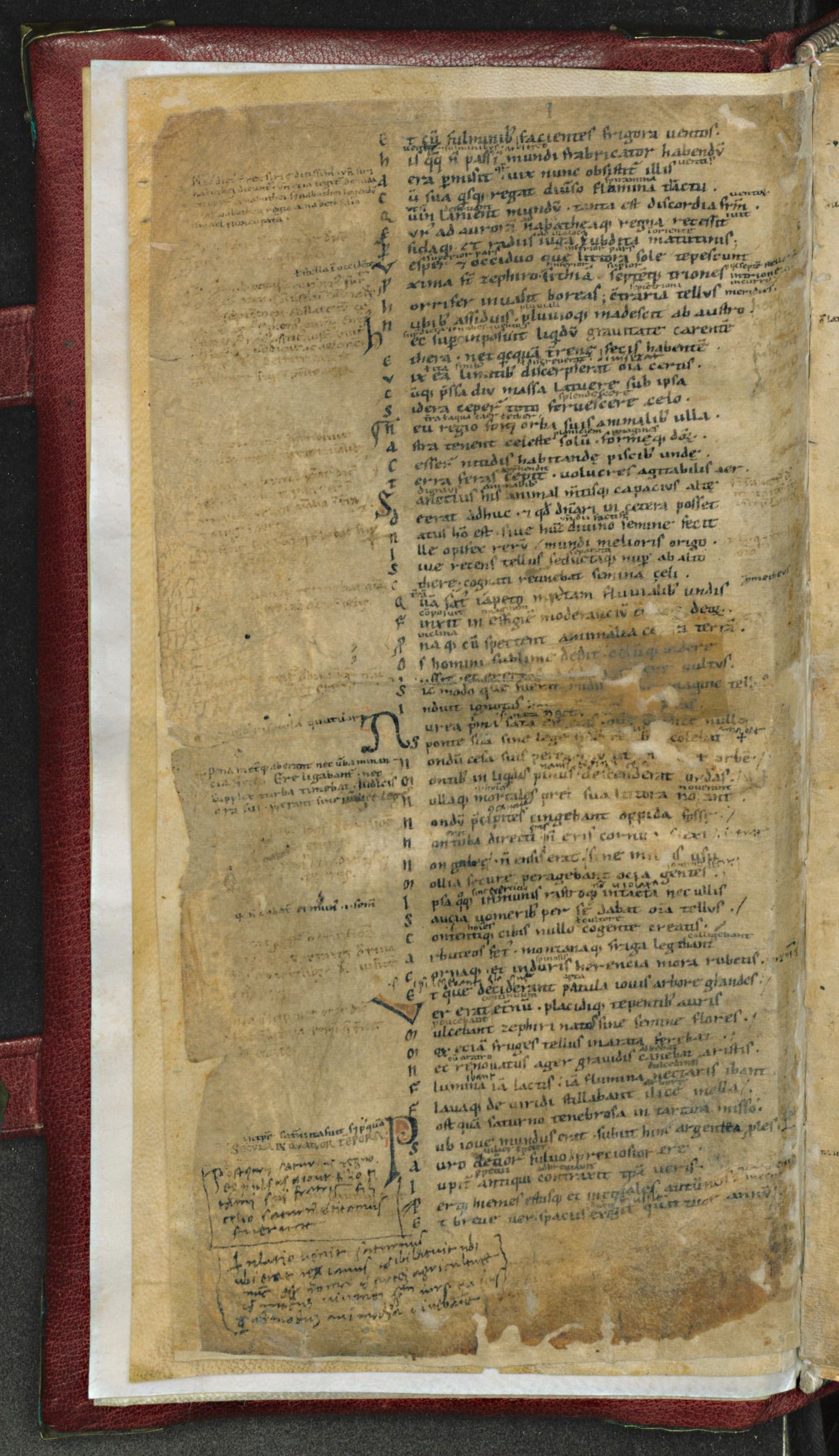
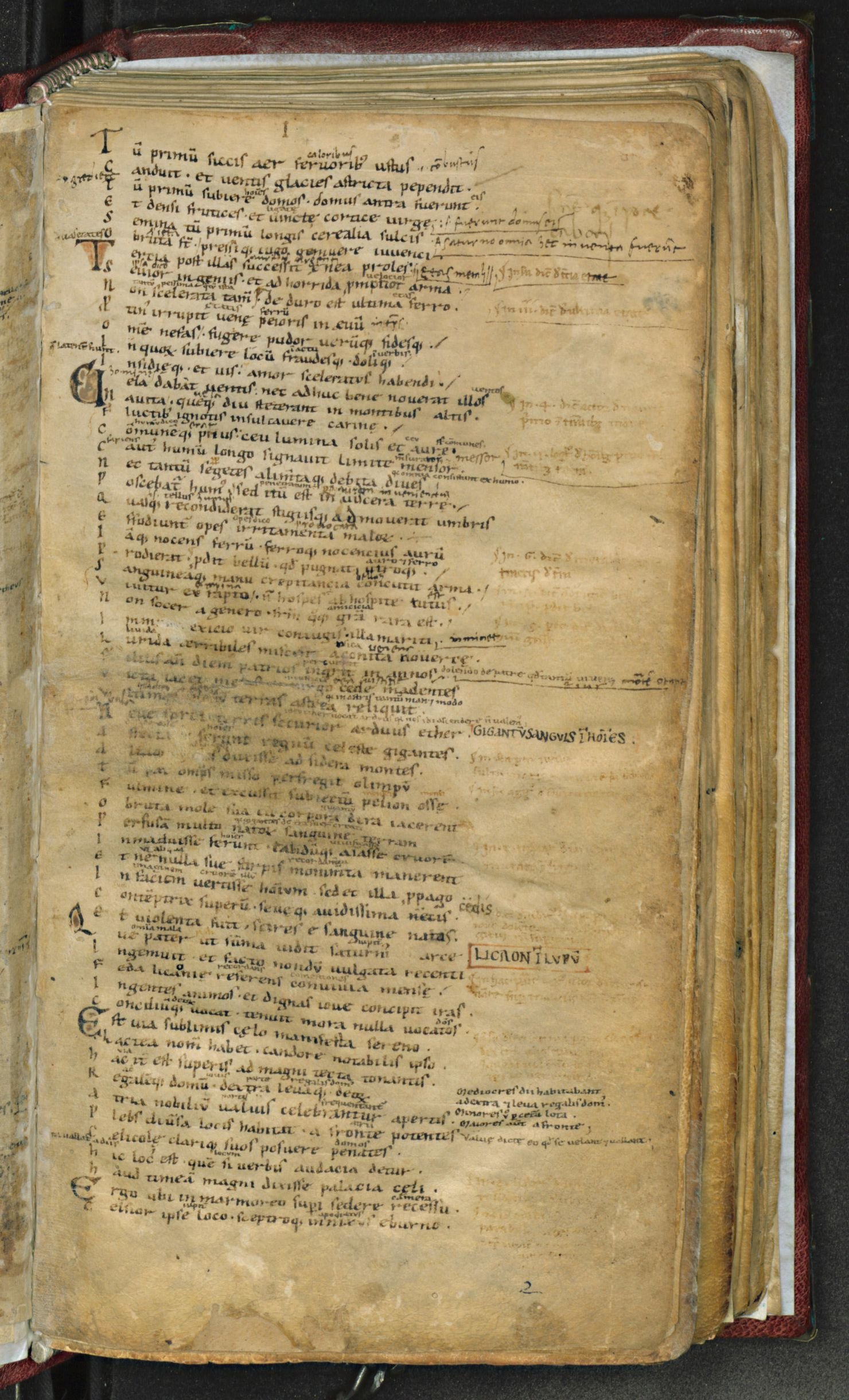
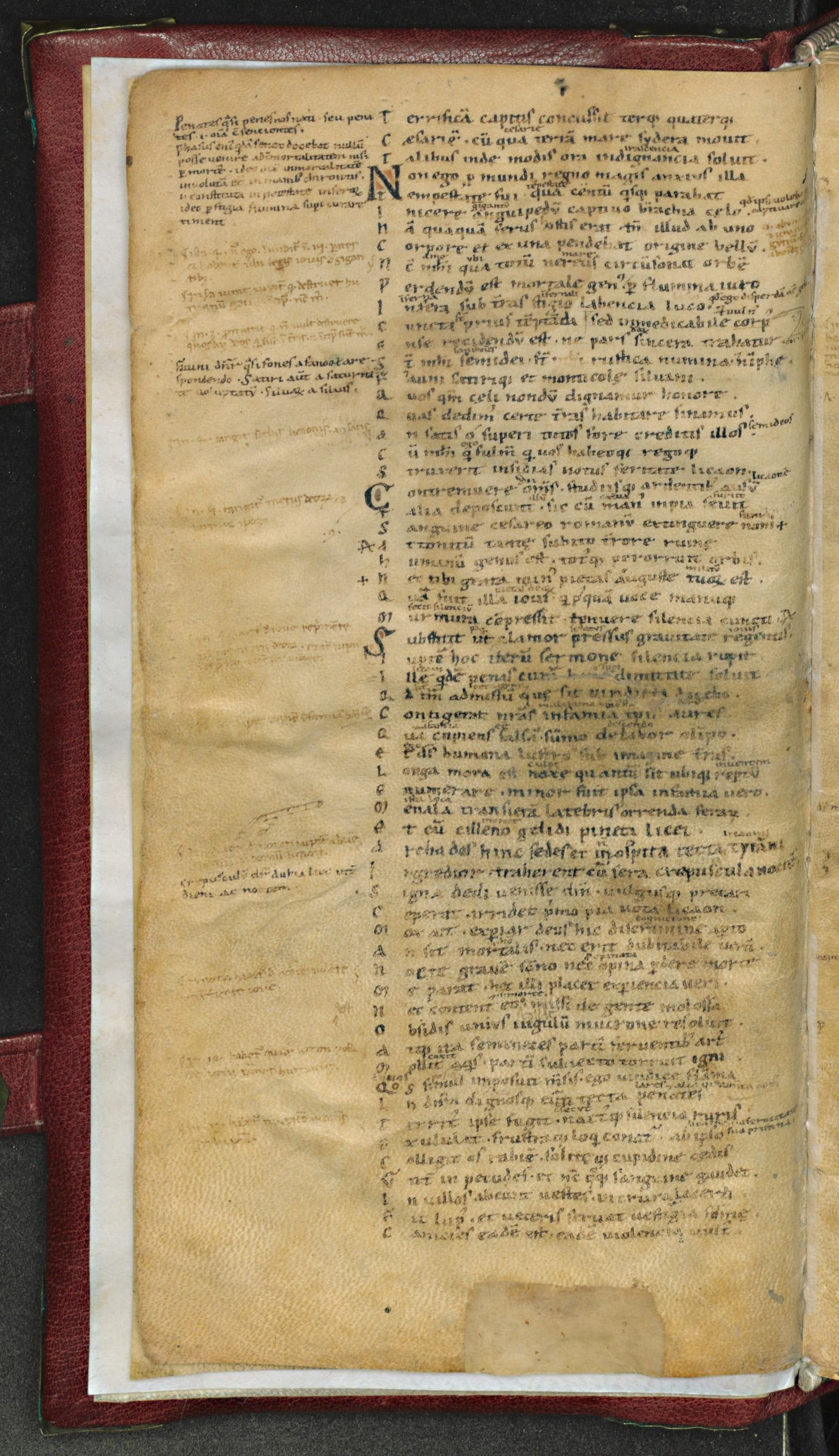
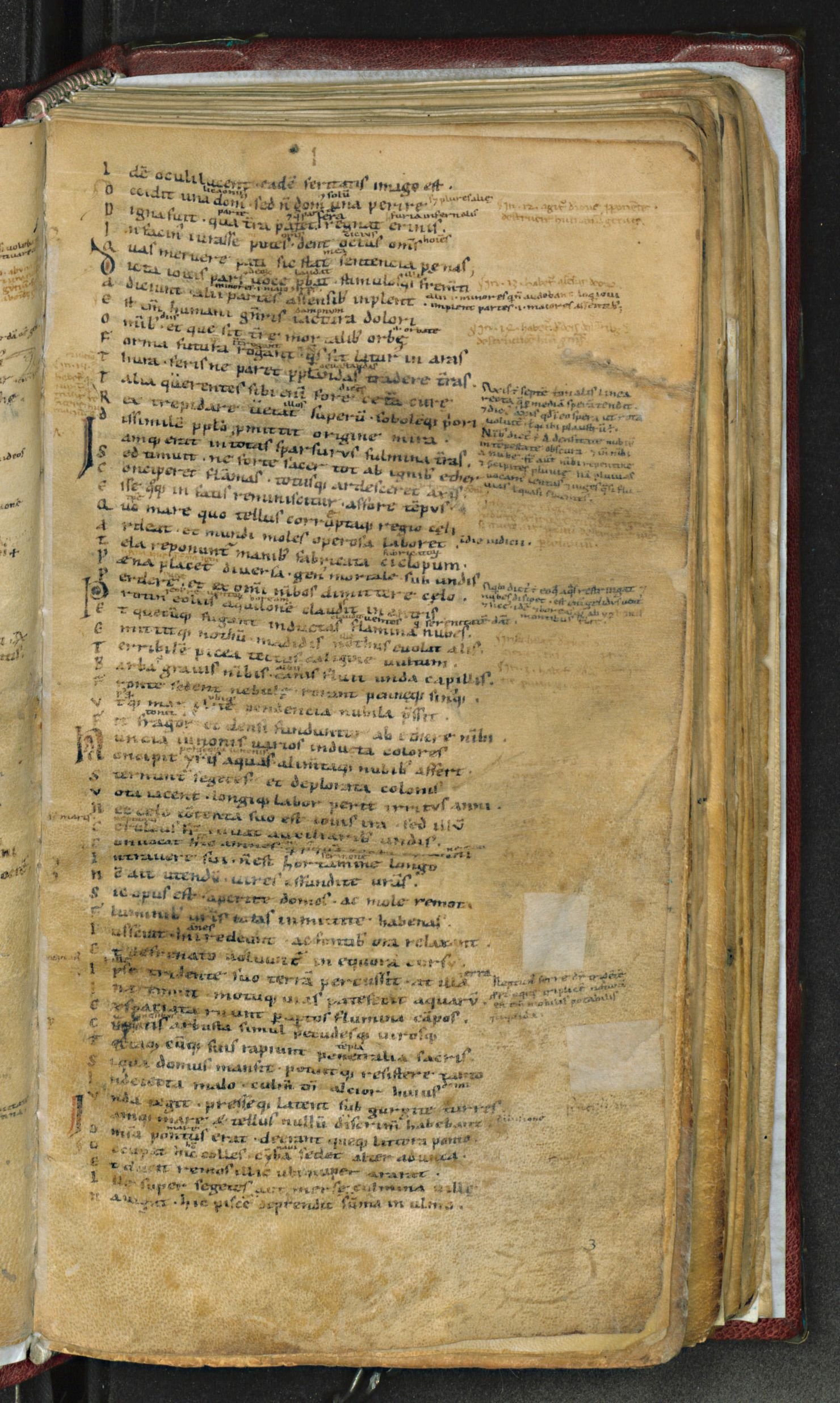
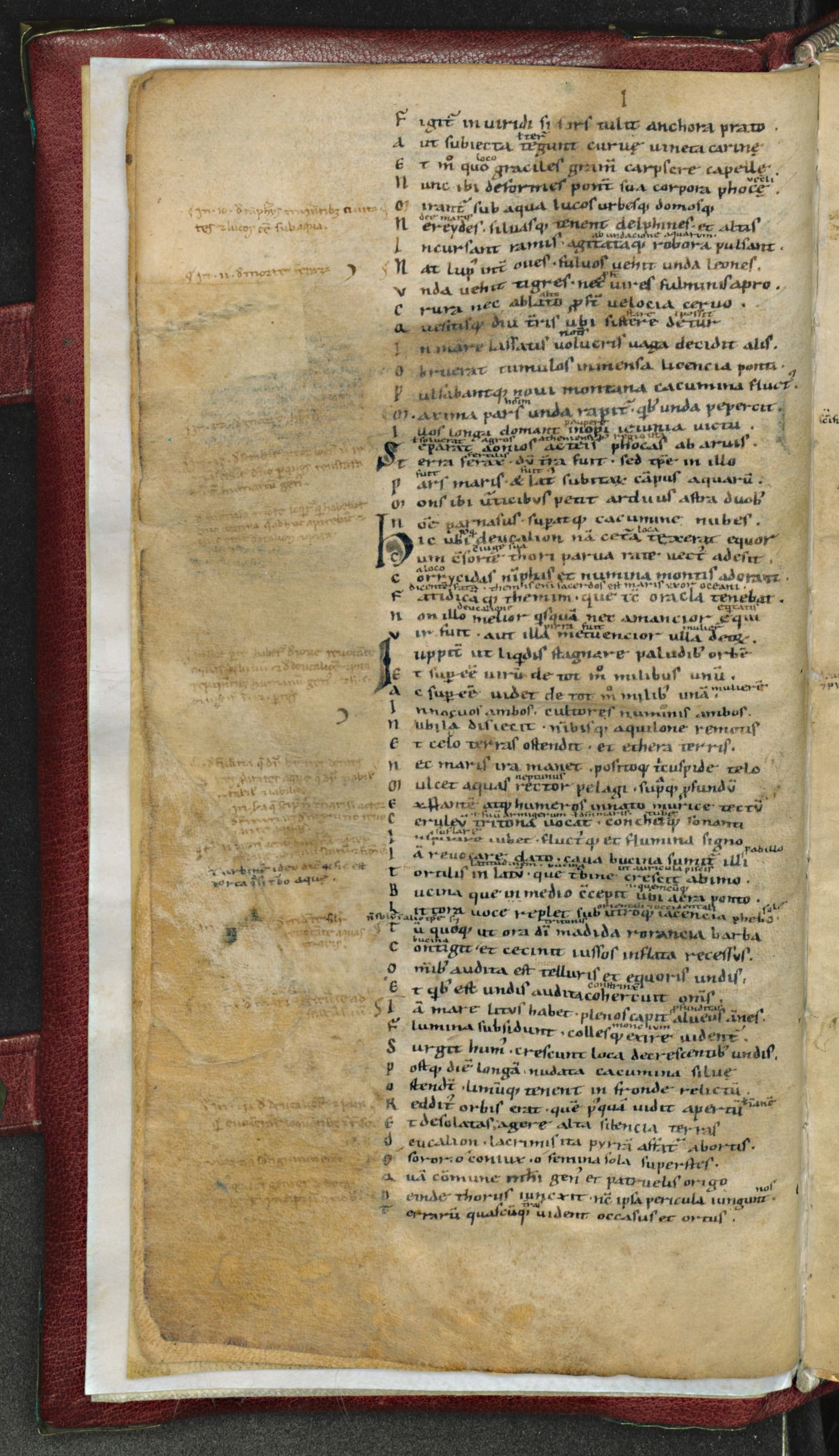
The pages shown are from Florence, Biblioteca Medicea Laurenziana, Plut. 36.12, a small manuscript of the poem dated by the library to the 11th century, one of the oldest surviving copies of book 1. It is written in one column of 55 to 63 verses a page, and 1.1-415 runs from fol. 1r to the top of fol. 4v. The first page (fol. 1r, lines 1-55) is badly abraded in its lower half, so the sections on it also show the same lines on a second early manuscript, Vatican City, Biblioteca Apostolica Vaticana, Urb. lat. 341 (fol. 1v-2r), written in Beneventan script in southern Italy in the 11th or 12th century. Each section below is a group of lines; the page or pages listed for it were identified by reading the first and last verse of every page on the images. The Latin is Hugo Magnus' edition (1892), not a transcription of the manuscript; where the copyist's reading was noticed to differ, the scan note says so. The English is Brookes More's blank-verse translation (1922). The passage is complete.
How was this verified? (Provenance)
Where on the image
Lines 1.1-4 are on Laur. Plut. 36.12 fol. 1r. Checked on the images: Laur. Plut. 36.12 fol. 1r runs from 'In nova fert animus mutatas dicere formas (under a faded red title)' on its first verse line (1.1) to '(iussit et humanas motura) tonitrua mentes' on its last (1.55). The last line is abraded and only its end is legible; the line above it ends 'consistere nubes' (1.54). The lower half of this page is abraded and many verses are only partly legible. Viewer: https://tecabml.contentdm.oclc.org/digital/collection/plutei/id/671608 Because fol. 1r of Laur. Plut. 36.12 is abraded, the same lines are also shown on Vat. Urb. lat. 341 fol. 1v: Vat. Urb. lat. 341 fol. 1v runs from 'In nova fert animus mutatas dicere formas (large initial I)' on its first verse line (1.1) to 'Iussit et ambitae circumdare litora terrae' on its last (1.37). Viewer: https://digi.vatlib.it/view/MSS_Urb.lat.341/0010 The Latin shown is Magnus' critical text; the copyists' spelling and some words differ from it.
1In nova fert animus mutatas dicere formas
2corpora; di, coeptis (nam vos mutastis et illas)
3adspirate meis primaque ab origine mundi
4ad mea perpetuum deducite tempora carmen.
1My soul is wrought to sing of forms transformed
to bodies new and strange! Immortal Gods
inspire my heart, for ye have changed yourselves
and all things you have changed! Oh lead my song
in smooth and measured strains, from olden days
when earth began to this completed time!
Where on the image
Lines 1.5-20 are on Laur. Plut. 36.12 fol. 1r. Checked on the images: Laur. Plut. 36.12 fol. 1r runs from 'In nova fert animus mutatas dicere formas (under a faded red title)' on its first verse line (1.1) to '(iussit et humanas motura) tonitrua mentes' on its last (1.55). The last line is abraded and only its end is legible; the line above it ends 'consistere nubes' (1.54). The lower half of this page is abraded and many verses are only partly legible. Viewer: https://tecabml.contentdm.oclc.org/digital/collection/plutei/id/671608 Because fol. 1r of Laur. Plut. 36.12 is abraded, the same lines are also shown on Vat. Urb. lat. 341 fol. 1v: Vat. Urb. lat. 341 fol. 1v runs from 'In nova fert animus mutatas dicere formas (large initial I)' on its first verse line (1.1) to 'Iussit et ambitae circumdare litora terrae' on its last (1.37). Viewer: https://digi.vatlib.it/view/MSS_Urb.lat.341/0010 The Latin shown is Magnus' critical text; the copyists' spelling and some words differ from it.
5Ante mare et terras et quod tegit omnia caelum
6unus erat toto naturae vultus in orbe,
7quem dixere chaos: rudis indigestaque moles
8nec quicquam nisi pondus iners congestaque eodem
9non bene iunctarum discordia semina rerum.
10nullus adhuc mundo praebebat lumina Titan,
11nec nova crescendo reparabat cornua Phoebe,
12nec circumfuso pendebat in aere tellus
13ponderibus librata suis, nec bracchia longo
14margine terrarum porrexerat Amphitrite;
15utque aer, tellus illic et pontus et aether.
16Sic erat instabilis tellus, innabilis unda,
17lucis egens aer: nulli sua forma manebat,
18obstabatque aliis aliud, quia corpore in uno
19frigida pugnabant calidis, umentia siccis,
20mollia cum duris, sine pondere habentia pondus.
5Before the ocean and the earth appeared—
before the skies had overspread them all—
the face of Nature in a vast expanse
was naught but Chaos uniformly waste.
It was a rude and undeveloped mass,
that nothing made except a ponderous weight;
and all discordant elements confused,
were there congested in a shapeless heap.
As yet the sun afforded earth no light,
nor did the moon renew her crescent horns;
the earth was not suspended in the air
exactly balanced by her heavy weight.
Not far along the margin of the shores
had Amphitrite stretched her lengthened arms,—
for all the land was mixed with sea and air.
The land was soft, the sea unfit to sail,
the atmosphere opaque, to naught was given
a proper form, in everything was strife,
and all was mingled in a seething mass—
with hot the cold parts strove, and wet with dry
and soft with hard, and weight with empty void.
Where on the image
Lines 1.21-31 are on Laur. Plut. 36.12 fol. 1r. Checked on the images: Laur. Plut. 36.12 fol. 1r runs from 'In nova fert animus mutatas dicere formas (under a faded red title)' on its first verse line (1.1) to '(iussit et humanas motura) tonitrua mentes' on its last (1.55). The last line is abraded and only its end is legible; the line above it ends 'consistere nubes' (1.54). The lower half of this page is abraded and many verses are only partly legible. Viewer: https://tecabml.contentdm.oclc.org/digital/collection/plutei/id/671608 Because fol. 1r of Laur. Plut. 36.12 is abraded, the same lines are also shown on Vat. Urb. lat. 341 fol. 1v: Vat. Urb. lat. 341 fol. 1v runs from 'In nova fert animus mutatas dicere formas (large initial I)' on its first verse line (1.1) to 'Iussit et ambitae circumdare litora terrae' on its last (1.37). Viewer: https://digi.vatlib.it/view/MSS_Urb.lat.341/0010 The Latin shown is Magnus' critical text; the copyists' spelling and some words differ from it.
21Hanc deus et melior litem natura diremit.
22Nam caelo terras et terris abscidit undas,
23et liquidum spisso secrevit ab aere caelum.
24Quae postquam evolvit caecoque exemit acervo,
25dissociata locis concordi pace ligavit.
26Ignea convexi vis et sine pondere caeli
27emicuit summaque locum sibi fecit in arce:
28proximus est aer illi levitate locoque:
29densior his tellus, elementaque grandia traxit
30et pressa est gravitate sua: circumfluus umor
31ultima possedit solidumque coercuit orbem.
21But God, or kindly Nature, ended strife—
he cut the land from skies, the sea from land,
the heavens ethereal from material air;
and when were all evolved from that dark mass
he bound the fractious parts in tranquil peace.
The fiery element of convex heaven
leaped from the mass devoid of dragging weight,
and chose the summit arch to which the air
as next in quality was next in place.
The earth more dense attracted grosser parts
and moved by gravity sank underneath;
and last of all the wide surrounding waves
in deeper channels rolled around the globe.
Where on the image
Lines 1.32-51 are on Laur. Plut. 36.12 fol. 1r. Checked on the images: Laur. Plut. 36.12 fol. 1r runs from 'In nova fert animus mutatas dicere formas (under a faded red title)' on its first verse line (1.1) to '(iussit et humanas motura) tonitrua mentes' on its last (1.55). The last line is abraded and only its end is legible; the line above it ends 'consistere nubes' (1.54). The lower half of this page is abraded and many verses are only partly legible. Viewer: https://tecabml.contentdm.oclc.org/digital/collection/plutei/id/671608 Because fol. 1r of Laur. Plut. 36.12 is abraded, the same lines are also shown on Vat. Urb. lat. 341 fol. 1v and Vat. Urb. lat. 341 fol. 2r: Vat. Urb. lat. 341 fol. 1v runs from 'In nova fert animus mutatas dicere formas (large initial I)' on its first verse line (1.1) to 'Iussit et ambitae circumdare litora terrae' on its last (1.37). Viewer: https://digi.vatlib.it/view/MSS_Urb.lat.341/0010 Vat. Urb. lat. 341 fol. 2r runs from 'Addidit et fontes et stagna inmensa lacusque' on its first verse line (1.38) to 'Terra feras cepit, volucres agitabilis aer' on its last (1.75). Viewer: https://digi.vatlib.it/view/MSS_Urb.lat.341/0011 The Latin shown is Magnus' critical text; the copyists' spelling and some words differ from it.
32Sic ubi dispositam quisquis fuit ille deorum
33congeriem secuit sectamque in membra redegit,
34principio terram, ne non aequalis ab omni
35parte foret, magni speciem glomeravit in orbis.
36Tum freta diffudit rapidisque tumescere ventis
37iussit et ambitae circumdare litora terrae.
38Addidit et fontes et stagna inmensa lacusque
39fluminaque obliquis cinxit declivia ripis,
40quae, diversa locis, partim sorbentur ab ipsa,
41in mare perveniunt partim campoque recepta
42liberioris aquae pro ripis litora pulsant.
43Iussit et extendi campos, subsidere valles,
44fronde tegi silvas, lapidosos surgere montes.
45Utque duae dextra caelum totidemque sinistra
46parte secant zonae, quinta est ardentior illis,
47sic onus inclusum numero distinxit eodem
48cura dei, totidemque plagae tellure premuntur.
49Quarum quae media est, non est habitabilis aestu:
50nix tegit alta duas: totidem inter utrumque locavit
51temperiemque dedit mixta cum frigore flamma.
32And when this God —which one is yet unknown—
had carved asunder that discordant mass,
had thus reduced it to its elements,
that every part should equally combine,
when time began He rounded out the earth
and moulded it to form a mighty globe.
Then poured He forth the deeps and gave command
that they should billow in the rapid winds,
that they should compass every shore of earth.
he also added fountains, pools and lakes,
and bound with shelving banks the slanting streams,
which partly are absorbed and partly join
the boundless ocean. Thus received amid
the wide expanse of uncontrolled waves,
they beat the shores instead of crooked banks.
At His command the boundless plains extend,
the valleys are depressed, the woods are clothed
in green, the stony mountains rise. And as
the heavens are intersected on the right
by two broad zones, by two that cut the left,
and by a fifth consumed with ardent heat,
with such a number did the careful God
mark off the compassed weight, and thus the earth
received as many climes.—Such heat consumes
the middle zone that none may dwell therein;
and two extremes are covered with deep snow;
and two are placed betwixt the hot and cold,
which mixed together give a temperate clime;
Where on the image
Lines 1.52-68 start on Laur. Plut. 36.12 fol. 1r and continue on fol. 1v (page break inside this section). Checked on the images: Laur. Plut. 36.12 fol. 1r runs from 'In nova fert animus mutatas dicere formas (under a faded red title)' on its first verse line (1.1) to '(iussit et humanas motura) tonitrua mentes' on its last (1.55). The last line is abraded and only its end is legible; the line above it ends 'consistere nubes' (1.54). The lower half of this page is abraded and many verses are only partly legible. Viewer: https://tecabml.contentdm.oclc.org/digital/collection/plutei/id/671608 Laur. Plut. 36.12 fol. 1v runs from 'Et cum fulminibus facientes frigora ventos' on its first verse line (1.56) to 'et breve ver spatiis exegit quattuor annum' on its last (1.118). Line 1 reads 'frigora ventos' where Magnus prints 'fulgura ventos' (1.56). Viewer: https://tecabml.contentdm.oclc.org/digital/collection/plutei/id/671609 Because fol. 1r of Laur. Plut. 36.12 is abraded, the same lines are also shown on Vat. Urb. lat. 341 fol. 2r: Vat. Urb. lat. 341 fol. 2r runs from 'Addidit et fontes et stagna inmensa lacusque' on its first verse line (1.38) to 'Terra feras cepit, volucres agitabilis aer' on its last (1.75). Viewer: https://digi.vatlib.it/view/MSS_Urb.lat.341/0011 The Latin shown is Magnus' critical text; the copyists' spelling and some words differ from it.
52Inminet his aer. Qui quanto est pondere terrae,
53pondere aquae levior tanto est onerosior igni.
54Illic et nebulas, illic consistere nubes
55iussit et humanas motura tonitrua mentes
56et cum fulminibus facientes fulgura ventos.
57His quoque non passim mundi fabricator habendum
58aera permisit: vix nunc obsistitur illis,
59cum sua quisque regant diverso flamina tractu,
60quin lanient mundum: tanta est discordia fratrum.
61Eurus ad Auroram Nabataeaque regna recessit
62Persidaque et radiis iuga subdita matutinis;
63vesper et occiduo quae litora sole tepescunt,
64proxima sunt Zephyro: Scythiam septemque triones
65horrifer invasit Boreas: contraria tellus
66nubibus adsiduis pluviaque madescit ab Austro.
67Haec super inposuit liquidum et gravitate carentem
68aethera nec quicquam terrenae faecis habentem.
52and over all the atmosphere suspends
with weight proportioned to the fiery sky,
exactly as the weight of earth compares
with weight of water.
And He ordered mist
to gather in the air and spread the clouds.
He fixed the thunders that disturb our souls,
and brought the lightning on destructive winds
that also waft the cold. Nor did the great
Artificer permit these mighty winds
to blow unbounded in the pathless skies,
but each discordant brother fixed in space,
although His power can scarce restrain their rage
to rend the universe. At His command
to far Aurora, Eurus took his way,
to Nabath, Persia, and that mountain range
first gilded by the dawn; and Zephyr's flight
was towards the evening star and peaceful shores,
warm with the setting sun; and Boreas
invaded Scythia and the northern snows;
and Auster wafted to the distant south
where clouds and rain encompass his abode.—
and over these He fixed the liquid sky,
devoid of weight and free from earthly dross.
Where on the image
Lines 1.69-75 are on Laur. Plut. 36.12 fol. 1v. Checked on the images: Laur. Plut. 36.12 fol. 1v runs from 'Et cum fulminibus facientes frigora ventos' on its first verse line (1.56) to 'et breve ver spatiis exegit quattuor annum' on its last (1.118). Line 1 reads 'frigora ventos' where Magnus prints 'fulgura ventos' (1.56). Viewer: https://tecabml.contentdm.oclc.org/digital/collection/plutei/id/671609 The Latin shown is Magnus' critical text; the copyists' spelling and some words differ from it.
69Vix ita limitibus dissaepserat omnia certis,
70cum, quae pressa diu massa latuere sub illa,
71sidera coeperunt toto effervescere caelo.
72Neu regio foret ulla suis animalibus orba,
73astra tenent caeleste solum formaeque deorum,
74cesserunt nitidis habitandae piscibus undae,
75terra feras cepit, volucres agitabilis aer.
69And scarcely had He separated these
and fixed their certain bounds, when all the stars,
which long were pressed and hidden in the mass,
began to gleam out from the plains of heaven,
and traversed, with the Gods, bright ether fields:
and lest some part might be bereft of life
the gleaming waves were filled with twinkling fish;
the earth was covered with wild animals;
the agitated air was filled with birds.
Where on the image
Lines 1.76-88 are on Laur. Plut. 36.12 fol. 1v. Checked on the images: Laur. Plut. 36.12 fol. 1v runs from 'Et cum fulminibus facientes frigora ventos' on its first verse line (1.56) to 'et breve ver spatiis exegit quattuor annum' on its last (1.118). Line 1 reads 'frigora ventos' where Magnus prints 'fulgura ventos' (1.56). Viewer: https://tecabml.contentdm.oclc.org/digital/collection/plutei/id/671609 The Latin shown is Magnus' critical text; the copyists' spelling and some words differ from it.
76Sanctius his animal mentisque capacius altae
77deerat adhuc et quod dominari in cetera posset.
78Natus homo est, sive hunc divino semine fecit
79ille opifex rerum, mundi melioris origo,
80sive recens tellus seductaque nuper ab alto
81aethere cognati retinebat semina caeli;
82quam satus Iapeto mixtam pluvialibus undis
83finxit in effigiem moderantum cuncta deorum.
84Pronaque cum spectent animalia cetera terram,
85os homini sublime dedit, caelumque videre
86iussit et erectos ad sidera tollere vultus.
87Sic, modo quae fuerat rudis et sine imagine, tellus
88induit ignotas hominum conversa figuras.
76But one more perfect and more sanctified,
a being capable of lofty thought,
intelligent to rule, was wanting still
man was created! Did the Unknown God
designing then a better world make man
of seed divine? or did Prometheus
take the new soil of earth (that still contained
some godly element of Heaven's Life)
and use it to create the race of man;
first mingling it with water of new streams;
so that his new creation, upright man,
was made in image of commanding Gods?
On earth the brute creation bends its gaze,
but man was given a lofty countenance
and was commanded to behold the skies;
and with an upright face may view the stars:—
and so it was that shapeless clay put on
the form of man till then unknown to earth.
Where on the image
Lines 1.89-112 are on Laur. Plut. 36.12 fol. 1v. Checked on the images: Laur. Plut. 36.12 fol. 1v runs from 'Et cum fulminibus facientes frigora ventos' on its first verse line (1.56) to 'et breve ver spatiis exegit quattuor annum' on its last (1.118). Line 1 reads 'frigora ventos' where Magnus prints 'fulgura ventos' (1.56). Viewer: https://tecabml.contentdm.oclc.org/digital/collection/plutei/id/671609 The Latin shown is Magnus' critical text; the copyists' spelling and some words differ from it.
89Aurea prima sata est aetas, quae vindice nullo,
90sponte sua, sine lege fidem rectumque colebat.
91Poena metusque aberant, nec verba minantia fixo
92aere legebantur, nec supplex turba timebat
93iudicis ora sui, sed erant sine vindice tuti.
94Nondum caesa suis, peregrinum ut viseret orbem,
95montibus in liquidas pinus descenderat undas,
96nullaque mortales praeter sua litora norant.
97Nondum praecipites cingebant oppida fossae;
98non tuba directi, non aeris cornua flexi,
99non galeae, non ensis erat: sine militis usu
100mollia securae peragebant otia gentes.
101ipsa quoque inmunis rastroque intacta nec ullis
102saucia vomeribus per se dabat omnia tellus;
103contentique cibis nullo cogente creatis
104arbuteos fetus montanaque fraga legebant
105cornaque et in duris haerentia mora rubetis
106et quae deciderant patula Iovis arbore glandes.
107Ver erat aeternum, placidique tepentibus auris
108mulcebant zephyri natos sine semine flores.
109Mox etiam fruges tellus inarata ferebat,
110nec renovatus ager gravidis canebat aristis;
111flumina iam lactis, iam flumina nectaris ibant,
112flavaque de viridi stillabant ilice mella.
89First was the Golden Age. Then rectitude
spontaneous in the heart prevailed, and faith.
Avengers were not seen, for laws unframed
were all unknown and needless. Punishment
and fear of penalties existed not.
No harsh decrees were fixed on brazen plates.
No suppliant multitude the countenance
of Justice feared, averting, for they dwelt
without a judge in peace. Descended not
the steeps, shorn from its height, the lofty pine,
cleaving the trackless waves of alien shores,
nor distant realms were known to wandering men.
The towns were not entrenched for time of war;
they had no brazen trumpets, straight, nor horns
of curving brass, nor helmets, shields nor swords.
There was no thought of martial pomp —secure
a happy multitude enjoyed repose.
Then of her own accord the earth produced
a store of every fruit. The harrow touched
her not, nor did the plowshare wound
her fields. And man content with given food,
and none compelling, gathered arbute fruits
and wild strawberries on the mountain sides,
and ripe blackberries clinging to the bush,
and corners and sweet acorns on the ground,
down fallen from the spreading tree of Jove.
Eternal Spring! Soft breathing zephyrs soothed
and warmly cherished buds and blooms, produced
without a seed. The valleys though unplowed
gave many fruits; the fields though not renewed
white glistened with the heavy bearded wheat:
rivers flowed milk and nectar, and the trees,
the very oak trees, then gave honey of themselves.
Where on the image
Lines 1.113-124 start on Laur. Plut. 36.12 fol. 1v and continue on fol. 2r (page break inside this section). Checked on the images: Laur. Plut. 36.12 fol. 1v runs from 'Et cum fulminibus facientes frigora ventos' on its first verse line (1.56) to 'et breve ver spatiis exegit quattuor annum' on its last (1.118). Line 1 reads 'frigora ventos' where Magnus prints 'fulgura ventos' (1.56). Viewer: https://tecabml.contentdm.oclc.org/digital/collection/plutei/id/671609 Laur. Plut. 36.12 fol. 2r runs from 'Tum primum siccis aer fervoribus ustus' on its first verse line (1.119) to 'celsior ipse loco sceptroque innixus eburno' on its last (1.178). At 1.173 the manuscript reads 'a fronte potentes' where Magnus prints 'hac parte potentes'. Viewer: https://tecabml.contentdm.oclc.org/digital/collection/plutei/id/671610 The Latin shown is Magnus' critical text; the copyists' spelling and some words differ from it.
113Postquam, Saturno tenebrosa in Tartara misso,
114sub Iove mundus erat, subiit argentea proles,
115auro deterior, fulvo pretiosior aere.
116Iuppiter antiqui contraxit tempora veris
117perque hiemes aestusque et inaequalis autumnos
118et breve ver spatiis exegit quattuor annum.
119Tum primum siccis aer fervoribus ustus
120canduit, et ventis glacies adstricta pependit.
121Tum primum subiere domus (domus antra fuerunt
122et densi frutices et vinctae cortice virgae).
123Semina tum primum longis Cerealia sulcis
124obruta sunt, pressique iugo gemuere iuvenci.
113When Saturn had been banished into night
and all the world was ruled by Jove supreme,
the Silver Age, though not so good as gold
but still surpassing yellow brass, prevailed.
Jove first reduced to years the Primal Spring,
by him divided into periods four,
unequal,—summer, autumn, winter, spring.—
then glowed with tawny heat the parched air,
or pendent icicles in winter froze
and man stopped crouching in crude caverns, while
he built his homes of tree rods, bark entwined.
Then were the cereals planted in long rows,
and bullocks groaned beneath the heavy yoke.
Where on the image
Lines 1.125-150 are on Laur. Plut. 36.12 fol. 2r. Checked on the images: Laur. Plut. 36.12 fol. 2r runs from 'Tum primum siccis aer fervoribus ustus' on its first verse line (1.119) to 'celsior ipse loco sceptroque innixus eburno' on its last (1.178). At 1.173 the manuscript reads 'a fronte potentes' where Magnus prints 'hac parte potentes'. Viewer: https://tecabml.contentdm.oclc.org/digital/collection/plutei/id/671610 The Latin shown is Magnus' critical text; the copyists' spelling and some words differ from it.
125Tertia post illam successit aenea proles,
126saevior ingeniis et ad horrida promptior arma,
127non scelerata tamen. De duro est ultima ferro.
128Protinus inrupit venae peioris in aevum
129omne nefas: fugere pudor verumque fidesque;
130In quorum subiere locum fraudesque dolique
131insidiaeque et vis et amor sceleratus habendi.
132Vela dabat ventis (nec adhuc bene noverat illos)
133navita; quaeque diu steterant in montibus altis,
134fluctibus ignotis insultavere carinae,
135communemque prius ceu lumina solis et auras
136cautus humum longo signavit limite mensor.
137Nec tantum segetes alimentaque debita dives
138poscebatur humus, sed itum est in viscera terrae:
139quasque recondiderat Stygiisque admoverat umbris,
140effodiuntur opes, inritamenta malorum.
141Iamque nocens ferrum ferroque nocentius aurum
142prodierat: prodit bellum, quod pugnat utroque,
143sanguineaque manu crepitantia concutit arma.
144Vivitur ex rapto: non hospes ab hospite tutus,
145non socer a genero; fratrum quoque gratia rara est.
146Inminet exitio vir coniugis, illa mariti;
147lurida terribiles miscent aconita novercae;
148filius ante diem patrios inquirit in annos.
149Victa iacet pietas, et virgo caede madentis,
150ultima caelestum terras Astraea reliquit.
125The third Age followed, called The Age of Bronze,
when cruel people were inclined to arms
but not to impious crimes. And last of all
the ruthless and hard Age of Iron prevailed,
from which malignant vein great evil sprung;
and modesty and faith and truth took flight,
and in their stead deceits and snares and frauds
and violence and wicked love of gain,
succeeded.—Then the sailor spread his sails
to winds unknown, and keels that long had stood
on lofty mountains pierced uncharted waves.
Surveyors anxious marked with metes and bounds
the lands, created free as light and air:
nor need the rich ground furnish only crops,
and give due nourishment by right required,—
they penetrated to the bowels of earth
and dug up wealth, bad cause of all our ills,—
rich ores which long ago the earth had hid
and deep removed to gloomy Stygian caves:
and soon destructive iron and harmful gold
were brought to light; and War, which uses both,
came forth and shook with sanguinary grip
his clashing arms. Rapacity broke forth—
the guest was not protected from his host,
the father in law from his own son in law;
even brothers seldom could abide in peace.
The husband threatened to destroy his wife,
and she her husband: horrid step dames mixed
the deadly henbane: eager sons inquired
their fathers, ages. Piety was slain:
and last of all the virgin deity,
Astraea vanished from the blood-stained earth.
Where on the image
Lines 1.151-162 are on Laur. Plut. 36.12 fol. 2r. Checked on the images: Laur. Plut. 36.12 fol. 2r runs from 'Tum primum siccis aer fervoribus ustus' on its first verse line (1.119) to 'celsior ipse loco sceptroque innixus eburno' on its last (1.178). At 1.173 the manuscript reads 'a fronte potentes' where Magnus prints 'hac parte potentes'. Viewer: https://tecabml.contentdm.oclc.org/digital/collection/plutei/id/671610 The Latin shown is Magnus' critical text; the copyists' spelling and some words differ from it.
151Neve foret terris securior arduus aether,
152adfectasse ferunt regnum caeleste Gigantas
153altaque congestos struxisse ad sidera montes.
154Tum pater omnipotens misso perfregit Olympum
155fulmine et excussit subiectae Pelion Ossae.
156Obruta mole sua cum corpora dira iacerent,
157perfusam multo natorum sanguine Terram
158inmaduisse ferunt calidumque animasse cruorem,
159et, ne nulla suae stirpis monimenta manerent,
160in faciem vertisse hominum. Sed et illa propago
161contemptrix superum saevaeque avidissima caedis
162et violenta fuit: scires e sanguine natos.
151And lest ethereal heights should long remain
less troubled than the earth, the throne of Heaven
was threatened by the Giants; and they piled
mountain on mountain to the lofty stars.
But Jove, omnipotent, shot thunderbolts
through Mount Olympus, and he overturned
from Ossa huge, enormous Pelion.
And while these dreadful bodies lay overwhelmed
in their tremendous bulk, (so fame reports)
the Earth was reeking with the copious blood
of her gigantic sons; and thus replete
with moisture she infused the steaming gore
with life renewed. So that a monument
of such ferocious stock should be retained,
she made that offspring in the shape of man;
but this new race alike despised the Gods,
and by the greed of savage slaughter proved
a sanguinary birth.
Where on the image
Lines 1.163-167 are on Laur. Plut. 36.12 fol. 2r. Checked on the images: Laur. Plut. 36.12 fol. 2r runs from 'Tum primum siccis aer fervoribus ustus' on its first verse line (1.119) to 'celsior ipse loco sceptroque innixus eburno' on its last (1.178). At 1.173 the manuscript reads 'a fronte potentes' where Magnus prints 'hac parte potentes'. Viewer: https://tecabml.contentdm.oclc.org/digital/collection/plutei/id/671610 The Latin shown is Magnus' critical text; the copyists' spelling and some words differ from it.
163Quae pater ut summa vidit Saturnius arce,
164ingemit et, facto nondum vulgata recenti,
165foeda Lycaoniae referens convivia mensae,
166ingentes animo et dignas Iove concipit iras,
167conciliumque vocat: tenuit mora nulla vocatos.
163When, from his throne
supreme, the Son of Saturn viewed their deeds,
he deeply groaned: and calling to his mind
the loathsome feast Lycaon had prepared,
a recent deed not common to report,
his soul conceived great anger —worthy Jove—
and he convened a council. No delay
detained the chosen Gods.
Where on the image
Lines 1.168-181 start on Laur. Plut. 36.12 fol. 2r and continue on fol. 2v (page break inside this section). Checked on the images: Laur. Plut. 36.12 fol. 2r runs from 'Tum primum siccis aer fervoribus ustus' on its first verse line (1.119) to 'celsior ipse loco sceptroque innixus eburno' on its last (1.178). At 1.173 the manuscript reads 'a fronte potentes' where Magnus prints 'hac parte potentes'. Viewer: https://tecabml.contentdm.oclc.org/digital/collection/plutei/id/671610 Laur. Plut. 36.12 fol. 2v runs from 'Terrificam capitis concussit terque quaterque' on its first verse line (1.179) to 'canities eadem est, eadem violentia vultus' on its last (1.238). Viewer: https://tecabml.contentdm.oclc.org/digital/collection/plutei/id/671611 The Latin shown is Magnus' critical text; the copyists' spelling and some words differ from it.
168Est via sublimis, caelo manifesta sereno:
169lactea nomen habet, candore notabilis ipso.
170Hac iter est superis ad magni tecta Tonantis
171regalemque domum. Dextra laevaque deorum
172atria nobilium valvis celebrantur apertis
173(plebs habitat diversa locis): hac parte potentes
174caelicolae clarique suos posuere penates.
175Hic locus est, quem, si verbis audacia detur,
176haud timeam magni dixisse Palatia caeli.
177Ergo ubi marmoreo superi sedere recessu,
178celsior ipse loco sceptroque innixus eburno
179terrificam capitis concussit terque quaterque
180caesariem, cum qua terram, mare, sidera movit.
181Talibus inde modis ora indignantia solvit:
168When skies are clear
a path is well defined on high, which men,
because so white, have named the Milky Way.
It makes a passage for the deities
and leads to mansions of the Thunder God,
to Jove's imperial home. On either side
of its wide way the noble Gods are seen,
inferior Gods in other parts abide,
but there the potent and renowned of Heaven
have fixed their homes.—It is a glorious place,
our most audacious verse might designate
the “Palace of High Heaven.” When the Gods
were seated, therefore, in its marble halls
the King of all above the throng sat high,
and leaning on his ivory scepter, thrice,
and once again he shook his awful locks,
wherewith he moved the earth, and seas and stars,—
and thus indignantly began to speak;
Where on the image
Lines 1.182-208 are on Laur. Plut. 36.12 fol. 2v. Checked on the images: Laur. Plut. 36.12 fol. 2v runs from 'Terrificam capitis concussit terque quaterque' on its first verse line (1.179) to 'canities eadem est, eadem violentia vultus' on its last (1.238). Viewer: https://tecabml.contentdm.oclc.org/digital/collection/plutei/id/671611 The Latin shown is Magnus' critical text; the copyists' spelling and some words differ from it.
182“Non ego pro mundi regno magis anxius illa
183tempestate fui, qua centum quisque parabat
184inicere anguipedum captivo bracchia caelo.
185Nam quamquam ferus hostis erat, tamen illud ab uno
186corpore et ex una pendebat origine bellum.
187Nunc mihi, qua totum Nereus circumsonat orbem,
188perdendum est mortale genus: per flumina iuro
189infera, sub terras Stygio labentia luco!
190cuncta prius temptata: sed inmedicabile corpus
191ense recidendum est, ne pars sincera trahatur.
192Sunt mihi semidei, sunt rustica numina, nymphae
193faunique satyrique et monticolae silvani:
194quos quoniam caeli nondum dignamur honore,
195quas dedimus certe terras habitare sinamus.
196An satis, o superi, tutos fore creditis illos,
197cum mihi, qui fulmen, qui vos habeoque regoque,
198struxerit insidias notus feritate Lycaon?”
199Confremuere omnes studiisque ardentibus ausum
200talia deposcunt. Sic, cum manus inpia saevit
201sanguine Caesareo Romanum exstinguere nomen,
202attonitum tanto subitae terrore ruinae
203humanum genus est totusque perhorruit orbis:
204nec tibi grata minus pietas, Auguste, tuorum est,
205quam fuit illa Iovi. Qui postquam voce manuque
206murmura conpressit, tenuere silentia cuncti.
207Substitit ut clamor pressus gravitate regentis,
208Iuppiter hoc iterum sermone silentia rupit:
182“The time when serpent footed giants strove
to fix their hundred arms on captive Heaven,
not more than this event could cause alarm
for my dominion of the universe.
Although it was a savage enemy,
yet warred we with a single source derived
of one. Now must I utterly destroy
this mortal race wherever Nereus roars
around the world. Yea, by the Infernal Streams
that glide through Stygian groves beneath the world,
I swear it. Every method has been tried.
The knife must cut immedicable wounds,
lest maladies infect untainted parts.
“Beneath my sway are demi gods and fauns,
nymphs, rustic deities, sylvans of the hills,
satyrs;—all these, unworthy Heaven's abodes,
we should at least permit to dwell on earth
which we to them bequeathed. What think ye, Gods,
is safety theirs when I, your sovereign lord,
the Thunder-bolt Controller, am ensnared
by fierce Lycaon?” Ardent in their wrath,
the astonished Gods demand revenge overtake
this miscreant; he who dared commit such crimes.
'Twas even thus when raged that impious band
to blot the Roman name in sacred blood
of Caesar, sudden apprehensive fears
of ruin absolute astonished man,
and all the world convulsed. Nor is the love
thy people bear to thee, Augustus, less
than these displayed to Jupiter whose voice
and gesture all the murmuring host restrained:
and as indignant clamour ceased, suppressed
by regnant majesty, Jove once again
broke the deep silence with imperial words;
Where on the image
Lines 1.209-215 are on Laur. Plut. 36.12 fol. 2v. Checked on the images: Laur. Plut. 36.12 fol. 2v runs from 'Terrificam capitis concussit terque quaterque' on its first verse line (1.179) to 'canities eadem est, eadem violentia vultus' on its last (1.238). Viewer: https://tecabml.contentdm.oclc.org/digital/collection/plutei/id/671611 The Latin shown is Magnus' critical text; the copyists' spelling and some words differ from it.
209“Ille quidem poenas, curam hanc dimittite, solvit.
210Quod tamen admissum, quae sit vindicta, docebo.
211Contigerat nostras infamia temporis aures;
212quam cupiens falsam summo delabor Olympo
213et deus humana lustro sub imagine terras.
214Longa mora est, quantum noxae sit ubique repertum,
215enumerare: minor fuit ipsa infamia vero.
209“Dismiss your cares; he paid the penalty
however all the crime and punishment
now learn from this:—An infamous report
of this unholy age had reached my ears,
and wishing it were false, I sloped my course
from high Olympus, and—although a God—
disguised in human form I viewed the world.
It would delay us to recount the crimes
unnumbered, for reports were less than truth.
Where on the image
Lines 1.216-239 start on Laur. Plut. 36.12 fol. 2v and continue on fol. 3r (page break inside this section). Checked on the images: Laur. Plut. 36.12 fol. 2v runs from 'Terrificam capitis concussit terque quaterque' on its first verse line (1.179) to 'canities eadem est, eadem violentia vultus' on its last (1.238). Viewer: https://tecabml.contentdm.oclc.org/digital/collection/plutei/id/671611 Laur. Plut. 36.12 fol. 3r runs from '(I)dem oculi lucent, eadem feritatis imago est' on its first verse line (1.239) to 'navigat, hic piscem deprendit summa in ulmo' on its last (1.296). The last line has the word order 'piscem deprendit summa in ulmo' (Magnus 'summa piscem deprendit in ulmo'). Viewer: https://tecabml.contentdm.oclc.org/digital/collection/plutei/id/671612 The Latin shown is Magnus' critical text; the copyists' spelling and some words differ from it.
216Maenala transieram latebris horrenda ferarum
217et cum Cyllene gelidi pineta Lycaei:
218Arcadis hinc sedes et inhospita tecta tyranni
219ingredior, traherent cum sera crepuscula noctem.
220Signa dedi venisse deum, vulgusque precari
221coeperat: inridet primo pia vota Lycaon,
222mox ait ”experiar deus hic, discrimine aperto,
223an sit mortalis. Nec erit dubitabile verum.”
224Nocte gravem somno necopina perdere morte
225me parat: haec illi placet experientia veri.
226Nec contentus eo est: missi de gente Molossa
227obsidis unius iugulum mucrone resolvit,
228atque ita semineces partim ferventibus artus
229mollit aquis, partim subiecto torruit igni.
230Quod simul inposuit mensis, ego vindice flamma
231in domino dignos everti tecta penates.
232Territus ipse fugit, nactusque silentia ruris
233exululat frustraque loqui conatur: ab ipso
234conligit os rabiem, solitaeque cupidine caedis
235vertitur in pecudes et nunc quoque sanguine gaudet.
236In villos abeunt vestes, in crura lacerti:
237fit lupus et veteris servat vestigia formae.
238Canities eadem est, eadem violentia vultus,
239idem oculi lucent, eadem feritatis imago est.
216“I traversed Maenalus where fearful dens
abound, over Lycaeus, wintry slopes
of pine tree groves, across Cyllene steep;
and as the twilight warned of night's approach,
I stopped in that Arcadian tyrant's realms
and entered his inhospitable home:—
and when I showed his people that a God
had come, the lowly prayed and worshiped me,
but this Lycaon mocked their pious vows
and scoffing said; ‘A fair experiment
will prove the truth if this be god or man.’
and he prepared to slay me in the night,—
to end my slumbers in the sleep of death.
So made he merry with his impious proof;
but not content with this he cut the throat
of a Molossian hostage sent to him,
and partly softened his still quivering limbs
in boiling water, partly roasted them
on fires that burned beneath. And when this flesh
was served to me on tables, I destroyed
his dwelling and his worthless Household Gods,
with thunder bolts avenging. Terror struck
he took to flight, and on the silent plains
is howling in his vain attempts to speak;
he raves and rages and his greedy jaws,
desiring their accustomed slaughter, turn
against the sheep—still eager for their blood.
His vesture separates in shaggy hair,
his arms are changed to legs; and as a wolf
he has the same grey locks, the same hard face,
the same bright eyes, the same ferocious look.
Where on the image
Lines 1.240-243 are on Laur. Plut. 36.12 fol. 3r. Checked on the images: Laur. Plut. 36.12 fol. 3r runs from '(I)dem oculi lucent, eadem feritatis imago est' on its first verse line (1.239) to 'navigat, hic piscem deprendit summa in ulmo' on its last (1.296). The last line has the word order 'piscem deprendit summa in ulmo' (Magnus 'summa piscem deprendit in ulmo'). Viewer: https://tecabml.contentdm.oclc.org/digital/collection/plutei/id/671612 The Latin shown is Magnus' critical text; the copyists' spelling and some words differ from it.
240Occidit una domus. Sed non domus una perire
241digna fuit: qua terra patet, fera regnat Erinys.
242In facinus iurasse putes. Dent ocius omnes
243quas meruere pati (sic stat sententia) poenas.”
240“Thus fell one house, but not one house alone
deserved to perish; over all the earth
ferocious deeds prevail,—all men conspire
in evil. Let them therefore feel the weight
of dreadful penalties so justly earned,
for such hath my unchanging will ordained.”
Where on the image
Lines 1.244-252 are on Laur. Plut. 36.12 fol. 3r. Checked on the images: Laur. Plut. 36.12 fol. 3r runs from '(I)dem oculi lucent, eadem feritatis imago est' on its first verse line (1.239) to 'navigat, hic piscem deprendit summa in ulmo' on its last (1.296). The last line has the word order 'piscem deprendit summa in ulmo' (Magnus 'summa piscem deprendit in ulmo'). Viewer: https://tecabml.contentdm.oclc.org/digital/collection/plutei/id/671612 The Latin shown is Magnus' critical text; the copyists' spelling and some words differ from it.
244Dicta Iovis pars voce probant stimulosque frementi
245adiciunt, alii partes adsensibus inplent.
246Est tamen humani generis iactura dolori
247omnibus, et, quae sit terrae mortalibus orbae
248forma futura, rogant, quis sit laturus in aras
249tura, ferisne paret populandas tradere terras.
250Talia quaerentes (sibi enim fore cetera curae)
251rex superum trepidare vetat subolemque priori
252dissimilem populo promittit origine mira.
244with exclamations some approved the words
of Jove and added fuel to his wrath,
while others gave assent: but all deplored
and questioned the estate of earth deprived
of mortals. Who could offer frankincense
upon the altars? Would he suffer earth
to be despoiled by hungry beasts of prey?
Such idle questions of the state of man
the King of Gods forbade, but granted soon
to people earth with race miraculous,
unlike the first.
Where on the image
Lines 1.253-273 are on Laur. Plut. 36.12 fol. 3r. Checked on the images: Laur. Plut. 36.12 fol. 3r runs from '(I)dem oculi lucent, eadem feritatis imago est' on its first verse line (1.239) to 'navigat, hic piscem deprendit summa in ulmo' on its last (1.296). The last line has the word order 'piscem deprendit summa in ulmo' (Magnus 'summa piscem deprendit in ulmo'). Viewer: https://tecabml.contentdm.oclc.org/digital/collection/plutei/id/671612 The Latin shown is Magnus' critical text; the copyists' spelling and some words differ from it.
253Iamque erat in totas sparsurus fulmina terras:
254sed timuit, ne forte sacer tot ab ignibus aether
255conciperet flammas longusque ardesceret axis:
256esse quoque in fatis reminiscitur, adfore tempus,
257quo mare, quo tellus correptaque regia caeli
258ardeat et mundi moles obsessa laboret.
259Tela reponuntur manibus fabricata Cyclopum:
260poena placet diversa, genus mortale sub undis
261perdere et ex omni nimbos demittere caelo.
262Protinus Aeoliis Aquilonem claudit in antris
263et quaecumque fugant inductas flamina nubes
264emittitque Notum. Madidis Notus evolat alis,
265terribilem picea tectus caligine vultum:
266barba gravis nimbis, canis fluit unda capillis;
267fronte sedent nebulae, rorant pennaeque sinusque.
268Utque manu late pendentia nubila pressit,
269fit fragor: hinc densi funduntur ab aethere nimbi.
270Nuntia Iunonis varios induta colores
271concipit Iris aquas alimentaque nubibus adfert.
272Sternuntur segetes et deplorata coloni
273vota iacent, longique perit labor inritus anni.
253And now his thunder bolts
would Jove wide scatter, but he feared the flames,
unnumbered, sacred ether might ignite
and burn the axle of the universe:
and he remembered in the scroll of fate,
there is a time appointed when the sea
and earth and Heavens shall melt, and fire destroy
the universe of mighty labour wrought.
Such weapons by the skill of Cyclops forged,
for different punishment he laid aside—
for straightway he preferred to overwhelm
the mortal race beneath deep waves and storms
from every raining sky. And instantly
he shut the Northwind in Aeolian caves,
and every other wind that might dispel
the gathering clouds. He bade the Southwind blow:—
the Southwind flies abroad with dripping wings,
concealing in the gloom his awful face:
the drenching rain descends from his wet beard
and hoary locks; dark clouds are on his brows
and from his wings and garments drip the dews:
his great hands press the overhanging clouds;
loudly the thunders roll; the torrents pour;
Iris, the messenger of Juno, clad
in many coloured raiment, upward draws
the steaming moisture to renew the clouds.
The standing grain is beaten to the ground,
the rustic's crops are scattered in the mire,
and he bewails the long year's fruitless toil.
Where on the image
Lines 1.274-292 are on Laur. Plut. 36.12 fol. 3r. Checked on the images: Laur. Plut. 36.12 fol. 3r runs from '(I)dem oculi lucent, eadem feritatis imago est' on its first verse line (1.239) to 'navigat, hic piscem deprendit summa in ulmo' on its last (1.296). The last line has the word order 'piscem deprendit summa in ulmo' (Magnus 'summa piscem deprendit in ulmo'). Viewer: https://tecabml.contentdm.oclc.org/digital/collection/plutei/id/671612 The Latin shown is Magnus' critical text; the copyists' spelling and some words differ from it.
274Nec caelo contenta suo est Iovis ira, sed illum
275caeruleus frater iuvat auxiliaribus undis.
276Convocat hic amnes. Qui postquam tecta tyranni
277intravere sui, “non est hortamine longo
278nunc” ait “utendum. Vires effundite vestras:
279sic opus est! aperite domos ac mole remota
280fluminibus vestris totas inmittite habenas!”
281Iusserat; hi redeunt ac fontibus ora relaxant
282et defrenato volvuntur in aequora cursu.
283Ipse tridente suo terram percussit: at illa
284intremuit motuque vias patefecit aquarum.
285Exspatiata ruunt per apertos flumina campos
286cumque satis arbusta simul pecudesque virosque
287tectaque cumque suis rapiunt penetralia sacris.
288Siqua domus mansit potuitque resistere tanto
289indeiecta malo, culmen tamen altior huius
290unda tegit, pressaeque latent sub gurgite turres.
291Iamque mare et tellus nullum discrimen habebant:
292omnia pontus erant; deerant quoque litora ponto.
274The wrath of Jove was not content with powers
that emanate from Heaven; he brought to aid
his azure brother, lord of flowing waves,
who called upon the Rivers and the Streams:
and when they entered his impearled abode,
Neptune, their ancient ruler, thus began;
“A long appeal is needless; pour ye forth
in rage of power; open up your fountains;
rush over obstacles; let every stream
pour forth in boundless floods.” Thus he commands,
and none dissenting all the River Gods
return, and opening up their fountains roll
tumultuous to the deep unfruitful sea.
And Neptune with his trident smote the Earth,
which trembling with unwonted throes heaved up
the sources of her waters bare; and through
her open plains the rapid rivers rushed
resistless, onward bearing the waving grain,
the budding groves, the houses, sheep and men,—
and holy temples, and their sacred urns.
The mansions that remained, resisting vast
and total ruin, deepening waves concealed
and whelmed their tottering turrets in the flood
and whirling gulf. And now one vast expanse,
the land and sea were mingled in the waste
of endless waves—a sea without a shore.
Where on the image
Lines 1.293-312 start on Laur. Plut. 36.12 fol. 3r and continue on fol. 3v (page break inside this section). Checked on the images: Laur. Plut. 36.12 fol. 3r runs from '(I)dem oculi lucent, eadem feritatis imago est' on its first verse line (1.239) to 'navigat, hic piscem deprendit summa in ulmo' on its last (1.296). The last line has the word order 'piscem deprendit summa in ulmo' (Magnus 'summa piscem deprendit in ulmo'). Viewer: https://tecabml.contentdm.oclc.org/digital/collection/plutei/id/671612 Laur. Plut. 36.12 fol. 3v runs from 'Figitur in viridi, si fors tulit, ancora prato' on its first verse line (1.297) to 'terrarum, quascumque vident occasus et ortus' on its last (1.354). Viewer: https://tecabml.contentdm.oclc.org/digital/collection/plutei/id/671613 The Latin shown is Magnus' critical text; the copyists' spelling and some words differ from it.
293Occupat hic collem, cumba sedet alter adunca
294et ducit remos illic, ubi nuper ararat,
295ille supra segetes aut mersae culmina villae
296navigat, hic summa piscem deprendit in ulmo.
297Figitur in viridi, si fors tulit, ancora prato,
298aut subiecta terunt curvae vineta carinae;
299et, modo qua graciles gramen carpsere capellae,
300nunc ibi deformes ponunt sua corpora phocae.
301Mirantur sub aqua lucos urbesque domosque
302Nereides, silvasque tenent delphines et altis
303incursant ramis agitataque robora pulsant.
304Nat lupus inter oves, fulvos vehit unda leones,
305unda vehit tigres, nec vires fulminis apro,
306crura nec ablato prosunt velocia cervo.
307Quaesitisque diu terris, ubi sistere possit,
308in mare lassatis volucris vaga decidit alis.
309Obruerat tumulos inmensa licentia ponti,
310pulsabantque novi montana cacumina fluctus.
311Maxima pars unda rapitur; quibus unda pepercit,
312illos longa domant inopi ieiunia victu.
293One desperate man seized on the nearest hill;
another sitting in his curved boat,
plied the long oar where he was wont to plow;
another sailed above his grain, above
his hidden dwelling; and another hooked
a fish that sported in a leafy elm.
Perchance an anchor dropped in verdant fields,
or curving keels were pushed through tangled vines;
and where the gracile goat enjoyed the green,
unsightly seals reposed. Beneath the waves
were wondering Nereids, viewing cities, groves
and houses. Dolphins darting mid the trees,
meshed in the twisted branches, beat against
the shaken oak trees. There the sheep, affrayed,
swim with the frightened wolf, the surging waves
float tigers and lions: availeth naught
his lightning shock the wild boar, nor avails
the stag's fleet footed speed. The wandering bird,
seeking umbrageous groves and hidden vales,
with wearied pinion droops into the sea.
The waves increasing surge above the hills,
and rising waters dash on mountain tops.
Myriads by the waves are swept away,
and those the waters spare, for lack of food,
starvation slowly overcomes at last.
Where on the image
Lines 1.313-323 are on Laur. Plut. 36.12 fol. 3v. Checked on the images: Laur. Plut. 36.12 fol. 3v runs from 'Figitur in viridi, si fors tulit, ancora prato' on its first verse line (1.297) to 'terrarum, quascumque vident occasus et ortus' on its last (1.354). Viewer: https://tecabml.contentdm.oclc.org/digital/collection/plutei/id/671613 The Latin shown is Magnus' critical text; the copyists' spelling and some words differ from it.
313Separat Aonios Oetaeis Phocis ab arvis,
314terra ferax, dum terra fuit, sed tempore in illo
315pars maris et latus subitarum campus aquarum.
316Mons ibi verticibus petit arduus astra duobus,
317nomine Parnasus, superantque cacumina nubes.
318Hic ubi Deucalion (nam cetera texerat aequor)
319cum consorte tori parva rate vectus adhaesit,
320Corycidas nymphas et numina montis adorant
321fatidicamque Themin, quae tunc oracla tenebat.
322Non illo melior quisquam nec amantior aequi
323vir fuit aut illa metuentior ulla deorum.
313A fruitful land and fair but now submerged
beneath a wilderness of rising waves,
'Twixt Oeta and Aonia, Phocis lies,
where through the clouds Parnassus' summits twain
point upward to the stars, unmeasured height,
save which the rolling billows covered all:
there in a small and fragile boat, arrived,
Deucalion and the consort of his couch,
prepared to worship the Corycian Nymphs,
the mountain deities, and Themis kind,
who in that age revealed in oracles
the voice of fate. As he no other lived
so good and just, as she no other feared
the Gods.
Where on the image
Lines 1.324-347 are on Laur. Plut. 36.12 fol. 3v. Checked on the images: Laur. Plut. 36.12 fol. 3v runs from 'Figitur in viridi, si fors tulit, ancora prato' on its first verse line (1.297) to 'terrarum, quascumque vident occasus et ortus' on its last (1.354). Viewer: https://tecabml.contentdm.oclc.org/digital/collection/plutei/id/671613 The Latin shown is Magnus' critical text; the copyists' spelling and some words differ from it.
324Iuppiter ut liquidis stagnare paludibus orbem
325et superesse virum de tot modo milibus unum,
326et superesse videt de tot modo milibus unam,
327innocuos ambo, cultores numinis ambo,
328nubila disiecit nimbisque aquilone remotis
329et caelo terras ostendit et aethera terris.
330Nec maris ira manet, positoque tricuspide telo
331mulcet aquas rector pelagi supraque profundum
332exstantem atque umeros innato murice tectum
333caeruleum Tritona vocat conchaeque sonanti
334inspirare iubet fluctusque et flumina signo
335iam revocare dato. Cava bucina sumitur illi,
336tortilis, in latum quae turbine crescit ab imo,
337bucina, quae medio concepit ubi aera ponto,
338litora voce replet sub utroque iacentia Phoebo.
339Tunc quoque, ut ora dei madida rorantia barba
340contigit et cecinit iussos inflata receptus,
341omnibus audita est telluris et aequoris undis,
342et quibus est undis audita, coercuit omnes.
343Iam mare litus habet, plenos capit alveus amnes,
344flumina subsidunt collesque exire videntur,
345surgit humus, crescunt loca decrescentibus undis,
346postque diem longam nudata cacumina silvae
347ostendunt limumque tenent in fronde relictum.
324When Jupiter beheld the globe
in ruin covered, swept with wasting waves,
and when he saw one man of myriads left,
one helpless woman left of myriads lone,
both innocent and worshiping the Gods,
he scattered all the clouds; he blew away
the great storms by the cold northwind.
Once more
the earth appeared to heaven and the skies
appeared to earth. The fury of the main
abated, for the Ocean ruler laid
his trident down and pacified the waves,
and called on azure Triton.—Triton arose
above the waving seas, his shoulders mailed
in purple shells.—He bade the Triton blow,
blow in his sounding shell, the wandering streams
and rivers to recall with signal known:
a hollow wreathed trumpet, tapering wide
and slender stemmed, the Triton took amain
and wound the pearly shell at midmost sea.
Betwixt the rising and the setting suns
the wildered notes resounded shore to shore,
and as it touched his lips, wet with the brine
beneath his dripping beard, sounded retreat:
and all the waters of the land and sea
obeyed. Their fountains heard and ceased to flow;
their waves subsided; hidden hills uprose;
emerged the shores of ocean; channels filled
with flowing streams; the soil appeared; the land
increased its surface as the waves decreased:
and after length of days the trees put forth,
with ooze on bending boughs, their naked tops.
Where on the image
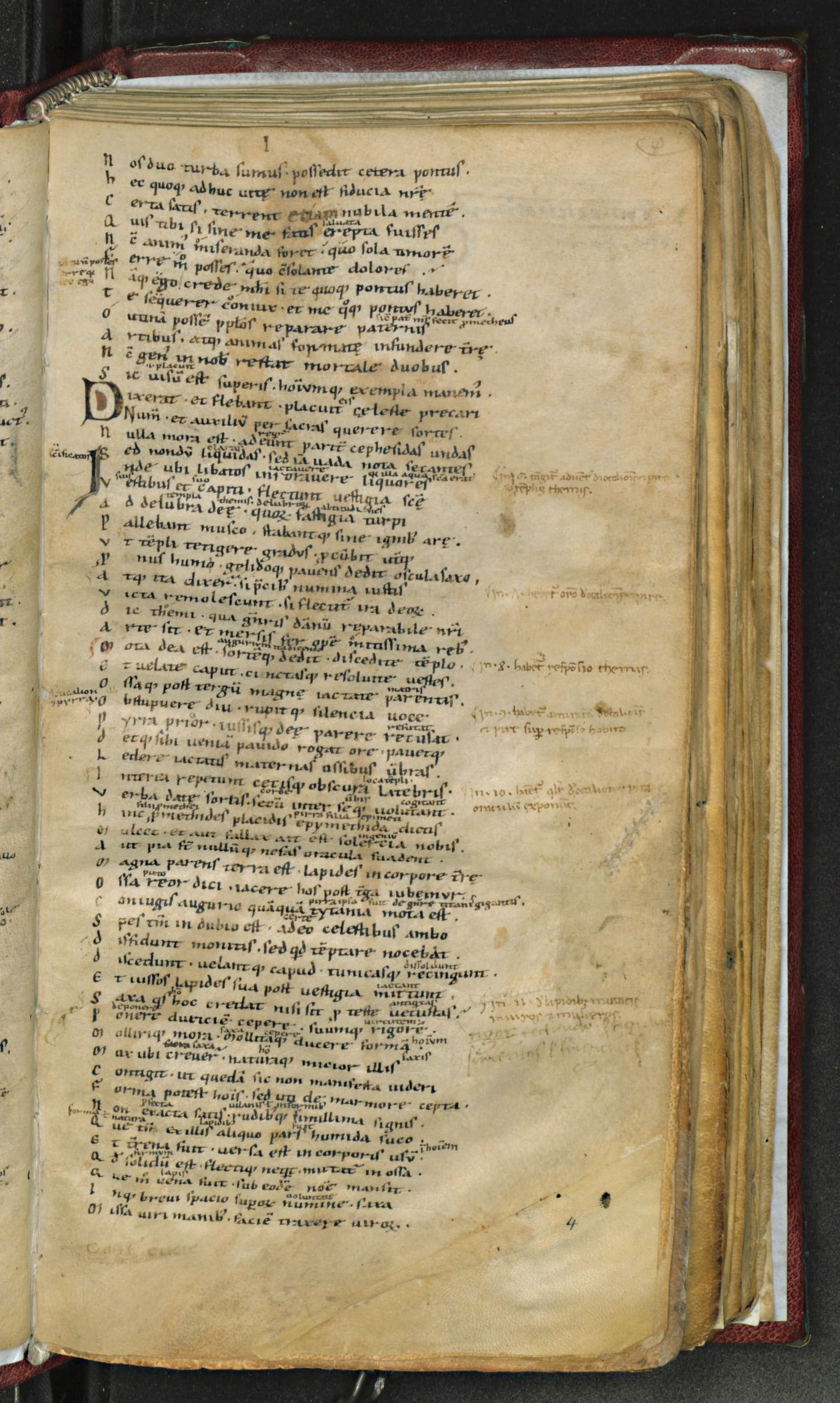
Lines 1.348-366 start on Laur. Plut. 36.12 fol. 3v and continue on fol. 4r (page break inside this section). Checked on the images: Laur. Plut. 36.12 fol. 3v runs from 'Figitur in viridi, si fors tulit, ancora prato' on its first verse line (1.297) to 'terrarum, quascumque vident occasus et ortus' on its last (1.354). Viewer: https://tecabml.contentdm.oclc.org/digital/collection/plutei/id/671613 Laur. Plut. 36.12 fol. 4r runs from '(N)os duo turba sumus, possidet cetera pontus' on its first verse line (1.355) to 'missa viri manibus faciem traxere virorum' on its last (1.412). Viewer: https://tecabml.contentdm.oclc.org/digital/collection/plutei/id/671614 The Latin shown is Magnus' critical text; the copyists' spelling and some words differ from it.
348Redditus orbis erat. Quem postquam vidit inanem
349et desolatas agere alta silentia terras,
350Deucalion lacrimis ita Pyrrham adfatur obortis:
351“O soror, o coniunx, o femina sola superstes,
352quam commune mihi genus et patruelis origo,
353deinde torus iunxit, nunc ipsa pericula iungunt,
354terrarum, quascumque vident occasus et ortus,
355nos duo turba sumus; possedit cetera pontus.
356Haec quoque adhuc vitae non est fiducia nostrae
357certa satis; terrent etiam nunc nubila mentem.
358Quis tibi, si sine me fatis erepta fuisses,
359nunc animus, miseranda, foret? quo sola timorem
360ferre modo posses? quo consolante doleres?
361Namque ego (crede mihi) si te quoque pontus haberet,
362te sequerer, coniunx, et me quoque pontus haberet.
363O utinam possim populos reparare paternis
364artibus atque animas formatae infundere terrae!
365Nunc genus in nobis restat mortale duobus
366(sic visum superis) hominumque exempla manemus.”
348And all the wasted globe was now restored,
but as he viewed the vast and silent world
Deucalion wept and thus to Pyrrha spoke;
“O sister! wife! alone of woman left!
My kindred in descent and origin!
Dearest companion of my marriage bed,
doubly endeared by deepening dangers borne,—
of all the dawn and eve behold of earth,
but you and I are left—for the deep sea
has kept the rest! And what prevents the tide
from overwhelming us? Remaining clouds
affright us. How could you endure your fears
if you alone were rescued by this fate,
and who would then console your bitter grief?
Oh be assured, if you were buried in the waves,
that I would follow you and be with you!
Oh would that by my father's art I might
restore the people, and inspire this clay
to take the form of man. Alas, the Gods
decreed and only we are living!”, Thus
Deucalion's plaint to Pyrrha;—and they wept.
Where on the image
Lines 1.367-380 are on Laur. Plut. 36.12 fol. 4r. Checked on the images: Laur. Plut. 36.12 fol. 4r runs from '(N)os duo turba sumus, possidet cetera pontus' on its first verse line (1.355) to 'missa viri manibus faciem traxere virorum' on its last (1.412). Viewer: https://tecabml.contentdm.oclc.org/digital/collection/plutei/id/671614 The Latin shown is Magnus' critical text; the copyists' spelling and some words differ from it.
367Dixerat, et flebant. Placuit caeleste precari
368numen et auxilium per sacras quaerere sortes.
369Nulla mora est: adeunt pariter Cephisidas undas,
370ut nondum liquidas, sic iam vada nota secantes.
371Inde ubi libatos inroravere liquores
372vestibus et capiti, flectunt vestigia sanctae
373ad delubra deae, quorum fastigia turpi
374pallebant musco stabantque sine ignibus arae.
375Ut templi tetigere gradus, procumbit uterque
376pronus humi gelidoque pavens dedit oscula saxo
377atque ita “si precibus” dixerunt “numina iustis
378victa remollescunt, si flectitur ira deorum,
379dic, Themi, qua generis damnum reparabile nostri
380arte sit, et mersis fer opem, mitissima, rebus.”
367And after he had spoken, they resolved
to ask the aid of sacred oracles,—
and so they hastened to Cephissian waves
which rolled a turbid flood in channels known.
Thence when their robes and brows were sprinkled well,
they turned their footsteps to the goddess' fane:
its gables were befouled with reeking moss
and on its altars every fire was cold.
But when the twain had reached the temple steps
they fell upon the earth, inspired with awe,
and kissed the cold stone with their trembling lips,
and said; “If righteous prayers appease the Gods,
and if the wrath of high celestial powers
may thus be turned, declare, O Themis! whence
and what the art may raise humanity?
O gentle goddess help the dying world!”
Where on the image
Lines 1.381-394 are on Laur. Plut. 36.12 fol. 4r. Checked on the images: Laur. Plut. 36.12 fol. 4r runs from '(N)os duo turba sumus, possidet cetera pontus' on its first verse line (1.355) to 'missa viri manibus faciem traxere virorum' on its last (1.412). Viewer: https://tecabml.contentdm.oclc.org/digital/collection/plutei/id/671614 The Latin shown is Magnus' critical text; the copyists' spelling and some words differ from it.
381Mota dea est sortemque dedit: “Discedite templo
382et velate caput cinctasque resolvite vestes
383ossaque post tergum magnae iactate parentis.”
384Obstipuere diu, rumpitque silentia voce
385Pyrrha prior iussisque deae parere recusat,
386detque sibi veniam pavido rogat ore, pavetque
387laedere iactatis maternas ossibus umbras.
388Interea repetunt caecis obscura latebris
389verba datae sortis secum inter seque volutant.
390Inde Promethides placidis Epimethida dictis
391mulcet et “aut fallax” ait “est sollertia nobis,
392aut pia sunt nullumque nefas oracula suadent.
393Magna parens terra est, lapides in corpore terrae
394ossa reor dici; iacere hos post terga iubemur.”
381Moved by their supplications, she replied;
“Depart from me and veil your brows; ungird
your robes, and cast behind you as you go,
the bones of your great mother.” Long they stood
in dumb amazement: Pyrrha, first of voice,
refused the mandate and with trembling lips
implored the goddess to forgive—she feared
to violate her mother's bones and vex
her sacred spirit. Often pondered they
the words involved in such obscurity,
repeating oft: and thus Deucalion
to Epimetheus' daughter uttered speech
of soothing import; “ Oracles are just
and urge not evil deeds, or naught avails
the skill of thought. Our mother is the Earth,
and I may judge the stones of earth are bones
that we should cast behind us as we go.”
Where on the image
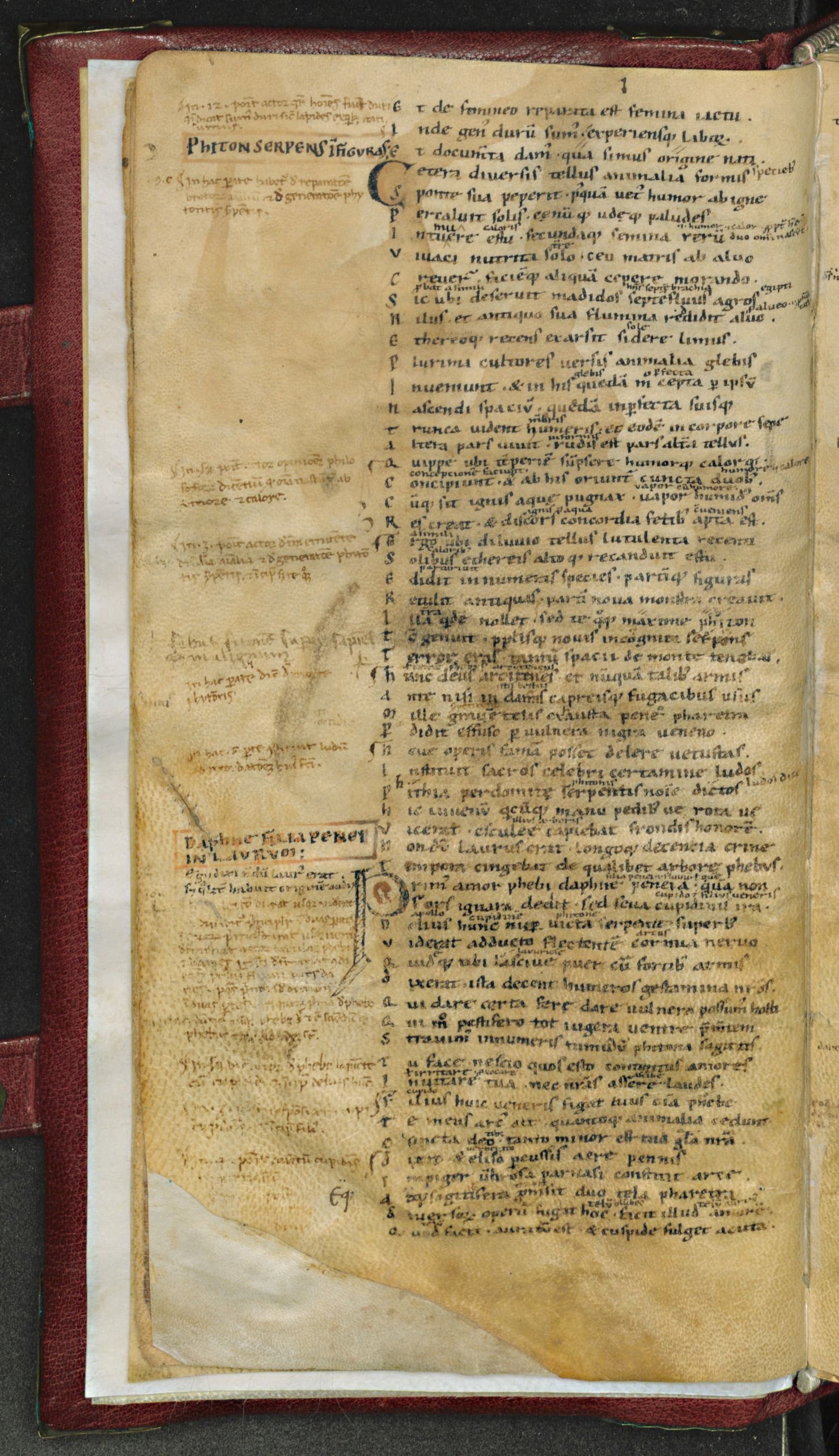
Lines 1.395-415 start on Laur. Plut. 36.12 fol. 4r and continue on fol. 4v (page break inside this section). Checked on the images: Laur. Plut. 36.12 fol. 4r runs from '(N)os duo turba sumus, possidet cetera pontus' on its first verse line (1.355) to 'missa viri manibus faciem traxere virorum' on its last (1.412). Viewer: https://tecabml.contentdm.oclc.org/digital/collection/plutei/id/671614 Laur. Plut. 36.12 fol. 4v runs from 'Et de femineo reparata est femina iactu' on its first verse line (1.413) to 'et documenta damus qua simus origine nati (line 3)' on its last (1.415). Lines 1-3 of the page are 1.413-415; line 4 begins the Python episode (1.416, 'Cetera diversis tellus animalia formis') with a large initial. Viewer: https://tecabml.contentdm.oclc.org/digital/collection/plutei/id/671615 The Latin shown is Magnus' critical text; the copyists' spelling and some words differ from it.
395Coniugis augurio quamquam Titania mota est,
396spes tamen in dubio est: adeo caelestibus ambo
397diffidunt monitis. Sed quid temptare nocebit?
398Discedunt velantque caput tunicasque recingunt
399et iussos lapides sua post vestigia mittunt.
400Saxa (quis hoc credat, nisi sit pro teste vetustas?)
401ponere duritiem coepere suumque rigorem
402mollirique mora mollitaque ducere formam.
403Mox ubi creverunt naturaque mitior illis
404contigit, ut quaedam, sic non manifesta, videri
405forma potest hominis, sed, uti de marmore coepta,
406non exacta satis rudibusque simillima signis.
407Quae tamen ex illis aliquo pars umida suco
408et terrena fuit, versa est in corporis usum;
409quod solidum est flectique nequit, mutatur in ossa;
410quae modo vena fuit, sub eodem nomine mansit;
411inque brevi spatio superorum numine saxa
412missa viri manibus faciem traxere virorum,
413et de femineo reparata est femina iactu.
414Inde genus durum sumus experiensque laborum
415et documenta damus qua simus origine nati.
395And although Pyrrha by his words was moved
she hesitated to comply; and both amazed
doubted the purpose of the oracle,
but deemed no harm to come of trial. They,
descending from the temple, veiled their heads
and loosed their robes and threw some stones
behind them. It is much beyond belief,
were not receding ages witness, hard
and rigid stones assumed a softer form,
enlarging as their brittle nature changed
to milder substance,—till the shape of man
appeared, imperfect, faintly outlined first,
as marble statue chiseled in the rough.
The soft moist parts were changed to softer flesh,
the hard and brittle substance into bones,
the veins retained their ancient name. And now
the Gods supreme ordained that every stone
Deucalion threw should take the form of man,
and those by Pyrrha cast should woman's form
assume: so are we hardy to endure
and prove by toil and deeds from what we sprung.
Notes
- Latin: Hugo Magnus, P. Ovidi Nasonis Metamorphoseon libri XV (Gotha, 1892), Perseus digital text; line numbers are Magnus'.
- English: Brookes More, Ovid's Metamorphoses (Boston: Cornhill, 1922), Perseus digital text. More's blank verse has more lines than the Latin; each English section begins where More begins the first Latin line of the section, so a phrase can fall on the neighbouring side of a break (for example, More's 'and they wept', for 'Dixerat, et flebant' at 1.367, ends the section 1.348-366).
Cite
Sources
- Source: Florence, Laur. Plut. 36.12 fol. 1r-4v (Teca digitale BML) with Vat. Urb. lat. 341 fol. 1v-2r (DigiVatLib) + Magnus Latin (Perseus) + Brookes More English (Perseus) (holding institution)
- Critical edition: Magnus, Metamorphoses (1892), via Perseus
← previous · → next · v cycle view · l back to library