Polycarp of Smyrna, Letter to the Philippians (Vat. gr. 859)
Introduction
Polycarp, bishop of Smyrna, wrote this letter to the church at Philippi in Macedonia, probably soon after Ignatius of Antioch passed through Smyrna on his way to death in Rome (about 110 AD); some scholars date part of it later. The Philippians had asked him to send them the letters of Ignatius. Polycarp writes about righteousness, the duties of wives, widows, deacons, young men and presbyters, a presbyter named Valens who had fallen into greed, and the Christ who came in the flesh. He was martyred at Smyrna about 156 AD.
The manuscripts. The Greek manuscripts of the letter all come from one damaged copy: each breaks off in 9.2 and runs on, without a break, into the Letter of Barnabas. The oldest of them is shown here, Vatican, Biblioteca Apostolica Vaticana, Vat. gr. 859 (end of the 12th century), fol. 195r-198r. Chapters 9 and 13 are quoted in Greek by Eusebius in his Church History (3.36), shown on Paris, BnF, grec 1431 (11th century), fol. 78v. Chapters 10-14 survive complete only in an ancient Latin version, shown on its oldest manuscript, Vatican, Reg. lat. 81 (9th century), fol. 93r-95r. Each section is one chapter, linked to the page or pages that carry it; the first and last words of every page were read on the images.
Texts. The Greek and Latin are Kirsopp Lake's edition (1912), proofread here against his printed pages; the English is J. B. Lightfoot's translation (1891), checked against the printed book. They are edited texts, so the wording on the pages differs from them in places.
How was this verified? (Provenance)
Where on the image
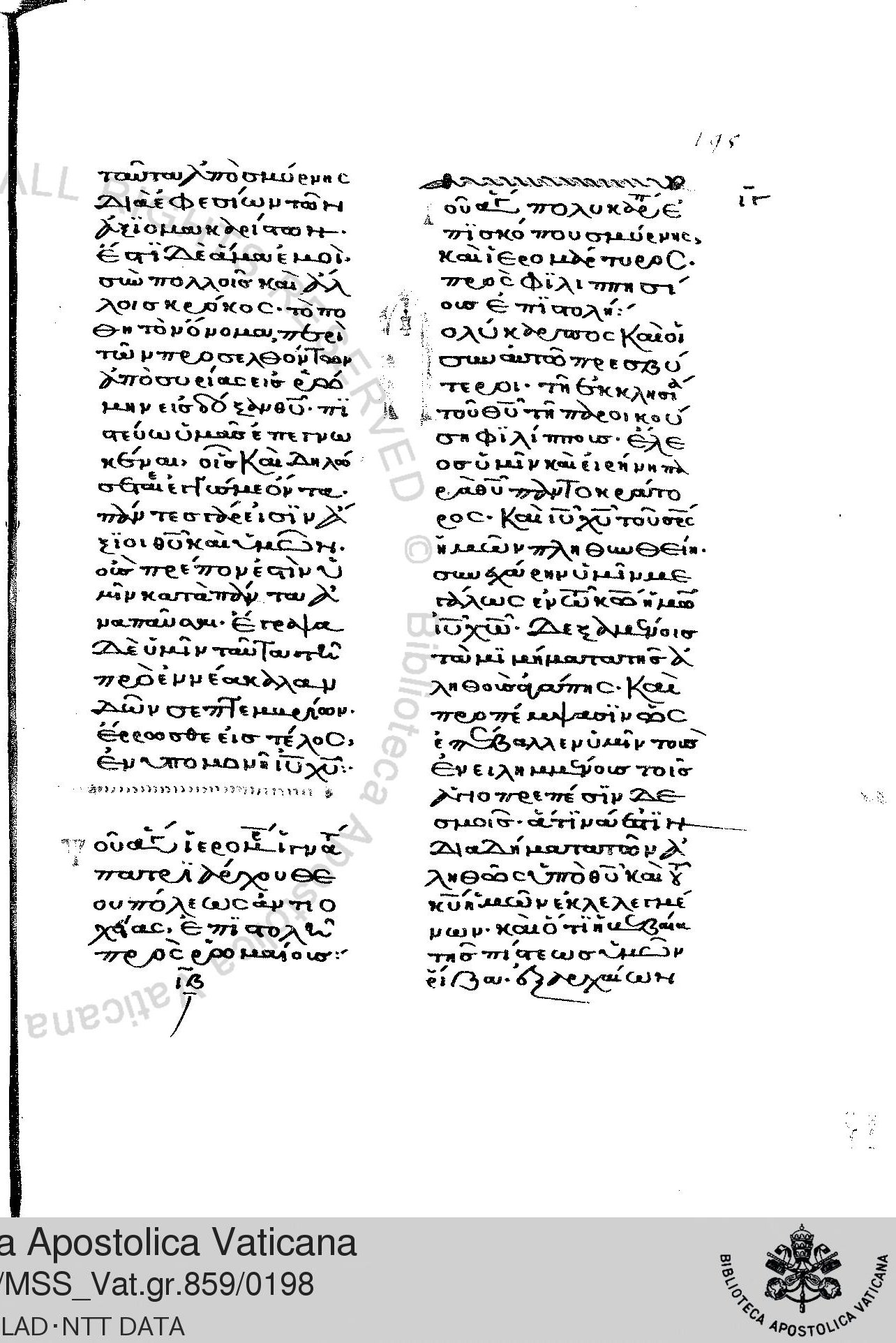
Checked on the images: Vat. gr. 859 fol. 195r: the page begins ‹col. a: end of Ignatius to the Romans; col. b: heading τοῦ ἁγίου Πολυκάρπου ἐπισκόπου Σμύρνης καὶ ἱερομάρτυρος πρὸς Φιλιππησίους ἐπιστολή, then Πολύκαρπος καὶ οἱ σὺν αὐτῷ πρεσβύτεροι (address)› and ends ‹καὶ ὅτι ἡ βεβαία τῆς πίστεως ὑμῶν ῥίζα ἐξ ἀρχαίων (1.2)›. The span of each page was found by reading its first and last words and locating them in the text. The Greek shown is Lake's edited text (1912), not a transcription of the page; the scribe's spellings and abbreviations differ in small details.
Πολύκαρπος καὶ οἱ σὺν αὐτῷ πρεσβύτεροι τῇ ἐκκλησίᾳ τοῦ θεοῦ τῇ παροικούσῃ Φιλίππους· ἔλεος ὑμῖν καὶ εἰρήνη παρὰ θεοῦ παντοκράτορος καὶ Ἰησοῦ Χριστοῦ τοῦ σωτῆρος ἡμῶν πληθυνθείη.
Polycarp and the presbyters that are with him unto the Church of God which sojourneth at Philippi; mercy unto you and peace from God Almighty and Jesus Christ our Saviour be multiplied.
Where on the image
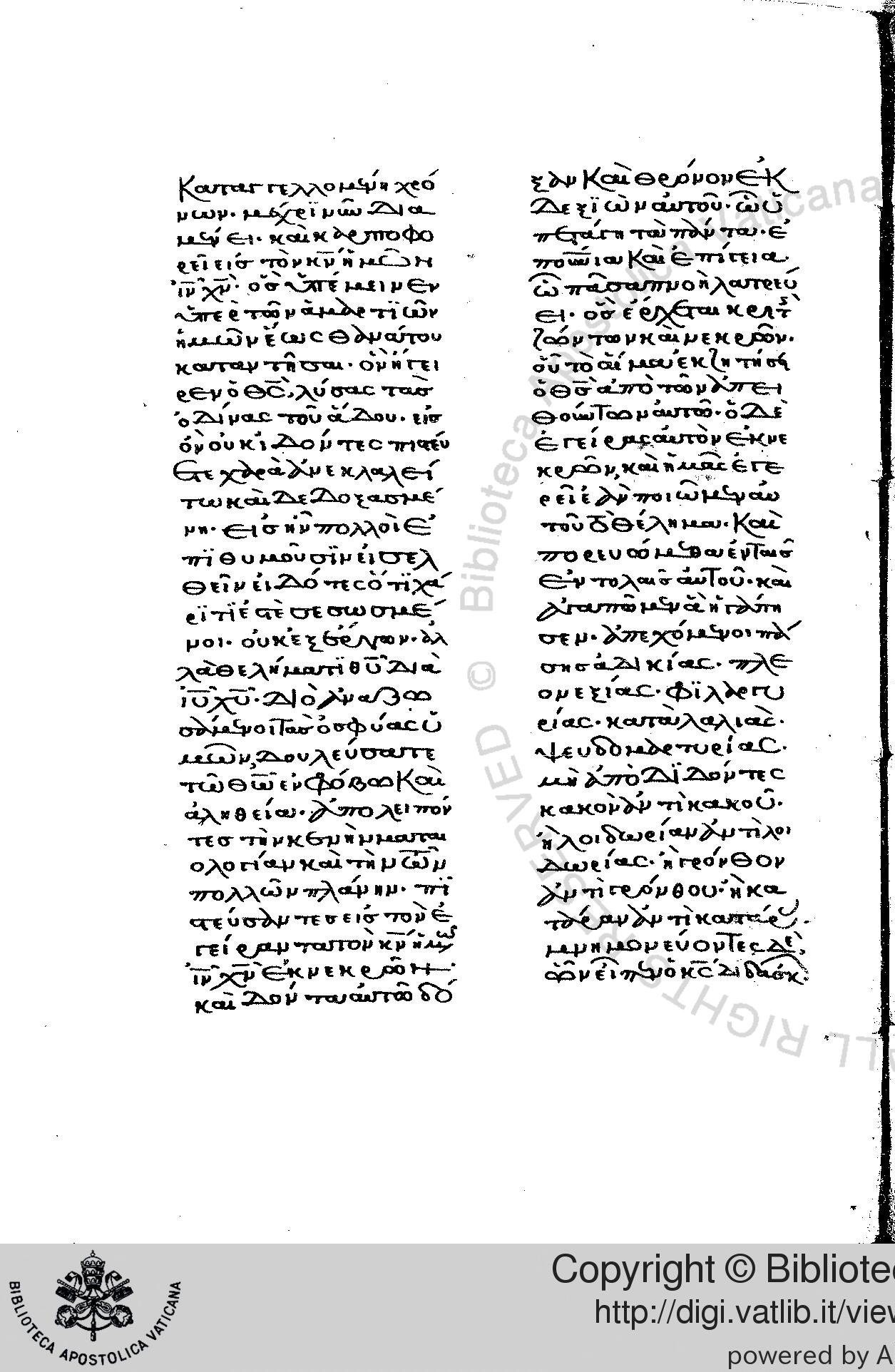
Checked on the images: Vat. gr. 859 fol. 195r: the page begins ‹col. a: end of Ignatius to the Romans; col. b: heading τοῦ ἁγίου Πολυκάρπου ἐπισκόπου Σμύρνης καὶ ἱερομάρτυρος πρὸς Φιλιππησίους ἐπιστολή, then Πολύκαρπος καὶ οἱ σὺν αὐτῷ πρεσβύτεροι (address)› and ends ‹καὶ ὅτι ἡ βεβαία τῆς πίστεως ὑμῶν ῥίζα ἐξ ἀρχαίων (1.2)›; Vat. gr. 859 fol. 195v: the page begins ‹καταγγελλομένη χρόνων, μέχρι νῦν διαμένει (1.2)› and ends ‹μνημονεύοντες δὲ ὧν εἶπεν ὁ κύριος διδάσκων (2.3)›. The span of each page was found by reading its first and last words and locating them in the text. The Greek shown is Lake's edited text (1912), not a transcription of the page; the scribe's spellings and abbreviations differ in small details.
1Συνεχάρην ὑμῖν μεγάλως ἐν τῷ κυρίῳ ἡμῶν Ἰησοῦ Χριστῷ, δεξαμένοις τὰ μιμήματα τῆς ἀληθοῦς ἀγάπης καὶ προπέμψασιν, ὡς ἐπέβαλεν ὑμῖν, τοὺς ἐνειλημένους τοῖς ἁγιοπρεπέσιν δεσμοῖς, ἅτινά ἐστιν διαδήματα τῶν ἀληθῶς ὑπὸ θεοῦ καὶ τοῦ κυρίου ἡμῶν ἐκλελεγμένων· 2καὶ ὅτι ἡ βεβαία τῆς πίστεως ὑμῶν ῥίζα, ἐξ ἀρχαίων καταγγελλομένη χρόνων, μέχρι νῦν διαμένει καὶ καρποφορεῖ εἰς τὸν κύριον ἡμῶν Ἰησοῦν Χριστόν, ὃς ὑπέμεινεν ὑπὲρ τῶν ἁμαρτιῶν ἡμῶν ἕως θανάτου καταντῆσαι, ὃν ἤγειρεν ὁ θεός, λύσας τὰς ὠδῖνας τοῦ ᾅδου· 3εἰς ὃν οὐκ ἰδόντες πιστεύετε χαρᾷ ἀνεκλαλήτῳ καὶ δεδοξασμένῃ, εἰς ἣν πολλοὶ ἐπιθυμοῦσιν εἰσελθεῖν, εἰδότες, ὅτι χάριτί ἐστε σεσωσμένοι, οὐκ ἐξ ἔργων, ἀλλὰ θελήματι θεοῦ διὰ Ἰησοῦ Χριστοῦ.
1I rejoiced with you greatly in our Lord Jesus Christ, for that ye received the followers of the true Love and escorted them on their way, as befitted you—those men encircled in saintly bonds which are the diadems of them that be truly chosen of God and our Lord; 2and that the stedfast root of your faith which was famed from primitive times abideth until now and beareth fruit unto our Lord Jesus Christ, who endured to face even death for our sins, whom God raised, having loosed the pangs of Hades; on whom, 3though ye saw Him not, ye believe with joy unutterable and full of glory; unto which joy many desire to enter in; forasmuch as ye know that it is by grace ye are saved, not of works, but by the will of God through Jesus Christ.
Where on the image
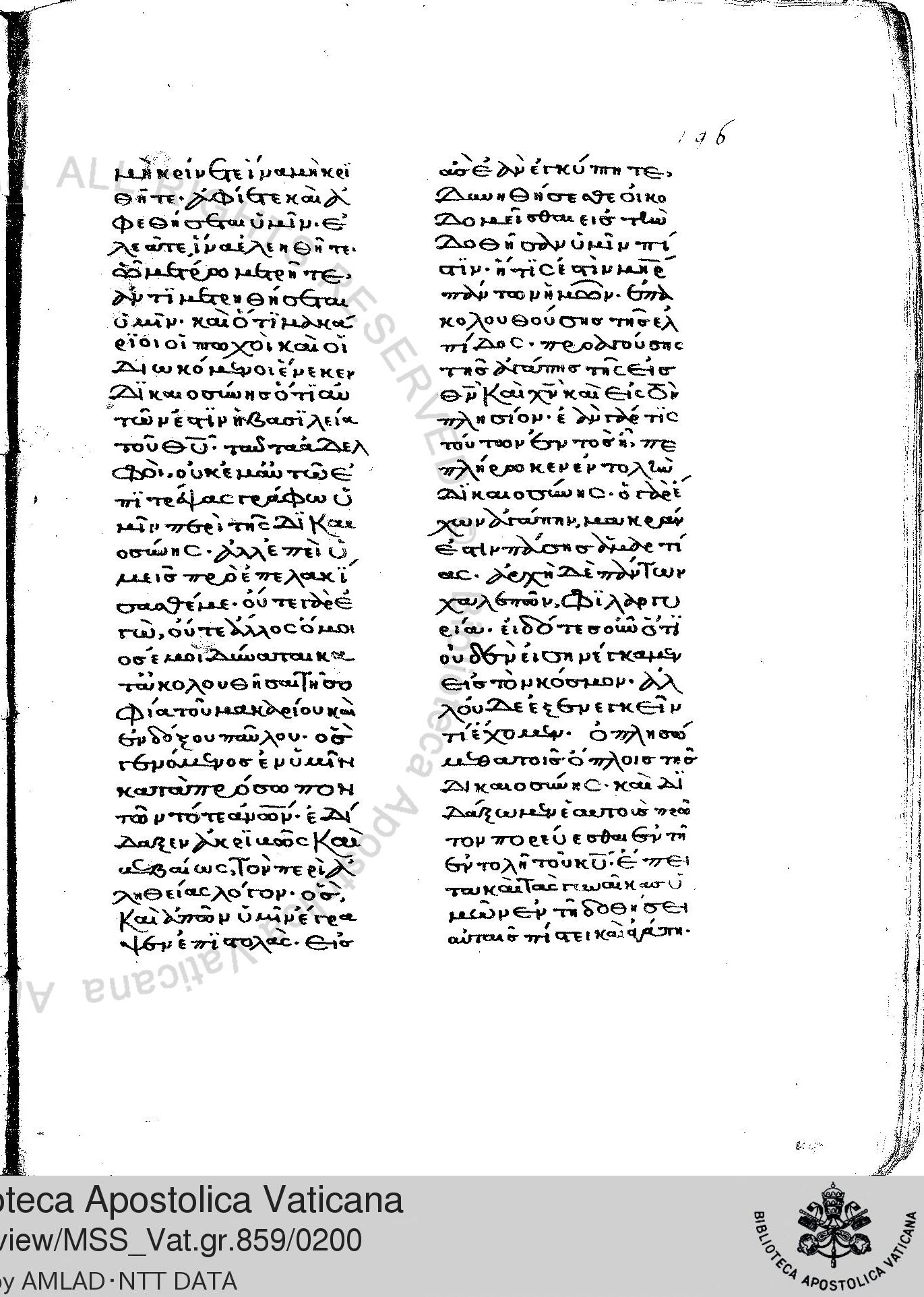
Checked on the images: Vat. gr. 859 fol. 195v: the page begins ‹καταγγελλομένη χρόνων, μέχρι νῦν διαμένει (1.2)› and ends ‹μνημονεύοντες δὲ ὧν εἶπεν ὁ κύριος διδάσκων (2.3)›; Vat. gr. 859 fol. 196r: the page begins ‹μὴ κρίνετε ἵνα μὴ κριθῆτε (2.3)› and ends ‹ἐν τῇ δοθείσῃ αὐταῖς πίστει καὶ ἀγάπῃ (4.2)›. The span of each page was found by reading its first and last words and locating them in the text. The Greek shown is Lake's edited text (1912), not a transcription of the page; the scribe's spellings and abbreviations differ in small details.
1Διὸ ἀναζωσάμενοι τὰς ὀσφύας ὑμῶν δουλεύσατε τῷ θεῷ ἐν φόβῳ καὶ ἀληθείᾳ, ἀπολιπόντες τὴν κενὴν ματαιολογίαν καὶ τὴν τῶν πολλῶν πλάνην, πιστεύσαντες εἰς τὸν ἐγείραντα τὸν κύριον ἡμῶν Ἰησοῦν Χριστὸν ἐκ νεκρῶν καὶ δόντα αὐτῷ δόξαν καὶ θρόνον ἐκ δεξιῶν αὐτοῦ· ᾧ ὑπετάγη τὰ πάντα ἐπουράνια καὶ ἐπίγεια, ᾧ πᾶσα πνοὴ λατρεύει, ὃς ἔρχεται κριτὴς ζώντων καὶ νεκρῶν, οὗ τὸ αἷμα ἐκζητήσει ὁ θεὸς ἀπὸ τῶν ἀπειθούντων αὐτῷ. 2ὁ δὲ ἐγείρας αὐτὸν ἐκ νεκρῶν καὶ ἡμᾶς ἐγερεῖ, ἐὰν ποιῶμεν αὐτοῦ τὸ θέλημα καὶ πορευώμεθα ἐν ταῖς ἐντολαῖς αὐτοῦ καὶ ἀγαπῶμεν ἃ ἠγάπησεν, ἀπεχόμενοι πάσης ἀδικίας, πλεονεξίας, φιλαργυρίας, καταλαλιᾶς, ψευδομαρτυρίας· μὴ ἀποδιδόντες κακὸν ἀντὶ κακοῦ ἢ λοιδορίαν ἀντὶ λοιδορίας ἢ γρόνθον ἀντὶ γρόνθον ἢ κατάραν ἀντὶ κατάρας· 3μνημονεύοντες δὲ ὧν εἶπεν ὁ κύριος διδάσκων· Μὴ κρίνετε, ἵνα μὴ κριθῆτε· ἀφίετε, καὶ ἀφεθήσεται ὑμῖν· ἐλεᾶτε, ἵνα ἐλεηθῆτε· ᾧ μέτρῳ μετρεῖτε, ἀντιμετρηθήσεται ὑμῖν· καὶ ὅτι μακάριοι οἱ πτωχοὶ καὶ οἱ διωκόμενοι ἕνεκεν δικαιοσύνης, ὅτι αὐτῶν ἐστὶν ἡ βασιλεία τοῦ θεοῦ.
1Wherefore gird up your loins and serve God in fear and truth, forsaking the vain and empty talking and the error of the many, for that ye have believed on Him that raised our Lord Jesus Christ from the dead and gave unto Him glory and a throne on His right hand; unto whom all things were made subject that are in heaven and that are on the earth; to whom every creature that hath breath doeth service; who cometh as judge of quick and dead; whose blood God will require of them that are disobedient unto Him. 2Now He that raised Him from the dead will raise us also; if we do His will and walk in His commandments and love the things which He loved, abstaining from all unrighteousness, covetousness, love of money, evil speaking, false witness; not rendering evil for evil or railing for railing or blow for blow or cursing for cursing; 3but remembering the words which the Lord spake, as He taught; Judge not that ye be not judged. Forgive, and it shall be forgiven to you. Have mercy that ye may receive mercy. With what measure ye mete, it shall be measured to you again; and again Blessed are the poor and they that are persecuted for righteousness’ sake, for theirs is the kingdom of God.
Where on the image
Checked on the images: Vat. gr. 859 fol. 196r: the page begins ‹μὴ κρίνετε ἵνα μὴ κριθῆτε (2.3)› and ends ‹ἐν τῇ δοθείσῃ αὐταῖς πίστει καὶ ἀγάπῃ (4.2)›. The span of each page was found by reading its first and last words and locating them in the text. The Greek shown is Lake's edited text (1912), not a transcription of the page; the scribe's spellings and abbreviations differ in small details.
1Ταῦτα, ἀδελφοί, οὐκ ἐμαυτῷ ἐπιτρέψας γράφω ὑμῖν περὶ τῆς δικαιοσύνης, ἀλλ’ ἐπεὶ ὑμεῖς προεπεκαλέσασθέ με. 2οὔτε γὰρ ἐγὼ οὔτε ἄλλος ὅμοιος ἐμοὶ δύναται κατακολουθῆσαι τῇ σοφίᾳ τοῦ μακαρίου καὶ ἐνδόξου Παύλου, ὃς γενόμενος ἐν ὑμῖν κατὰ πρόσωπον τῶν τότε ἀνθρώπων ἐδίδαξεν ἀκριβῶς καὶ βεβαίως τὸν περὶ ἀληθείας λόγον, ὃς καὶ ἀπὼν ὑμῖν ἔγραψεν ἐπιστολάς, εἰς ἃς ἐὰν ἐγκύπτητε, δυνηθήσεσθε οἰκοδομεῖσθαι εἰς τὴν δοθεῖσαν ὑμῖν πίστιν· 3ἥτις ἐστὶν μήτηρ πάντων ἡμῶν, ἐπακολουθούσης τῆς ἐλπίδος, προαγούσης τῆς ἀγάπης τῆς εἰς θεὸν καὶ Χριστὸν καὶ εἰς τὸν πλησίον. ἐὰν γάρ τις τούτων ἐντὸς ᾖ, πεπλήρωκεν ἐντολὴν δικαιοσύνης· ὁ γὰρ ἔχων ἀγάπην μακράν ἐστιν πάσης ἁμαρτίας.
1These things, brethren, I write unto you concerning righteousness, not because I laid this charge upon myself, but because ye invited me. 2For neither am I, nor is any other like unto me, able to follow the wisdom of the blessed and glorious Paul, who when he came among you taught face to face with the men of that day the word which concerneth truth carefully and surely; who also, when he was absent, wrote a letter unto you, into the which if ye look diligently, ye shall be able to be builded up unto the faith given to you, 3which is the mother of us all, while hope followeth after and love goeth before—love toward God and Christ and toward our neighbor. For if any man be occupied with these, he hath fulfilled the commandment of righteousness; for he that hath love is far from all sin.
Where on the image
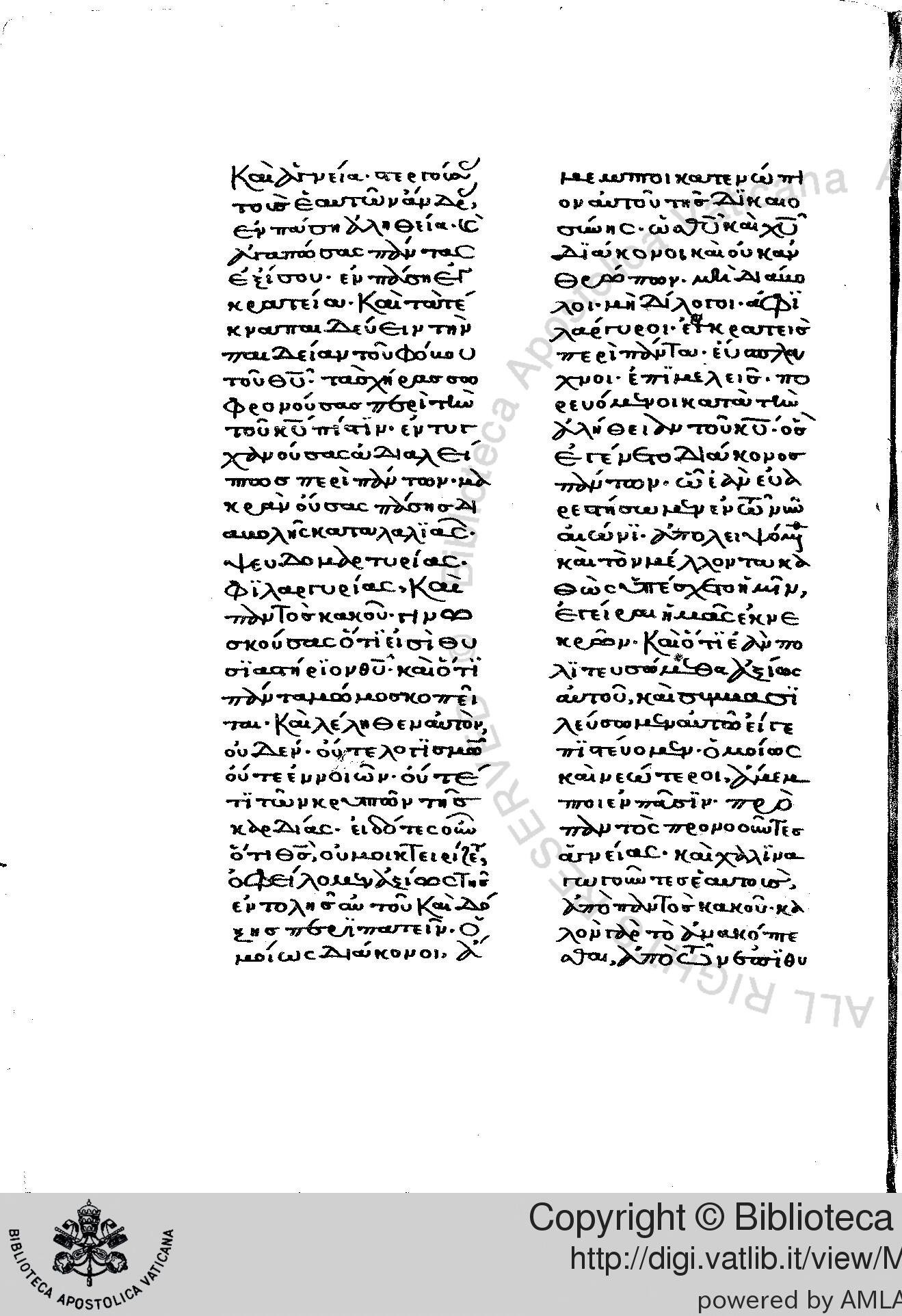
Checked on the images: Vat. gr. 859 fol. 196r: the page begins ‹μὴ κρίνετε ἵνα μὴ κριθῆτε (2.3)› and ends ‹ἐν τῇ δοθείσῃ αὐταῖς πίστει καὶ ἀγάπῃ (4.2)›; Vat. gr. 859 fol. 196v: the page begins ‹καὶ ἁγνείᾳ, στεργούσας τοὺς ἑαυτῶν ἄνδρας (4.2)› and ends ‹καλὸν γὰρ τὸ ἀνακόπτεσθαι ἀπὸ τῶν ἐπιθυ- (5.3)›. The span of each page was found by reading its first and last words and locating them in the text. The Greek shown is Lake's edited text (1912), not a transcription of the page; the scribe's spellings and abbreviations differ in small details.
1Ἀρχὴ δὲ πάντων χαλεπῶν φιλαργυρία. εἰδότες οὖν ὅτι οὐδὲν εἰσηνέγκαμεν εἰς τὸν κόσμον, ἀλλ’ οὐδὲ ἐξενεγκεῖν τι ἔχομεν, ὁπλισώμεθα τοῖς ὅπλοις τῆς δικαιοσύνης καὶ διδάξωμεν ἑαυτοὺς πρῶτον πορεύεσθαι ἐν τῇ ἐντολῇ τοῦ κυριοῦ· 2ἔπειτα καὶ τὰς γυναῖκας ἡμῶν ἐν τῇ δοθείσῃ αὐταῖς πίστει καὶ ἀγάπῃ καὶ ἁγνείᾳ στεργούσας τοὺς ἑαυτῶν ἄνδρας ἐν πάσῃ ἀληθείᾳ καὶ ἀγαπώσας πάντας ἐξ ἴσου ἐν πάσῃ ἐγκρατείᾳ, καὶ τὰ τέκνα παιδεύειν τὴν παιδείαν τοῦ φόβου τοῦ θεοῦ· 3τὰς χήρας σωφρονούσας περὶ τὴν τοῦ κυρίου πίστιν, ἐντυγχανούσας ἀδιαλείπτως περὶ πάντων, μακρὰν οὔσας πάσης διαβολῆς, καταλαλιᾶς, ψευδομαρτυρίας, φιλαργυρίας καὶ παντὸς κακοῦ, γινωσκούσας ὅτι εἰσὶ θυσιαστήριον θεοῦ καὶ ὅτι πάντα μωμοσκοπεῖται, καὶ λέληθεν αὐτὸν οὐδὲν οὔτε λογισμῶν οὔτε ἐννοιῶν οὔτε τι τῶν κρυπτῶν τῆς καρδίας.
1But the love of money is the beginning of all troubles. Knowing therefore that we brought nothing into the world neither can we carry anything out, let us arm ourselves with the armour of righteousness, and let us teach ourselves first to walk in the commandment of the Lord; 2and then our wives also, to walk in the faith that hath been given unto them and in love and purity, cherishing their own husbands in all truth and loving all men equally in all chastity, and to train their children in the training of the fear of God. 3Our widows must be sober-minded as touching the faith of the Lord, making intercession without ceasing for all men, abstaining from all calumny, evil speaking, false witness, love of money, and every evil thing, knowing that they are God’s altar, and that all sacrifices are carefully inspected, and nothing escapeth Him either of their thoughts or intents or any of the secret things of the heart.
Where on the image
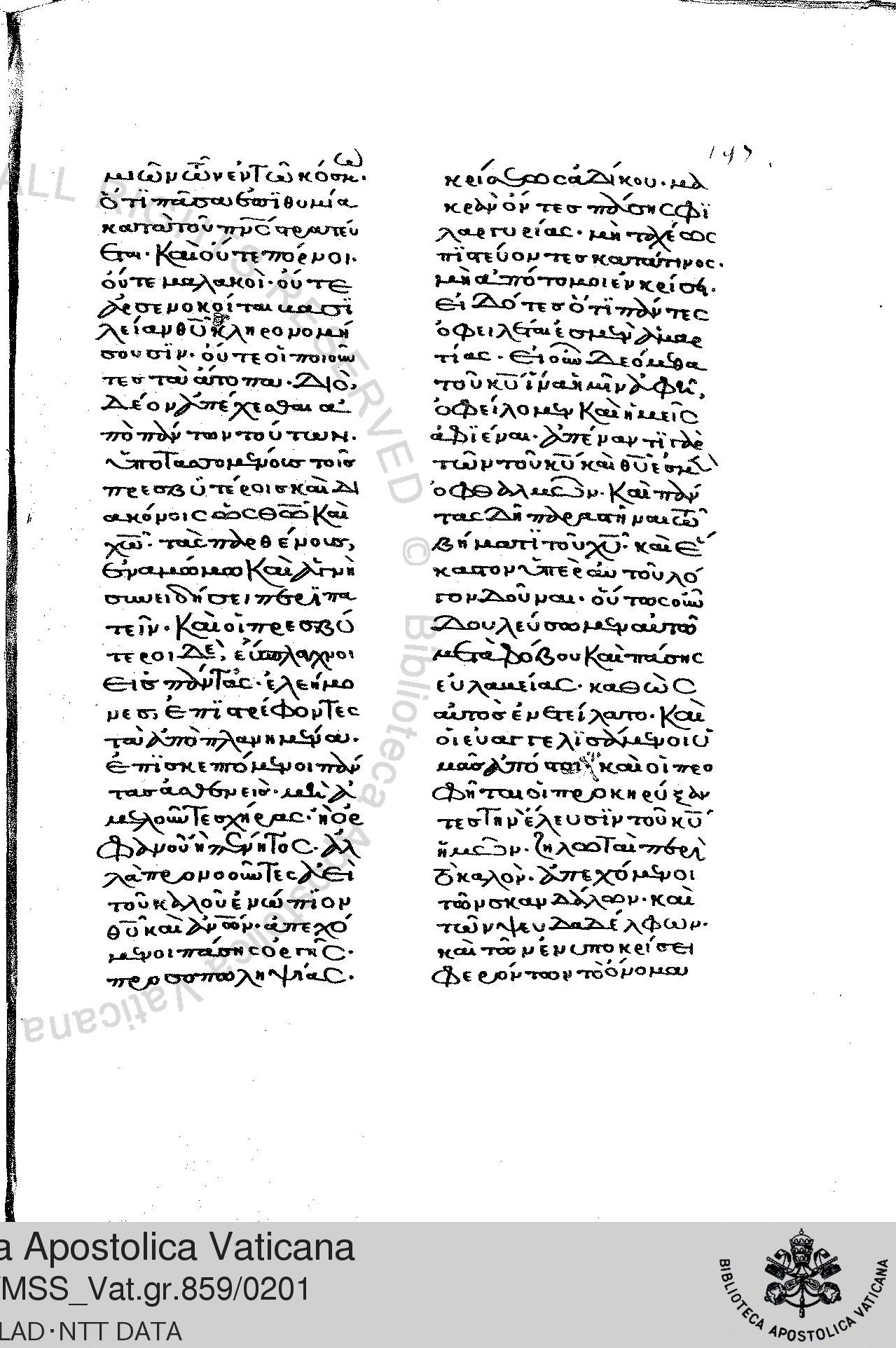
Checked on the images: Vat. gr. 859 fol. 196v: the page begins ‹καὶ ἁγνείᾳ, στεργούσας τοὺς ἑαυτῶν ἄνδρας (4.2)› and ends ‹καλὸν γὰρ τὸ ἀνακόπτεσθαι ἀπὸ τῶν ἐπιθυ- (5.3)›; Vat. gr. 859 fol. 197r: the page begins ‹-μιῶν τῶν ἐν τῷ κόσμῳ, ὅτι πᾶσα ἐπιθυμία κατὰ τοῦ πνεύματος στρατεύεται (5.3)› and ends ‹καὶ τῶν ἐν ὑποκρίσει φερόντων τὸ ὄνομα (6.3)›. The span of each page was found by reading its first and last words and locating them in the text. The Greek shown is Lake's edited text (1912), not a transcription of the page; the scribe's spellings and abbreviations differ in small details.
1Εἰδότες, οὖν, ὅτι θεὸς οὐ μυκτηρίζεται, ὀφείλομεν ἀξίως τῆς ἐντολῆς αὐτοῦ καὶ δόξης περιπατεῖν. 2ὁμοίως διάκονοι ἄμεμπτοι κατενώπιον αὐτοῦ τῆς δικαιοσύνης ὡς θεοῦ καὶ Χριστοῦ διάκονοι καὶ οὐκ ἀνθρώπων· μὴ διάβολοι, μὴ δίλογοι, ἀφιλάργυροι, ἐγκρατεῖς περὶ πάντα, εὔσπλαγχνοι, ἐπιμελεῖς, πορευόμενοι κατὰ τὴν ἀλήθειαν τοῦ κυρίου, ὃς ἐγένετο διάκονος πάντων· ᾧ ἐὰν εὐαρεστήσωμεν ἐν τῷ νῦν αἰῶνι, ἀποληψόμεθα καὶ τὸν μέλλοντα, καθὼς ὑπέσχετο ἡμῖν ἐγεῖραι ἡμᾶς ἐκ νεκρῶν, καὶ ὅτι ἐὰν πολιτευσώμεθα ἀξίως αὐτοῦ, καὶ συμβασιλεύσομεν αὐτῷ, εἴγε πιστεύομεν. 3ὁμοίως καὶ νεώτεροι ἄμεμπτοι ἐν πᾶσιν, πρὸ παντὸς προνοοῦντες ἁγνείας καὶ χαλιναγωγοῦντες ἑαυτοὺς ἀπὸ παντὸς κακοῦ. καλὸν γὰρ τὸ ἀνακόπτεσθαι ἀπὸ τῶν ἐπιθυμιῶν ἐν τῷ κόσμῳ, ὅτι πᾶσα ἐπιθυμία κατὰ τοῦ πνεύματος στρατεύεται, καὶ οὔτε πόρνοι οὔτε μαλακοὶ οὔτε ἀρσενοκοῖται βασιλείαν θεοῦ κληρονομήσουσιν, οὔτε οἱ ποιοῦντες τὰ ἄτοπα. διὸ δέον ἀπέχεσθαι ἀπὸ πάντων τούτων, ὑποτασσομένους τοῖς πρεσβυτέροις καὶ διακόνοις ὡς θεῷ καὶ Χριστῷ· τὰς παρθένους ἐν ἀμώμῳ καὶ ἁγνῇ συνειδήσει περιπατεῖν.
1Knowing then that God is not mocked, we ought to walk worthily of His commandment and His glory. 2In like manner deacons should be blameless in the presence of His righteousness, as deacons of God and Christ and not of men; not calumniators, not double-tongued, not lovers of money, temperate in all things, compassionate, diligent, walking according to the truth of the Lord who became a minister (deacon) of all. For if we be well pleasing unto Him in this present world, we shall receive the future world also, according as He promised us to raise us from the dead, and that if we conduct ourselves worthily of Him we shall also reign with Him, if indeed we have faith. 3In like manner also the younger men must be blameless in all things, caring for purity before everything and curbing themselves from every evil. For it is a good thing to refrain from lusts in the world, for every lust warreth against the Spirit, and neither whoremongers nor effeminate persons nor defilers of themselves with men shall inherit the kingdom of God, neither they that do untoward things. Wherefore it is right to abstain from all these things, submitting yourselves to the presbyters and deacons as to God and Christ. The virgins must walk in a blameless and pure conscience.
Where on the image
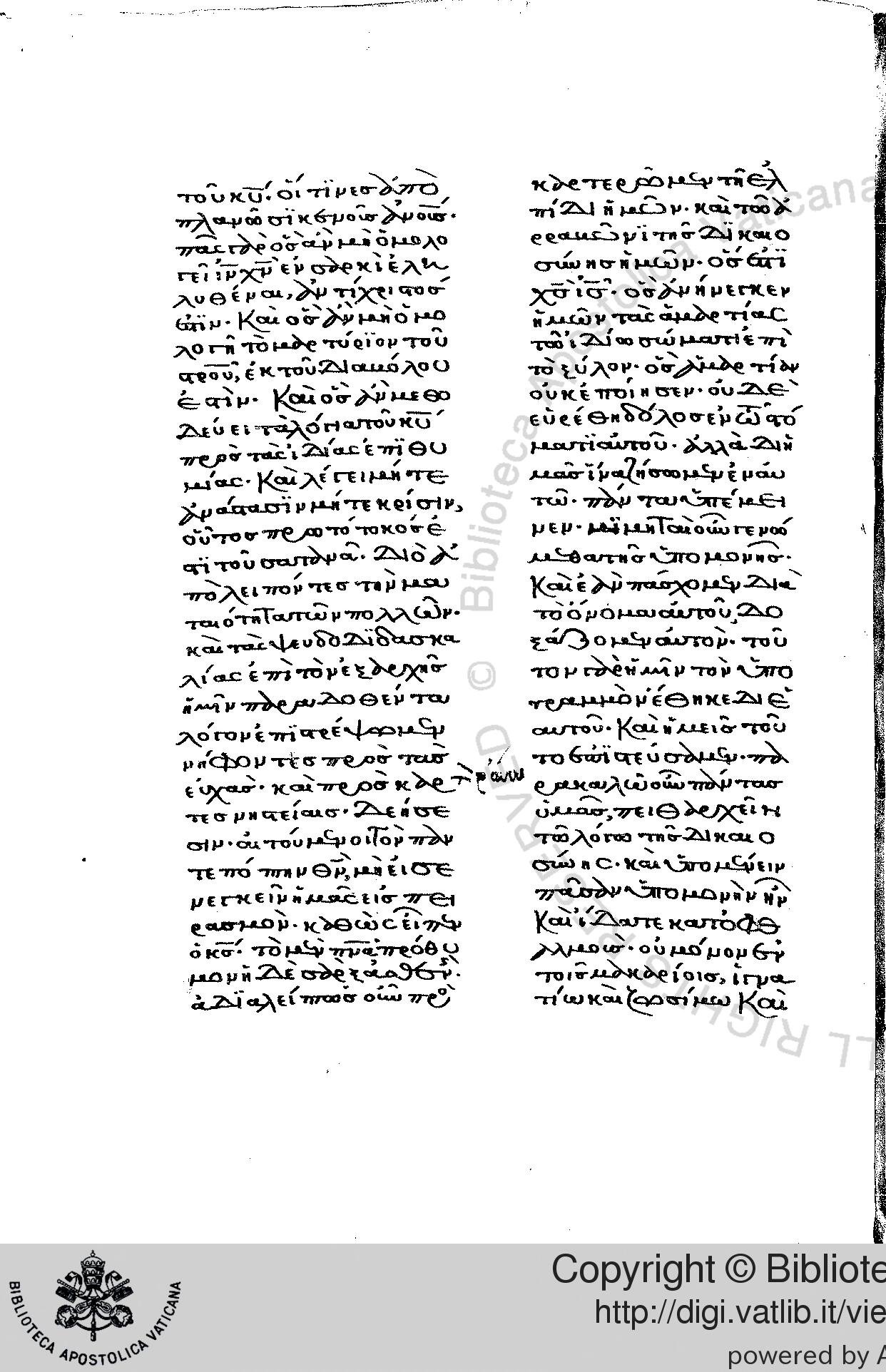
Checked on the images: Vat. gr. 859 fol. 197r: the page begins ‹-μιῶν τῶν ἐν τῷ κόσμῳ, ὅτι πᾶσα ἐπιθυμία κατὰ τοῦ πνεύματος στρατεύεται (5.3)› and ends ‹καὶ τῶν ἐν ὑποκρίσει φερόντων τὸ ὄνομα (6.3)›; Vat. gr. 859 fol. 197v: the page begins ‹τοῦ κυρίου, οἵτινες ἀποπλανῶσι κενοὺς ἀνθρώπους (6.3)› and ends ‹ἐν τοῖς μακαρίοις Ἰγνατίῳ καὶ Ζωσίμῳ καὶ (9.1)›. The span of each page was found by reading its first and last words and locating them in the text. The Greek shown is Lake's edited text (1912), not a transcription of the page; the scribe's spellings and abbreviations differ in small details.
1Καὶ οἱ πρεσβύτεροι δὲ εὔσπλαγχνοι, εἰς πάντας ἐλεήμονες, ἐπιστρέφοντες τὰ ἀποπεπλανημένα, ἐπισκεπτόμενοι πάντας ἀσθενεῖς, μὴ ἀμελοῦντες χήρας ἢ ὀρφανοῦ ἢ πένητος ἀλλὰ προνοοῦντες ἀεὶ τοῦ καλοῦ ἐνώπιον θεοῦ καὶ ἀνθρώπων, ἀπεχόμενοι πάσης ὀργῆς, προσωποληψίας, κρίσεως ἀδίκου, μακρὰν ὄντες πάσης φιλαργυρίας, μὴ ταχέως πιστεύοντες κατά τινος, μὴ ἀπότομοι ἐν κρίσει, εἰδότες ὅτι πάντες ὀφειλέται ἐσμὲν ἁμαρτίας. 2εἰ οὖν δεόμεθα τοῦ κυρίου, ἵνα ἡμῖν ἀφῇ, ὀφείλομεν καὶ ἡμεῖς ἀφιέναι· ἀπέναντι γὰρ τῶν τοῦ κυρίου καὶ θεοῦ ἐσμὲν ὀφθαλμῶν, καὶ πάντας δεῖ παραστῆναι τῷ βήματι τοῦ Χριστοῦ καὶ ἕκαστον ὑπὲρ αὐτοῦ λόγον δοῦναι. 3οὕτως οὖν δουλεύσωμεν αὐτῷ μετὰ φόβου καὶ πάσης εὐλαβείας, καθὼς αὐτὸς ἐνετείλατο καὶ οἱ εὐαγγελισάμενοι ἡμᾶς ἀπόστολοι καὶ οἱ προφῆται, οἱ προκηρύξαντες τὴν ἔλευσιν τοῦ κυρίου ἡμῶν· ζηλωταὶ περὶ τὸ καλόν, ἀπεχόμενοι τῶν σκανδάλων καὶ τῶν ψευδαδέλφων καὶ τῶν ἐν ὑποκρίσει φερόντων τὸ ὄνομα τοῦ κυρίον, οἵτινες ἀποπλανῶσι κενοὺς ἀνθρώπους.
1And the presbyters also must be compassionate, merciful towards all men, turning back the sheep that are gone astray, visiting all the infirm, not neglecting a widow or an orphan or a poor man: but providing always for that which is honorable in the sight of God and of men, abstaining from all anger, respect of persons, unrighteous judgment, being far from all love of money, not quick to believe anything against any man, not hasty in judgment, knowing that we all are debtors of sin. 2If then we entreat the Lord that He would forgive us, we also ought to forgive: for we are before the eyes of our Lord and God, and we must all stand at the judgment-seat of Christ, and each man must give an account of himself. 3Let us therefore so serve Him with fear and all reverence, as He himself gave commandment and the Apostles who preached the Gospel to us and the prophets who proclaimed beforehand the coming of our Lord; being zealous as touching that which is good, abstaining from offences and from the false brethren and from them that bear the name of the Lord in hypocrisy, who lead foolish men astray.
Where on the image
Checked on the images: Vat. gr. 859 fol. 197v: the page begins ‹τοῦ κυρίου, οἵτινες ἀποπλανῶσι κενοὺς ἀνθρώπους (6.3)› and ends ‹ἐν τοῖς μακαρίοις Ἰγνατίῳ καὶ Ζωσίμῳ καὶ (9.1)›. The span of each page was found by reading its first and last words and locating them in the text. The Greek shown is Lake's edited text (1912), not a transcription of the page; the scribe's spellings and abbreviations differ in small details.
1Πᾶς γὰρ ὃς ἂν μὴ ὁμολογῇ Ἰησοῦν Χριστὸν ἐν σαρκὶ ἐληλυθέναι, ἀντιχριστός ἐστιν· καὶ ὃς ἂν μὴ ὁμολογῇ τὸ μαρτύριον τοῦ σταυροῦ, ἐκ τοῦ διαβόλου ἐστίν· καὶ ὃς ἂν μεθοδεύῃ τὰ λόγια τοῦ κυρίου πρὸς τὰς ἰδίας ἐπιθυμίας καὶ λέγῃ μήτε ἀνάστασιν μήτε κρίσιν, οὗτος πρωτότοκος ἐστι τοῦ σατανᾶ. 2διὸ ἀπολιπόντες τὴν ματαιότητα τῶν πολλῶν καὶ τὰς ψευδοδιδασκαλίας ἐπὶ τὸν ἐξ ἀρχῆς ἡμῖν παραδοθέντα λόγον ἐπιστρέψωμεν, νήφοντες πρὸς τὰς εὐχὰς καὶ προσκαρτεροῦντες νηστείαις, δεήσεσιν αἰτούμενοι τὸν παντεπόπτην θεὸν μὴ εἰσενεγκεῖν ἡμᾶς εἰς πειρασμόν, καθὼς εἶπεν ὁ κύριος· Τὸ μὲν πνεῦμα πρόθυμον, ἡ δὲ σὰρξ ἀσθενής.
1For every one who shall not confess that Jesus Christ is come in the flesh, is antichrist: and whosoever shall not confess the testimony of the Cross, is of the devil; and whosoever shall pervert the oracles of the Lord to his own lusts and say that there is neither resurrection nor judgment, that man is the first-born of Satan. 2Wherefore let us forsake the vain doing of the many and their false teachings, and turn unto the word which was delivered unto us from the beginning, being sober unto prayer and constant in fastings, entreating the all-seeing God with supplications that He bring us not into temptation, according as the Lord said, The spirit is indeed willing, but the flesh is weak.
Where on the image
Checked on the images: Vat. gr. 859 fol. 197v: the page begins ‹τοῦ κυρίου, οἵτινες ἀποπλανῶσι κενοὺς ἀνθρώπους (6.3)› and ends ‹ἐν τοῖς μακαρίοις Ἰγνατίῳ καὶ Ζωσίμῳ καὶ (9.1)›. The span of each page was found by reading its first and last words and locating them in the text. The Greek shown is Lake's edited text (1912), not a transcription of the page; the scribe's spellings and abbreviations differ in small details.
1Ἀδιαλείπτως οὖν προσκαρτερῶμεν τῇ ἐλπίδι ἡμῶν καὶ τῷ ἀρραβῶνι τῆς δικαιοσύνης ἡμῶν, ὅς ἐστι Χριστὸς Ἰησοῦς, ὃς ἀνήνεγκεν ἡμῶν τὰς ἁμαρτίας τῷ ἰδίῳ σώματι ἐπὶ τὸ ξύλον, ὃς ἁμαρτίαν οὐκ ἐποίησεν, οὐδὲ εὑρέθη δόλος ἐν τῷ στόματι αὐτοῦ· ἀλλὰ δι’ ἡμᾶς, ἵνα ζήσωμεν ἐν αὐτῷ, πάντα ὑπέμεινεν. 2μιμηταὶ οὖν γενώμεθα τῆς ὑπομονῆς αὐτοῦ, καὶ ἐὰν πάσχωμεν διὰ τὸ ὄνομα αὐτοῦ, δοξάζωμεν αὐτόν. τοῦτον γὰρ ἡμῖν τὸν ὑπογραμμὸν ἔθηκε δι’ ἑαυτοῦ, καὶ ἡμεῖς τοῦτο ἐπιστεύσαμεν.
1Let us therefore without ceasing hold fast by our hope and by the earnest of our righteousness, which is Jesus Christ who took up our sins in His own body upon the tree, who did no sin, neither was guile found in His mouth, but for our sakes He endured all things, that we might live in Him. 2Let us therefore become imitators of His endurance; and if we should suffer for His name’s sake, let us glorify Him. For He gave this example to us in His own person, and we believed this.
Where on the image
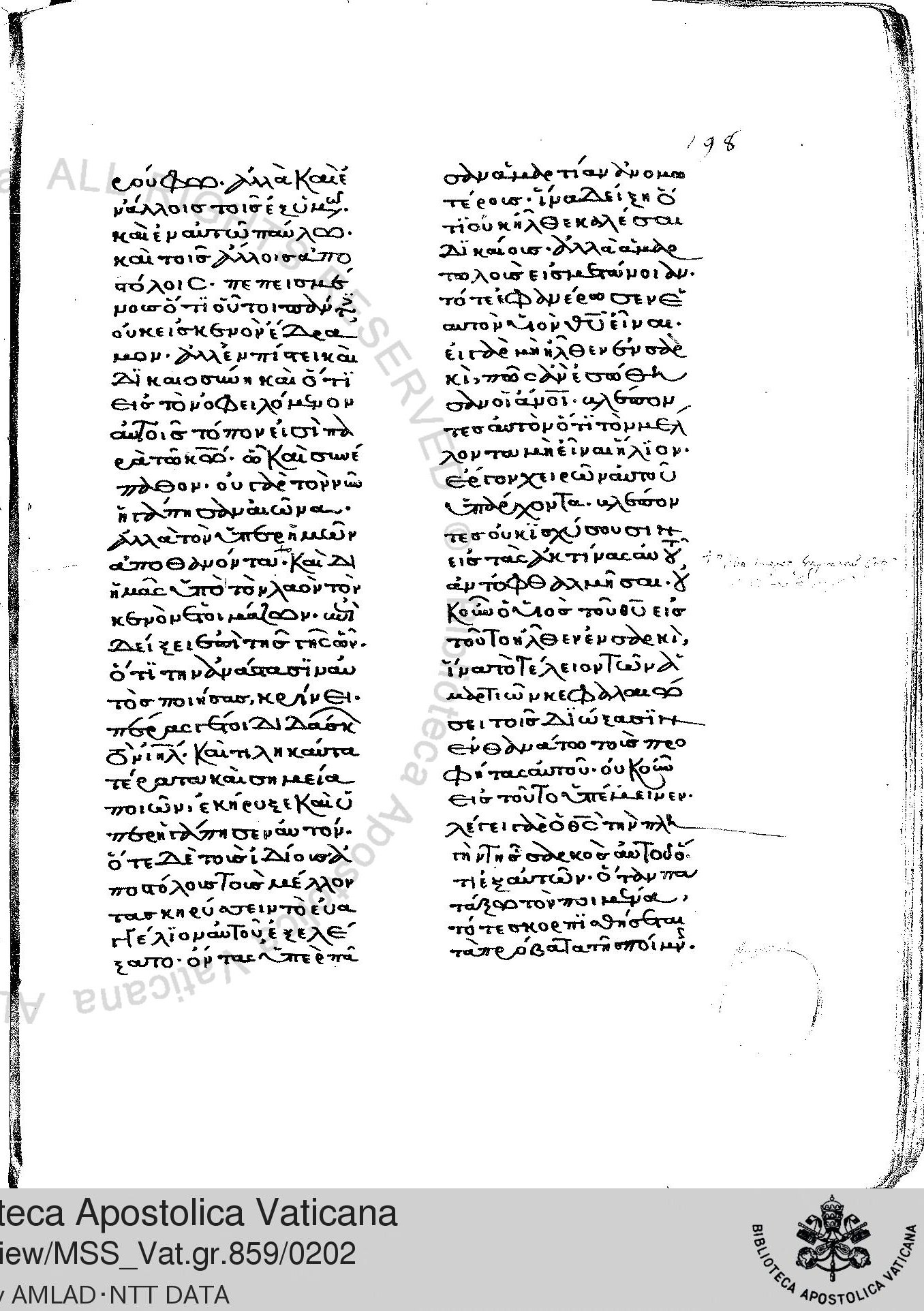
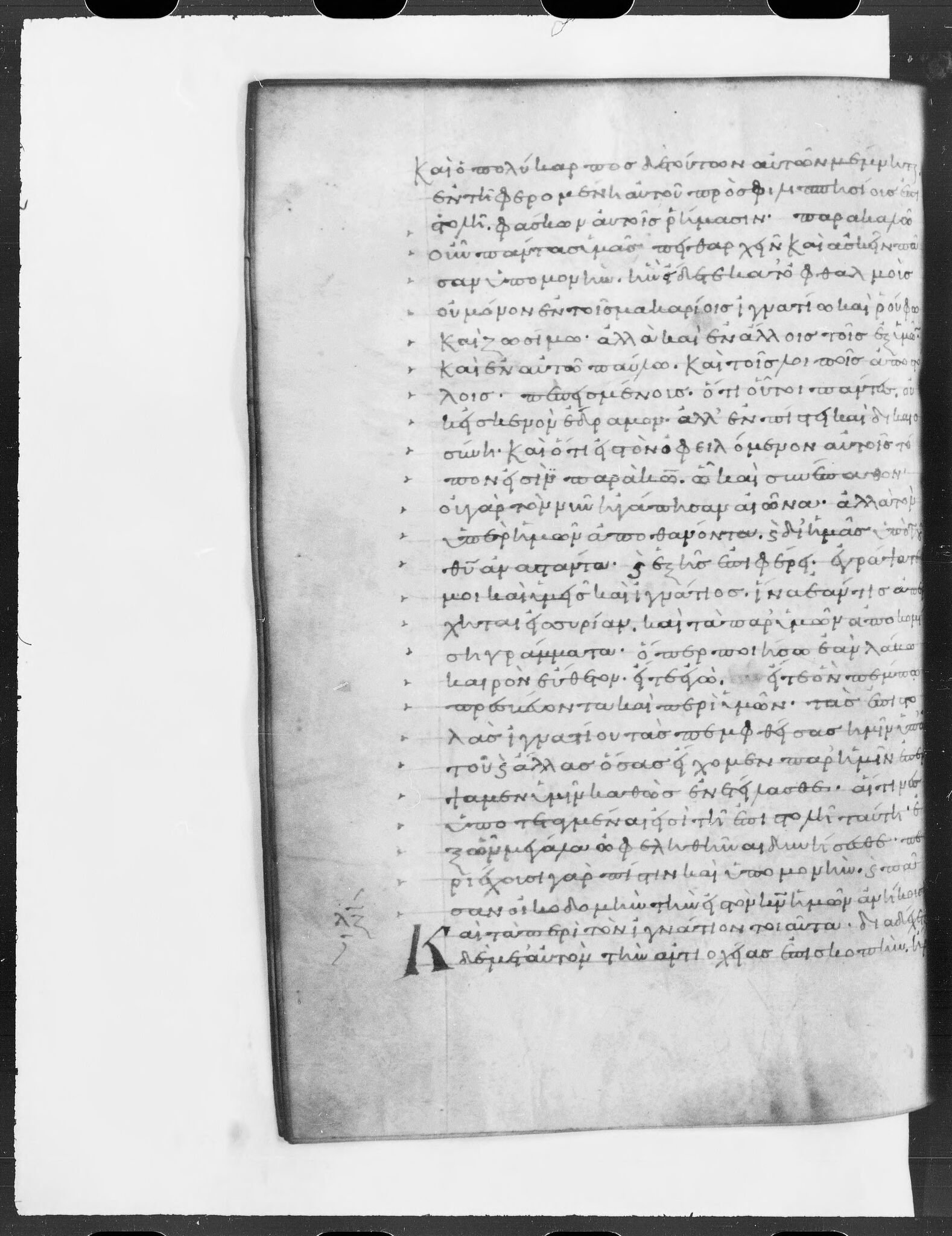
Checked on the images: Vat. gr. 859 fol. 197v: the page begins ‹τοῦ κυρίου, οἵτινες ἀποπλανῶσι κενοὺς ἀνθρώπους (6.3)› and ends ‹ἐν τοῖς μακαρίοις Ἰγνατίῳ καὶ Ζωσίμῳ καὶ (9.1)›; Vat. gr. 859 fol. 198r: the page begins ‹Ῥούφῳ, ἀλλὰ καὶ ἐν ἄλλοις τοῖς ἐξ ὑμῶν (9.1)› and ends ‹col. a line 17 ἀλλὰ τὸν ὑπὲρ ἡμῶν ἀποθανόντα καὶ δι’ ἡμᾶς (9.2), after which the copy runs on without a break into the Letter of Barnabas 5.7 (τὸν λαὸν τὸν καινὸν ἑτοιμάζων)›; Paris gr. 1431 fol. 78v (Eusebius, Church History 3.36.13-15): ‹Καὶ ὁ Πολύκαρπος δὲ τούτων αὐτῶν μέμνηται ἐν τῇ φερομένῃ αὐτοῦ πρὸς Φιλιππησίους ἐπιστολῇ ... παρακαλῶ οὖν πάντας ὑμᾶς (Phil. 9.1)› ... ‹πᾶσαν οἰκοδομὴν τὴν εἰς τὸν κύριον ἡμῶν ἀνήκουσαν (Phil. 13.2), followed by Καὶ τὰ μὲν περὶ τὸν Ἰγνάτιον τοιαῦτα (end of the quotation, which is marked with diplai in the margin)›. The span of each page was found by reading its first and last words and locating them in the text. Vat. gr. 859, like every Greek manuscript of the letter, breaks off in 9.2 after καὶ δι’ ἡμᾶς; the rest of the sentence (ὑπὸ τοῦ θεοῦ ἀναστάντα) comes from Eusebius, whose quotation of the whole chapter is shown on Paris gr. 1431. The Greek shown is Lake's edited text (1912).
1Παρακαλῶ οὖν πάντας ὑμᾶς, πειθαρχεῖν τῷ λόγῳ τῆς δικαιοσύνης καὶ ἀσκεῖν πᾶσαν ὑπομονήν, ἣν καὶ εἴδατε κατ’ ὀφθαλμοὺς οὐ μόνον ἐν τοῖς μακαρίοις Ἰγνατίῳ καὶ Ζωσίμῳ καὶ Ῥούφῳ, ἀλλὰ καὶ ἐν ἄλλοις τοῖς ἐξ ὑμῶν καὶ ἐν αὐτῷ Παύλῳ καὶ τοῖς λοιποῖς ἀποστόλοις· 2πεπεισμένους ὅτι οὗτοι πάντες οὐκ εἰς κενὸν ἔδραμον, ἀλλ’ ἐν πίστει καὶ δικαιοσύνῃ, καὶ ὅτι εἰς τὸν ὀφειλόμενον αὐτοῖς τόπον εἰσὶ παρὰ τῷ κυρίῳ, ᾧ καὶ συνέπαθον. οὐ γὰρ τὸν νῦν ἠγάπησαν αἰῶνα, ἀλλὰ τὸν ὑπὲρ ἡμῶν ἀποθανόντα καὶ δι’ ἡμᾶς ὑπὸ τοῦ θεοῦ ἀναστάντα.
1I exhort you all therefore to be obedient unto the word of righteousness and to practise all endurance, which also ye saw with your own eyes in the blessed Ignatius and Zosimus and Rufus, yea and in others also who came from among yourselves, as well as in Paul himself and the rest of the Apostles; 2being persuaded that all these ran not in vain but in faith and righteousness, and that they are in their due place in the presence of the Lord, with whom also they suffered. For they loved not the present world, but Him that died for our sakes and was raised by God for us.
Where on the image
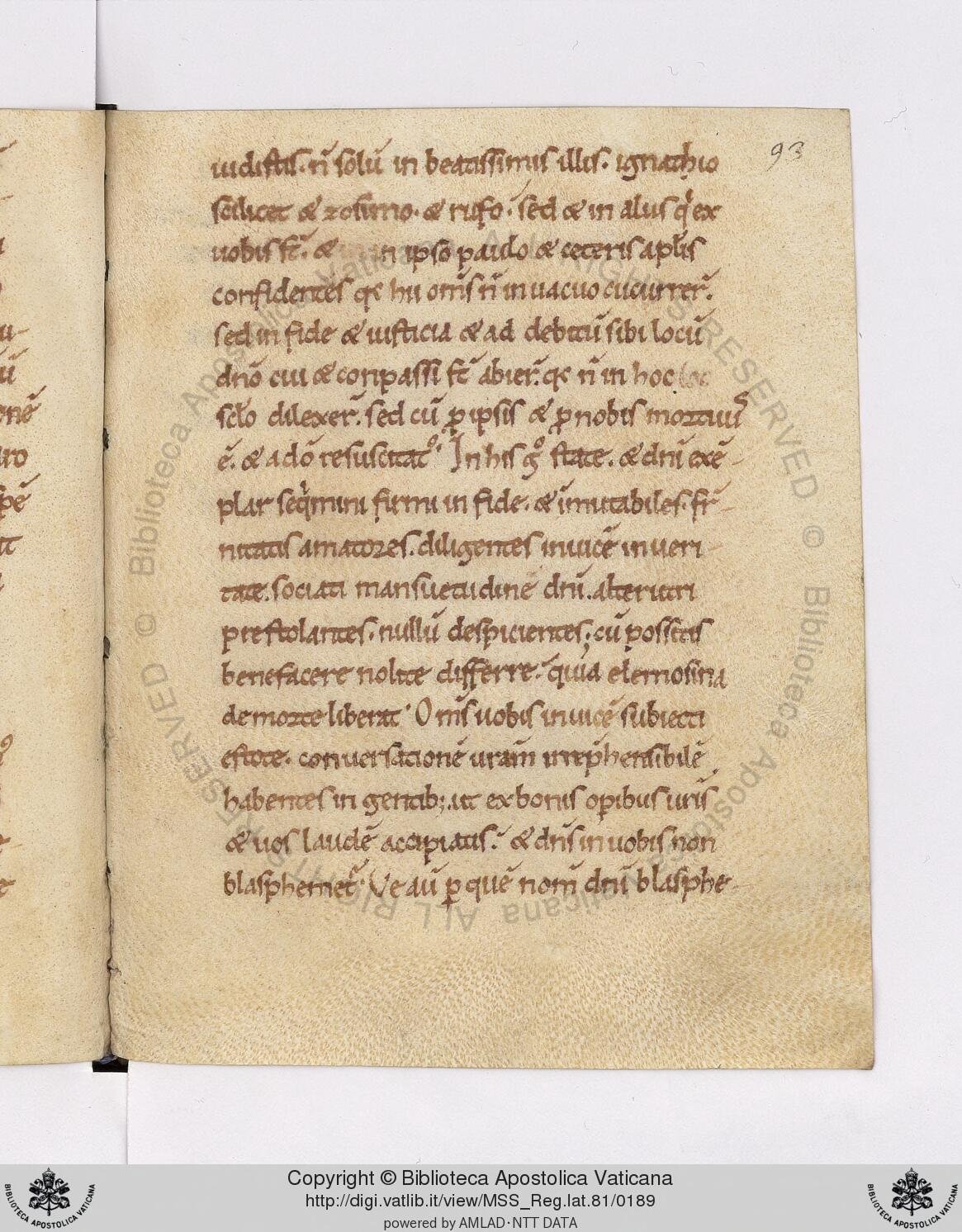
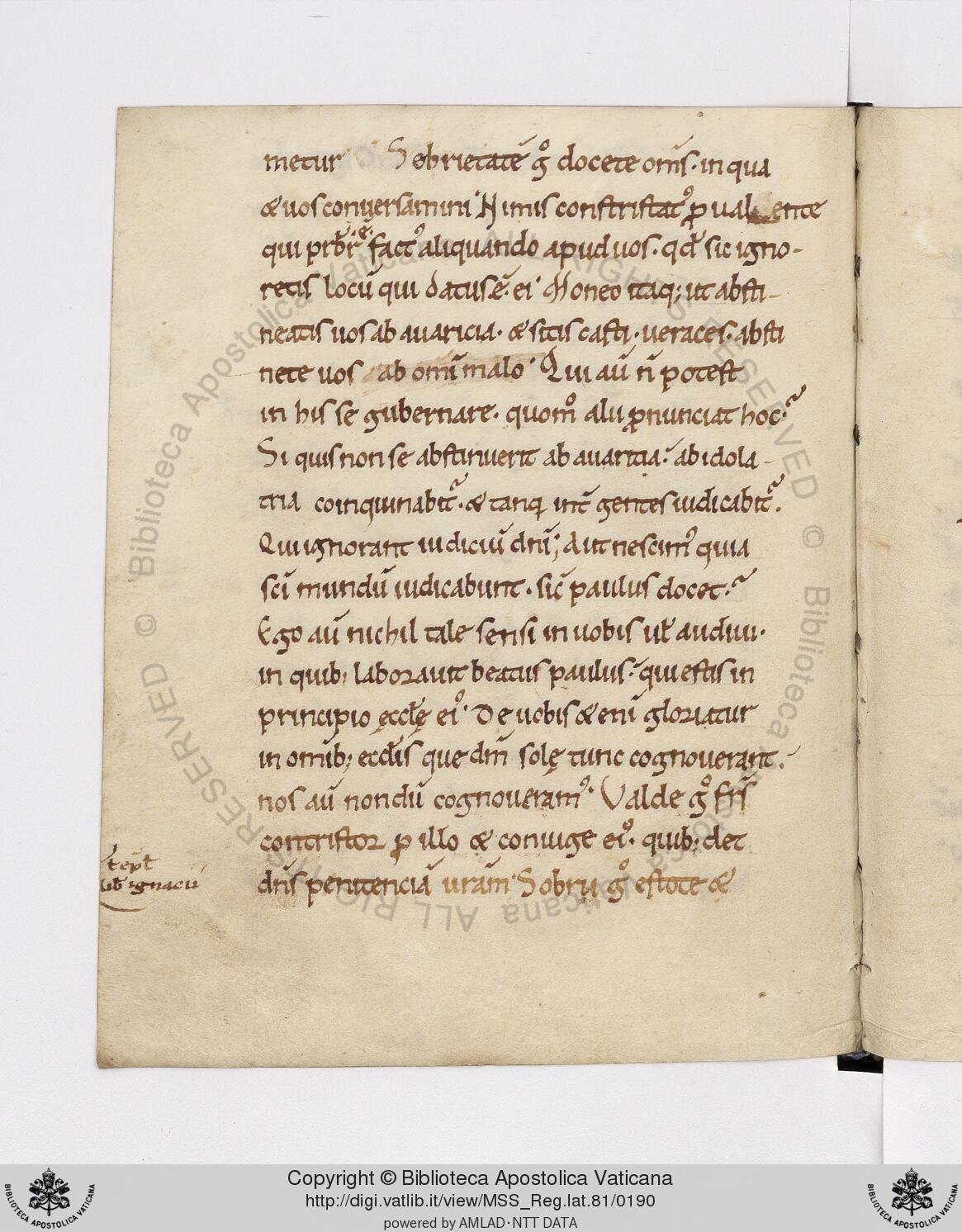
Checked on the images: Reg. lat. 81 fol. 93r: the page begins ‹vidistis non solum in beatissimis illis Ignatio scilicet et Zosimo et Rufo (9.1)› and ends ‹Vae autem per quem nomen domini blasphe- (10.3)›; Reg. lat. 81 fol. 93v: the page begins ‹-matur. Sobrietatem ergo docete omnes (10.3)› and ends ‹Sobrii ergo estote et (11.4)›. The span of each page was found by reading its first and last words and locating them in the text. No Greek manuscript or quotation preserves this chapter; the text shown is the ancient Latin version as edited by Lake (1912), and the Latin manuscript's spelling and wording differ from it in small details.
1In his ergo state et domini exemplar sequimini, firmi in fide et immutabiles, fraternitatis amatores, diligentes invicem, in veritate sociati, mansuetudine domini alterutri praestolantes, nullum despicientes. 2Cum possitis benefacere, nolite differre, quia eleëmosyna de morte liberat. Omnes vobis invicem subiecti estote, conversationem vestram irreprensibilem habentes in gentibus, ut ex bonis operibus vestris et vos laudem accipiatis et dominus in vobis non blasphemetur. 3Vae autem, per quem nomen domini blasphematur. Sobrietatem ergo docete omnes, in qua et vos conversamini.
1Stand fast therefore in these things and follow the example of the Lord, being firm in the faith and immovable, in love of the brotherhood kindly affectioned one to another, partners with the truth, forestalling one another in the gentleness of the Lord, despising no man. 2When ye are able to do good, defer it not, for Pitifulness delivereth from death. Be ye all subject one to another, having your conversation unblameable among the Gentiles, that from your good works both ye may receive praise and the Lord may not be blasphemed in you. 3But woe to him through whom the name of the Lord is blasphemed. Therefore teach all men soberness, in which ye yourselves also walk.
Where on the image
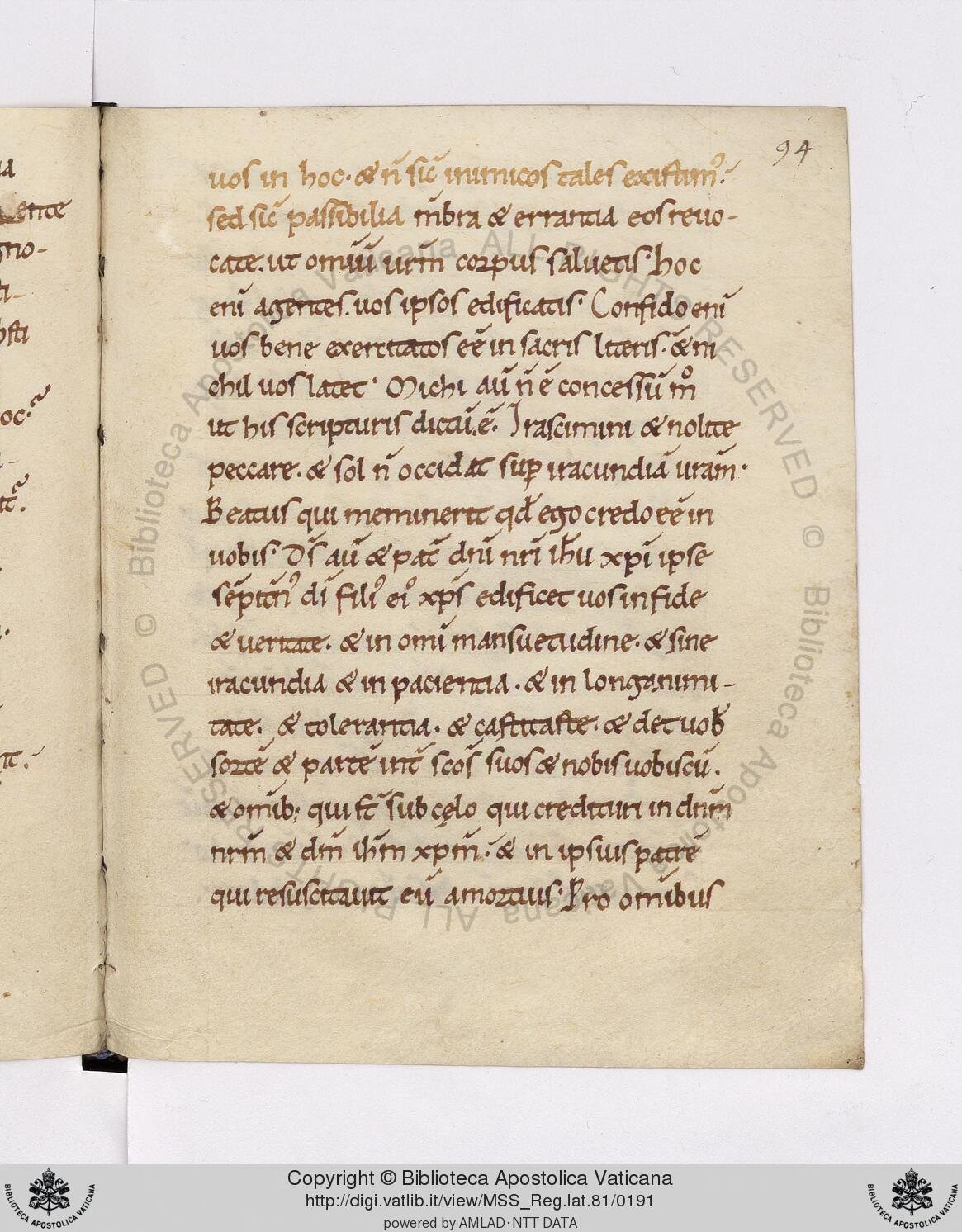
Checked on the images: Reg. lat. 81 fol. 93v: the page begins ‹-matur. Sobrietatem ergo docete omnes (10.3)› and ends ‹Sobrii ergo estote et (11.4)›; Reg. lat. 81 fol. 94r: the page begins ‹vos in hoc, et non sicut inimicos tales existimetis (11.4)› and ends ‹qui resuscitavit eum a mortuis. Pro omnibus (12.2-3)›. The span of each page was found by reading its first and last words and locating them in the text. No Greek manuscript or quotation preserves this chapter; the text shown is the ancient Latin version as edited by Lake (1912), and the Latin manuscript's spelling and wording differ from it in small details.
1Nimis contristatus sum pro Valente, qui presbyter factus est aliquando apud vos, quod sic ignoret is locum qui datus est ei. Moneo itaque ut abstineatis vos ab avaritia et sitis casti veraces. Abstinete vos ab omni malo. 2Qui autem non potest se in his gubernare, quomodo alii pronuntiat hoc? Si quis non se abstinuerit ab avaritia, ab idololatria coinquinabitur et tamquam inter gentes iudicabitur, qui ignorant iudicium domini. Aut nescimus, quia sancti mundum iudicabunt? sicut Paulus docet. 3Ego autem nihil tale sensi in vobis vel audivi, in quibus laboravit beatus Paulus, qui estis in principio epistulae eius. De vobis etenim gloriatur in omnibus ecclesiis, quae dominum solae tunc cognoverant; nos autem nondum cognoveramus. 4Valde ergo, fratres, contristor pro illo et pro coniuge eius, quibus det dominus paenitentiam veram. Sobrii ergo estote et vos in hoc; et non sicut inimicos tales existimetis, sed sicut passibilia membra et errantia eos revocate, ut omnium vestrum corpus salvetis. Hoc enim agentes vos ipsos aedificatis.
1I was exceedingly grieved for Valens, who aforetime was a presbyter among you, because he is so ignorant of the office which was given unto him. I warn you therefore that ye refrain from covetousness, and that ye be pure and truthful. Refrain from all evil. 2But he who cannot govern himself in these things, how doth he enjoin this upon another? If a man refrain not from covetousness, he shall be defiled by idolatry, and shall be judged as one of the Gentiles who know not the judgment of the Lord. Nay, know we not, that the saints shall judge the world, as Paul teacheth? 3But I have not found any such thing in you, neither have heard thereof, among whom the blessed Paul labored, who were his letters in the beginning. For he boasteth of you in all those churches which alone at that time knew God; for we knew Him not as yet. 4Therefore I am exceedingly grieved for him and for his wife, unto whom may the Lord grant true repentance. Be ye therefore yourselves also sober herein, and hold not such as enemies, but restore them as frail and erring members, that ye may save the whole body of you. For so doing, ye do edify one another.
Where on the image
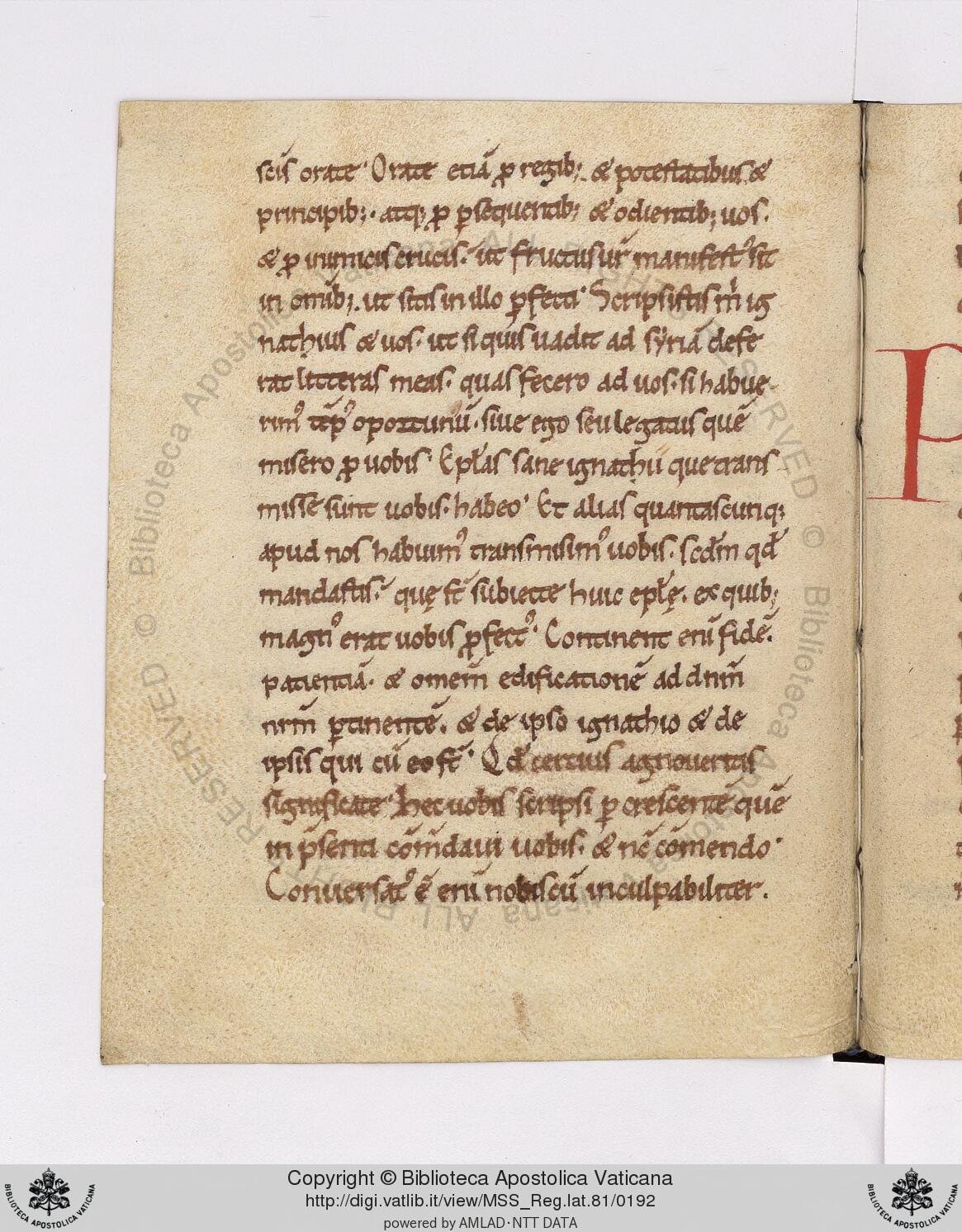
Checked on the images: Reg. lat. 81 fol. 94r: the page begins ‹vos in hoc, et non sicut inimicos tales existimetis (11.4)› and ends ‹qui resuscitavit eum a mortuis. Pro omnibus (12.2-3)›; Reg. lat. 81 fol. 94v: the page begins ‹sanctis orate. Orate etiam pro regibus (12.3)› and ends ‹Conversatus est enim nobiscum inculpabiliter (14)›. The span of each page was found by reading its first and last words and locating them in the text. No Greek manuscript or quotation preserves this chapter; the text shown is the ancient Latin version as edited by Lake (1912), and the Latin manuscript's spelling and wording differ from it in small details.
1Confido enim vos bene exercitatos esse in sacris literis et nihil vos latet; mihi autem non est concessum. Modo, ut his scripturis dictum est, irascimini et nolite peccare, et sol non occidat super iracundiam vestram. Beatus, qui meminerit; quod ego credo esse in vobis. 2Deus autem et pater domini nostri Iesu Christi, et ipse sempiternus pontifex, dei filius Iesus Christus, aedificet vos in fide et veritate et in omni mansuetudine et sine iracundia et in patientia et in longanimitate et tolerantia et castitate; et det vobis sortem et partem inter sanctos suos et nobis vobiscum et omnibus, qui sunt sub caelo, qui credituri sunt in dominum nostrum et deum Iesum Christum et in ipsius patrem, qui resuscitavit eum a mortuis. 3Pro omnibus sanctis orate. Orate etiam pro regibus et potestatibus et principibus atque pro persequentibus et odientibus vos et pro inimicis crucis, ut fructus vester manifestus sit in omnibus, ut sitis in illo perfecti.
1For I am persuaded that ye are well trained in the sacred writings, and nothing is hidden from you. But to myself this is not granted. Only, as it is said in these scriptures, Be ye angry and sin not, and Let not the sun set on your wrath. Blessed is he that remembereth this; and I trust that this is in you. 2Now may the God and Father of our Lord Jesus Christ, and the eternal High-priest Himself, the [Son of] God Jesus Christ, build you up in faith and truth, and in all gentleness and in all avoidance of wrath and in forbearance and long suffering and in patient endurance and in purity; and may He grant unto you a lot and portion among His saints, and to us with you, and to all that are under heaven, who shall believe on our Lord and God Jesus Christ and on His Father that raised Him from the dead. 3Pray for all the saints. Pray also for kings and powers and princes, and for them that persecute and hate you, and for the enemies of the cross, that your fruit may be manifest among all men, that ye may be perfect in Him.
Where on the image
Checked on the images: Paris gr. 1431 fol. 78v (Eusebius, Church History 3.36.13-15): ‹Καὶ ὁ Πολύκαρπος δὲ τούτων αὐτῶν μέμνηται ἐν τῇ φερομένῃ αὐτοῦ πρὸς Φιλιππησίους ἐπιστολῇ ... παρακαλῶ οὖν πάντας ὑμᾶς (Phil. 9.1)› ... ‹πᾶσαν οἰκοδομὴν τὴν εἰς τὸν κύριον ἡμῶν ἀνήκουσαν (Phil. 13.2), followed by Καὶ τὰ μὲν περὶ τὸν Ἰγνάτιον τοιαῦτα (end of the quotation, which is marked with diplai in the margin)›; Reg. lat. 81 fol. 94v: the page begins ‹sanctis orate. Orate etiam pro regibus (12.3)› and ends ‹Conversatus est enim nobiscum inculpabiliter (14)›. The span of each page was found by reading its first and last words and locating them in the text. The Greek of 13.1-2 (to ἀνήκουσαν) is known only from Eusebius' quotation, shown here on Paris gr. 1431; the last sentence survives only in Latin and is shown on Reg. lat. 81 fol. 94v, where the whole chapter stands in the Latin version. The text is Lake's edition (1912).
1Ἐγράψατέ μοι καὶ ὑμεῖς καὶ Ἰγνάτιος, ἵν’, ἐάν τις ἀπέρχηται εἰς Συρίαν, καὶ τὰ παρ’ ὑμῶν ἀποκομίσῃ γράμματα· ὅπερ ποιήσω, ἐὰν λάβω καιρὸν εὔθετον, εἴτε ἐγώ, εἴτε ὃν πέμπω πρεσβεύσοντα καὶ περὶ ὑμῶν. 2τὰς ἐπιστολὰς Ἰγνατίου τὰς πεμφθείσας ἡμῖν ὑπ’ αὐτοῦ καὶ ἄλλας, ὅσας εἴχομεν παρ’ ἡμῖν, ἐπέμψαμεν ὑμῖν, καθὼς ἐνετείλασθε· αἵτινες ὑποτεταγμέναι εἰσὶν τῇ ἐπιστολῇ ταύτῃ, ἐξ ὧν μεγάλα ὠφεληθῆναι δυνήσεσθε. περιέχουσι γὰρ πίστιν καὶ ὑπομονὴν καὶ πᾶσαν οἰκοδομὴν τὴν εἰς τὸν κύριον ἡμῶν ἀνήκουσαν. Et de ipso Ignatio et de his, qui cum eo sunt, quod certius agnoveritis, significate.
1Ye wrote to me, both ye yourselves and Ignatius, asking that if any one should go to Syria he might carry thither the letters from you. And this I will do, if I get a fit opportunity, either I myself, or he whom I shall send to be ambassador on your behalf also. 2The letters of Ignatius which were sent to us by him, and others as many as we had by us, we send unto you, according as ye gave charge; the which are subjoined to this letter; from which ye will be able to gain great advantage. For they comprise faith and endurance and every kind of edification, which pertaineth unto our Lord. Moreover concerning Ignatius himself and those that were with him, if ye have any sure tidings, certify us.
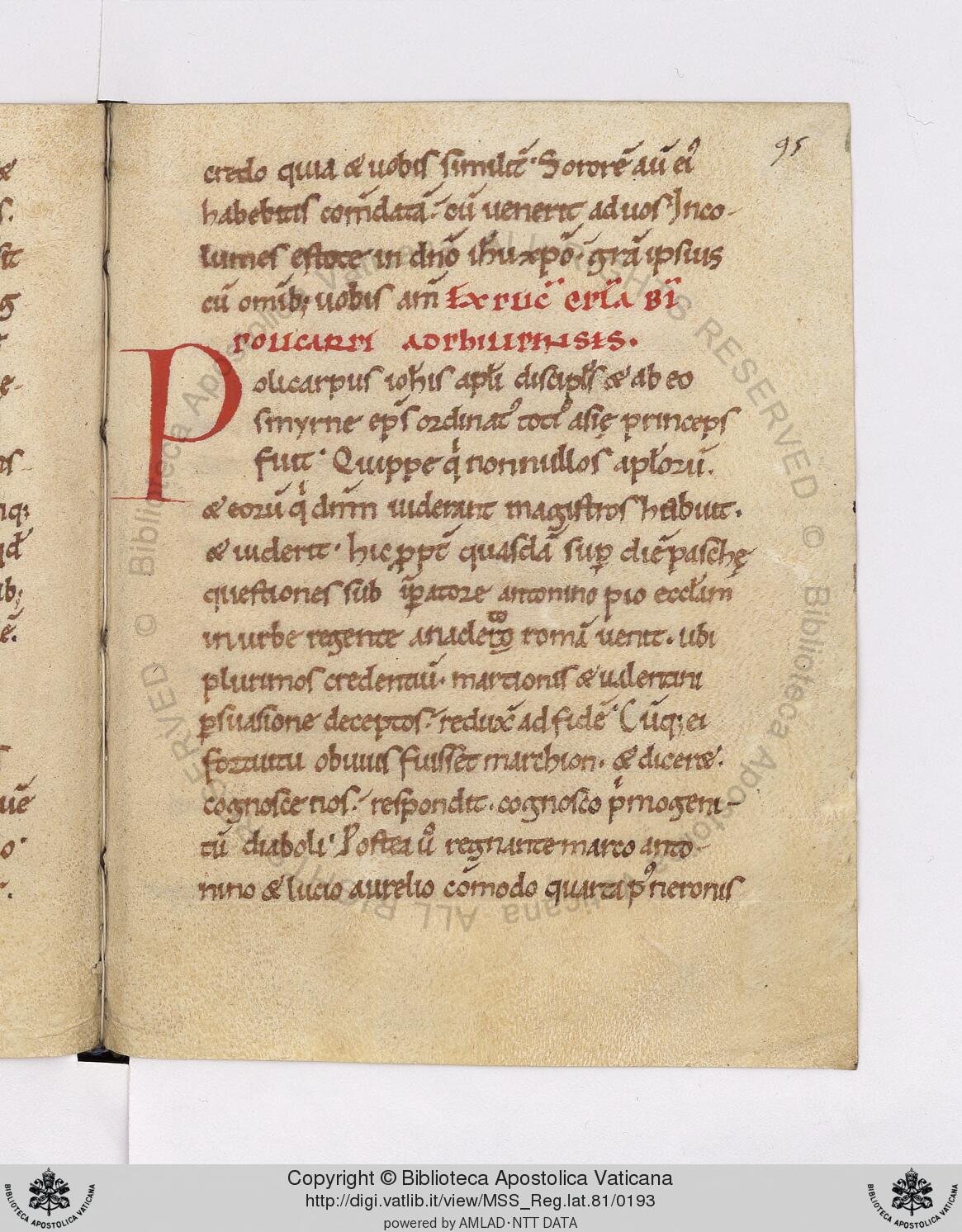
Where on the image
Checked on the images: Reg. lat. 81 fol. 94v: the page begins ‹sanctis orate. Orate etiam pro regibus (12.3)› and ends ‹Conversatus est enim nobiscum inculpabiliter (14)›; Reg. lat. 81 fol. 95r: the page begins ‹credo quia et vobiscum similiter (14)› and ends ‹cum omnibus vestris. Amen (14), then the red explicit of the letter and Jerome's notice on Polycarp (De viris illustribus 17), Polycarpus Iohannis apostoli discipulus›. The span of each page was found by reading its first and last words and locating them in the text. No Greek manuscript or quotation preserves this chapter; the text shown is the ancient Latin version as edited by Lake (1912), and the Latin manuscript's spelling and wording differ from it in small details.
1Haec vobis scripsi per Crescentem, quem in praesenti commendavi vobis et nunc commendo. Conversatus est enim nobiscum inculpabiliter; credo quia et vobiscum similiter. Sororem autem eius habebitis commendatam, cum venerit ad vos. Incolumes estote in domino Iesu Christo in gratia cum omnibus vestris. Amen.
1I write these things to you by Crescens, whom I commended to you recently and now commend unto you: for he hath walked blamelessly with us; and I believe also with you in like manner. But ye shall have his sister commended, when she shall come to you. Fare ye well in the Lord Jesus Christ in grace, ye and all yours. Amen.
Notes
- Greek: Kirsopp Lake, The Apostolic Fathers I (Loeb Classical Library, 1912), digital text of the First1KGreek project (tlg1622.tlg001, CC BY-SA 4.0); Lake's footnotes are not shown. Elided words are written with an apostrophe and the digital text's colon is shown as the raised dot. Chapters 10-12, 14 and the last sentence of 13 are Lake's Latin, transcribed from his printed pages 294-300 (the digital file has them in garbled Greek letters).
- Proofreading: Lake's Greek pages (archive.org theapostolicfath00unknuoft, leaves 293-311) were read by OCR twice and aligned with the digital text; every word on which both OCR readings disagreed with the digital text, and every suspicious form, was looked up on the page image. Corrections: 2.1 'οὖ' to 'οὗ'; 2.3 'αὑτῶν' to 'αὐτῶν'; 13.1 'ὄν' to 'ὃν'. Phil. 1.2: Lake's print has ἀμαρτιῶν with a smooth breathing; the digital text's ἁμαρτιῶν is kept.
- English: J. B. Lightfoot, The Apostolic Fathers (1891, ed. J. R. Harmer), pp. 177-181. The earlychristianwritings.com transcription was compared with the printed pages (archive.org apostolicfathers00lighuoft and cu31924024254744) and Lightfoot's spelling and punctuation were restored where it differs: prologue:1 'our Savior' to 'our Saviour'; 1:2 'the steadfast root' to 'the stedfast root'; 2:1 'gave unto him glory' to 'gave unto Him glory'; 4:1 'the armor of' to 'the armour of'; 4:3 'God's altar' to 'God’s altar'; 6:3 'from offenses' to 'from offences'; 7:1 'the firstborn of' to 'the first-born of'; 7:2 'The Spirit is' to 'The spirit is'; 8:2 'His name's sake' to 'His name’s sake'; 9:1 'to practice all' to 'to practise all'; 10:2 'unblamable' to 'unblameable'; 10:2 'the gentiles, that your good' to 'the Gentiles, that from your good'; 10:3 'the Lord be blasphemed' to 'the Lord is blasphemed'; 11:2 'the judgment of the Lord, Nay' to 'the judgment of the Lord. Nay'; 11:4 'such as enemies but' to 'such as enemies, but'; 12:2 'High-priest Himself the [Son of God' to 'High-priest Himself, the [Son of] God'; 12:2 'that raised him from' to 'that raised Him from'; 12:3 'and princes and for them' to 'and princes, and for them'; 12:3 'and hate you and for' to 'and hate you, and for'. Lightfoot's italics (quotations from Scripture) are kept. Lightfoot's verse division follows the transcription and differs from Lake's in places.
Cite
Sources
- Source: Vat. gr. 859, Paris gr. 1431 and Reg. lat. 81 (IIIF) + Lake 1912 Greek and Latin (First1KGreek, CC BY-SA 4.0) + Lightfoot 1891 English (public domain) (holding institution)
- Critical edition: Kirsopp Lake, The Apostolic Fathers I-II (1912-1913), via First1KGreek
← previous · → next · v cycle view · l back to library