Rigveda 1.42: To Pusan
Introduction
Rigveda 1.42 is a hymn of 10 verses addressed to Pusan. It stands in book (maṇḍala) 1, a collection of hymns by many families of poets. The Rigveda is the oldest collection of Sanskrit hymns, composed in the second half of the second millennium BCE and handed down orally for many centuries before it was written down.
The manuscript shown is Penn Ms. Coll. 390 Item 41 (University of Pennsylvania), an undated paper manuscript of the padapāṭha (the word-by-word recitation text, in which every word is written separately and compounds are split) of the whole Ṛgveda in Devanāgarī, 884 leaves in fascicles, 7-9 lines to the page, accents in red; this hymn stands on fol. 29r-29v. Each section below gives the verses that end on one page; the page boundaries were read on the images (the opening words of every page), not counted out. Where the manuscript is a padapāṭha (the word-by-word recitation text), the section shows Aufrecht's continuous (saṃhitā) text first and, as the edition text, the padapāṭha of the same verses, which is the form written on the page.
How was this verified? (Provenance)
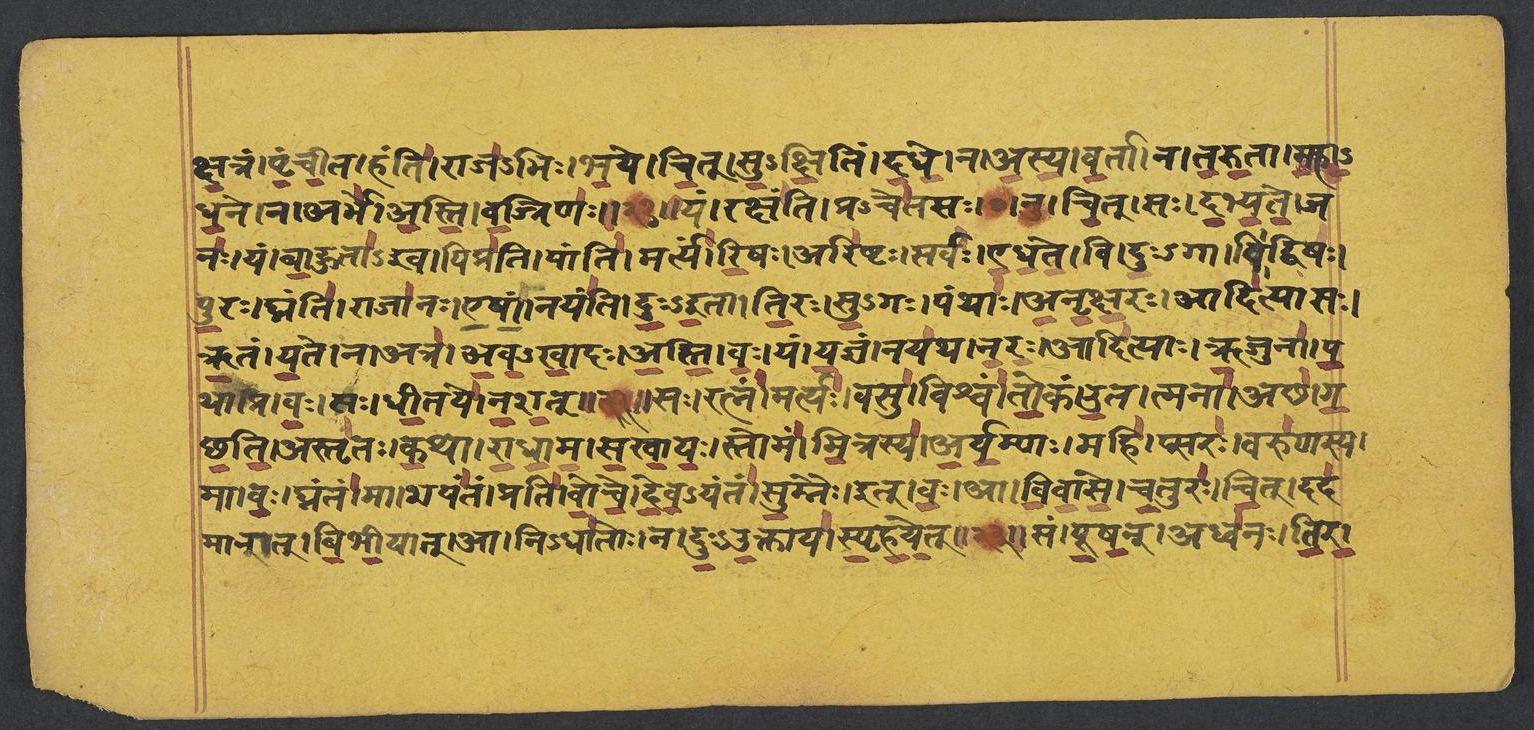
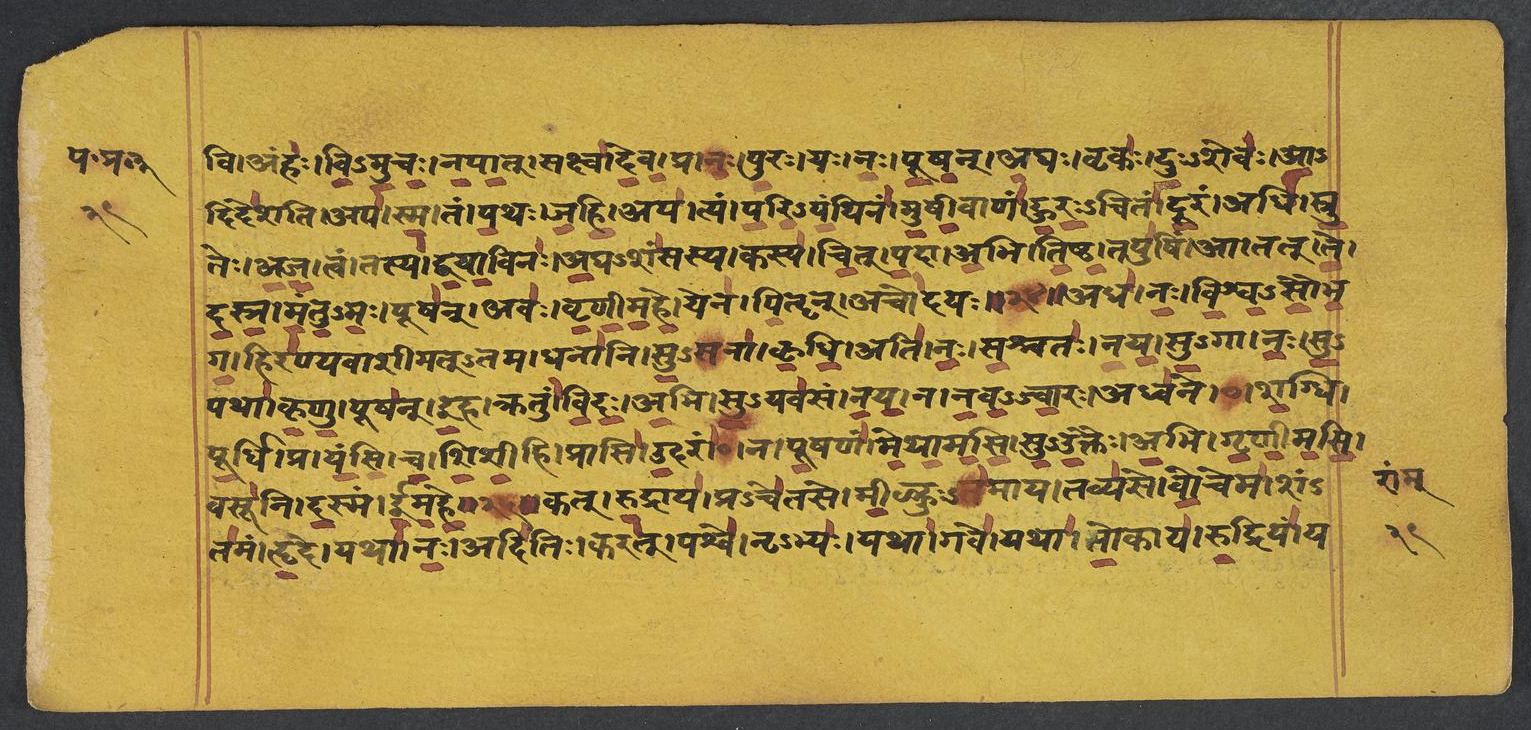
Where on the image
Penn Ms. Coll. 390 Item 41, fol. 29v (OPenn image 31, upper leaf). Checked on the image: the Rigveda text on this page begins in RV 1.42.1 ‹vi aṃhaḥ vi-mucaḥ napāt›. The next page with Rigveda text, fol. 30r, begins in RV 1.43.3 ‹yathā naḥ mitraḥ varuṇaḥ›. Verses 1.42.1-10 end on this page; 1.42.1 begins on fol. 29r.
1sam pū̍ṣa̱nn adhva̍nas tira̱ vy aṁho̍ vimuco napāt | sakṣvā̍ deva̱ pra ṇa̍s pu̱raḥ ||
2yo na̍ḥ pūṣann a̱gho vṛko̍ du̱ḥśeva̍ ā̱dide̍śati | apa̍ sma̱ tam pa̱tho ja̍hi ||
3apa̱ tyam pa̍ripa̱nthina̍m muṣī̱vāṇa̍ṁ hura̱ścita̍m | dū̱ram adhi̍ sru̱ter a̍ja ||
4tvaṁ tasya̍ dvayā̱vino̱ 'ghaśa̍ṁsasya̱ kasya̍ cit | pa̱dābhi ti̍ṣṭha̱ tapu̍ṣim ||
5ā tat te̍ dasra mantuma̱ḥ pūṣa̱nn avo̍ vṛṇīmahe | yena̍ pi̱tṝn aco̍dayaḥ ||
6adhā̍ no viśvasaubhaga̱ hira̍ṇyavāśīmattama | dhanā̍ni su̱ṣaṇā̍ kṛdhi ||
7ati̍ naḥ sa̱ścato̍ naya su̱gā na̍ḥ su̱pathā̍ kṛṇu | pūṣa̍nn i̱ha kratu̍ṁ vidaḥ ||
8a̱bhi sū̱yava̍saṁ naya̱ na na̍vajvā̱ro adhva̍ne | pūṣa̍nn i̱ha kratu̍ṁ vidaḥ ||
9śa̱gdhi pū̱rdhi pra ya̍ṁsi ca śiśī̱hi prāsy u̱dara̍m | pūṣa̍nn i̱ha kratu̍ṁ vidaḥ ||
10na pū̱ṣaṇa̍m methāmasi sū̱ktair a̱bhi gṛ̍ṇīmasi | vasū̍ni da̱smam ī̍mahe ||
Compare: Padapāṭha (word-by-word text written in the manuscript; Sansknet e-text via GRETIL)
1sam | pūṣan | adhvanaḥ | tira | vi | aṃhaḥ | vi-mucaḥ | napāt | sakṣva | deva | pra | naḥ | puraḥ
2yaḥ | naḥ | pūṣan | aghaḥ | vṛkaḥ | duḥśeva | ādideśati | apa | sma | tam | pathaḥ | jahi
3apa | tyam | pari-panthinam | muṣīvāṇam | huraḥ-citam | dūram | adhi | sruteḥ | aja
4tvam | tasya | dvayāvinaḥ | agha-saṃsasya | kasya | cit | padā | abhi | tiṣṭha | tapuṣim
5ā | tat | te | dasra | mantu-maḥ | pūṣan | avaḥ | vṛṇīmahe | yena | pitṝn | acodayaḥ
6adhaḥ | naḥ | viśva-saubhaga | hiraṇyavāśīmat-tama | dhanāni | su-sanā | kṛdhi
7ati | naḥ | saścataḥ | naya | su-gā | naḥ | su-pathā | kṛṇu | pūṣan | iha | kratum | vidaḥ
8abhi | su-yavasam | naya | na | nava-jvāraḥ | adhvane | pūṣan | iha | kratum | vidaḥ
9śagdhi | pūrdhi | pra | yaṃsi | ca | śiśīhi | prāsi | udaram | pūṣan | iha | kratum | vidaḥ
10na | pūṣaṇam | methāmasi | sūktaiḥ | abhi | gṛṇīmasi | vasūni | dasmam | īmahe
1SHORTEN our ways, O Pûshan, move aside obstruction in the path: Go close before us, cloud-born God.
2Drive, Pûshan, from our road the wolf, the wicked inauspicious wolf, Who lies in Wait to injure us.
3Who lurks about the path we take, the robber with a guileful heart: Far from the road chase him away.
4Tread with thy foot and trample out the firebrand of the wicked one, The double-tongued, whoe'er he be.
5Wise Pûshan, Wonder-Worker, we claim of thee now the aid wherewith Thou furtheredst our sires of old.
6So, Lord of all prosperity, best wielder of the golden sword, Make riches easy to be won.
7Past all pursuers lead us, make pleasant our path and fair to tread: O Pûshan, find thou power for this.
8Lead us to meadows rich in grass: send on our way no early heat: O Pûshan, find thou power for this.
9Be gracious to us, fill us full, give, feed us, and invigorate: O Pûshan, find thou power for this.
10No blame have we for Pûshan; him we magnify with songs of praise: We seek the Mighty One for wealth.
Notes
- Sanskrit: Aufrecht's edition (1877) with the Vedic accents, as entered by van Nooten and Holland (GRETIL).
- English: Ralph T. H. Griffith, The Hymns of the Rigveda (1889-1892; 2nd ed. 1896-1897), from the VedaWeb digital text; OCR slips in that text were corrected against the printed 2nd edition (data/sources/rigveda/griffith_errata.json).
- Padapāṭha (edition text): Sansknet e-text via GRETIL (CC BY-NC-SA 4.0).
Cite
Sources
- Source: Penn Ms. Coll. 390 Item 41 (undated (catalogued with Penn's 18th-19th c. Vedic manuscripts)), OPenn, Public Domain Mark + Aufrecht's accented text (GRETIL) + Griffith's English (VedaWeb) (holding institution)
- Critical edition: Aufrecht (1877), accented e-text via GRETIL
← previous · → next · v cycle view · l back to library