Rigveda 1.98: To Agni Viasvanara
Introduction
Rigveda 1.98 is a hymn of 3 verses addressed to Agni Viasvanara. It stands in book (maṇḍala) 1, a collection of hymns by many families of poets. The Rigveda is the oldest collection of Sanskrit hymns, composed in the second half of the second millennium BCE and handed down orally for many centuries before it was written down.
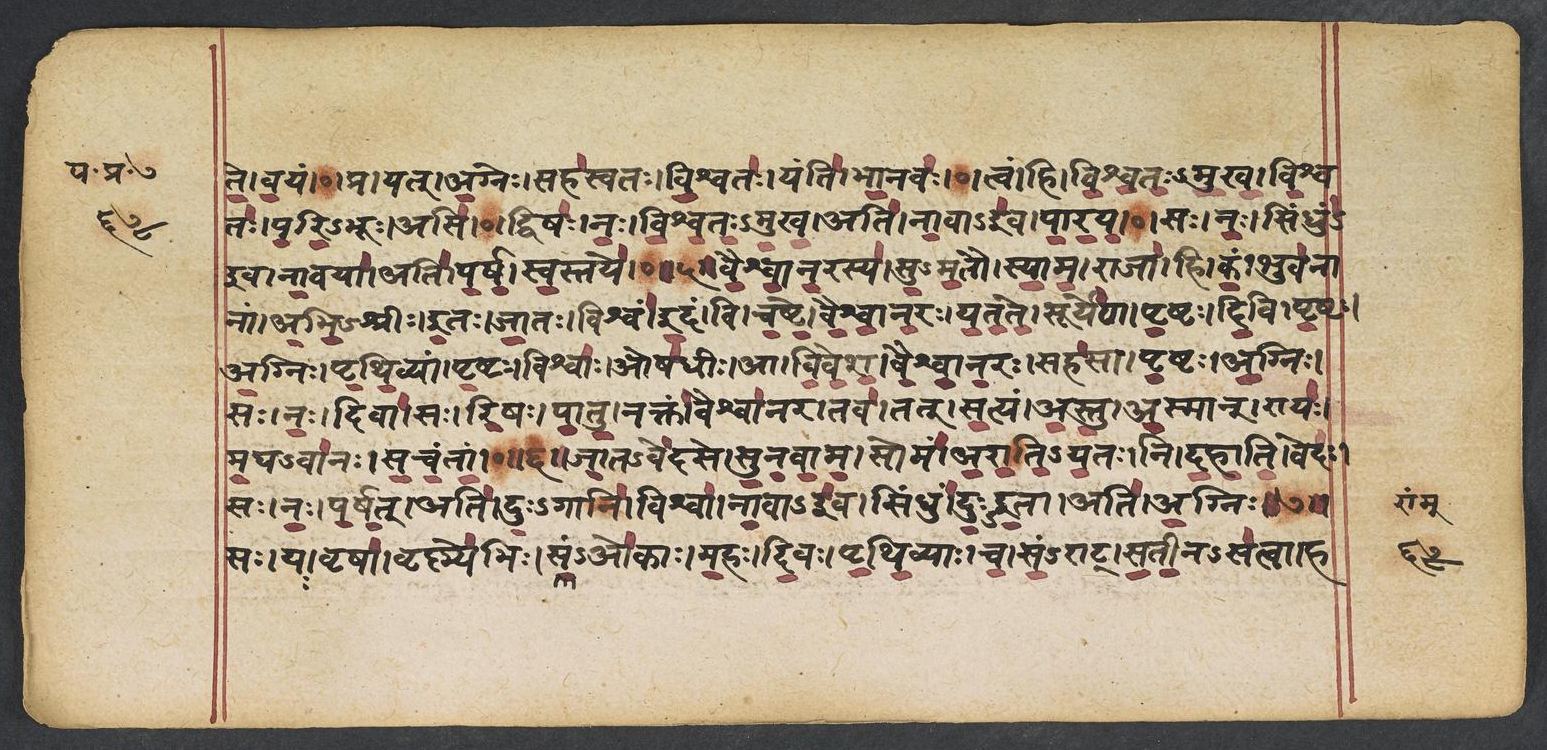
The manuscript shown is Penn Ms. Coll. 390 Item 41 (University of Pennsylvania), an undated paper manuscript of the padapāṭha (the word-by-word recitation text, in which every word is written separately and compounds are split) of the whole Ṛgveda in Devanāgarī, 884 leaves in fascicles, 7-9 lines to the page, accents in red; this hymn stands on fol. 68v. Each section below gives the verses that end on one page; the page boundaries were read on the images (the opening words of every page), not counted out. Where the manuscript is a padapāṭha (the word-by-word recitation text), the section shows Aufrecht's continuous (saṃhitā) text first and, as the edition text, the padapāṭha of the same verses, which is the form written on the page.
How was this verified? (Provenance)
Where on the image
Penn Ms. Coll. 390 Item 41, fol. 68v (OPenn image 70, upper leaf). Checked on the image: the Rigveda text on this page begins in RV 1.97.4 ‹-śośucat agham›. The next page with Rigveda text, fol. 69r, begins in RV 1.100.1 ‹-havyaḥ bhareṣu marutvān naḥ›. Verses 1.98.1-3 end on this page.
1vai̱śvā̱na̱rasya̍ suma̱tau syā̍ma̱ rājā̱ hi ka̱m bhuva̍nānām abhi̱śrīḥ | i̱to jā̱to viśva̍m i̱daṁ vi ca̍ṣṭe vaiśvāna̱ro ya̍tate̱ sūrye̍ṇa ||
2pṛ̱ṣṭo di̱vi pṛ̱ṣṭo a̱gniḥ pṛ̍thi̱vyām pṛ̱ṣṭo viśvā̱ oṣa̍dhī̱r ā vi̍veśa | vai̱śvā̱na̱raḥ saha̍sā pṛ̱ṣṭo a̱gniḥ sa no̱ divā̱ sa ri̱ṣaḥ pā̍tu̱ nakta̍m ||
3vaiśvā̍nara̱ tava̱ tat sa̱tyam a̍stv a̱smān rāyo̍ ma̱ghavā̍naḥ sacantām | tan no̍ mi̱tro varu̍ṇo māmahantā̱m adi̍ti̱ḥ sindhu̍ḥ pṛthi̱vī u̱ta dyauḥ ||
Compare: Padapāṭha (word-by-word text written in the manuscript; Sansknet e-text via GRETIL)
1vaiśvānarasya | su-matau | syāma | rājā | hi | kam | bhuvanānām | abhi-śrīḥ | itaḥ | jātaḥ | viśvam | idam | vi | caṣṭe | vaiśvānaraḥ | yatate | sūryeṇa
2pṛṣṭaḥ | divi | pṛṣṭaḥ | agniḥ | pṛthivyām | pṛṣṭaḥ | viśvāḥ | oṣadhīḥ | ā | viveśa | vaiśvānaraḥ | sahasā | pṛṣṭaḥ | agniḥ | saḥ | naḥ | divā | saḥ | riṣaḥ | pātu | naktam
3vaiśvānara | tava | tat | satyam | astu | asmān | rāyaḥ | maghavānaḥ | sacantām | tat | naḥ | mitraḥ | varuṇaḥ | mamahantām | aditiḥ | sindhuḥ | pṛthivī | uta | dyauḥ
1STILL in Vaiṣvânara's grace may we continue: yea, he is King supreme o'er all things living. Sprung hence to life upon this All he looketh. Vaiṣvânara hath rivalry with Sûrya.
2Present in heaven, in earth, all-present Agni,– all plants that grow on ground hath he pervaded. May Agni, may Vaiṣvânara with vigour, present, preserve us day and night from foemen.
3Be this thy truth, Vaiṣvânara, to us-ward: let wealth in rich abundance gather round us. This prayer of ours may Varuṇa grant, and Mitra, and Aditi and Sindhu, Earth and Heaven.
Notes
- Sanskrit: Aufrecht's edition (1877) with the Vedic accents, as entered by van Nooten and Holland (GRETIL).
- English: Ralph T. H. Griffith, The Hymns of the Rigveda (1889-1892; 2nd ed. 1896-1897), from the VedaWeb digital text; OCR slips in that text were corrected against the printed 2nd edition (data/sources/rigveda/griffith_errata.json).
- Padapāṭha (edition text): Sansknet e-text via GRETIL (CC BY-NC-SA 4.0).
Cite
Sources
- Source: Penn Ms. Coll. 390 Item 41 (undated (catalogued with Penn's 18th-19th c. Vedic manuscripts)), OPenn, Public Domain Mark + Aufrecht's accented text (GRETIL) + Griffith's English (VedaWeb) (holding institution)
- Critical edition: Aufrecht (1877), accented e-text via GRETIL
← previous · → next · v cycle view · l back to library