Rigveda 10.174: Blessing of a king
Introduction
Rigveda 10.174 is a hymn of 5 verses addressed to blessing of a king. It stands in book (maṇḍala) 10, the last and latest book. The Rigveda is the oldest collection of Sanskrit hymns, composed in the second half of the second millennium BCE and handed down orally for many centuries before it was written down.
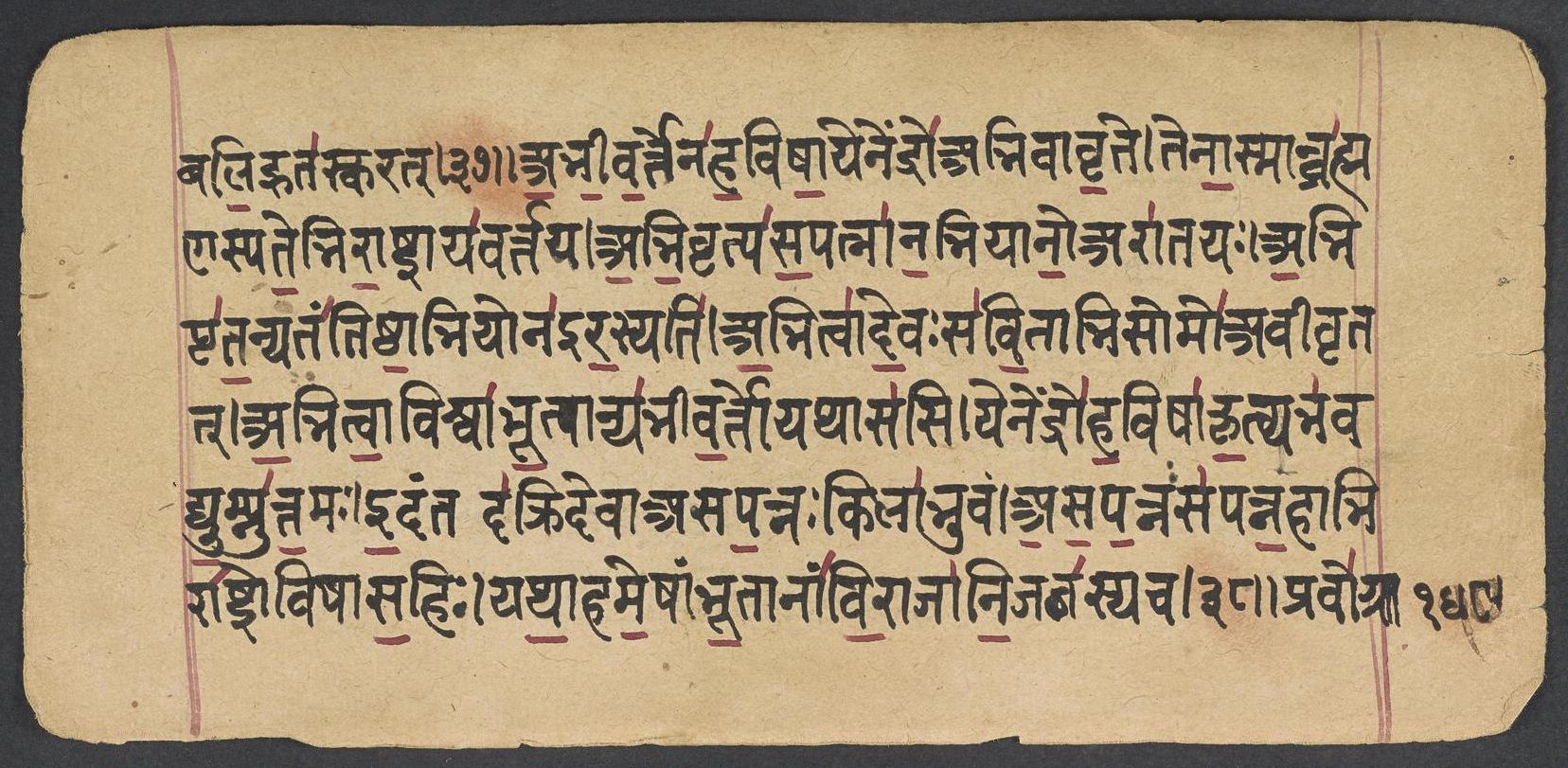
The manuscript shown is Penn Ms. Coll. 390 Item 48 (University of Pennsylvania), a paper manuscript of the eighth aṣṭaka (RV 10.46-10.191) of the Ṛgveda Saṃhitā in Devanāgarī, 158 leaves, 6 lines to the page, with the accents marked in red; the scribe's colophon on fol. 158 gives Saṃvat 1768 (1711 CE); this hymn stands on fol. 149v. Each section below gives the verses that end on one page; the page boundaries were read on the images (the opening words of every page), not counted out. Like most Rigveda manuscripts, Penn Ms. Coll. 390 Item 48 writes a repeated refrain in short form after its first occurrence (for example kasmai° for kasmai devāya haviṣā vidhema); the Sanskrit shown is the full text of Aufrecht's edition.
How was this verified? (Provenance)
Where on the image
Penn Ms. Coll. 390 Item 48, fol. 149v (OPenn image 149, upper leaf). Checked on the image: the Rigveda text on this page begins in RV 10.173.6 ‹-viśo balihṛtas karat›. The next page with Rigveda text, fol. 150r, begins in RV 10.175.1 ‹-grāvāṇaḥ savitā devaḥ suvatu›. Verses 10.174.1-5 end on this page.
1a̱bhī̱va̱rtena̍ ha̱viṣā̱ yenendro̍ abhivāvṛ̱te | tenā̱smān bra̍hmaṇas pate̱ 'bhi rā̱ṣṭrāya̍ vartaya ||
2a̱bhi̱vṛtya̍ sa̱patnā̍n a̱bhi yā no̱ arā̍tayaḥ | a̱bhi pṛ̍ta̱nyanta̍ṁ tiṣṭhā̱bhi yo na̍ ira̱syati̍ ||
3a̱bhi tvā̍ de̱vaḥ sa̍vi̱tābhi somo̍ avīvṛtat | a̱bhi tvā̱ viśvā̍ bhū̱tāny a̍bhīva̱rto yathāsa̍si ||
4yenendro̍ ha̱viṣā̍ kṛ̱tvy abha̍vad dyu̱mny u̍tta̱maḥ | i̱daṁ tad a̍kri devā asapa̱tnaḥ kilā̍bhuvam ||
5a̱sa̱pa̱tnaḥ sa̍patna̱hābhirā̍ṣṭro viṣāsa̱hiḥ | yathā̱ham e̍ṣām bhū̱tānā̍ṁ vi̱rājā̍ni̱ jana̍sya ca ||
1WITH offering for success in fight whence Indra was victorious. With this, O Brahmaṇaspati, let us attain to royal sway.
2Subduing those who rival us, subduing all malignities, Withstand the man who menaces, withstand the man who angers us.
3Soma and Savitar the God have made thee a victorious King All elements have aided thee, to make thee general conqueror.
4Oblation, that which Indra. gave and thus grew glorious and most high,– This have I offered, Gods! and hence now, verily, am rivalless.
5Slayer of rivals, rivalless, victorious, with royal sway, Over these beings may I rule, may I be Sovran of the folk.
Notes
- Sanskrit: Aufrecht's edition (1877) with the Vedic accents, as entered by van Nooten and Holland (GRETIL).
- English: Ralph T. H. Griffith, The Hymns of the Rigveda (1889-1892; 2nd ed. 1896-1897), from the VedaWeb digital text; OCR slips in that text were corrected against the printed 2nd edition (data/sources/rigveda/griffith_errata.json).
Cite
Sources
- Source: Penn Ms. Coll. 390 Item 48 (1711 CE (colophon: Saṃvat 1768)), OPenn, Public Domain Mark + Aufrecht's accented text (GRETIL) + Griffith's English (VedaWeb) (holding institution)
- Critical edition: Aufrecht (1877), accented e-text via GRETIL
← previous · → next · v cycle view · l back to library