Rigveda 10.187: To Agni
Introduction
Rigveda 10.187 is a hymn of 5 verses addressed to Agni. It stands in book (maṇḍala) 10, the last and latest book. The Rigveda is the oldest collection of Sanskrit hymns, composed in the second half of the second millennium BCE and handed down orally for many centuries before it was written down.
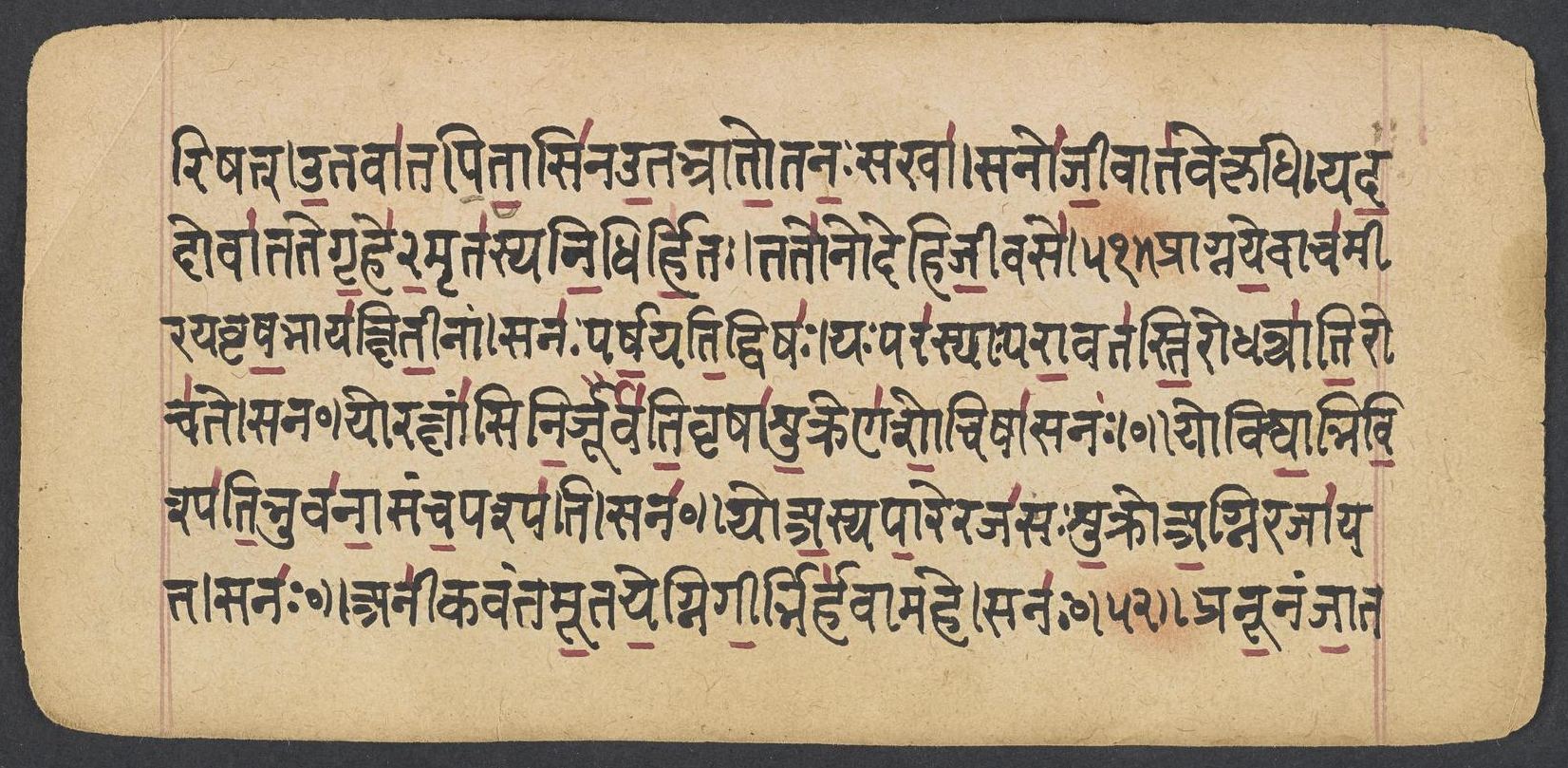
The manuscript shown is Penn Ms. Coll. 390 Item 48 (University of Pennsylvania), a paper manuscript of the eighth aṣṭaka (RV 10.46-10.191) of the Ṛgveda Saṃhitā in Devanāgarī, 158 leaves, 6 lines to the page, with the accents marked in red; the scribe's colophon on fol. 158 gives Saṃvat 1768 (1711 CE); this hymn stands on fol. 154r. Each section below gives the verses that end on one page; the page boundaries were read on the images (the opening words of every page), not counted out. Like most Rigveda manuscripts, Penn Ms. Coll. 390 Item 48 writes a repeated refrain in short form after its first occurrence (for example kasmai° for kasmai devāya haviṣā vidhema); the Sanskrit shown is the full text of Aufrecht's edition.
How was this verified? (Provenance)
Where on the image
Penn Ms. Coll. 390 Item 48, fol. 154r (OPenn image 153, lower leaf). Checked on the image: the Rigveda text on this page begins in RV 10.186.1 ‹-tāriṣat›. The next page with Rigveda text, fol. 154v, begins in RV 10.188.1 ‹-jātavedasam aśvaṁ hinota vājinam›. Verses 10.187.1-5 end on this page.
1prāgnaye̱ vāca̍m īraya vṛṣa̱bhāya̍ kṣitī̱nām | sa na̍ḥ parṣa̱d ati̱ dviṣa̍ḥ ||
2yaḥ para̍syāḥ parā̱vata̍s ti̱ro dhanvā̍ti̱roca̍te | sa na̍ḥ parṣa̱d ati̱ dviṣa̍ḥ ||
3yo rakṣā̍ṁsi ni̱jūrva̍ti̱ vṛṣā̍ śu̱kreṇa̍ śo̱ciṣā̍ | sa na̍ḥ parṣa̱d ati̱ dviṣa̍ḥ ||
4yo viśvā̱bhi vi̱paśya̍ti̱ bhuva̍nā̱ saṁ ca̱ paśya̍ti | sa na̍ḥ parṣa̱d ati̱ dviṣa̍ḥ ||
5yo a̱sya pā̱re raja̍saḥ śu̱kro a̱gnir ajā̍yata | sa na̍ḥ parṣa̱d ati̱ dviṣa̍ḥ ||
1To Agni send I forth my song, to him the Bull of all the folk: So may he bear us past our foes.
2Who from the distance far away shines brilliantly across the wastes: So may he bear us past our foes.
3The Bull with brightly-gleaming flame who utterly consumes the fiends So may he bear us past our foes.
4Who looks on all existing things and comprehends them with his view: So may he bear us past our foes.
5Resplendent Agni, who was born in farthest region of the air: So may he bear us past our foes.
Notes
- Sanskrit: Aufrecht's edition (1877) with the Vedic accents, as entered by van Nooten and Holland (GRETIL).
- English: Ralph T. H. Griffith, The Hymns of the Rigveda (1889-1892; 2nd ed. 1896-1897), from the VedaWeb digital text; OCR slips in that text were corrected against the printed 2nd edition (data/sources/rigveda/griffith_errata.json).
Cite
Sources
- Source: Penn Ms. Coll. 390 Item 48 (1711 CE (colophon: Saṃvat 1768)), OPenn, Public Domain Mark + Aufrecht's accented text (GRETIL) + Griffith's English (VedaWeb) (holding institution)
- Critical edition: Aufrecht (1877), accented e-text via GRETIL
← previous · → next · v cycle view · l back to library