Rigveda 4.57: Gods of the field (charm for unfruitful land)
Introduction
Rigveda 4.57 is a hymn of 8 verses addressed to gods of the field (charm for unfruitful land). It stands in book (maṇḍala) 4, the family book of Vāmadeva. The Rigveda is the oldest collection of Sanskrit hymns, composed in the second half of the second millennium BCE and handed down orally for many centuries before it was written down.
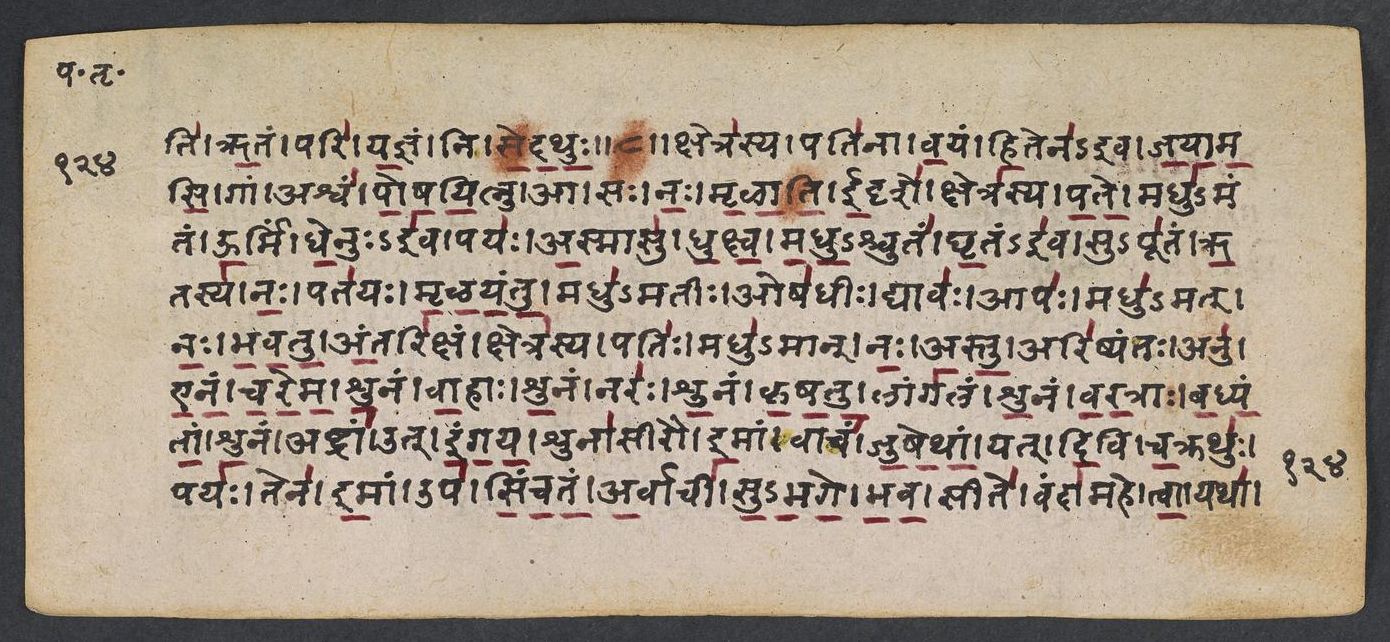
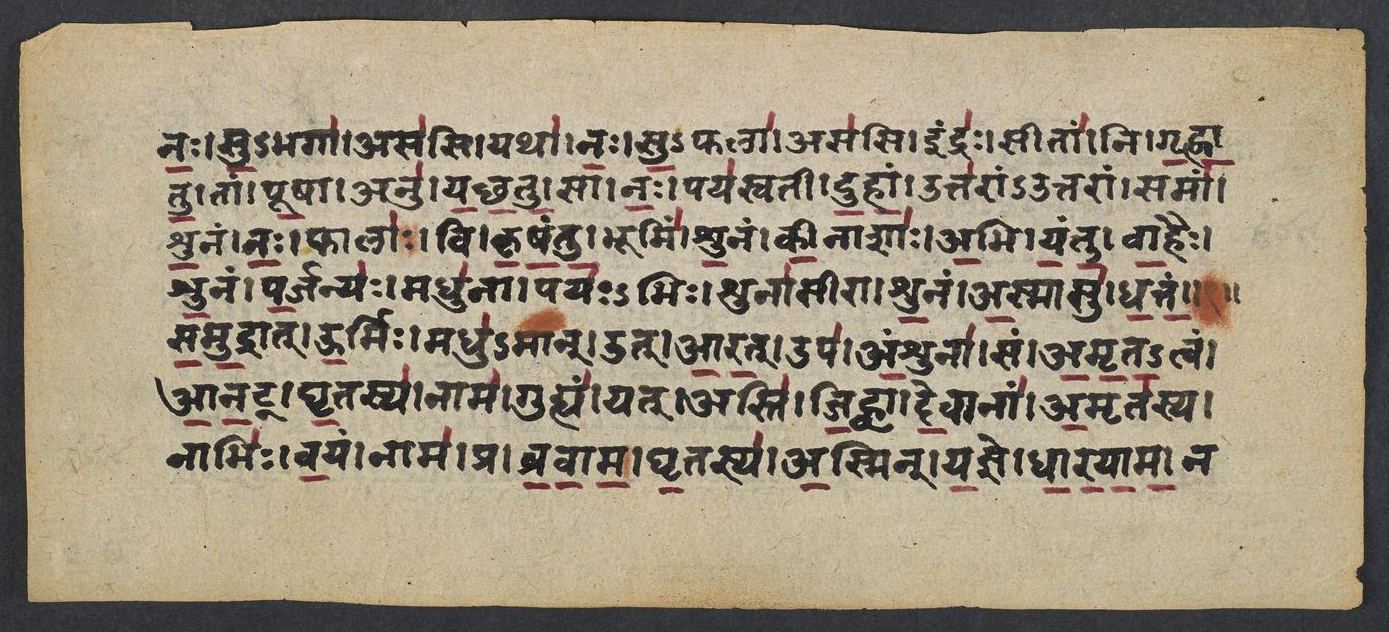
The manuscript shown is Penn Ms. Coll. 390 Item 41 (University of Pennsylvania), an undated paper manuscript of the padapāṭha (the word-by-word recitation text, in which every word is written separately and compounds are split) of the whole Ṛgveda in Devanāgarī, 884 leaves in fascicles, 7-9 lines to the page, accents in red; this hymn stands on fol. 315v-316r. Each section below gives the verses that end on one page; the page boundaries were read on the images (the opening words of every page), not counted out. Where the manuscript is a padapāṭha (the word-by-word recitation text), the section shows Aufrecht's continuous (saṃhitā) text first and, as the edition text, the padapāṭha of the same verses, which is the form written on the page.
How was this verified? (Provenance)
Where on the image
Penn Ms. Coll. 390 Item 41, fol. 315v (numbered 124v by the scribe) (OPenn image 316, upper leaf). Checked on the image: the Rigveda text on this page begins in RV 4.56.7 ‹-iti ṛtam pari yajñam›. The next page with Rigveda text, fol. 316r (numbered 125r by the scribe), begins in RV 4.57.6 ‹naḥ su-bhagā asasi yathā›. Verses 4.57.1-5 end on this page.
1kṣetra̍sya̱ pati̍nā va̱yaṁ hi̱tene̍va jayāmasi | gām aśva̍m poṣayi̱tnv ā sa no̍ mṛḻātī̱dṛśe̍ ||
2kṣetra̍sya pate̱ madhu̍mantam ū̱rmiṁ dhe̱nur i̍va̱ payo̍ a̱smāsu̍ dhukṣva | ma̱dhu̱ścuta̍ṁ ghṛ̱tam i̍va̱ supū̍tam ṛ̱tasya̍ na̱ḥ pata̍yo mṛḻayantu ||
3madhu̍matī̱r oṣa̍dhī̱r dyāva̱ āpo̱ madhu̍man no bhavatv a̱ntari̍kṣam | kṣetra̍sya̱ pati̱r madhu̍mān no a̱stv ari̍ṣyanto̱ anv e̍naṁ carema ||
4śu̱naṁ vā̱hāḥ śu̱naṁ nara̍ḥ śu̱naṁ kṛ̍ṣatu̱ lāṅga̍lam | śu̱naṁ va̍ra̱trā ba̍dhyantāṁ śu̱nam aṣṭrā̱m ud i̍ṅgaya ||
5śunā̍sīrāv i̱māṁ vāca̍ṁ juṣethā̱ṁ yad di̱vi ca̱krathu̱ḥ paya̍ḥ | tene̱mām upa̍ siñcatam ||
Compare: Padapāṭha (word-by-word text written in the manuscript; Sansknet e-text via GRETIL)
1kṣetrasya | patinā | vayam | hitena-iva | jayāmasi | gām | asvam | poṣayitnu | ā | saḥ | naḥ | mṛḷāti | īdṛśe
2kṣetrasya | pate | madhu-mantam | ūrmim | dhenuḥ-iva | payaḥ | asmāsu | dhukṣva | madhu-ścutam | ghṛtam-iva | su-pāūtam | ṛtasya | naḥ | patayaḥ | mṛḷayantu
3madhu-matīḥ | oṣadhīḥ | dyāvaḥ | āpaḥ | madhu-mat | naḥ | bhavatu | antarikṣam | kṣetrasya | patiḥ | madhu-mān | naḥ | astu | ariṣyantaḥ | anu | enam | carema
4śunam | vāhāḥ | śunam | naraḥ | śunam | kṛṣatu | lāṅgalam | / śunam | varatrāḥ | badhyantām | śunam | aṣṭrām | ut | iṅgaya
5śunāsīrau | imām | vācam | juṣethām | yat | divi | cakrathuḥ | payaḥ | tena | imām | upa | siñcatam
1WE through the Master of the Field, even as through a friend, obtain What nourisheth our kine and steeds. In such may he be good to us.
2As the cow yieldeth milk, pour for us freely, Lord of the Field, the wave that beareth sweetness, Distilling meath, well-purified like butter, and let the. Lords of holy Law be gracious.
3Sweet be the plants for us. the heavens, the waters, and full of sweets for us be air's mid-region. May the Field's Lord for us be full of sweetness, and may we follow after him uninjured.
4Happily work our steers and men, may the plough furrow happily. Happily be the traces bound; happily may he ply the goad.
5Ṣuna and Sîra, welcome ye this laud, and with the milk which ye have made in heaven Bedew ye both this earth of ours.
Where on the image
Penn Ms. Coll. 390 Item 41, fol. 316r (numbered 125r by the scribe) (OPenn image 316, lower leaf). Checked on the image: the Rigveda text on this page begins in RV 4.57.6 ‹naḥ su-bhagā asasi yathā›. The next page with Rigveda text, fol. 316v (numbered 125v by the scribe), begins in RV 4.58.2 ‹-namaḥ-bhiḥ upa brahmā śṛṇavat›. Verses 4.57.6-8 end on this page; 4.57.6 begins on fol. 315v (numbered 124v by the scribe).
6a̱rvācī̍ subhage bhava̱ sīte̱ vandā̍mahe tvā | yathā̍ naḥ su̱bhagāsa̍si̱ yathā̍ naḥ su̱phalāsa̍si ||
7indra̱ḥ sītā̱ṁ ni gṛ̍hṇātu̱ tām pū̱ṣānu̍ yacchatu | sā na̱ḥ paya̍svatī duhā̱m utta̍rām-uttarā̱ṁ samā̍m ||
8śu̱naṁ na̱ḥ phālā̱ vi kṛ̍ṣantu̱ bhūmi̍ṁ śu̱naṁ kī̱nāśā̍ a̱bhi ya̍ntu vā̱haiḥ | śu̱nam pa̱rjanyo̱ madhu̍nā̱ payo̍bhi̱ḥ śunā̍sīrā śu̱nam a̱smāsu̍ dhattam ||
Compare: Padapāṭha (word-by-word text written in the manuscript; Sansknet e-text via GRETIL)
6arvācī | su-bhage | bhava | sīte | vandāmahe | tvā | yathā | naḥ | su-bhagā | asasi | yathā | naḥ | suphalā | asasi
7indraḥ | sītām | ni | gṛhṇātu | tām | pūṣā | anu | yacchatu | sā | naḥ | payasvatī | duhām | uttarām-uttarām | samām
8śunam | naḥ | phālāḥ | vi | kṛṣantu | bhūmim | śunam | kīnāśāḥ | abhi | yantu | vāhaiḥ | śunam | parjanyaḥ | madhunā | payaḥ-bhiḥ | śunāsīrā | śunam | asmāsu | dhattam
6Auspicious Sita, come thou near: we venerate and worship thee That thou mayst bless and prosper us and bring us fruits abundantly.
7May Indra press the furrow down, may Pûshan guide its course aright. May she, as rich in milk, be drained for us through each succeeding year.
8Happily let the shares turn up the ploughland, happily go the ploughers with the oxen. With meath and milk Parjanya make us happy. Grant us prosperity, Ṣuna and Sîra.
Notes
- Sanskrit: Aufrecht's edition (1877) with the Vedic accents, as entered by van Nooten and Holland (GRETIL).
- English: Ralph T. H. Griffith, The Hymns of the Rigveda (1889-1892; 2nd ed. 1896-1897), from the VedaWeb digital text; OCR slips in that text were corrected against the printed 2nd edition (data/sources/rigveda/griffith_errata.json).
- Padapāṭha (edition text): Sansknet e-text via GRETIL (CC BY-NC-SA 4.0).
Cite
Sources
- Source: Penn Ms. Coll. 390 Item 41 (undated (catalogued with Penn's 18th-19th c. Vedic manuscripts)), OPenn, Public Domain Mark + Aufrecht's accented text (GRETIL) + Griffith's English (VedaWeb) (holding institution)
- Critical edition: Aufrecht (1877), accented e-text via GRETIL
← previous · → next · v cycle view · l back to library