Rigveda 5.15: To Agni
Introduction
Rigveda 5.15 is a hymn of 5 verses addressed to Agni. It stands in book (maṇḍala) 5, the family book of the Atri clan. The Rigveda is the oldest collection of Sanskrit hymns, composed in the second half of the second millennium BCE and handed down orally for many centuries before it was written down.
The manuscript shown is Penn Ms. Coll. 390 Item 41 (University of Pennsylvania), an undated paper manuscript of the padapāṭha (the word-by-word recitation text, in which every word is written separately and compounds are split) of the whole Ṛgveda in Devanāgarī, 884 leaves in fascicles, 7-9 lines to the page, accents in red; this hymn stands on fol. 332r-332v. Each section below gives the verses that end on one page; the page boundaries were read on the images (the opening words of every page), not counted out. Where the manuscript is a padapāṭha (the word-by-word recitation text), the section shows Aufrecht's continuous (saṃhitā) text first and, as the edition text, the padapāṭha of the same verses, which is the form written on the page.
How was this verified? (Provenance)
Where on the image
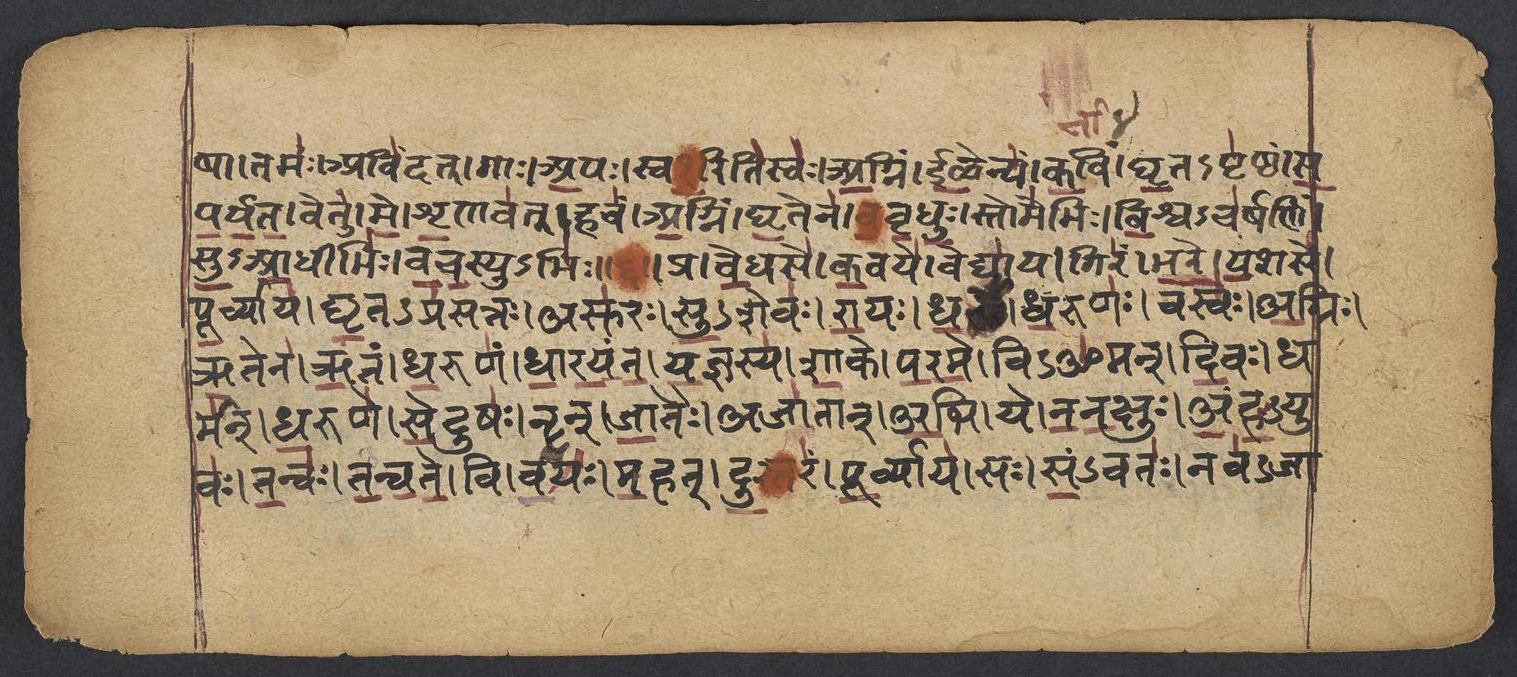
Penn Ms. Coll. 390 Item 41, fol. 332r (numbered 5r by the scribe) (OPenn image 332, lower leaf). Checked on the image: the Rigveda text on this page begins in RV 5.14.4 ‹-jyotiṣā tamaḥ avindat gāḥ›. The next page with Rigveda text, fol. 332v (numbered 5v by the scribe), begins in RV 5.15.3 ‹-nava-jātaḥ tuturyāt siṃham na›. Verses 5.15.1-2 end on this page.
1pra ve̱dhase̍ ka̱vaye̱ vedyā̍ya̱ gira̍m bhare ya̱śase̍ pū̱rvyāya̍ | ghṛ̱tapra̍satto̱ asu̍raḥ su̱śevo̍ rā̱yo dha̱rtā dha̱ruṇo̱ vasvo̍ a̱gniḥ ||
2ṛ̱tena̍ ṛ̱taṁ dha̱ruṇa̍ṁ dhārayanta ya̱jñasya̍ śā̱ke pa̍ra̱me vyo̍man | di̱vo dharma̍n dha̱ruṇe̍ se̱duṣo̱ nṝñ jā̱tair ajā̍tām̐ a̱bhi ye na̍na̱kṣuḥ ||
Compare: Padapāṭha (word-by-word text written in the manuscript; Sansknet e-text via GRETIL)
1pra | vedhase | kavaye | vedyāya | giram | bhare | yaśase | pūrvyāya | ghṛta-prasattaḥ | asuraḥ | su-śevaḥ | rāyaḥ | dhartā | dharuṇaḥ | vasvaḥ | agniḥ
2ṛtena | ṛtam | dharuṇam | dhārayanta | yajñasya | śoke | parame | vi-oman | divaḥ | dharman | dharuṇe | seduṣaḥ | nṝn | jātaiḥ | ajātān | abhi | ye | nanakṣuḥ
1To him, the far-renowned, the wise Ordainer, ancient and glorious, a song I offer. Enthroned in oil, the Asura, bliss-giver, is Agni, firm support of noble, riches.
2By holy Law they kept supporting Order, by help of sacrifice, in loftiest heaven,– They who attained with born men to the unborn, men seated on that stay, heaven's firm sustainer.
Where on the image
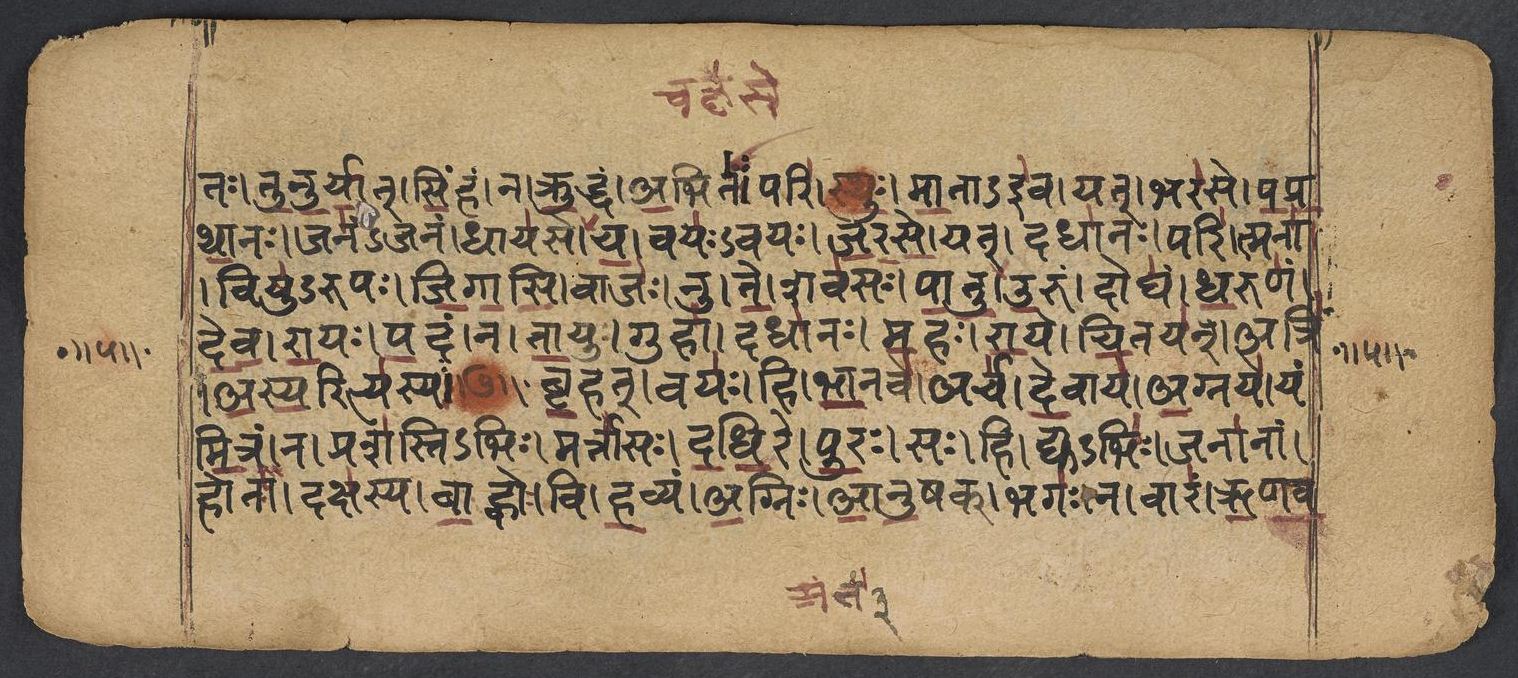
Penn Ms. Coll. 390 Item 41, fol. 332v (numbered 5v by the scribe) (OPenn image 333, upper leaf). Checked on the image: the Rigveda text on this page begins in RV 5.15.3 ‹-nava-jātaḥ tuturyāt siṃham na›. The next page with Rigveda text, fol. 333r (numbered 6r by the scribe), begins in RV 5.16.2 ‹-ṛṇvati›. Verses 5.15.3-5 end on this page; 5.15.3 begins on fol. 332r (numbered 5r by the scribe).
3a̱ṅho̱yuva̍s ta̱nva̍s tanvate̱ vi vayo̍ ma̱had du̱ṣṭara̍m pū̱rvyāya̍ | sa sa̱ṁvato̱ nava̍jātas tuturyāt si̱ṅhaṁ na kru̱ddham a̱bhita̱ḥ pari̍ ṣṭhuḥ ||
4mā̱teva̱ yad bhara̍se paprathā̱no jana̍ṁ-jana̱ṁ dhāya̍se̱ cakṣa̍se ca | vayo̍-vayo jarase̱ yad dadhā̍na̱ḥ pari̱ tmanā̱ viṣu̍rūpo jigāsi ||
5vājo̱ nu te̱ śava̍sas pā̱tv anta̍m u̱ruṁ dogha̍ṁ dha̱ruṇa̍ṁ deva rā̱yaḥ | pa̱daṁ na tā̱yur guhā̱ dadhā̍no ma̱ho rā̱ye ci̱taya̱nn atri̍m aspaḥ ||
Compare: Padapāṭha (word-by-word text written in the manuscript; Sansknet e-text via GRETIL)
3aṃhaḥ-yuvaḥ | tanvaḥ | tanvate | vi | vayaḥ | mahat | dustaram | pūrvyāya | saḥ | sam-vataḥ | nava-jātaḥ | tuturyāt | siṃham | na | kruddham | abhitaḥ | pari | sthuḥ
4mātāiva | yat | bharase | paprathānaḥ | janam-janam | dhāyase | cakṣase | ca | vayaḥ-vayaḥ | jarase | yat | dadhānaḥ | pari | tmanā | viṣu-rūpaḥ | jigāsi
5vājaḥ | nu | te | śavasaḥ | pātu | antam | urum | dogham | dharuṇam | deva | rāyaḥ | padam | na | tāyuḥ | guhā | dadhānaḥ | mahaḥ | rāye | citayan | atrim | aspar ity aspaḥ
3Averting woe, they labour hard to bring him, the ancient, plenteous food as power resistless. May he, born newly, conquer his assailants: round him they stand as round an angry lion.
4When, like a mother, spreading forth to nourish, to cherish and regard each man that liveth,– Consuming all the strength that thou hast gotten, thou wanderest round, thyself, in varied fashion.
5May strength preserve the compass of thy vigour, God! that broad stream of thine that beareth riches. Thou, like a thief who keeps his refuge secret, hast holpen Atri to great wealth, by teaching.
Notes
- Sanskrit: Aufrecht's edition (1877) with the Vedic accents, as entered by van Nooten and Holland (GRETIL).
- English: Ralph T. H. Griffith, The Hymns of the Rigveda (1889-1892; 2nd ed. 1896-1897), from the VedaWeb digital text; OCR slips in that text were corrected against the printed 2nd edition (data/sources/rigveda/griffith_errata.json).
- Padapāṭha (edition text): Sansknet e-text via GRETIL (CC BY-NC-SA 4.0).
Cite
Sources
- Source: Penn Ms. Coll. 390 Item 41 (undated (catalogued with Penn's 18th-19th c. Vedic manuscripts)), OPenn, Public Domain Mark + Aufrecht's accented text (GRETIL) + Griffith's English (VedaWeb) (holding institution)
- Critical edition: Aufrecht (1877), accented e-text via GRETIL
← previous · → next · v cycle view · l back to library