Rigveda 5.56: To the Maruts
Introduction
Rigveda 5.56 is a hymn of 9 verses addressed to the Maruts. It stands in book (maṇḍala) 5, the family book of the Atri clan. The Rigveda is the oldest collection of Sanskrit hymns, composed in the second half of the second millennium BCE and handed down orally for many centuries before it was written down.
The manuscript shown is Penn Ms. Coll. 390 Item 41 (University of Pennsylvania), an undated paper manuscript of the padapāṭha (the word-by-word recitation text, in which every word is written separately and compounds are split) of the whole Ṛgveda in Devanāgarī, 884 leaves in fascicles, 7-9 lines to the page, accents in red; this hymn stands on fol. 375v-376v. Each section below gives the verses that end on one page; the page boundaries were read on the images (the opening words of every page), not counted out. Where the manuscript is a padapāṭha (the word-by-word recitation text), the section shows Aufrecht's continuous (saṃhitā) text first and, as the edition text, the padapāṭha of the same verses, which is the form written on the page.
How was this verified? (Provenance)
Where on the image
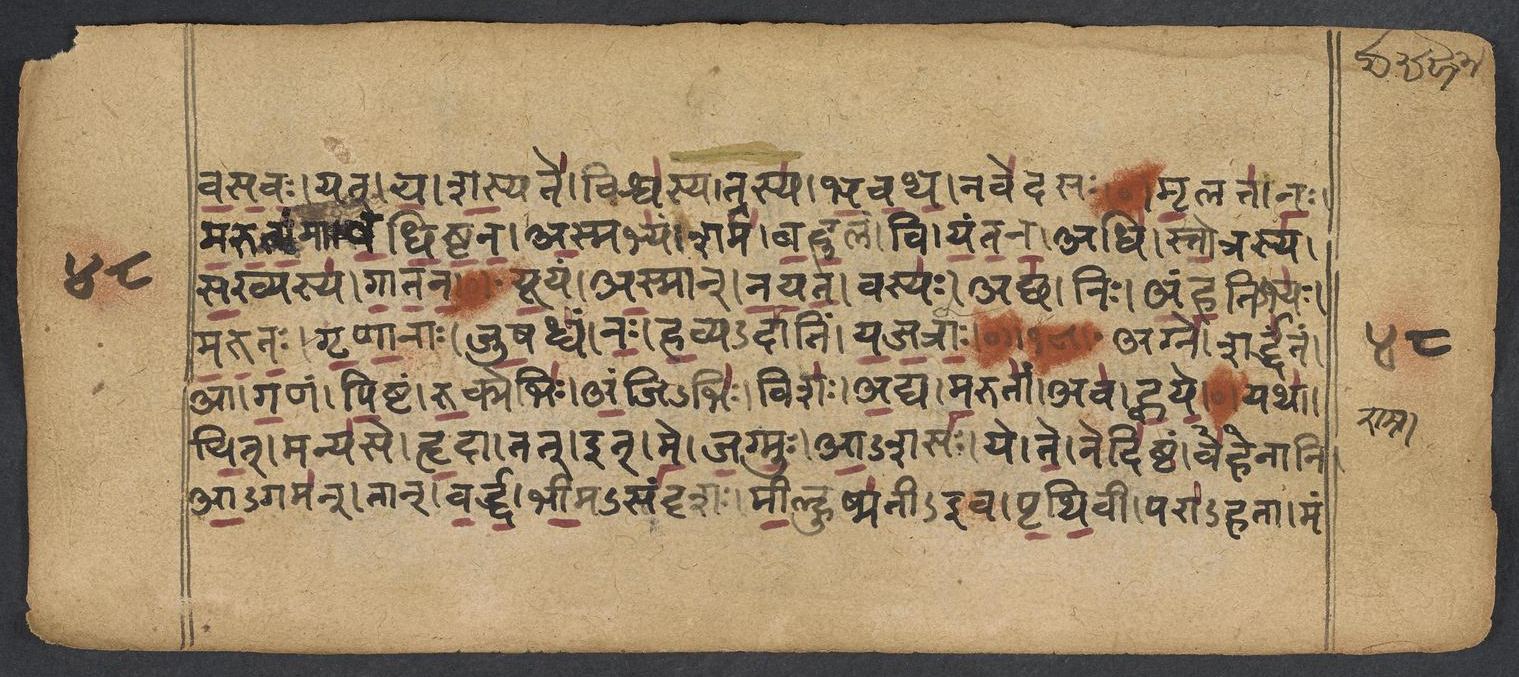
Penn Ms. Coll. 390 Item 41, fol. 375v (numbered 48v by the scribe) (OPenn image 376, upper leaf). Checked on the image: the Rigveda text on this page begins in RV 5.55.8 ‹vasavaḥ yat ca śasyate›. The next page with Rigveda text, fol. 376r (numbered 49r by the scribe), begins in RV 5.56.3 ‹-madantī eti asmat ā›. Verses 5.56.1-2 end on this page.
1agne̱ śardha̍nta̱m ā ga̱ṇam pi̱ṣṭaṁ ru̱kmebhi̍r a̱ñjibhi̍ḥ | viśo̍ a̱dya ma̱rutā̱m ava̍ hvaye di̱vaś ci̍d roca̱nād adhi̍ ||
2yathā̍ ci̱n manya̍se hṛ̱dā tad in me̍ jagmur ā̱śasa̍ḥ | ye te̱ nedi̍ṣṭha̱ṁ hava̍nāny ā̱gama̱n tān va̍rdha bhī̱masa̍ṁdṛśaḥ ||
Compare: Padapāṭha (word-by-word text written in the manuscript; Sansknet e-text via GRETIL)
1agne | śardhantam | ā | gaṇam | piṣṭam | rukmebhiḥ | añji-bhiḥ | viśaḥ | adya | marutām | ava | hvaye | divaḥ | cit | rocanāt | adhi
2yathā | cit | manyase | hṛdā | tat | it | me | jagmuḥ | āśasaḥ | ye | te | nediṣṭham | havanāni | āgaman | tān | vardha | bhīma-sandṛśaḥ
1AGNI, that valorous company adorned with ornaments of gold, The people of the Maruts, I call down to-day even from the luminous realm of heaven.
2Even as thou thinkest in thy heart, thither my wishes also tend. Those who have come most near to thine invoking calls, strengthen them fearful to behold.
Where on the image
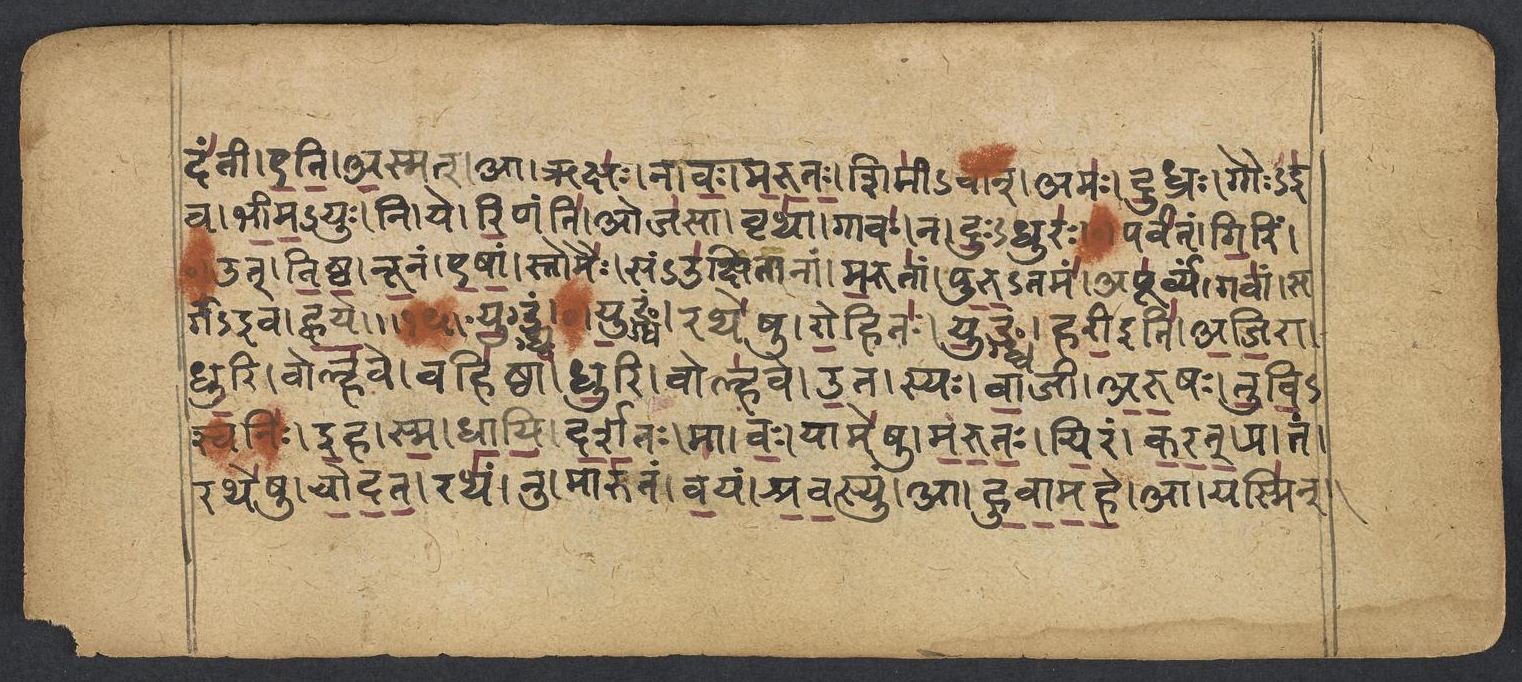
Penn Ms. Coll. 390 Item 41, fol. 376r (numbered 49r by the scribe) (OPenn image 376, lower leaf). Checked on the image: the Rigveda text on this page begins in RV 5.56.3 ‹-madantī eti asmat ā›. The next page with Rigveda text, fol. 376v (numbered 49v by the scribe), begins in RV 5.56.8 ‹tasthau suraṇāni bibhratī sacā›. Verses 5.56.3-7 end on this page; 5.56.3 begins on fol. 375v (numbered 48v by the scribe).
3mī̱ḻhuṣma̍tīva pṛthi̱vī parā̍hatā̱ mada̍nty ety a̱smad ā | ṛkṣo̱ na vo̍ maruta̱ḥ śimī̍vā̱m̐ amo̍ du̱dhro gaur i̍va bhīma̱yuḥ ||
4ni ye ri̱ṇanty oja̍sā̱ vṛthā̱ gāvo̱ na du̱rdhura̍ḥ | aśmā̍naṁ cit sva̱rya1̱̍m parva̍taṁ gi̱rim pra cyā̍vayanti̱ yāma̍bhiḥ ||
5ut ti̍ṣṭha nū̱nam e̍ṣā̱ṁ stomai̱ḥ samu̍kṣitānām | ma̱rutā̍m puru̱tama̱m apū̍rvya̱ṁ gavā̱ṁ sarga̍m iva hvaye ||
6yu̱ṅgdhvaṁ hy aru̍ṣī̱ rathe̍ yu̱ṅgdhvaṁ rathe̍ṣu ro̱hita̍ḥ | yu̱ṅgdhvaṁ harī̍ aji̱rā dhu̱ri voḻha̍ve̱ vahi̍ṣṭhā dhu̱ri voḻha̍ve ||
7u̱ta sya vā̱jy a̍ru̱ṣas tu̍vi̱ṣvaṇi̍r i̱ha sma̍ dhāyi darśa̱taḥ | mā vo̱ yāme̍ṣu marutaś ci̱raṁ ka̍ra̱t pra taṁ rathe̍ṣu codata ||
Compare: Padapāṭha (word-by-word text written in the manuscript; Sansknet e-text via GRETIL)
3mīḷhuṣmatī-iva | pṛthivī | parāhatā | madantī | eti | asmat | ā | ṛkṣaḥ | na | vaḥ | marutaḥ | śimī-vān | amaḥ | dudhraḥ | gauḥ-iva | bhīma-yuḥ
4ni | ye | riṇanti | ojasā | vṛthā | gāvaḥ | na | duḥ-dhuraḥ | aśmānam | cit | svaryam | parvatam | girim | pra | cyavayanti | yāma-bhiḥ
5ut | tiṣṭha | nūnam | eṣām | stomaiḥ | sam-ukṣitānām | marutām | puru-tamam | apūrvyam | gavām | sargam-iva | hvaye
6yuṅgdhvam | hi | aruṣīḥ | rathe | yuṅgdhvam | ratheṣu | rohitaḥ | yuṅgdhvam | harī iti | ajirā | dhuri | voḷhave | vahiṣṭhā | dhuri | voḷhave
7uta | syaḥ | vājī | aruṣaḥ | tuvi-svaṇiḥ | iha | sma | dhāyi | darśataḥ | mā | vaḥ | yāmeṣu | marutaḥ | ciram | karat | pra | tam | ratheṣu | codata
3Earth, like a bounteous lady, liberal of her gifts, struck down and shaken, yet exultant, comes to us. Impetuous as a bear, O Maruts, is your rush terrible as a dreadful bull..
4They who with mighty strength o'erthrow like oxen difficult to yoke, Cause e'en the heavenly stone to shake ' yea, shake the rocky mountain as they race along.
5Rise up! even now with lauds I call the very numerous company, Unequalled, of these Maruts, like a herd of kine, grown up together in their strength.
6Bind to your car the bright red mares, yoke the red coursers to your car. Bind to the pole, to draw, the fleet-foot tawny steeds, the best at drawing, to the pole.
7Yea, and this loudly-neighing bright red vigorous horse who hath been sutioned, fair to see, Let him not cause delay, O Maruts,, in your course, urge ye him onward in your cars.
Where on the image
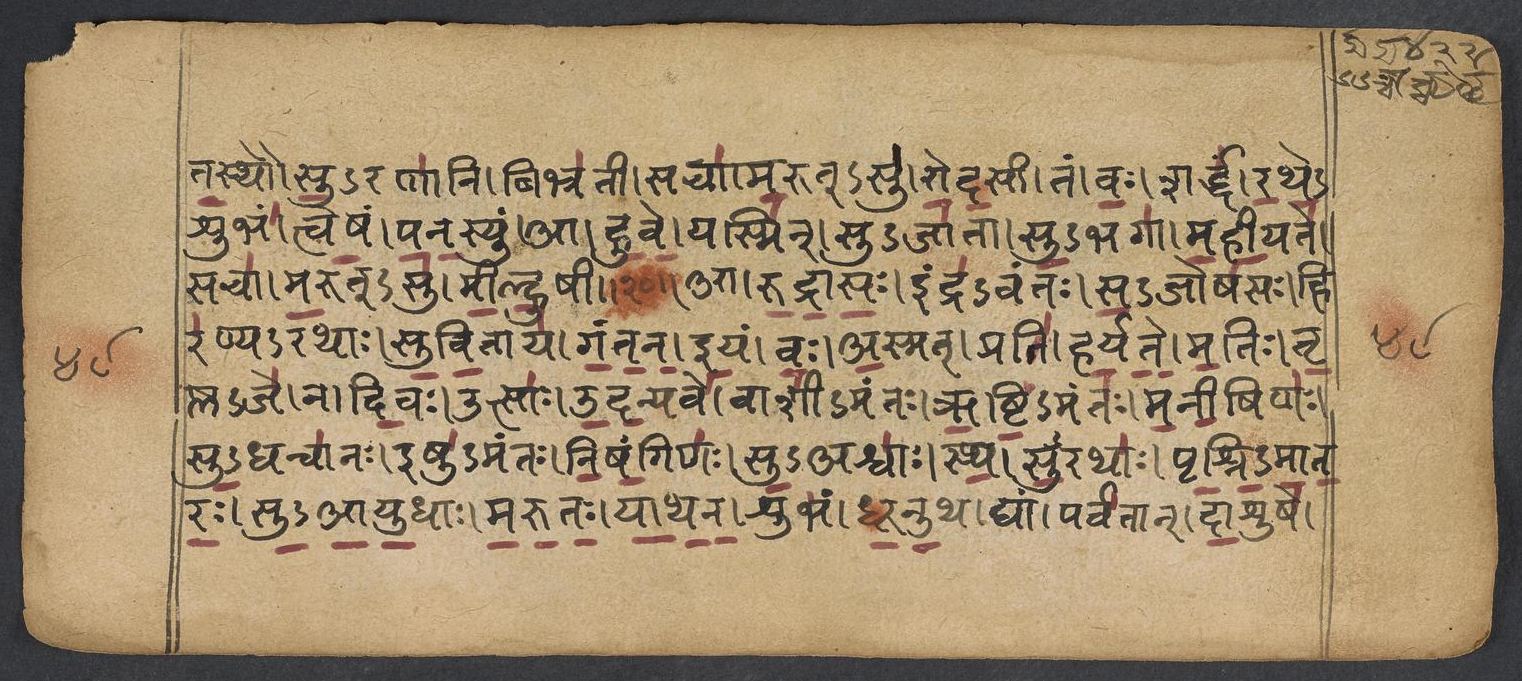
Penn Ms. Coll. 390 Item 41, fol. 376v (numbered 49v by the scribe) (OPenn image 377, upper leaf). Checked on the image: the Rigveda text on this page begins in RV 5.56.8 ‹tasthau suraṇāni bibhratī sacā›. The next page with Rigveda text, fol. 377r (numbered 50r by the scribe), begins in RV 5.57.3 ‹vasu ni vaḥ vanā›. Verses 5.56.8-9 end on this page; 5.56.8 begins on fol. 376r (numbered 49r by the scribe).
8ratha̱ṁ nu māru̍taṁ va̱yaṁ śra̍va̱syum ā hu̍vāmahe | ā yasmi̍n ta̱sthau su̱raṇā̍ni̱ bibhra̍tī̱ sacā̍ ma̱rutsu̍ roda̱sī ||
9taṁ va̱ḥ śardha̍ṁ rathe̱śubha̍ṁ tve̱ṣam pa̍na̱syum ā hu̍ve | yasmi̱n sujā̍tā su̱bhagā̍ mahī̱yate̱ sacā̍ ma̱rutsu̍ mīḻhu̱ṣī ||
Compare: Padapāṭha (word-by-word text written in the manuscript; Sansknet e-text via GRETIL)
8ratham | nu | mārutam | vayam | śravasyum | ā | huvāmahe | ā | yasmin | tasthau | suraṇāni | bibhratī | sacā | marut-su | rodasī
9tam | vaḥ | śardham | rathe--śubham | tveṣam | panasyum | ā | huve | yasmin | su-jātā | su-bhagā | mahīyate | sacā | marut-su | mīḷhuṣī
8The Maruts' chariot, ever fain to gather glory, we invoke, Which Rodasî hath mounted, bringing pleasant gifts, with Maruts in her company.
9I call that brilliant band of yours, adorable, rapid on the car Whereon the bounteous Dame, auspicious, nobly born, shows glorious with the Marut host.
Notes
- Sanskrit: Aufrecht's edition (1877) with the Vedic accents, as entered by van Nooten and Holland (GRETIL).
- English: Ralph T. H. Griffith, The Hymns of the Rigveda (1889-1892; 2nd ed. 1896-1897), from the VedaWeb digital text; OCR slips in that text were corrected against the printed 2nd edition (data/sources/rigveda/griffith_errata.json).
- Padapāṭha (edition text): Sansknet e-text via GRETIL (CC BY-NC-SA 4.0).
Cite
Sources
- Source: Penn Ms. Coll. 390 Item 41 (undated (catalogued with Penn's 18th-19th c. Vedic manuscripts)), OPenn, Public Domain Mark + Aufrecht's accented text (GRETIL) + Griffith's English (VedaWeb) (holding institution)
- Critical edition: Aufrecht (1877), accented e-text via GRETIL
← previous · → next · v cycle view · l back to library