Rigveda 5.66: To Mitra and Varuna
Introduction
Rigveda 5.66 is a hymn of 6 verses addressed to Mitra and Varuna. It stands in book (maṇḍala) 5, the family book of the Atri clan. The Rigveda is the oldest collection of Sanskrit hymns, composed in the second half of the second millennium BCE and handed down orally for many centuries before it was written down.
The manuscript shown is Penn Ms. Coll. 390 Item 41 (University of Pennsylvania), an undated paper manuscript of the padapāṭha (the word-by-word recitation text, in which every word is written separately and compounds are split) of the whole Ṛgveda in Devanāgarī, 884 leaves in fascicles, 7-9 lines to the page, accents in red; this hymn stands on fol. 385v-386r. Each section below gives the verses that end on one page; the page boundaries were read on the images (the opening words of every page), not counted out. Where the manuscript is a padapāṭha (the word-by-word recitation text), the section shows Aufrecht's continuous (saṃhitā) text first and, as the edition text, the padapāṭha of the same verses, which is the form written on the page.
How was this verified? (Provenance)
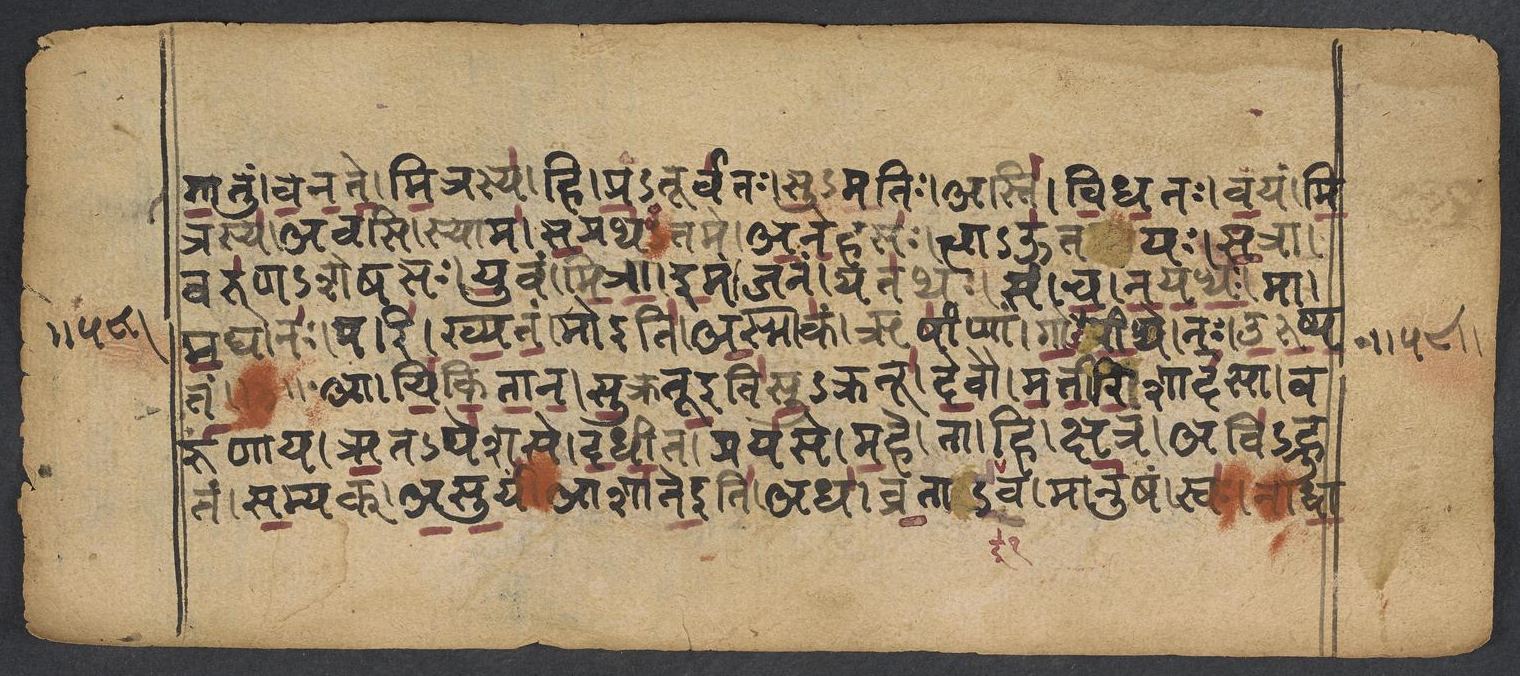
Where on the image
Penn Ms. Coll. 390 Item 41, fol. 385v (numbered 58v by the scribe) (OPenn image 386, upper leaf). Checked on the image: the Rigveda text on this page begins in RV 5.65.4 ‹gātum vanate mitrasya hi›. The next page with Rigveda text, fol. 386r (numbered 59r by the scribe), begins in RV 5.66.2 ‹dhāyi darśatam›. Verse 5.66.1 ends on this page.
1ā ci̍kitāna su̱kratū̍ de̱vau ma̍rta ri̱śāda̍sā | varu̍ṇāya ṛ̱tape̍śase dadhī̱ta praya̍se ma̱he ||
Compare: Padapāṭha (word-by-word text written in the manuscript; Sansknet e-text via GRETIL)
1ā | cikitāna | sukratūitisu-kratū | devau | marta | riśādasā | varuṇāya | ṛta-peśase | dadhīta | prayase mahe
1O SAPIENT man, call the Two Gods, the very wise, who slay the foe. For Varuṇa, whose form is Law, place offerings for his great delight.
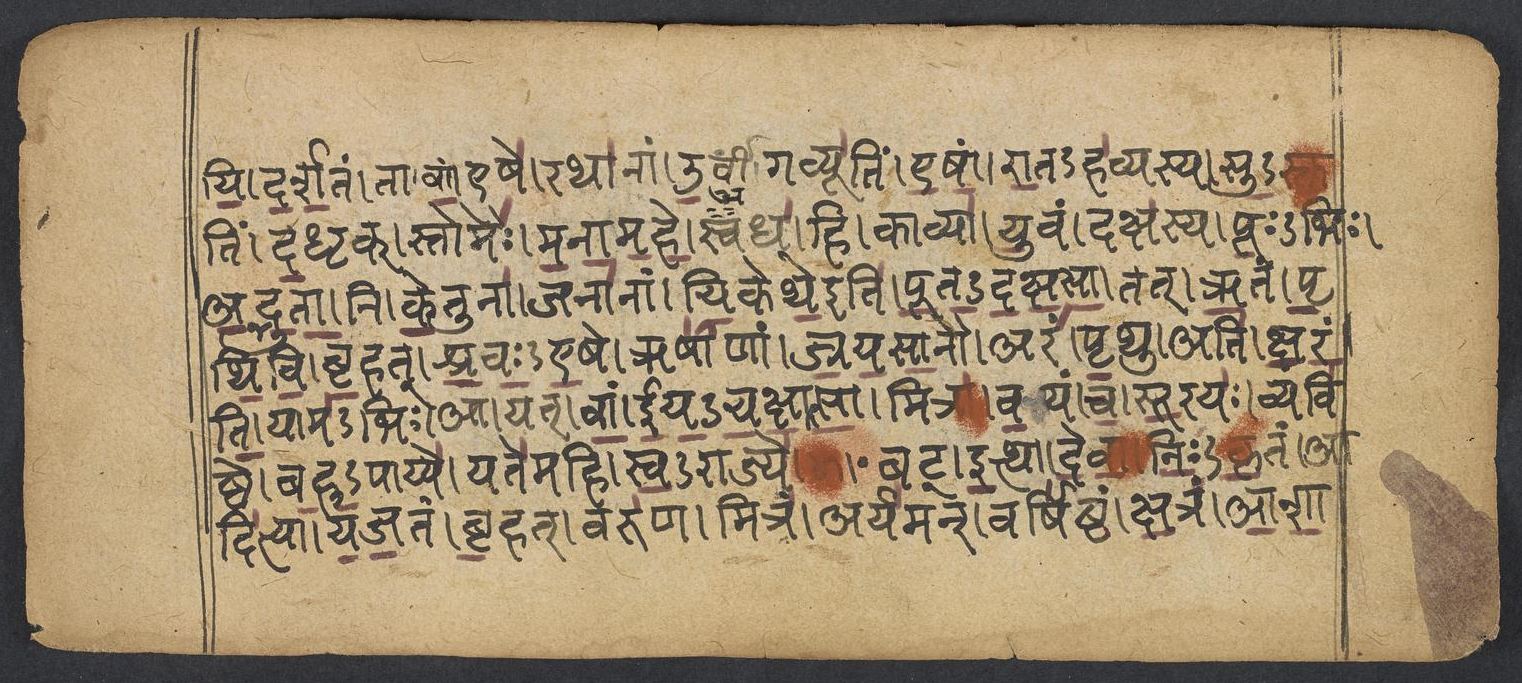
Where on the image
Penn Ms. Coll. 390 Item 41, fol. 386r (numbered 59r by the scribe) (OPenn image 386, lower leaf). Checked on the image: the Rigveda text on this page begins in RV 5.66.2 ‹dhāyi darśatam›. The next page with Rigveda text, fol. 386v (numbered 59v by the scribe), begins in RV 5.67.1 ‹-āśātheiti›. Verses 5.66.2-6 end on this page; 5.66.2 begins on fol. 385v (numbered 58v by the scribe).
2tā hi kṣa̱tram avi̍hrutaṁ sa̱myag a̍su̱rya1̱̍m āśā̍te | adha̍ vra̱teva̱ mānu̍ṣa̱ṁ sva1̱̍r ṇa dhā̍yi darśa̱tam ||
3tā vā̱m eṣe̱ rathā̍nām u̱rvīṁ gavyū̍tim eṣām | rā̱taha̍vyasya suṣṭu̱tiṁ da̱dhṛk stomai̍r manāmahe ||
4adhā̱ hi kāvyā̍ yu̱vaṁ dakṣa̍sya pū̱rbhir a̍dbhutā | ni ke̱tunā̱ janā̍nāṁ ci̱kethe̍ pūtadakṣasā ||
5tad ṛ̱tam pṛ̍thivi bṛ̱hac chra̍vae̱ṣa ṛṣī̍ṇām | jra̱ya̱sā̱nāv ara̍m pṛ̱thv ati̍ kṣaranti̱ yāma̍bhiḥ ||
6ā yad vā̍m īyacakṣasā̱ mitra̍ va̱yaṁ ca̍ sū̱raya̍ḥ | vyaci̍ṣṭhe bahu̱pāyye̱ yate̍mahi sva̱rājye̍ ||
Compare: Padapāṭha (word-by-word text written in the manuscript; Sansknet e-text via GRETIL)
2tā | hi | kṣatram | avi-hrutam | samyak | asuryam | āśāteiti | adha | vratāiva | mānuṣam | svaḥ | na | dhāyi | darśatam
3tā | vām | eṣe | rathānām | urvīm | gavyūtim | eṣām | rāta-havyasya | su-stutim | dadhṛk | stomaiḥ | manāmahe
4adha | hi | kāvyā | yuvam | dakṣasya | pūḥ-bhiḥ | adbhutā | ni | ketunā | janānām | ciketheiti | pūta-dakṣasā
5tat | ṛtam | pṛthivi | bṛhat | śravaḥ-eṣe | ṛṣīṇām | jrayasānau | aram | pṛthu | ati | kṣaranti | yāma-bhiḥ
6ā | yat | vām | īya-cakṣasā | mitrā | vayam | ca | sūrayaḥ | vyaciṣṭhe | bahu-pāyye | yatemahi | sva-rājye
2For they have won unbroken sway in full perfection, power divine. And, like high laws, the world of man hath been made beautiful as light.
3Therefore we praise you that your cars may travel far in front of ours- You who accept the eulogy of Râtahavya with his hymns.
4And ye show wisdom, Wondrous Gods with fulness of intellIgence. By men's discernment are Ve marked, O ye whose might is purified.
5This is the Law sublime, O Earth: to aid the R̥ishis' toil for fame The Two, wide-spreading, are prepared. They come with ample overflow.
6Mitra, ye Gods with wandering eyes, would that the worshippers and we Might strive to reach the realm ye rule, most spacious and protected well,
Notes
- Sanskrit: Aufrecht's edition (1877) with the Vedic accents, as entered by van Nooten and Holland (GRETIL).
- English: Ralph T. H. Griffith, The Hymns of the Rigveda (1889-1892; 2nd ed. 1896-1897), from the VedaWeb digital text; OCR slips in that text were corrected against the printed 2nd edition (data/sources/rigveda/griffith_errata.json).
- Padapāṭha (edition text): Sansknet e-text via GRETIL (CC BY-NC-SA 4.0).
Cite
Sources
- Source: Penn Ms. Coll. 390 Item 41 (undated (catalogued with Penn's 18th-19th c. Vedic manuscripts)), OPenn, Public Domain Mark + Aufrecht's accented text (GRETIL) + Griffith's English (VedaWeb) (holding institution)
- Critical edition: Aufrecht (1877), accented e-text via GRETIL
← previous · → next · v cycle view · l back to library