Rigveda 6.71: To Savitri
Introduction
Rigveda 6.71 is a hymn of 6 verses addressed to Savitri. It stands in book (maṇḍala) 6, the family book of Bharadvāja. The Rigveda is the oldest collection of Sanskrit hymns, composed in the second half of the second millennium BCE and handed down orally for many centuries before it was written down.
The manuscript shown is Penn Ms. Coll. 390 Item 41 (University of Pennsylvania), an undated paper manuscript of the padapāṭha (the word-by-word recitation text, in which every word is written separately and compounds are split) of the whole Ṛgveda in Devanāgarī, 884 leaves in fascicles, 7-9 lines to the page, accents in red; this hymn stands on fol. 488v-489r. Each section below gives the verses that end on one page; the page boundaries were read on the images (the opening words of every page), not counted out. Where the manuscript is a padapāṭha (the word-by-word recitation text), the section shows Aufrecht's continuous (saṃhitā) text first and, as the edition text, the padapāṭha of the same verses, which is the form written on the page.
How was this verified? (Provenance)
Where on the image
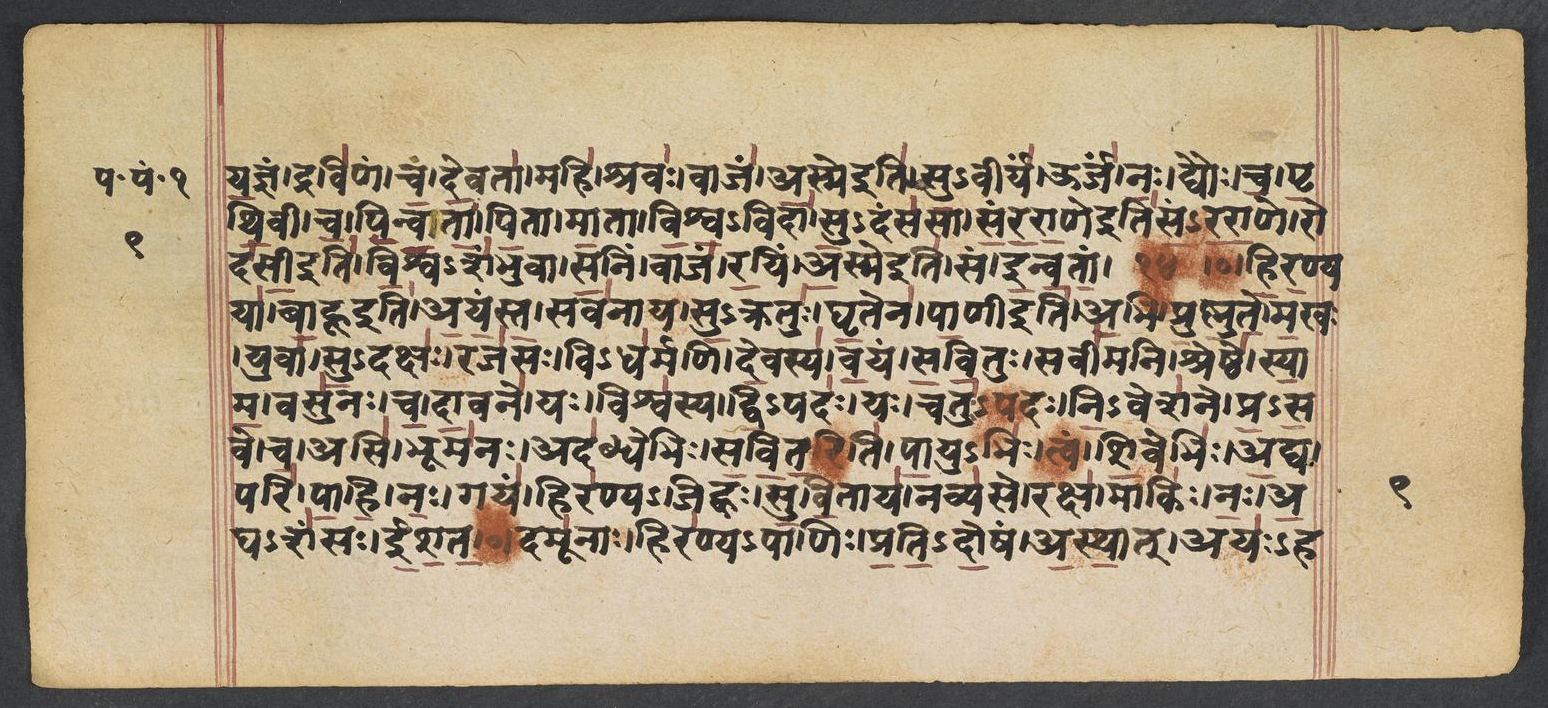
Penn Ms. Coll. 390 Item 41, fol. 488v (numbered 9v by the scribe) (OPenn image 489, upper leaf). Checked on the image: the Rigveda text on this page begins in RV 6.70.5 ‹yajñam draviṇam ca devatā›. The next page with Rigveda text, fol. 489r (numbered 10r by the scribe), begins in RV 6.71.4 ‹-ayaḥ-hanuḥ yajataḥ mandra-jihvaḥ ā›. Verses 6.71.1-3 end on this page.
1ud u̱ ṣya de̱vaḥ sa̍vi̱tā hi̍ra̱ṇyayā̍ bā̱hū a̍yaṁsta̱ sava̍nāya su̱kratu̍ḥ | ghṛ̱tena̍ pā̱ṇī a̱bhi pru̍ṣṇute ma̱kho yuvā̍ su̱dakṣo̱ raja̍so̱ vidha̍rmaṇi ||
2de̱vasya̍ va̱yaṁ sa̍vi̱tuḥ savī̍mani̱ śreṣṭhe̍ syāma̱ vasu̍naś ca dā̱vane̍ | yo viśva̍sya dvi̱pado̱ yaś catu̍ṣpado ni̱veśa̍ne prasa̱ve cāsi̱ bhūma̍naḥ ||
3ada̍bdhebhiḥ savitaḥ pā̱yubhi̱ṣ ṭvaṁ śi̱vebhi̍r a̱dya pari̍ pāhi no̱ gaya̍m | hira̍ṇyajihvaḥ suvi̱tāya̱ navya̍se̱ rakṣā̱ māki̍r no a̱ghaśa̍ṁsa īśata ||
Compare: Padapāṭha (word-by-word text written in the manuscript; Sansknet e-text via GRETIL)
1ut | oṃ iti | syaḥ | devaḥ | savitā | hiraṇyayā | bāhū iti | ayaṃsta | savanāya | su-kratuḥ | ghṛtena | pāṇī iti | abhi | pruṣṇute | makhaḥ | yuvā | su-dakṣaḥ | rajasaḥ | vi-dharmaṇi
2devasya | vayam | savituḥ | savīmani | śreṣṭhe | syāma | vasunaḥ | ca | dāvane | yaḥ | viśvasya | dvi-padaḥ | yaḥ | catuḥ-padaḥ | ni-veśane | pra-save | ca | asi | bhūmanaḥ
3adabdhebhiḥ | savitariti | payu-bhiḥ | tvam | śivebhiḥ | adya | pari | pāhi | naḥ | gayam | hiraṇya-jihvaḥ | suvitāya | navyase | rakṣa | mākiḥ | naḥ | agha-śaṃsaḥ | īśata
1FULL of effectual wisdom Savitar the God hath stretched out golden arms that he may bring forth life. Young and most skilful, while he holds the region up, the Warrior sprinkles fatness over both his hands.
2May we enjoy the noblest vivifying force of Savitar the God, that he may give us wealth: For thou art mighty to produce and lull to rest the world of life that moves on two feet and on four.
3Protect our habitation, Savitar, this day, with guardian aids around, auspicious, firm and true. God of the golden tongue, keep us for newest bliss: let not the evil-wisher have us in his power.
Where on the image
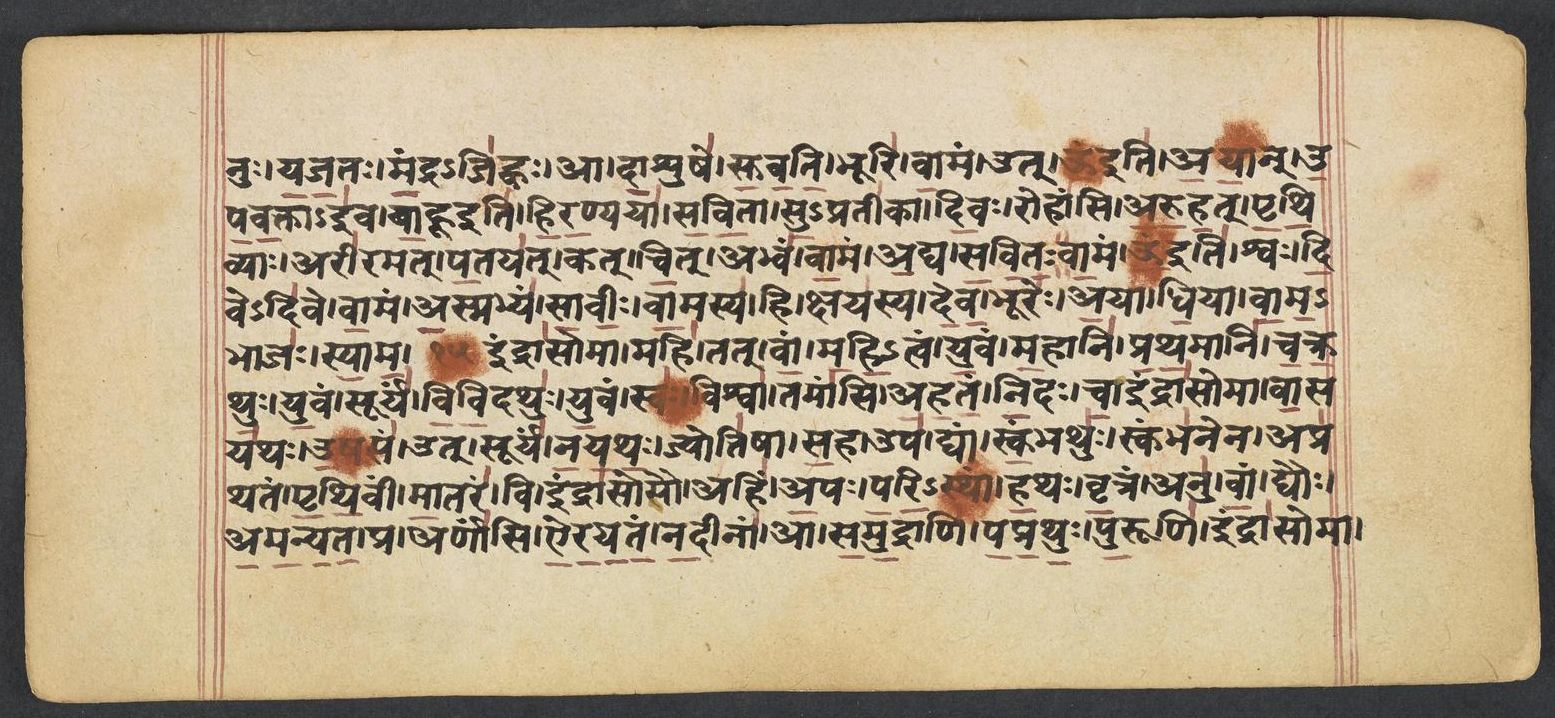
Penn Ms. Coll. 390 Item 41, fol. 489r (numbered 10r by the scribe) (OPenn image 489, lower leaf). Checked on the image: the Rigveda text on this page begins in RV 6.71.4 ‹-ayaḥ-hanuḥ yajataḥ mandra-jihvaḥ ā›. The next page with Rigveda text, fol. 489v (numbered 10v by the scribe), begins in RV 6.72.4 ‹pakvam āmāsu antaḥ ni›. Verses 6.71.4-6 end on this page; 6.71.4 begins on fol. 488v (numbered 9v by the scribe).
4ud u̱ ṣya de̱vaḥ sa̍vi̱tā damū̍nā̱ hira̍ṇyapāṇiḥ pratido̱ṣam a̍sthāt | ayo̍hanur yaja̱to ma̱ndraji̍hva̱ ā dā̱śuṣe̍ suvati̱ bhūri̍ vā̱mam ||
5ud ū̍ ayām̐ upava̱kteva̍ bā̱hū hi̍ra̱ṇyayā̍ savi̱tā su̱pratī̍kā | di̱vo rohā̍ṁsy aruhat pṛthi̱vyā arī̍ramat pa̱taya̱t kac ci̱d abhva̍m ||
6vā̱mam a̱dya sa̍vitar vā̱mam u̱ śvo di̱ve-di̍ve vā̱mam a̱smabhya̍ṁ sāvīḥ | vā̱masya̱ hi kṣaya̍sya deva̱ bhūre̍r a̱yā dhi̱yā vā̍ma̱bhāja̍ḥ syāma ||
Compare: Padapāṭha (word-by-word text written in the manuscript; Sansknet e-text via GRETIL)
4ut | oṃ iti | syaḥ | devaḥ | savitā | damūnāḥ | hiraṇya-pāṇiḥ | prati-doṣam | asthāt | ayaḥ-hanuḥ | yajataḥ | mandra-jihvaḥ | ā | dāśuṣe | suvati | bhūri | vāmam
5ut | oṃ iti | ayān | upavaktāiva | bāhū iti | hiranyayā | savitā | su-pratīkā | divaḥ | rohāṃsi | aruhat | pṛthivyāḥ | arīramat | patayat | kat | cit | abhvam
6vāmam | adya | savitaḥ | vāmam | oṃ iti | śvaḥ | dive--dive | vāmam | asmabhyam | sāvīḥ | vāmasya | hi | kṣayasya | deva | bhūreḥ | ayā | dhiyā | vāma-bhājaḥ | syāma
4This Savitar the God, the golden-handed, Friend of the home, hath risen to meet the twilight. With cheeks of brass, with pleasant tongue, the Holy, he sends the worshipper rich gifts in plenty.
5Like a Director, Savitar hath extended his golden arms, exceeding fair to look on. He hath gone up the heights of earth and heaven, and made each monster fall and cease from troubling.
6Fair wealth, O Savitar, to-day, to-morrow, fair wealth produce for us each day that passes. May we through this our song be happy gainers, God, of a fair and spacious habitation.
Notes
- Sanskrit: Aufrecht's edition (1877) with the Vedic accents, as entered by van Nooten and Holland (GRETIL).
- English: Ralph T. H. Griffith, The Hymns of the Rigveda (1889-1892; 2nd ed. 1896-1897), from the VedaWeb digital text; OCR slips in that text were corrected against the printed 2nd edition (data/sources/rigveda/griffith_errata.json).
- Padapāṭha (edition text): Sansknet e-text via GRETIL (CC BY-NC-SA 4.0).
Cite
Sources
- Source: Penn Ms. Coll. 390 Item 41 (undated (catalogued with Penn's 18th-19th c. Vedic manuscripts)), OPenn, Public Domain Mark + Aufrecht's accented text (GRETIL) + Griffith's English (VedaWeb) (holding institution)
- Critical edition: Aufrecht (1877), accented e-text via GRETIL
← previous · → next · v cycle view · l back to library