Rigveda 7.48: To the Ribhus
Introduction
Rigveda 7.48 is a hymn of 4 verses addressed to the Ribhus. It stands in book (maṇḍala) 7, the family book of Vasiṣṭha. The Rigveda is the oldest collection of Sanskrit hymns, composed in the second half of the second millennium BCE and handed down orally for many centuries before it was written down.
The manuscript shown is Penn Ms. Coll. 390 Item 41 (University of Pennsylvania), an undated paper manuscript of the padapāṭha (the word-by-word recitation text, in which every word is written separately and compounds are split) of the whole Ṛgveda in Devanāgarī, 884 leaves in fascicles, 7-9 lines to the page, accents in red; this hymn stands on fol. 524v-525r. Each section below gives the verses that end on one page; the page boundaries were read on the images (the opening words of every page), not counted out. Where the manuscript is a padapāṭha (the word-by-word recitation text), the section shows Aufrecht's continuous (saṃhitā) text first and, as the edition text, the padapāṭha of the same verses, which is the form written on the page.
How was this verified? (Provenance)
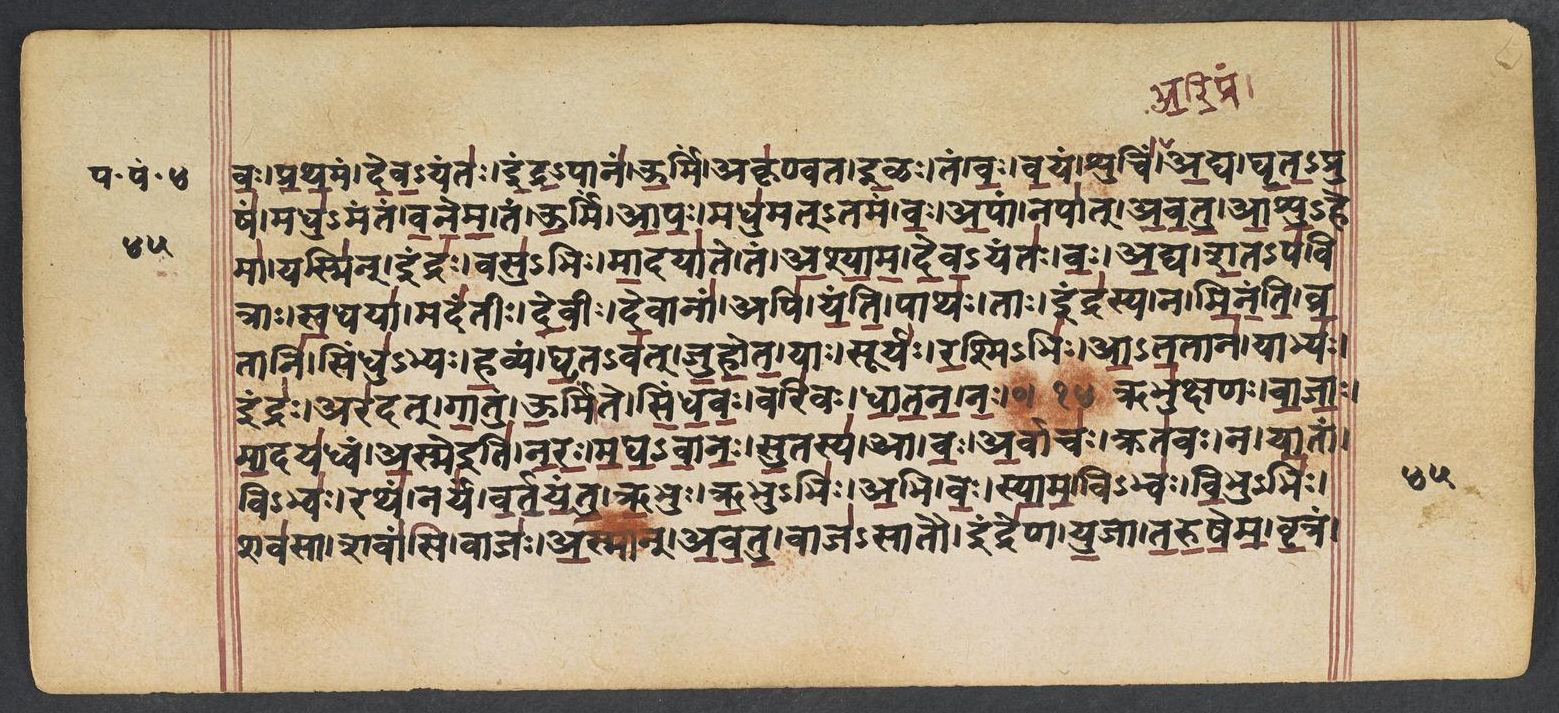
Where on the image
Penn Ms. Coll. 390 Item 41, fol. 524v (numbered 45v by the scribe) (OPenn image 525, upper leaf). Checked on the image: the Rigveda text on this page begins in RV 7.47.1 ‹-yam vaḥ prathamam dava-yantaḥ›. The next page with Rigveda text, fol. 525r (numbered 46r by the scribe), begins in RV 7.48.3 ‹te cit hi pūrvīḥ›. Verses 7.48.1-2 end on this page.
1ṛbhu̍kṣaṇo vājā mā̱daya̍dhvam a̱sme na̍ro maghavānaḥ su̱tasya̍ | ā vo̱ 'rvāca̱ḥ krata̍vo̱ na yā̱tāṁ vibhvo̱ ratha̱ṁ narya̍ṁ vartayantu ||
2ṛ̱bhur ṛ̱bhubhi̍r a̱bhi va̍ḥ syāma̱ vibhvo̍ vi̱bhubhi̱ḥ śava̍sā̱ śavā̍ṁsi | vājo̍ a̱smām̐ a̍vatu̱ vāja̍sātā̱v indre̍ṇa yu̱jā ta̍ruṣema vṛ̱tram ||
Compare: Padapāṭha (word-by-word text written in the manuscript; Sansknet e-text via GRETIL)
1ṛbhu-kṣaṇaḥ | vājāḥ | mādayadhvam | asme iti | naraḥ | magha-vānaḥ | sutasya | ā | vaḥ | arvācaḥ | kratavaḥ | na | yātām | vi-bhvaḥ | ratham | naryam | vartayantu
2ṛbhuḥ | ṛbhu-bhiḥ | abhi | vaḥ | syāma | vi-bhvaḥ | vi-bhumiḥ | śavasā | śavāṃsi | vājaḥ | asmān | avatu | vāja-sātau | indreṇa | yujā | taruṣema | vṛtram
1YE liberal Heroes, Vâjas and R̥ibhukshans, come and delight you with our flowing Soma. May your strength, Vibhûs, as ye come to meet us, turn hitherward your car that brings men profit.
2May we as R̥ibhu with your R̥ibhus conquer strength with our strength, as Vibhûs with the Vibhûs. May Vâja aid us in the fight for booty, and helped by Indra may we quell the foeman.
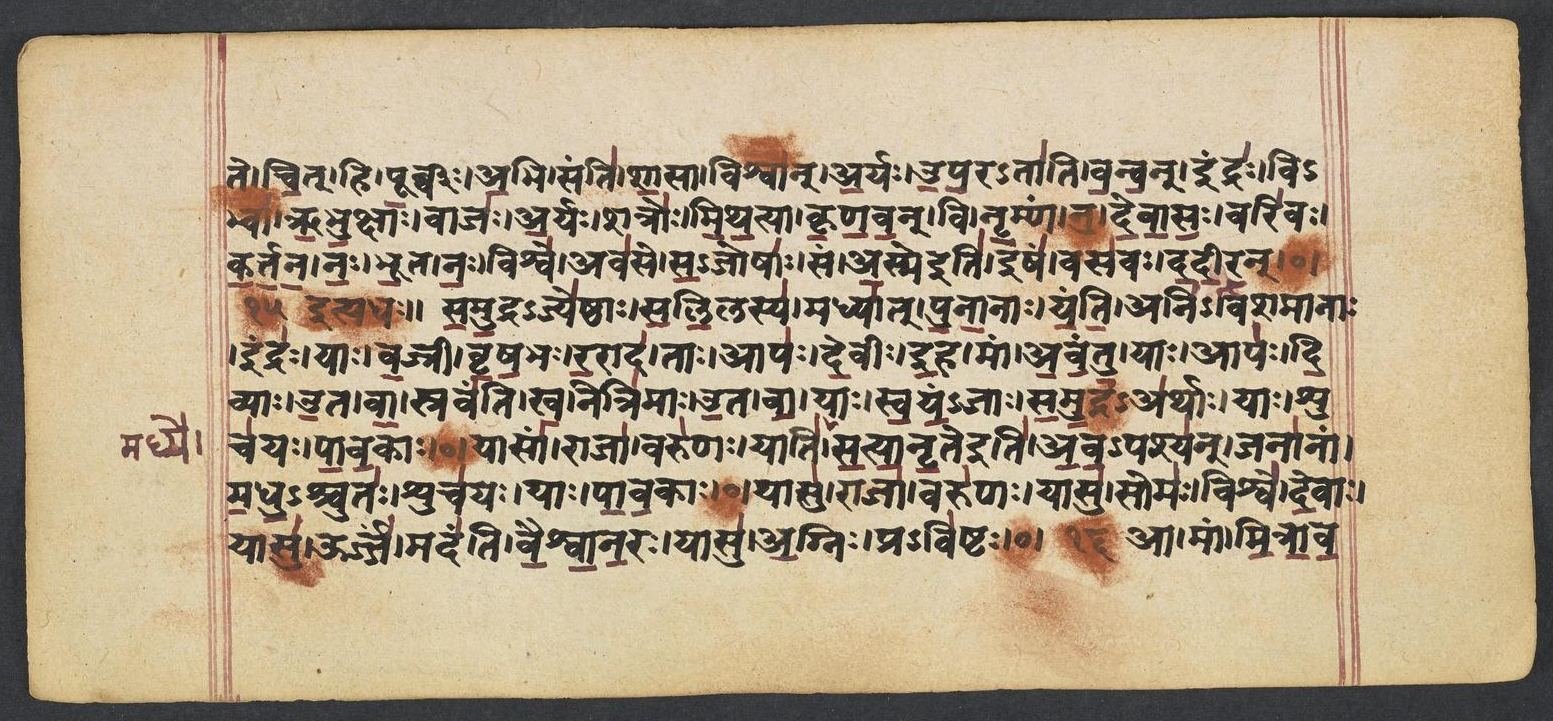
Where on the image
Penn Ms. Coll. 390 Item 41, fol. 525r (numbered 46r by the scribe) (OPenn image 525, lower leaf). Checked on the image: the Rigveda text on this page begins in RV 7.48.3 ‹te cit hi pūrvīḥ›. The next page with Rigveda text, fol. 525v (numbered 46v by the scribe), begins in RV 7.50.1 ‹-mitrāvaruṇā iha rakṣatam kulāyayat›. Verses 7.48.3-4 end on this page.
3te ci̱d dhi pū̱rvīr a̱bhi santi̍ śā̱sā viśvā̍m̐ a̱rya u̍pa̱ratā̍ti vanvan | indro̱ vibhvā̍m̐ ṛbhu̱kṣā vājo̍ a̱ryaḥ śatro̍r mitha̱tyā kṛ̍ṇava̱n vi nṛ̱mṇam ||
4nū de̍vāso̱ vari̍vaḥ kartanā no bhū̱ta no̱ viśve 'va̍se sa̱joṣā̍ḥ | sam a̱sme iṣa̱ṁ vasa̍vo dadīran yū̱yam pā̍ta sva̱stibhi̱ḥ sadā̍ naḥ ||
Compare: Padapāṭha (word-by-word text written in the manuscript; Sansknet e-text via GRETIL)
3te | cit | hi | pūrvīḥ | abhi | santi | śāsā | viśvān | aryaḥ | upara-tāti | vanvan | indraḥ | vi-bhvā | ṛbhukṣāḥ | vājaḥ | aryaḥ | śatroḥ | mithatyā | kṛṇavan | vi | nṛmṇam
4nu | devāsaḥ | varivaḥ | kartana | naḥ | bhūta | naḥ | viśve | avase | sa-joṣāḥ | sam | asme iti | iṣam | vasavaḥ | dadīran | yūyam | pāta | svasti-bhiḥ | sadā | naḥ
3For they rule many tribes with high dominion, and conquer all their foes in close encounter. May Indra, Vibhvan, Vâja, and R̥ibhukshan destroy by turns the wicked foeman's valour.
4Now, Deities, give us ample room and freedom: be all of you, one-minded, our protection. So let the Vasus grant us strength and vigour. Preserve us evermore, ye Gods, with blessings.
Notes
- Sanskrit: Aufrecht's edition (1877) with the Vedic accents, as entered by van Nooten and Holland (GRETIL).
- English: Ralph T. H. Griffith, The Hymns of the Rigveda (1889-1892; 2nd ed. 1896-1897), from the VedaWeb digital text; OCR slips in that text were corrected against the printed 2nd edition (data/sources/rigveda/griffith_errata.json).
- Padapāṭha (edition text): Sansknet e-text via GRETIL (CC BY-NC-SA 4.0).
Cite
Sources
- Source: Penn Ms. Coll. 390 Item 41 (undated (catalogued with Penn's 18th-19th c. Vedic manuscripts)), OPenn, Public Domain Mark + Aufrecht's accented text (GRETIL) + Griffith's English (VedaWeb) (holding institution)
- Critical edition: Aufrecht (1877), accented e-text via GRETIL
← previous · → next · v cycle view · l back to library