Rigveda 7.50: Diverse gods
Introduction
Rigveda 7.50 is a hymn of 4 verses addressed to diverse gods. It stands in book (maṇḍala) 7, the family book of Vasiṣṭha. The Rigveda is the oldest collection of Sanskrit hymns, composed in the second half of the second millennium BCE and handed down orally for many centuries before it was written down.
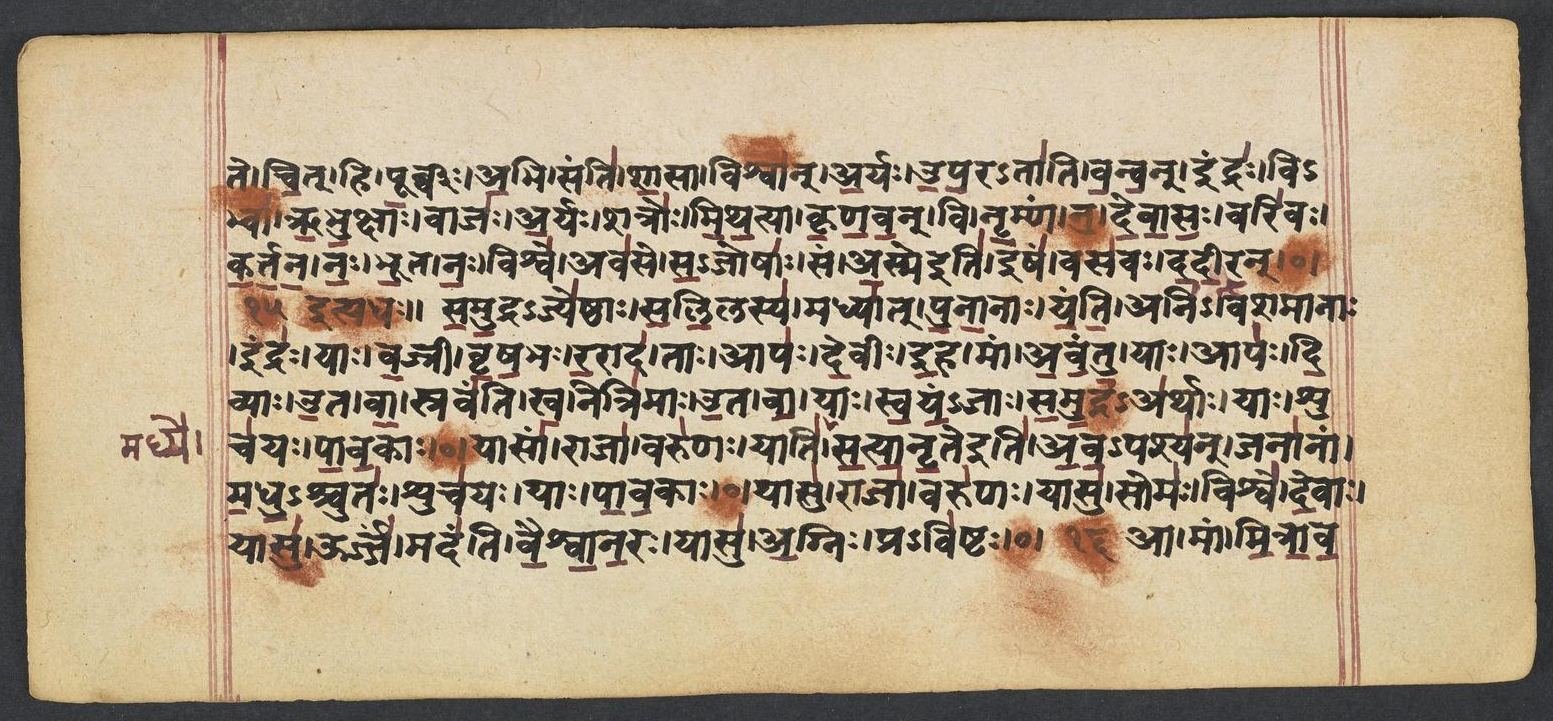
The manuscript shown is Penn Ms. Coll. 390 Item 41 (University of Pennsylvania), an undated paper manuscript of the padapāṭha (the word-by-word recitation text, in which every word is written separately and compounds are split) of the whole Ṛgveda in Devanāgarī, 884 leaves in fascicles, 7-9 lines to the page, accents in red; this hymn stands on fol. 525r-525v. Each section below gives the verses that end on one page; the page boundaries were read on the images (the opening words of every page), not counted out. Where the manuscript is a padapāṭha (the word-by-word recitation text), the section shows Aufrecht's continuous (saṃhitā) text first and, as the edition text, the padapāṭha of the same verses, which is the form written on the page.
How was this verified? (Provenance)
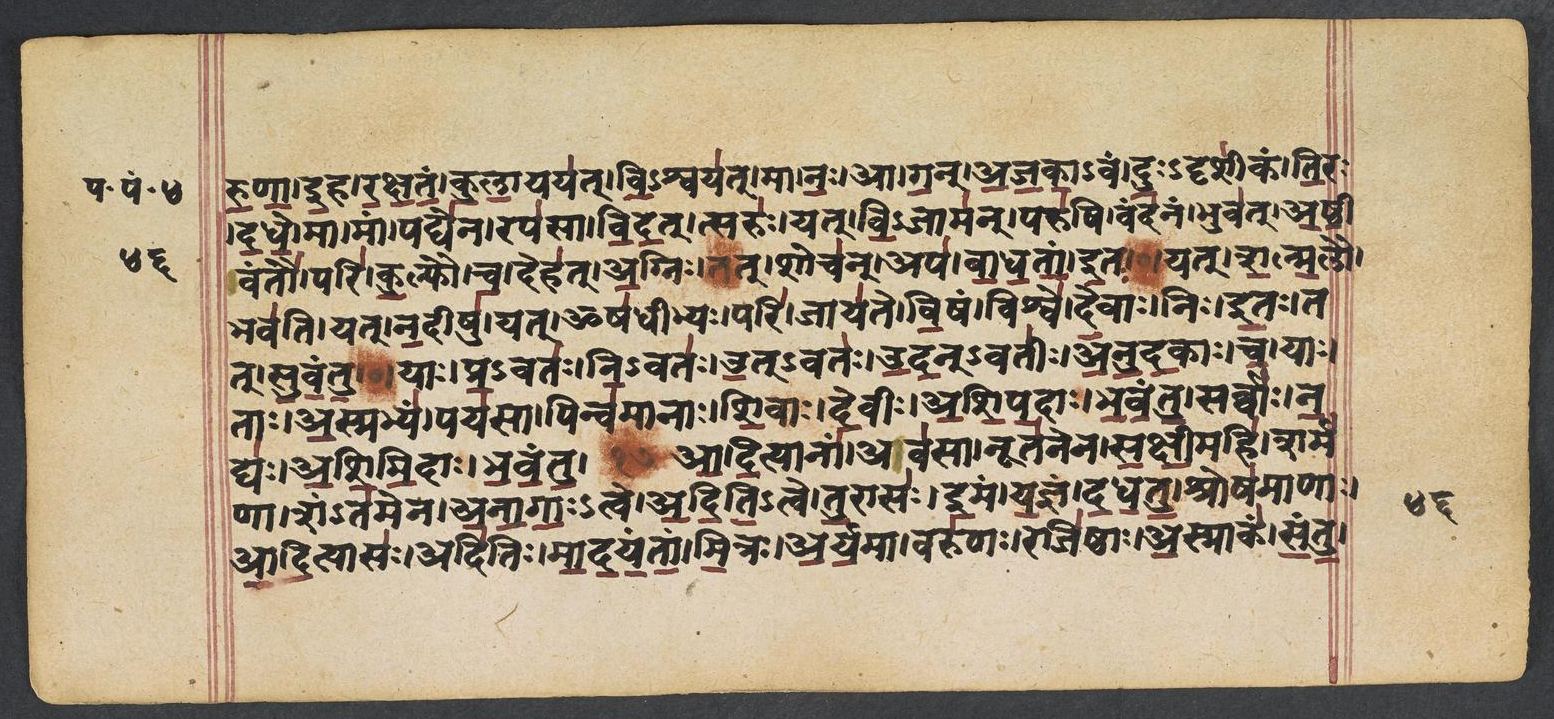
Where on the image
Penn Ms. Coll. 390 Item 41, fol. 525v (numbered 46v by the scribe) (OPenn image 526, upper leaf). Checked on the image: the Rigveda text on this page begins in RV 7.50.1 ‹-mitrāvaruṇā iha rakṣatam kulāyayat›. The next page with Rigveda text, fol. 526r (numbered 47r by the scribe), begins in RV 7.51.2 ‹bhuvanasya gopāḥ pibantu somam›. Verses 7.50.1-4 end on this page; 7.50.1 begins on fol. 525r (numbered 46r by the scribe).
1ā mām mi̍trāvaruṇe̱ha ra̍kṣataṁ kulā̱yaya̍d vi̱śvaya̱n mā na̱ ā ga̍n | a̱ja̱kā̱vaṁ du̱rdṛśī̍kaṁ ti̱ro da̍dhe̱ mā mām padye̍na̱ rapa̍sā vida̱t tsaru̍ḥ ||
2yad vi̱jāma̱n paru̍ṣi̱ vanda̍na̱m bhuva̍d aṣṭhī̱vantau̱ pari̍ ku̱lphau ca̱ deha̍t | a̱gniṣ ṭac choca̱nn apa̍ bādhatām i̱to mā mām padye̍na̱ rapa̍sā vida̱t tsaru̍ḥ ||
3yac cha̍lma̱lau bhava̍ti̱ yan na̱dīṣu̱ yad oṣa̍dhībhya̱ḥ pari̱ jāya̍te vi̱ṣam | viśve̍ de̱vā nir i̱tas tat su̍vantu̱ mā mām padye̍na̱ rapa̍sā vida̱t tsaru̍ḥ ||
4yāḥ pra̱vato̍ ni̱vata̍ u̱dvata̍ uda̱nvatī̍r anuda̱kāś ca̱ yāḥ | tā a̱smabhya̱m paya̍sā̱ pinva̍mānāḥ śi̱vā de̱vīr a̍śipa̱dā bha̍vantu̱ sarvā̍ na̱dyo̍ aśimi̱dā bha̍vantu ||
Compare: Padapāṭha (word-by-word text written in the manuscript; Sansknet e-text via GRETIL)
1ā | mām | mitrāvaruṇā | iha | rakṣatam | kulāyayat | vi-śvayat | mā | naḥ | ā | gan | ajakāvam | duḥ-dṛśīkam | tiraḥ | dadhe | mā | mām | padyena | rapasā | vidat | tsaruḥ
2yat | vi-jāman | paruṣi | vandanam | bhuvat | aṣṭhīvantau | pari | kulphau | ca | dehat | agniḥ | tat | śocan | apa | bādhatām | itaḥ | mā | mām | padyena | rapasā | vidat | tsaruḥ
3yat | śalmalau | bhavati | yat | nadīṣu | yat | oṣadhībhyaḥ | pari | jāyate | viṣam | viśve | devāḥ | niḥ | itaḥ | tat | suvantu | mā | mām | padyena | rapasā | vidat | tsaruḥ
4yāḥ | pra-vataḥ | ni-vataḥ | ut-vataḥ | udan-vatīḥ | anudakāḥ | ca | yāḥ | tāḥ | asmabhyam | payasā | pinvamānāḥ | śivāḥ | devīḥ | aśipadāḥ | bhavantu | sarvāḥ | nadyaḥ | aśimidāḥ | bhavantu
1O MITRA-Varuṇa, guard and protect me here: let not that come to me which nests within and swells. I drive afar the scorpion hateful to the sight: let not the winding worm touch me and wound my foot.
2Eruption that appears upon the twofold joints, and that which overspreads the ankles and the knees, May the refulgent Agni banish far away let not the winding worm touch me and wound my foot.
3The poison that is formed upon the Ṣalmali, that which is found in streams, that which the plants produce, All this may all the Gods banish and drive away: let not the winding worm touch me and wound my foot.
4The steep declivities, the valleys, and the heights, the channels full of water, and the waterless- May those who swell with water, gracious Goddesses, never afflict us with the Ṣipada disease, may all the rivers keep us free from Ṣimidâ.
Notes
- Sanskrit: Aufrecht's edition (1877) with the Vedic accents, as entered by van Nooten and Holland (GRETIL).
- English: Ralph T. H. Griffith, The Hymns of the Rigveda (1889-1892; 2nd ed. 1896-1897), from the VedaWeb digital text; OCR slips in that text were corrected against the printed 2nd edition (data/sources/rigveda/griffith_errata.json).
- Padapāṭha (edition text): Sansknet e-text via GRETIL (CC BY-NC-SA 4.0).
Cite
Sources
- Source: Penn Ms. Coll. 390 Item 41 (undated (catalogued with Penn's 18th-19th c. Vedic manuscripts)), OPenn, Public Domain Mark + Aufrecht's accented text (GRETIL) + Griffith's English (VedaWeb) (holding institution)
- Critical edition: Aufrecht (1877), accented e-text via GRETIL
← previous · → next · v cycle view · l back to library