Rigveda 7.84: To Indra and Varuna
Introduction
Rigveda 7.84 is a hymn of 5 verses addressed to Indra and Varuna. It stands in book (maṇḍala) 7, the family book of Vasiṣṭha. The Rigveda is the oldest collection of Sanskrit hymns, composed in the second half of the second millennium BCE and handed down orally for many centuries before it was written down.
The manuscript shown is Penn Ms. Coll. 390 Item 41 (University of Pennsylvania), an undated paper manuscript of the padapāṭha (the word-by-word recitation text, in which every word is written separately and compounds are split) of the whole Ṛgveda in Devanāgarī, 884 leaves in fascicles, 7-9 lines to the page, accents in red; this hymn stands on fol. 545v. Each section below gives the verses that end on one page; the page boundaries were read on the images (the opening words of every page), not counted out. Where the manuscript is a padapāṭha (the word-by-word recitation text), the section shows Aufrecht's continuous (saṃhitā) text first and, as the edition text, the padapāṭha of the same verses, which is the form written on the page.
How was this verified? (Provenance)
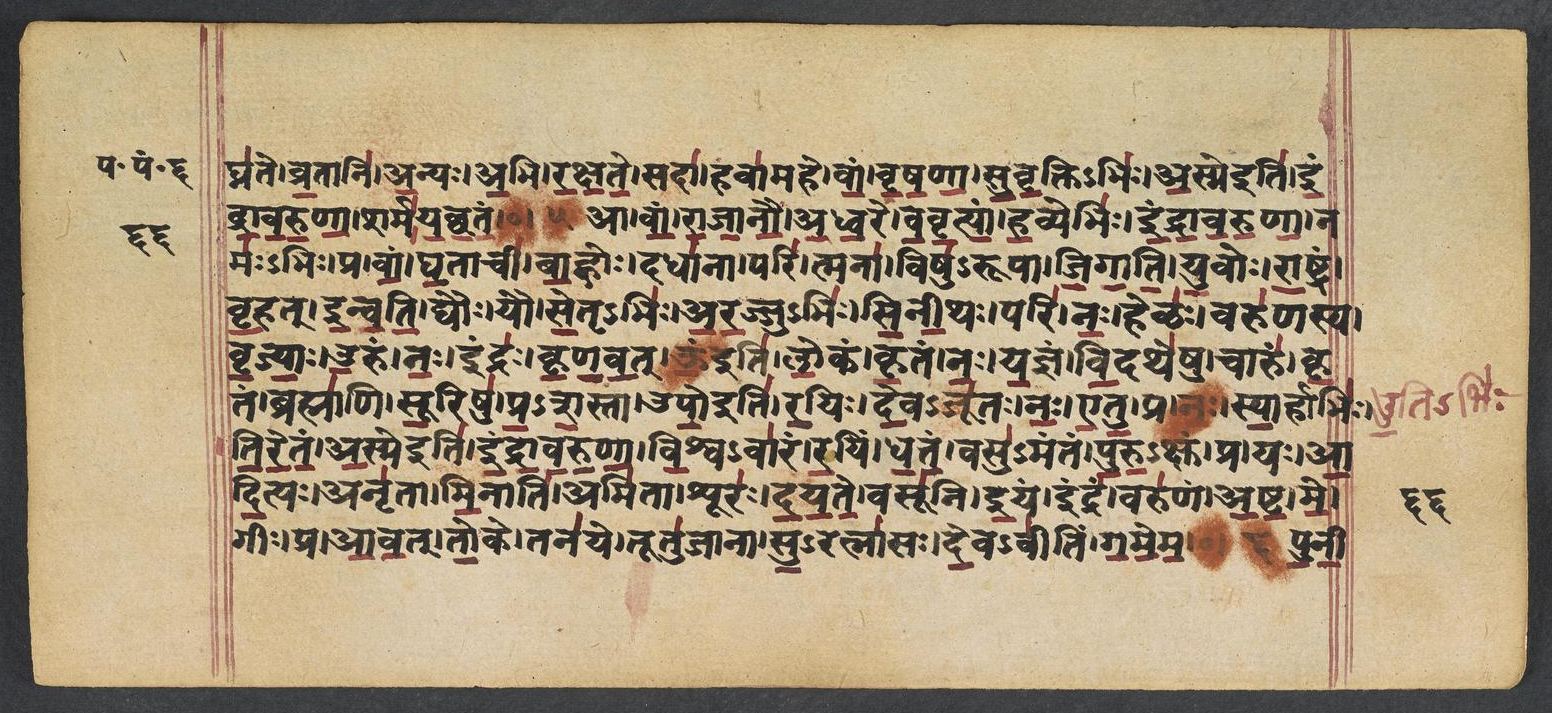
Where on the image
Penn Ms. Coll. 390 Item 41, fol. 545v (numbered 66v by the scribe) (OPenn image 546, upper leaf). Checked on the image: the Rigveda text on this page begins in RV 7.83.9 ‹-jighnate vratāni anyaḥ abhi›. The next page with Rigveda text, fol. 546r (numbered 67r by the scribe), begins in RV 7.85.1 ‹-punīṣe vām arakṣasam manīṣām›. Verses 7.84.1-5 end on this page.
1ā vā̍ṁ rājānāv adhva̱re va̍vṛtyāṁ ha̱vyebhi̍r indrāvaruṇā̱ namo̍bhiḥ | pra vā̍ṁ ghṛ̱tācī̍ bā̱hvor dadhā̍nā̱ pari̱ tmanā̱ viṣu̍rūpā jigāti ||
2yu̱vo rā̱ṣṭram bṛ̱had i̍nvati̱ dyaur yau se̱tṛbhi̍r ara̱jjubhi̍ḥ sinī̱thaḥ | pari̍ no̱ heḻo̱ varu̍ṇasya vṛjyā u̱ruṁ na̱ indra̍ḥ kṛṇavad u lo̱kam ||
3kṛ̱taṁ no̍ ya̱jñaṁ vi̱dathe̍ṣu̱ cāru̍ṁ kṛ̱tam brahmā̍ṇi sū̱riṣu̍ praśa̱stā | upo̍ ra̱yir de̱vajū̍to na etu̱ pra ṇa̍ḥ spā̱rhābhi̍r ū̱tibhi̍s tiretam ||
4a̱sme i̍ndrāvaruṇā vi̱śvavā̍raṁ ra̱yiṁ dha̍tta̱ṁ vasu̍mantam puru̱kṣum | pra ya ā̍di̱tyo anṛ̍tā mi̱nāty ami̍tā̱ śūro̍ dayate̱ vasū̍ni ||
5i̱yam indra̱ṁ varu̍ṇam aṣṭa me̱ gīḥ prāva̍t to̱ke tana̍ye̱ tūtu̍jānā | su̱ratnā̍so de̱vavī̍tiṁ gamema yū̱yam pā̍ta sva̱stibhi̱ḥ sadā̍ naḥ ||
Compare: Padapāṭha (word-by-word text written in the manuscript; Sansknet e-text via GRETIL)
1ā | vām | rājānau | adhvare | vavṛtyām | havyebhiḥ | indrāvaruṇā | namaḥ-bhiḥ | pra | vām | ghṛtācī | bāhvoḥ | dadhānā | pari | tmanā | viṣu-rūpā | jigāti
2yuvaḥ | rāṣṭram | bṛhat | invati | dyauḥ | yau | setṛ-bhiḥ | arajju-bhiḥ | sinīthaḥ | pari | naḥ | heḷaḥ | varuṇasya | vṛjyāḥ | urum | naḥ | indraḥ | kṛṇavat | oṃ iti | lokam
3kṛtam | naḥ | yajñam | vidatheṣu | cārum | kṛtam | brahmāṇi | sūriṣu | pra-śastā | upo iti | rayiḥ | deva-jūtaḥ | naḥ | etu | pra | naḥ | spārhābhiḥ | ūti-bhiḥ | tiretam
4asme iti | indrāvaruṇā | viśva-vāram | rayim | dhattam | vasu-mantam | puru-kṣum | pra | yaḥ | ādityaḥ | anṛtā | mināti | amitā | śūraḥ | dayate | vasūni
5iyam | indram | varuṇam | aṣṭa | me | gīḥ | pra | āvat | toke | tanaye | tūtujānā | su-ratnāsaḥ | deva-vītim | gamema | yūyam | pāta | svasti-bhiḥ | sadā | naḥ
1KINGS, Indra-Varuṇa, I would turn you hither to this our sacrifice with gifts and homage. Held in both arms the ladle, dropping fatness, goes of itself to you whose forms are varied.
2Dyaus quickens and promotes your high dominion who bind with bonds not wrought of rope or cordage. Far from us still be Varuṇa's displeasure may Indra give us spacious room to dwell in.
3Make ye our sacrifice fair amid the assemblies: make ye our prayers approved among our princes. May God-sent riches come for our possession: further ye us with your delightful succours.
4O Indra-Varuṇa, vouchsafe us riches with store of treasure, food, and every blessing; For the Âditya, banisher of falsehood, the Hero, dealeth wealth in boundless plenty.
5May this my song reach Varuṇa and Indra, and, strongly urging, win me sons and offspring. To the Gods' banquet may we go with riches. Preserve us evermore, ye Gods, with blessings.
Notes
- Sanskrit: Aufrecht's edition (1877) with the Vedic accents, as entered by van Nooten and Holland (GRETIL).
- English: Ralph T. H. Griffith, The Hymns of the Rigveda (1889-1892; 2nd ed. 1896-1897), from the VedaWeb digital text; OCR slips in that text were corrected against the printed 2nd edition (data/sources/rigveda/griffith_errata.json).
- Padapāṭha (edition text): Sansknet e-text via GRETIL (CC BY-NC-SA 4.0).
Cite
Sources
- Source: Penn Ms. Coll. 390 Item 41 (undated (catalogued with Penn's 18th-19th c. Vedic manuscripts)), OPenn, Public Domain Mark + Aufrecht's accented text (GRETIL) + Griffith's English (VedaWeb) (holding institution)
- Critical edition: Aufrecht (1877), accented e-text via GRETIL
← previous · → next · v cycle view · l back to library