Rigveda 8.56: Thanksgiving
Introduction
Rigveda 8.56 is a hymn of 5 verses addressed to thanksgiving. It stands in book (maṇḍala) 8, the book of the Kaṇva and Aṅgiras poets. The Rigveda is the oldest collection of Sanskrit hymns, composed in the second half of the second millennium BCE and handed down orally for many centuries before it was written down.
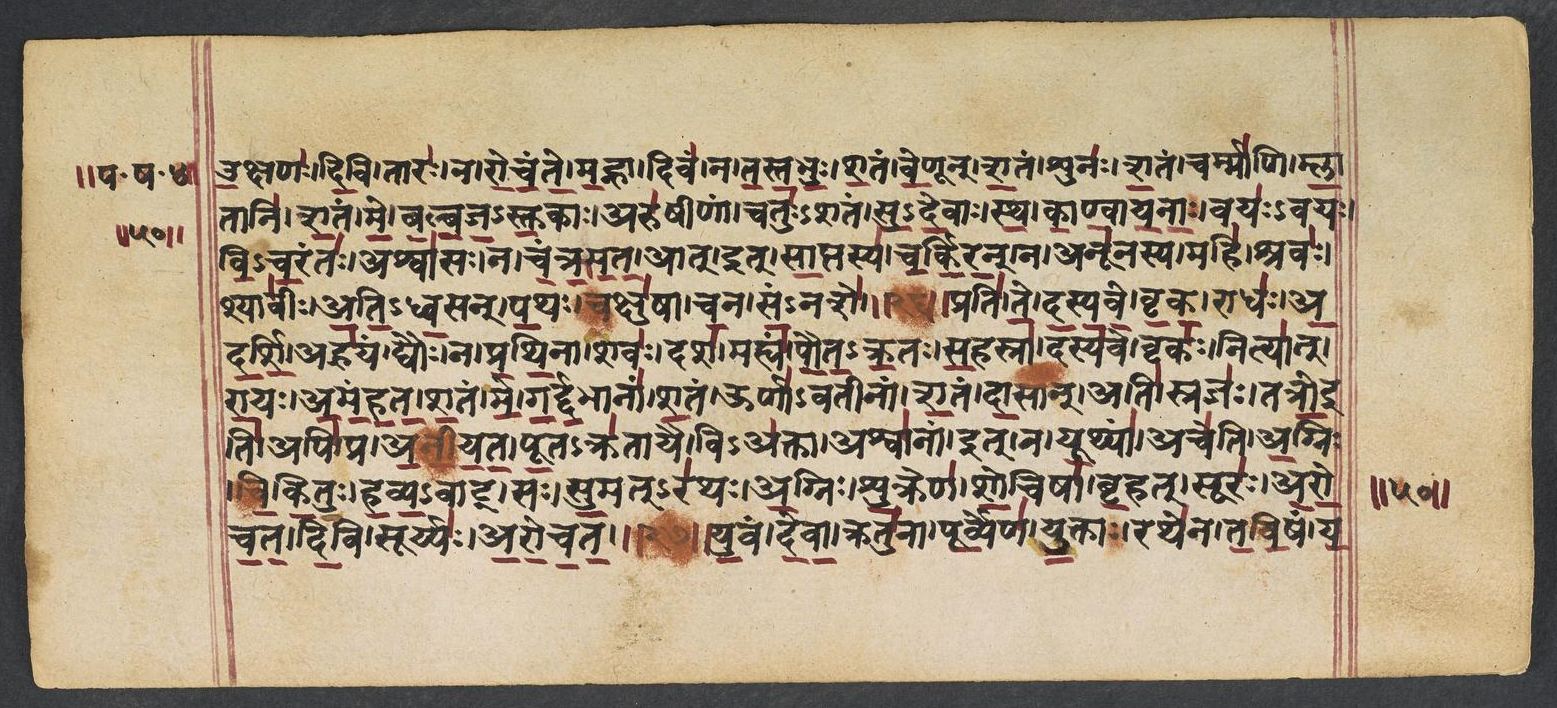
The manuscript shown is Penn Ms. Coll. 390 Item 41 (University of Pennsylvania), an undated paper manuscript of the padapāṭha (the word-by-word recitation text, in which every word is written separately and compounds are split) of the whole Ṛgveda in Devanāgarī, 884 leaves in fascicles, 7-9 lines to the page, accents in red; this hymn stands on fol. 628v. Each section below gives the verses that end on one page; the page boundaries were read on the images (the opening words of every page), not counted out. Where the manuscript is a padapāṭha (the word-by-word recitation text), the section shows Aufrecht's continuous (saṃhitā) text first and, as the edition text, the padapāṭha of the same verses, which is the form written on the page.
How was this verified? (Provenance)
Where on the image
Penn Ms. Coll. 390 Item 41, fol. 628v (numbered 50v by the scribe) (OPenn image 629, upper leaf). Checked on the image: the Rigveda text on this page begins in RV 8.55.2 ‹ukṣaṇaḥ divi tāraḥ na›. The next page with Rigveda text, fol. 629r (numbered 51r by the scribe), begins in RV 8.57.1 ‹-yajatrā ā agacchatam nāsatyā›. Verses 8.56.1-5 end on this page.
1prati̍ te dasyave vṛka̱ rādho̍ ada̱rśy ahra̍yam | dyaur na pra̍thi̱nā śava̍ḥ ||
2daśa̱ mahya̍m pautakra̱taḥ sa̱hasrā̱ dasya̍ve̱ vṛka̍ḥ | nityā̍d rā̱yo a̍maṁhata ||
3śa̱tam me̍ garda̱bhānā̍ṁ śa̱tam ūrṇā̍vatīnām | śa̱taṁ dā̱sām̐ ati̱ sraja̍ḥ ||
4tatro̱ api̱ prāṇī̍yata pū̱takra̍tāyai̱ vya̍ktā | aśvā̍nā̱m in na yū̱thyā̍m ||
5ace̍ty a̱gniś ci̍ki̱tur ha̍vya̱vāṭ sa su̱madra̍thaḥ | a̱gniḥ śu̱kreṇa̍ śo̱ciṣā̍ bṛ̱hat sūro̍ arocata di̱vi sūryo̍ arocata ||
Compare: Padapāṭha (word-by-word text written in the manuscript; Sansknet e-text via GRETIL)
1prati | te | dasyave | vṛka | rādhaḥ | adarśi | ahrayam | dyauḥ | na | prathinā | śavaḥ
2daśa | mahyam | pauta-krataḥ | sahasrā | dasyave | vṛkaḥ | nityāt | rāyaḥ | amaṃhata
3śatam | me | gardabhānām | śatam | ūrṇāvatīnām | śatam | dāsān | ati | srajaḥ
4tatro iti | api | pra | aṇīyata | pūta-kratāyai | vi-aktā | aśvānām | it | na | yūthyām
5aceti | agniḥ | cikituḥ | havya-vāṭ | saḥ | sumat-rathaḥ | agniḥ | śukreṇa | śociṣā | bṛhat | sūraḥ | arocata | divi | sūryaḥ | arocata
1THY bounty, Dasyave-vr̥ika, exhaustless hath displayed itself: Its fulness is as broad as heaven.
2Ten thousand Dasyave-vr̥ika, the son of Pûtakratu, hath From his own wealth bestowed on me.
3A hundred asses hath he given, a hundred head of fleecy sheep, A hundred slaves, and wreaths besides.
4There also was a mare led forth, picked out for Putakrata's sake, Not of the horses of the herd.
5Observant Agni hath appeared, oblation-bearer with his car. Agni with his resplendent flame hath shone on high as shines the Sun, hath shone like Sûrya in the heavens.
Notes
- Sanskrit: Aufrecht's edition (1877) with the Vedic accents, as entered by van Nooten and Holland (GRETIL).
- English: Ralph T. H. Griffith, The Hymns of the Rigveda (1889-1892; 2nd ed. 1896-1897), from the VedaWeb digital text; OCR slips in that text were corrected against the printed 2nd edition (data/sources/rigveda/griffith_errata.json).
- Padapāṭha (edition text): Sansknet e-text via GRETIL (CC BY-NC-SA 4.0).
Cite
Sources
- Source: Penn Ms. Coll. 390 Item 41 (undated (catalogued with Penn's 18th-19th c. Vedic manuscripts)), OPenn, Public Domain Mark + Aufrecht's accented text (GRETIL) + Griffith's English (VedaWeb) (holding institution)
- Critical edition: Aufrecht (1877), accented e-text via GRETIL
← previous · → next · v cycle view · l back to library