Rigveda 8.82: To Indra
Introduction
Rigveda 8.82 is a hymn of 9 verses addressed to Indra. It stands in book (maṇḍala) 8, the book of the Kaṇva and Aṅgiras poets. The Rigveda is the oldest collection of Sanskrit hymns, composed in the second half of the second millennium BCE and handed down orally for many centuries before it was written down.
The manuscript shown is Penn Ms. Coll. 390 Item 41 (University of Pennsylvania), an undated paper manuscript of the padapāṭha (the word-by-word recitation text, in which every word is written separately and compounds are split) of the whole Ṛgveda in Devanāgarī, 884 leaves in fascicles, 7-9 lines to the page, accents in red; this hymn stands on fol. 649r-649v. Each section below gives the verses that end on one page; the page boundaries were read on the images (the opening words of every page), not counted out. Where the manuscript is a padapāṭha (the word-by-word recitation text), the section shows Aufrecht's continuous (saṃhitā) text first and, as the edition text, the padapāṭha of the same verses, which is the form written on the page.
How was this verified? (Provenance)
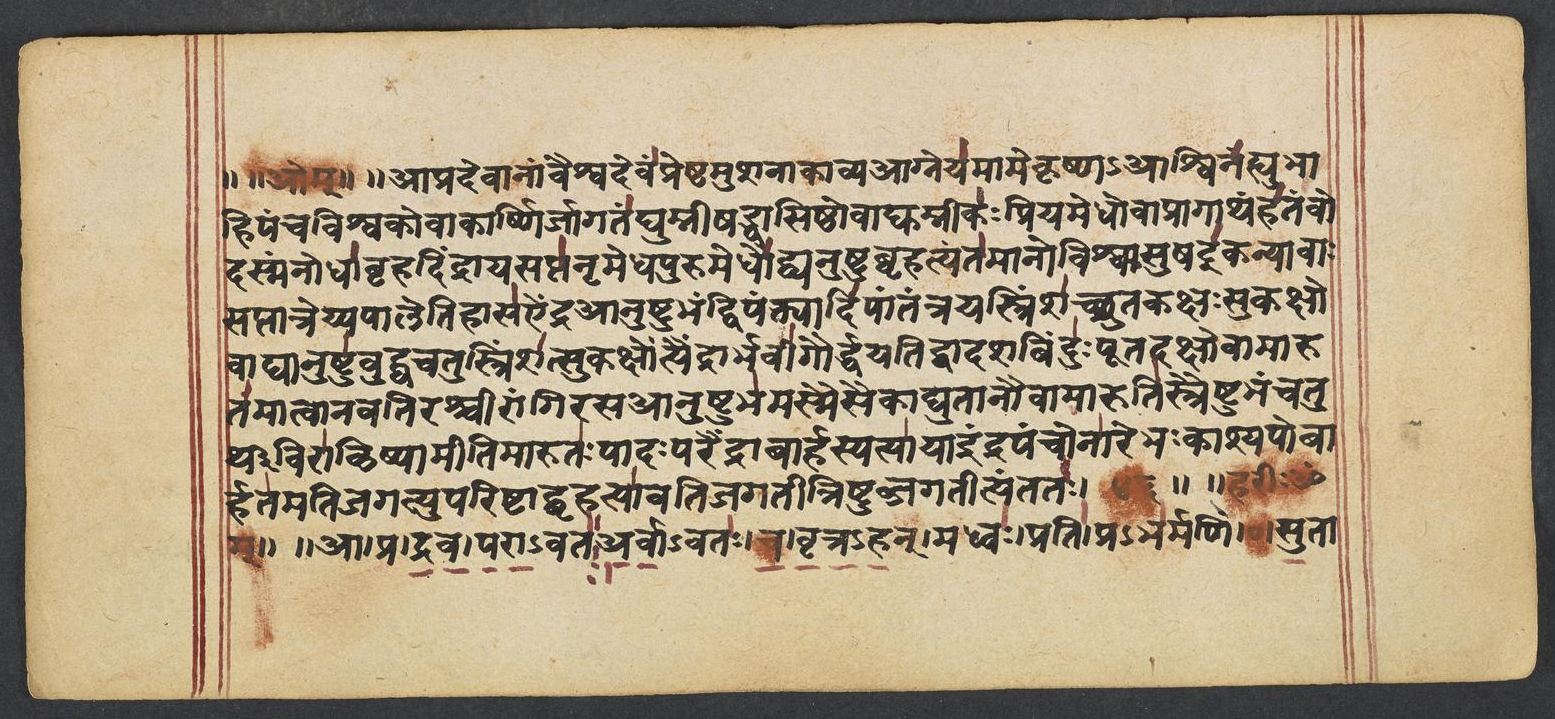
Where on the image
Penn Ms. Coll. 390 Item 41, fol. 649r (numbered 71r by the scribe) (OPenn image 649, lower leaf). Checked on the image: the Rigveda text on this page begins in RV 8.82.1 ‹ā pra drava parāvataḥ›. Lines 1-9 carry oṃ and the anukramaṇī for aṣṭaka 6, adhyāya 6; 8.82.1 (ā pra drava parāvataḥ) begins in line 9. The next page with Rigveda text, fol. 649v (numbered 71v by the scribe), begins in RV 8.82.2 ‹-sutāsaḥ mādayiṣṇavaḥ piba dadhṛk›. Verse 8.82.1 ends on this page.
1ā pra dra̍va parā̱vato̍ 'rvā̱vata̍ś ca vṛtrahan | madhva̱ḥ prati̱ prabha̍rmaṇi ||
Compare: Padapāṭha (word-by-word text written in the manuscript; Sansknet e-text via GRETIL)
1ā | pra | drava | parāvataḥ | arvāvataḥ | ca | vṛtra-han | madhvaḥ | prati | pra-bharmaṇi
1HASTE forward to us from afar, or, Vritra-slayer, from anear, To meet the offering to the meath.
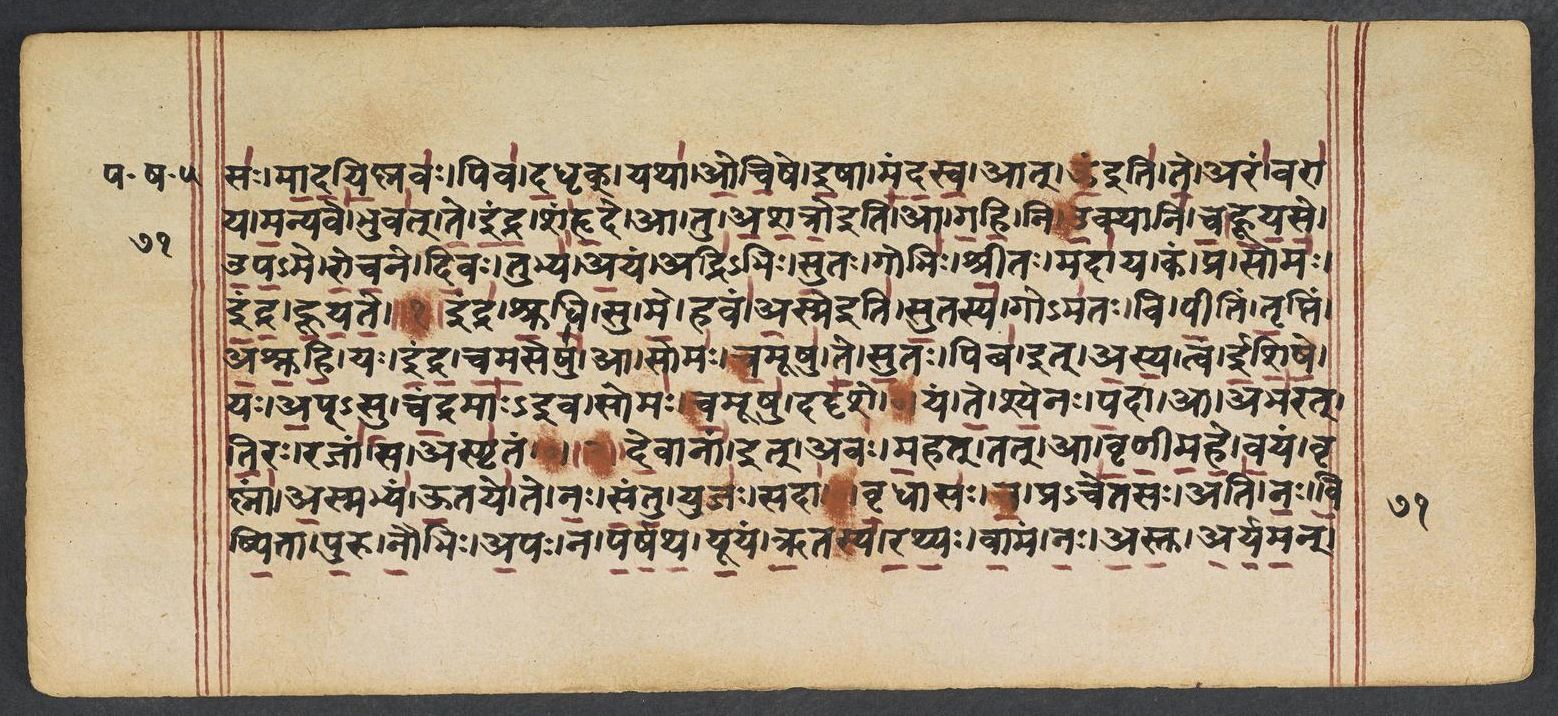
Where on the image
Penn Ms. Coll. 390 Item 41, fol. 649v (numbered 71v by the scribe) (OPenn image 650, upper leaf). Checked on the image: the Rigveda text on this page begins in RV 8.82.2 ‹-sutāsaḥ mādayiṣṇavaḥ piba dadhṛk›. The next page with Rigveda text, fol. 650r (numbered 72r by the scribe), begins in RV 8.83.4 ‹vāmam varuṇa śaṃsyam vāmam›. Verses 8.82.2-9 end on this page; 8.82.2 begins on fol. 649r (numbered 71r by the scribe).
2tī̱vrāḥ somā̍sa̱ ā ga̍hi su̱tāso̍ mādayi̱ṣṇava̍ḥ | pibā̍ da̱dhṛg yatho̍ci̱ṣe ||
3i̱ṣā ma̍nda̱svād u̱ te 'ra̱ṁ varā̍ya ma̱nyave̍ | bhuva̍t ta indra̱ śaṁ hṛ̱de ||
4ā tv a̍śatra̱v ā ga̍hi̱ ny u1̱̍kthāni̍ ca hūyase | u̱pa̱me ro̍ca̱ne di̱vaḥ ||
5tubhyā̱yam adri̍bhiḥ su̱to gobhi̍ḥ śrī̱to madā̍ya̱ kam | pra soma̍ indra hūyate ||
6indra̍ śru̱dhi su me̱ hava̍m a̱sme su̱tasya̱ goma̍taḥ | vi pī̱tiṁ tṛ̱ptim a̍śnuhi ||
7ya i̍ndra cama̱seṣv ā soma̍ś ca̱mūṣu̍ te su̱taḥ | pibed a̍sya̱ tvam ī̍śiṣe ||
8yo a̱psu ca̱ndramā̍ iva̱ soma̍ś ca̱mūṣu̱ dadṛ̍śe | pibed a̍sya̱ tvam ī̍śiṣe ||
9yaṁ te̍ śye̱naḥ pa̱dābha̍rat ti̱ro rajā̱ṁsy aspṛ̍tam | pibed a̍sya̱ tvam ī̍śiṣe ||
Compare: Padapāṭha (word-by-word text written in the manuscript; Sansknet e-text via GRETIL)
2tīvrāḥ | somāsaḥ | ā | gahi | sutāsaḥ | mādayiṣṇavaḥ | piba | dadhṛk | yathā | ociṣe
3iṣā | mandasva | āt | oṃ iti | te | aram | varāya | manyave | bhuvat | te | indra | śam | hṛde
4ā | tu | asatro iti | ā | gahi | ni | ukthāni | ca | hūyasce | upa-me | rocane | divaḥ
5tubhya | ayam | adri-bhiḥ | sutaḥ | gobhiḥ | śrītaḥ | madāya | kam | pra | somaḥ | indra | hūyate
6indra | śrudhi | su | me | havam | asme iti | sutasya | go--mataḥ | vi | pītim | tṛptim | aśnuhi
7yaḥ | indra | camaseṣu | ā | somaḥ | camūṣu | te | sutaḥ | piba | it | asya | tvam | īśiṣe
8yaḥ | ap-su | candramāḥ-iva | somaḥ | camūṣu | dadṛśe | piba | it | asya | tvam | īśiṣe
9yam | te | śyenaḥ | padā | abharat | tiraḥ | rajāṃsi | aspṛtam | piba | it | asya | tvam | īśiṣe
2Strong are the Soma-draughts; come nigh: the juices fill thee with delight: Drink boldly even as thou art wont'.
3Joy, Indra, in the strengthening food: let it content thy wish and thought, And be delightful to thine heart.
4Come to us thou who hast no foe: we call thee down to hymns of praise, In heaven's sublimest realm of light.
5This Soma here expressed with stones and dressed with milk for thy carouse, Indra, is offered up to thee.
6Graciously, Indra, hear my call. Come and obtain the draught, and sate Thyself with juices blent with milk.
7The Soma, Indra, which is shed in chalices and vats for thee, Drink thou, for thou art Lord thereof.
8The Soma seen within the vats, as in the flood the Moon is seen, Drink thou, for thou art Lord thereof.
9That which the Hawk brought in his claw, inviolate, through the air to thee, Drink thou, for thou art Lord thereof.
Notes
- Sanskrit: Aufrecht's edition (1877) with the Vedic accents, as entered by van Nooten and Holland (GRETIL).
- English: Ralph T. H. Griffith, The Hymns of the Rigveda (1889-1892; 2nd ed. 1896-1897), from the VedaWeb digital text; OCR slips in that text were corrected against the printed 2nd edition (data/sources/rigveda/griffith_errata.json).
- Padapāṭha (edition text): Sansknet e-text via GRETIL (CC BY-NC-SA 4.0).
Cite
Sources
- Source: Penn Ms. Coll. 390 Item 41 (undated (catalogued with Penn's 18th-19th c. Vedic manuscripts)), OPenn, Public Domain Mark + Aufrecht's accented text (GRETIL) + Griffith's English (VedaWeb) (holding institution)
- Critical edition: Aufrecht (1877), accented e-text via GRETIL
← previous · → next · v cycle view · l back to library