Rigveda 8.84: To Agni
Introduction
Rigveda 8.84 is a hymn of 9 verses addressed to Agni. It stands in book (maṇḍala) 8, the book of the Kaṇva and Aṅgiras poets. The Rigveda is the oldest collection of Sanskrit hymns, composed in the second half of the second millennium BCE and handed down orally for many centuries before it was written down.
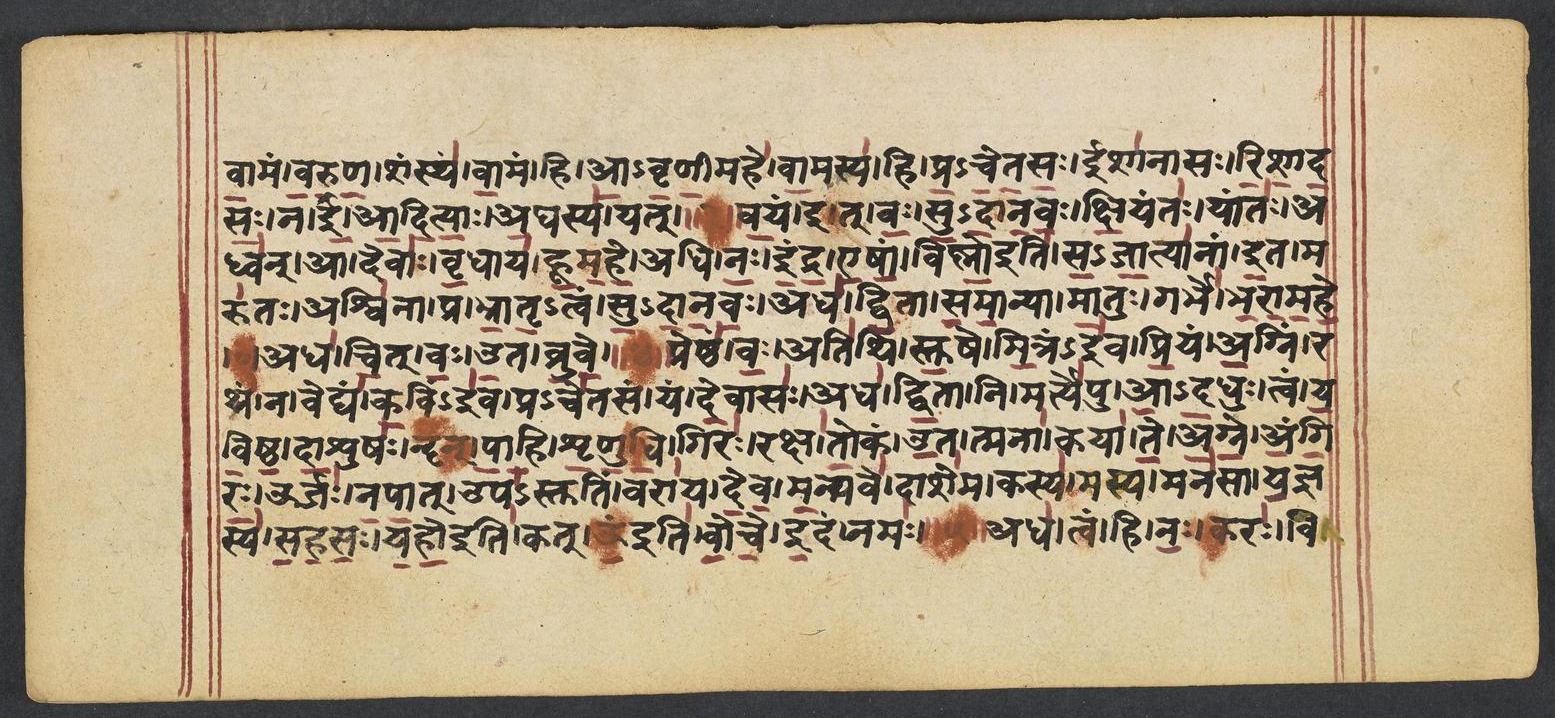
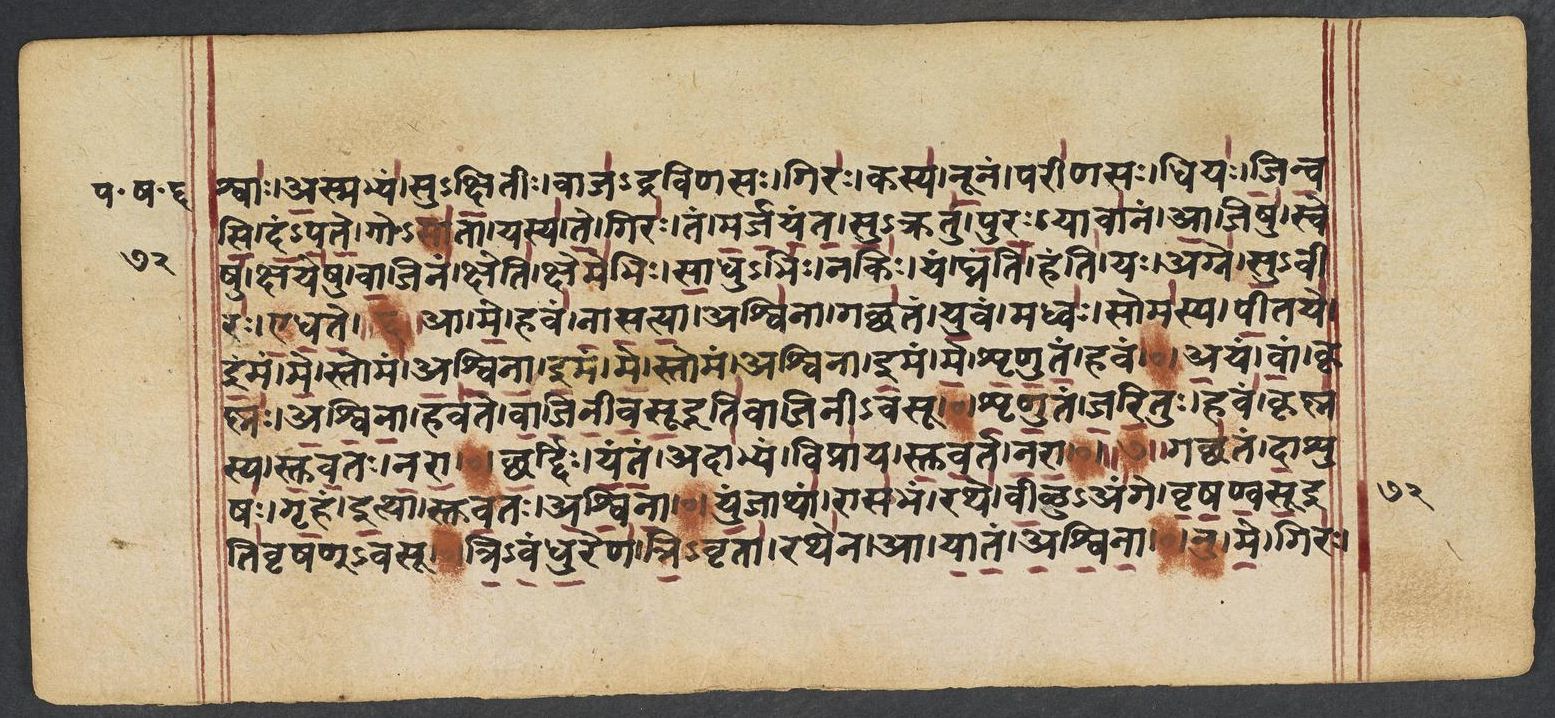
The manuscript shown is Penn Ms. Coll. 390 Item 41 (University of Pennsylvania), an undated paper manuscript of the padapāṭha (the word-by-word recitation text, in which every word is written separately and compounds are split) of the whole Ṛgveda in Devanāgarī, 884 leaves in fascicles, 7-9 lines to the page, accents in red; this hymn stands on fol. 650r-650v. Each section below gives the verses that end on one page; the page boundaries were read on the images (the opening words of every page), not counted out. Where the manuscript is a padapāṭha (the word-by-word recitation text), the section shows Aufrecht's continuous (saṃhitā) text first and, as the edition text, the padapāṭha of the same verses, which is the form written on the page.
How was this verified? (Provenance)
Where on the image
Penn Ms. Coll. 390 Item 41, fol. 650r (numbered 72r by the scribe) (OPenn image 650, lower leaf). Checked on the image: the Rigveda text on this page begins in RV 8.83.4 ‹vāmam varuṇa śaṃsyam vāmam›. The next page with Rigveda text, fol. 650v (numbered 72v by the scribe), begins in RV 8.84.6 ‹-viśvāḥ asmabhyam su-kṣitīḥ vāja-draviṇasaḥ›. Verses 8.84.1-5 end on this page.
1preṣṭha̍ṁ vo̱ ati̍thiṁ stu̱ṣe mi̱tram i̍va pri̱yam | a̱gniṁ ratha̱ṁ na vedya̍m ||
2ka̱vim i̍va̱ prace̍tasa̱ṁ yaṁ de̱vāso̱ adha̍ dvi̱tā | ni martye̍ṣv āda̱dhuḥ ||
3tvaṁ ya̍viṣṭha dā̱śuṣo̱ nṝm̐ḥ pā̍hi śṛṇu̱dhī gira̍ḥ | rakṣā̍ to̱kam u̱ta tmanā̍ ||
4kayā̍ te agne aṅgira̱ ūrjo̍ napā̱d upa̍stutim | varā̍ya deva ma̱nyave̍ ||
5dāśe̍ma̱ kasya̱ mana̍sā ya̱jñasya̍ sahaso yaho | kad u̍ voca i̱daṁ nama̍ḥ ||
Compare: Padapāṭha (word-by-word text written in the manuscript; Sansknet e-text via GRETIL)
1preṣṭham | vaḥ | atithim | stuṣe | mitram-iva | priyam | agnim | ratham | na | vedyam
2kavim-iva | pra-cetasam | yam | devāsaḥ | adha | dvitā | ni | martyeṣu | ādadhuḥ
3tvam | yaviṣṭha | dāśuṣaḥ | nṝn | pāhi | śṛṇudhi | giraḥ | rakṣa | tokam | uta | tmanā
4kayā | te | agne | aṅgiraḥ | ūrjaḥ | napāt | upa-stutim | varāya | deva | manyave
5dāśema | kasya | manasā | yajñasya | sahasaḥ | yaho iti | kat | oṃ iti | voce | idam | namaḥ
1AGNI, your dearest Guest, I laud, him who is loving as a friend, Who brings us riches like a car.
2Whom as a far-foreseeing Sage the Gods have, from the olden time, Established among mortal men.
3Do thou, Most Youthful God, protect the men who offer, hear their songs, And of thyself preserve their seed.
4What is the praise wherewith, O God, Afigiras, Agni, Son of Strength, We, after thine own wish and thought,
5May serve thee, O thou Child of Power, and with what sacrifice's plan? What prayer shall I now speak to thee?
Where on the image
Penn Ms. Coll. 390 Item 41, fol. 650v (numbered 72v by the scribe) (OPenn image 651, upper leaf). Checked on the image: the Rigveda text on this page begins in RV 8.84.6 ‹-viśvāḥ asmabhyam su-kṣitīḥ vāja-draviṇasaḥ›. The next page with Rigveda text, fol. 651r (numbered 73r by the scribe), begins in RV 8.85.9 ‹nāsatyā aśvinā pra avatam›. Verses 8.84.6-9 end on this page; 8.84.6 begins on fol. 650r (numbered 72r by the scribe).
6adhā̱ tvaṁ hi na̱s karo̱ viśvā̍ a̱smabhya̍ṁ sukṣi̱tīḥ | vāja̍draviṇaso̱ gira̍ḥ ||
7kasya̍ nū̱nam parī̍ṇaso̱ dhiyo̍ jinvasi dampate | goṣā̍tā̱ yasya̍ te̱ gira̍ḥ ||
8tam ma̍rjayanta su̱kratu̍m puro̱yāvā̍nam ā̱jiṣu̍ | sveṣu̱ kṣaye̍ṣu vā̱jina̍m ||
9kṣeti̱ kṣeme̍bhiḥ sā̱dhubhi̱r naki̱r yaṁ ghnanti̱ hanti̱ yaḥ | agne̍ su̱vīra̍ edhate ||
Compare: Padapāṭha (word-by-word text written in the manuscript; Sansknet e-text via GRETIL)
6adha | tvam | hi | naḥ | karaḥ | viśvāḥ | asmabhyam | su-kṣitīḥ | vāja-draviṇasaḥ | giraḥ
7kasya | nūnam | parīṇasaḥ | dhiyaḥ | jinvasi | dam-pate | go--sātā | yasya | te | giraḥ
8tam | marjayanta | su-kratum | puraḥ-yāvānam | ājiṣu | sveṣu | kṣayeṣu | vājinam
9kṣeti | kṣemebhiḥ | sādhu-bhiḥ | nakiḥ | yam | ghnanti | hanti | yaḥ | agne | su-vīraḥ | edhate
6Our God, make all of us to dwell in happy habitations, and Reward our songs with spoil and wealth.
7Lord of the house, what plenty fills the songs which thou inspirest now, Thou whose hymn helps to win the kine?
8Him Wise and Strong they glorify, the foremost Champion in the fray, And mighty in his dwelling-place.
9Agni, he dwells in rest and peace who smites and no one smites again: With hero sons he prospers well
Notes
- Sanskrit: Aufrecht's edition (1877) with the Vedic accents, as entered by van Nooten and Holland (GRETIL).
- English: Ralph T. H. Griffith, The Hymns of the Rigveda (1889-1892; 2nd ed. 1896-1897), from the VedaWeb digital text; OCR slips in that text were corrected against the printed 2nd edition (data/sources/rigveda/griffith_errata.json).
- Padapāṭha (edition text): Sansknet e-text via GRETIL (CC BY-NC-SA 4.0).
Cite
Sources
- Source: Penn Ms. Coll. 390 Item 41 (undated (catalogued with Penn's 18th-19th c. Vedic manuscripts)), OPenn, Public Domain Mark + Aufrecht's accented text (GRETIL) + Griffith's English (VedaWeb) (holding institution)
- Critical edition: Aufrecht (1877), accented e-text via GRETIL
← previous · → next · v cycle view · l back to library