Rigveda 9.18: To Soma
Introduction
Rigveda 9.18 is a hymn of 7 verses addressed to Soma. It stands in book (maṇḍala) 9, the hymns to Soma Pavamāna. The Rigveda is the oldest collection of Sanskrit hymns, composed in the second half of the second millennium BCE and handed down orally for many centuries before it was written down.
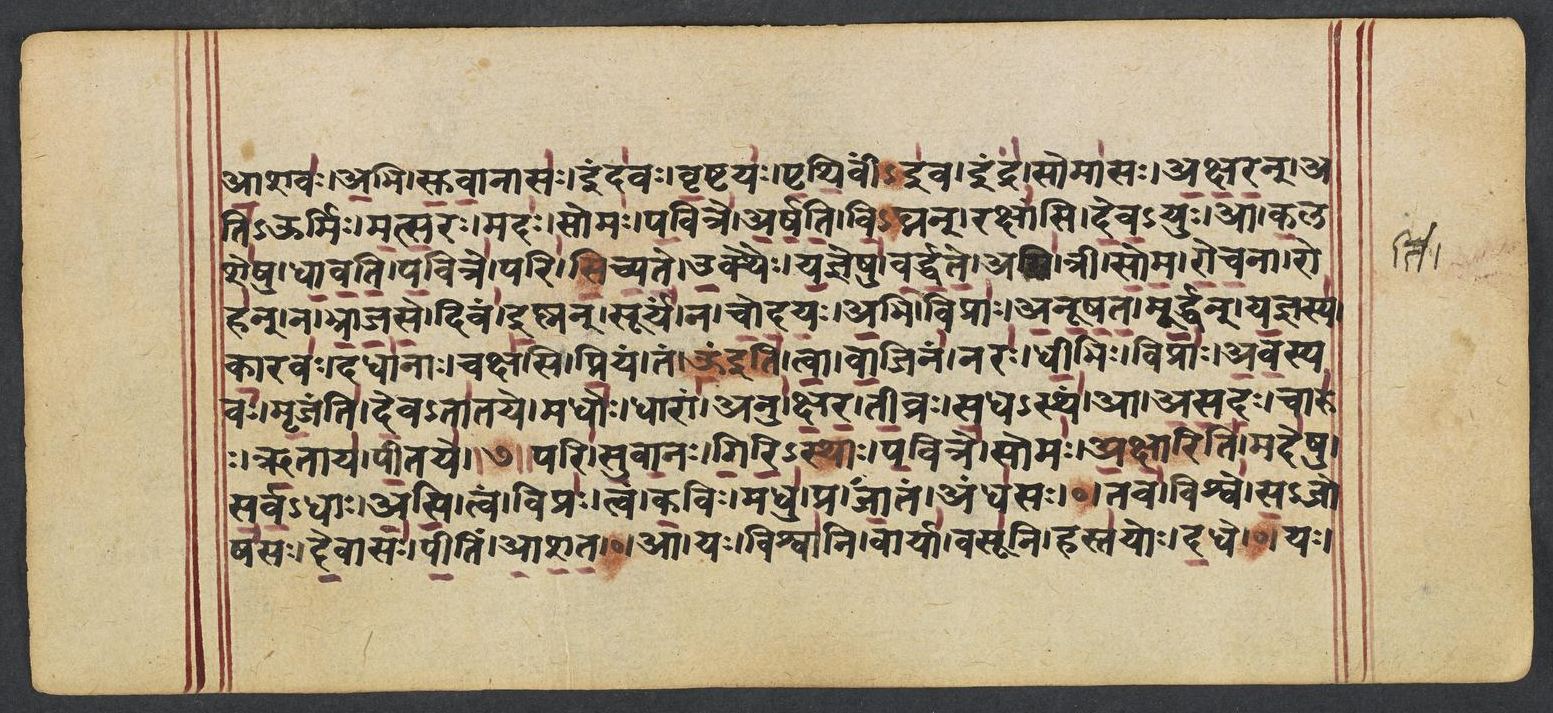
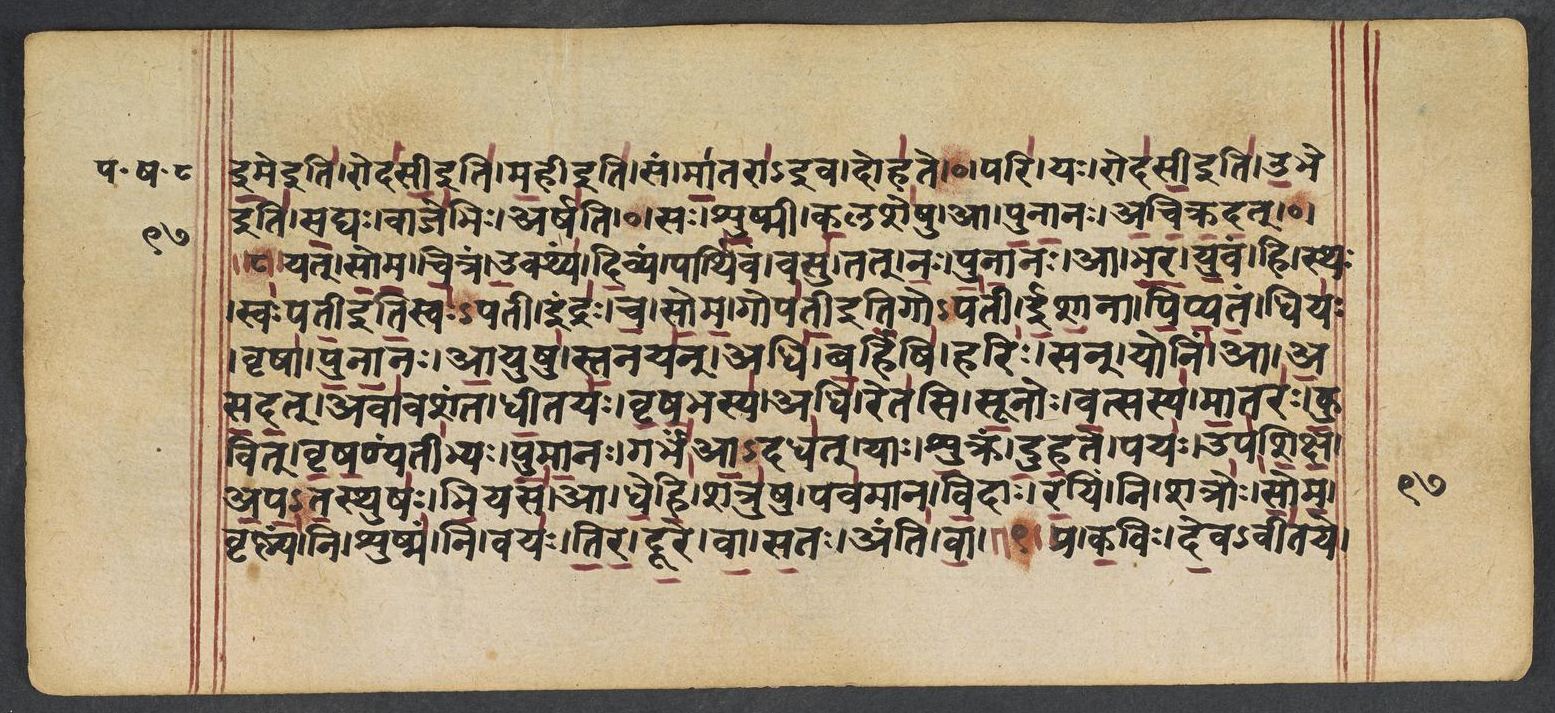
The manuscript shown is Penn Ms. Coll. 390 Item 41 (University of Pennsylvania), an undated paper manuscript of the padapāṭha (the word-by-word recitation text, in which every word is written separately and compounds are split) of the whole Ṛgveda in Devanāgarī, 884 leaves in fascicles, 7-9 lines to the page, accents in red; this hymn stands on fol. 675r-675v. Each section below gives the verses that end on one page; the page boundaries were read on the images (the opening words of every page), not counted out. Where the manuscript is a padapāṭha (the word-by-word recitation text), the section shows Aufrecht's continuous (saṃhitā) text first and, as the edition text, the padapāṭha of the same verses, which is the form written on the page.
How was this verified? (Provenance)
Where on the image
Penn Ms. Coll. 390 Item 41, fol. 675r (numbered 97r by the scribe) (OPenn image 675, lower leaf). Checked on the image: the Rigveda text on this page begins in RV 9.17.1 ‹āśavaḥ›. The next page with Rigveda text, fol. 675v (numbered 97v by the scribe), begins in RV 9.18.5 ‹ime iti rodasī iti›. Verses 9.18.1-4 end on this page.
1pari̍ suvā̱no gi̍ri̱ṣṭhāḥ pa̱vitre̱ somo̍ akṣāḥ | made̍ṣu sarva̱dhā a̍si ||
2tvaṁ vipra̱s tvaṁ ka̱vir madhu̱ pra jā̱tam andha̍saḥ | made̍ṣu sarva̱dhā a̍si ||
3tava̱ viśve̍ sa̱joṣa̍so de̱vāsa̍ḥ pī̱tim ā̍śata | made̍ṣu sarva̱dhā a̍si ||
4ā yo viśvā̍ni̱ vāryā̱ vasū̍ni̱ hasta̍yor da̱dhe | made̍ṣu sarva̱dhā a̍si ||
Compare: Padapāṭha (word-by-word text written in the manuscript; Sansknet e-text via GRETIL)
1pari | suvānaḥ | giri-sthāḥ | pavitre | somaḥ | akṣāriti | madeṣu | sarva-dhāḥ | asi
2tvam | vipraḥ | tvam | kaviḥ | madhu | pra | jātam | andhasaḥ | madeṣu | sarva-dhāḥ | asi
3tava | viśve | sa-joṣasaḥ | devāsaḥ | pītim | āśata | madeṣu | sarva-dhāḥ | asi
4ā | yaḥ | viśvāni | vāryā | vasūni | hastayoḥ | dadhe | madeṣu | sarva-dhāḥ | asi
1THOU, Soma, dweller on the hills, effused, hast flowed into the sieve,: All-bounteous art thou in carouse.
2Thou art a sacred Bard, a Sage; the meath is offspring of thy sap: All-bountcous art thou in carouse.
3All Deities of one accord have come that they may drink of thee: All-bounteous art thou in carouse.
4He who containeth in his hands all treasures much to be desired: All-bounteous art thou in carouse.
Where on the image
Penn Ms. Coll. 390 Item 41, fol. 675v (numbered 97v by the scribe) (OPenn image 676, upper leaf). Checked on the image: the Rigveda text on this page begins in RV 9.18.5 ‹ime iti rodasī iti›. The next page with Rigveda text, fol. 676r (numbered 98r by the scribe), begins in RV 9.20.1 ‹avyaḥ vārebhiḥ arṣati sahvān›. Verses 9.18.5-7 end on this page; 9.18.5 begins on fol. 675r (numbered 97r by the scribe).
5ya i̱me roda̍sī ma̱hī sam mā̱tare̍va̱ doha̍te | made̍ṣu sarva̱dhā a̍si ||
6pari̱ yo roda̍sī u̱bhe sa̱dyo vāje̍bhi̱r arṣa̍ti | made̍ṣu sarva̱dhā a̍si ||
7sa śu̱ṣmī ka̱laśe̱ṣv ā pu̍nā̱no a̍cikradat | made̍ṣu sarva̱dhā a̍si ||
Compare: Padapāṭha (word-by-word text written in the manuscript; Sansknet e-text via GRETIL)
5yaḥ | ime iti | rodasī iti | mahī iti | sam | mātarā-iva | dohate | madeṣu | sarva-dhāḥ | asi
6pari | yaḥ | rodasī iti | ubhe iti | sadyaḥ | vājebhiḥ | arṣati | madeṣu | sarva-dhāḥ | asi
7saḥ | śuṣmī | kalaśeṣu | ā | punānaḥ | acikradat | madeṣu | sarva-dhāḥ | asi
5Who milketh out this mighty Pair, the Earth and Heaven, like mother kine All-bounteous art thou in carouse.
6Who in a moment mightily floweth around these two world-halvcs: All-bounteous art thou in carouse.
7The Strong One, being purified, hath in the pitchers cried aloud: All-bounteous art thou in carouse.
Notes
- Sanskrit: Aufrecht's edition (1877) with the Vedic accents, as entered by van Nooten and Holland (GRETIL).
- English: Ralph T. H. Griffith, The Hymns of the Rigveda (1889-1892; 2nd ed. 1896-1897), from the VedaWeb digital text; OCR slips in that text were corrected against the printed 2nd edition (data/sources/rigveda/griffith_errata.json).
- Padapāṭha (edition text): Sansknet e-text via GRETIL (CC BY-NC-SA 4.0).
Cite
Sources
- Source: Penn Ms. Coll. 390 Item 41 (undated (catalogued with Penn's 18th-19th c. Vedic manuscripts)), OPenn, Public Domain Mark + Aufrecht's accented text (GRETIL) + Griffith's English (VedaWeb) (holding institution)
- Critical edition: Aufrecht (1877), accented e-text via GRETIL
← previous · → next · v cycle view · l back to library