Rigveda 9.30: To Soma
Introduction
Rigveda 9.30 is a hymn of 6 verses addressed to Soma. It stands in book (maṇḍala) 9, the hymns to Soma Pavamāna. The Rigveda is the oldest collection of Sanskrit hymns, composed in the second half of the second millennium BCE and handed down orally for many centuries before it was written down.
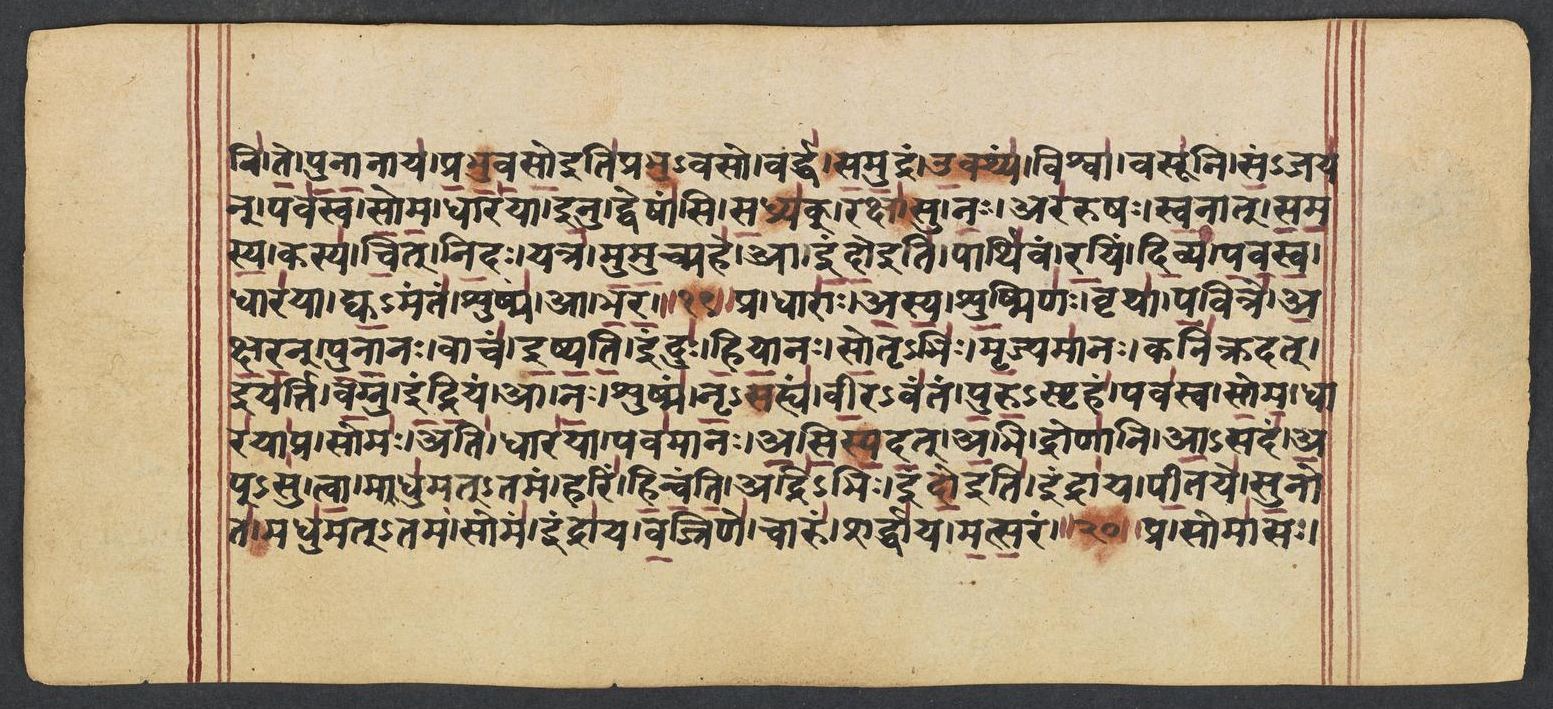
The manuscript shown is Penn Ms. Coll. 390 Item 41 (University of Pennsylvania), an undated paper manuscript of the padapāṭha (the word-by-word recitation text, in which every word is written separately and compounds are split) of the whole Ṛgveda in Devanāgarī, 884 leaves in fascicles, 7-9 lines to the page, accents in red; this hymn stands on fol. 679r. Each section below gives the verses that end on one page; the page boundaries were read on the images (the opening words of every page), not counted out. Where the manuscript is a padapāṭha (the word-by-word recitation text), the section shows Aufrecht's continuous (saṃhitā) text first and, as the edition text, the padapāṭha of the same verses, which is the form written on the page.
How was this verified? (Provenance)
Where on the image
Penn Ms. Coll. 390 Item 41, fol. 679r (numbered 101r by the scribe) (OPenn image 679, lower leaf). Checked on the image: the Rigveda text on this page begins in RV 9.29.3 ‹-tāni te punānāya prabhuvaso›. The next page with Rigveda text, fol. 679v (numbered 101v by the scribe), begins in RV 9.31.1 ‹svādhyaḥ pavamānāsaḥ akramuḥ rayim›. Verses 9.30.1-6 end on this page.
1pra dhārā̍ asya śu̱ṣmiṇo̱ vṛthā̍ pa̱vitre̍ akṣaran | pu̱nā̱no vāca̍m iṣyati ||
2indu̍r hiyā̱naḥ so̱tṛbhi̍r mṛ̱jyamā̍na̱ḥ kani̍kradat | iya̍rti va̱gnum i̍ndri̱yam ||
3ā na̱ḥ śuṣma̍ṁ nṛ̱ṣāhya̍ṁ vī̱rava̍ntam puru̱spṛha̍m | pava̍sva soma̱ dhāra̍yā ||
4pra somo̱ ati̱ dhāra̍yā̱ pava̍māno asiṣyadat | a̱bhi droṇā̍ny ā̱sada̍m ||
5a̱psu tvā̱ madhu̍mattama̱ṁ hari̍ṁ hinva̱nty adri̍bhiḥ | inda̱v indrā̍ya pī̱taye̍ ||
6su̱notā̱ madhu̍mattama̱ṁ soma̱m indrā̍ya va̱jriṇe̍ | cāru̱ṁ śardhā̍ya matsa̱ram ||
Compare: Padapāṭha (word-by-word text written in the manuscript; Sansknet e-text via GRETIL)
1pra | dhārāḥ | asya | śuṣmiṇaḥ | vṛthā | pavitre | akṣaran | punānaḥ | vācam | iṣyati
2induḥ | hiyānaḥ | sotṛ-bhiḥ | mṛjyamānaḥ | kanikradat | iyarti | vagnum | indriyam
3ā | naḥ | śuṣmam | nṛ-sahyam | vīra-vantam | puru-spṛham | pavasva | soma | dhārayā
4pra | somaḥ | ati | dhārayā | pavamānaḥ | asisyadat | abhi | droṇāni | āsadam
5ap-su | tvā | madhumat-tamam | harim | hinvanti | adri-bhiḥ | indo iti | indrāya | pītaye
6sunota | madhumat-tamam | somam | indrāya | vajriṇe | cārum | śardhāya | matsaram
1STREAMS of this Potent One have flowed easily to the straining-cloth: While he is cleansed he lifts his voice.
2Indu, by pressers urged to speed, bellowing out while beautified. Sends forth a very mighty sound.
3Pour on us, Soma, with thy stream manconquering might which many crave, Accompanied with hero sons.
4Hither hath Pavamâna flowed, Soma flowed hither in a stream, To settle in the vats of wood.
5To waters with the stones they drive thee tawny-hued, most rich in sweets, O Indu, to be Indra's drink.
6For Indra, for the Thunderer press the Soma very rich in sweets, Lovely, inspiriting, for strength.
Notes
- Sanskrit: Aufrecht's edition (1877) with the Vedic accents, as entered by van Nooten and Holland (GRETIL).
- English: Ralph T. H. Griffith, The Hymns of the Rigveda (1889-1892; 2nd ed. 1896-1897), from the VedaWeb digital text; OCR slips in that text were corrected against the printed 2nd edition (data/sources/rigveda/griffith_errata.json).
- Padapāṭha (edition text): Sansknet e-text via GRETIL (CC BY-NC-SA 4.0).
Cite
Sources
- Source: Penn Ms. Coll. 390 Item 41 (undated (catalogued with Penn's 18th-19th c. Vedic manuscripts)), OPenn, Public Domain Mark + Aufrecht's accented text (GRETIL) + Griffith's English (VedaWeb) (holding institution)
- Critical edition: Aufrecht (1877), accented e-text via GRETIL
← previous · → next · v cycle view · l back to library