Rigveda 9.36: To Soma
Introduction
Rigveda 9.36 is a hymn of 6 verses addressed to Soma. It stands in book (maṇḍala) 9, the hymns to Soma Pavamāna. The Rigveda is the oldest collection of Sanskrit hymns, composed in the second half of the second millennium BCE and handed down orally for many centuries before it was written down.
The manuscript shown is Penn Ms. Coll. 390 Item 41 (University of Pennsylvania), an undated paper manuscript of the padapāṭha (the word-by-word recitation text, in which every word is written separately and compounds are split) of the whole Ṛgveda in Devanāgarī, 884 leaves in fascicles, 7-9 lines to the page, accents in red; this hymn stands on fol. 680v-681r. Each section below gives the verses that end on one page; the page boundaries were read on the images (the opening words of every page), not counted out. Where the manuscript is a padapāṭha (the word-by-word recitation text), the section shows Aufrecht's continuous (saṃhitā) text first and, as the edition text, the padapāṭha of the same verses, which is the form written on the page.
How was this verified? (Provenance)
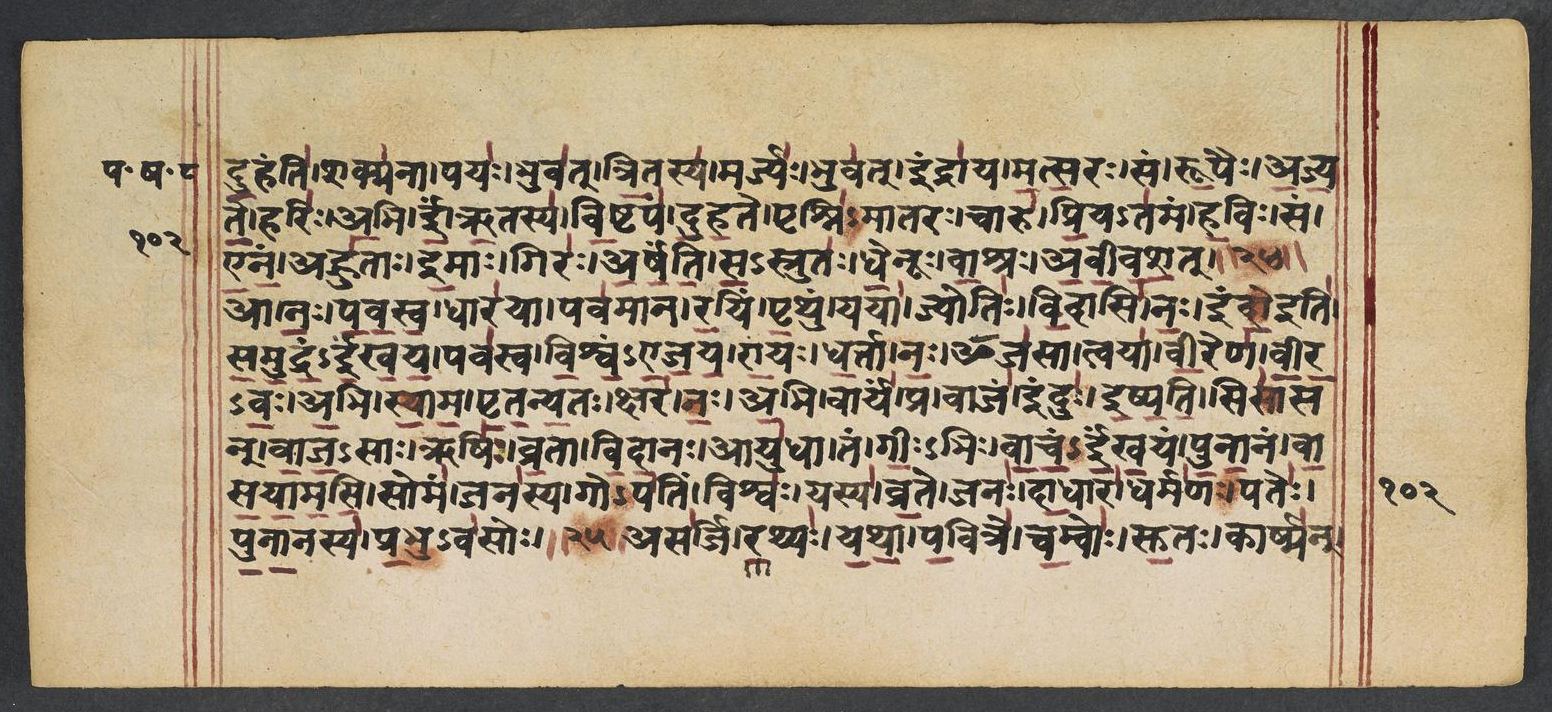
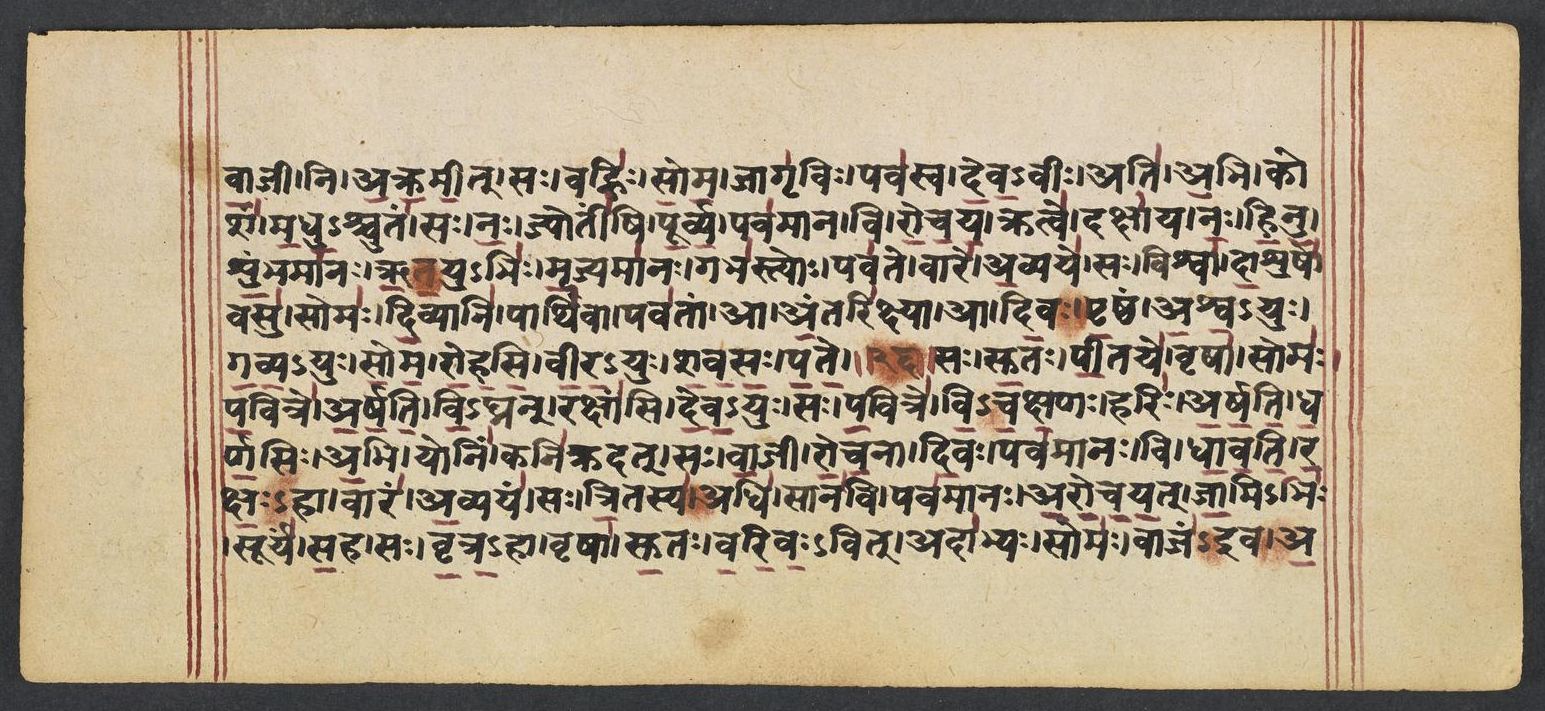
Where on the image
Penn Ms. Coll. 390 Item 41, fol. 681r (numbered 103r by the scribe) (OPenn image 681, lower leaf). Checked on the image: the Rigveda text on this page begins in RV 9.36.1 ‹vājī ni akramīt›. The next page with Rigveda text, fol. 681v (numbered 103v by the scribe), begins in RV 9.37.5 ‹-asarat›. Verses 9.36.1-6 end on this page; 9.36.1 begins on fol. 680v (numbered 102v by the scribe).
1asa̍rji̱ rathyo̍ yathā pa̱vitre̍ ca̱mvo̍ḥ su̱taḥ | kārṣma̍n vā̱jī ny a̍kramīt ||
2sa vahni̍ḥ soma̱ jāgṛ̍vi̱ḥ pava̍sva deva̱vīr ati̍ | a̱bhi kośa̍m madhu̱ścuta̍m ||
3sa no̱ jyotī̍ṁṣi pūrvya̱ pava̍māna̱ vi ro̍caya | kratve̱ dakṣā̍ya no hinu ||
4śu̱mbhamā̍na ṛtā̱yubhi̍r mṛ̱jyamā̍no̱ gabha̍styoḥ | pava̍te̱ vāre̍ a̱vyaye̍ ||
5sa viśvā̍ dā̱śuṣe̱ vasu̱ somo̍ di̱vyāni̱ pārthi̍vā | pava̍tā̱m āntari̍kṣyā ||
6ā di̱vas pṛ̱ṣṭham a̍śva̱yur ga̍vya̱yuḥ so̍ma rohasi | vī̱ra̱yuḥ śa̍vasas pate ||
Compare: Padapāṭha (word-by-word text written in the manuscript; Sansknet e-text via GRETIL)
1asarji | rathyaḥ | yathā | pavitre | camvoḥ | sutaḥ | kārṣman | vājī | ni | akramīt
2saḥ | vahniḥ | soma | jāgṛviḥ | pavasva | deva-vīḥ | ati | abhi | kośam | madhu-ścutam
3saḥ | naḥ | jyotīṃṣi | pūrvya | pavamāna | vi | rocaya | kratve | dakṣāya | naḥ | hinu
4śumbhamānaḥ | ṛtayu-bhiḥ | mṛjyamānaḥ | gabhastyoḥ | pavate | vāre | avyaye
5saḥ | viśvā | dāśuṣe | vasu | somaḥ | divyāni | pārthivā | pavatām | ā | antarikṣyā
6ā | divaḥ | pṛṣṭham | aśva-yuḥ | gavya-yuḥ | soma | rohasi | vīra-yuḥ | śavasaḥ | pate
1FORTH from the mortar is the juice sent, like a car-horse, to the sieve: The Steed steps forward to the goal.
2Thus, Soma, watchful, bearing well, cheering the Gods, flow past the sieve, Turned to the vat that drops with meath.
3Excellent Pavamâna, make the lights shine brightly out for us. Speed us to mental power and skill.
4He, beautified by pious men, and coming from their hands adorned, Flows through the fleecy straining-cloth.
5May Soma pour all treasures of the heavens, the earth, the firmament Upon the liberal worshipper.
6Thou mountest to the height of heaven, O Soma, seeking steeds and kine, And seeking heroes, Lord of Strength!
Notes
- Sanskrit: Aufrecht's edition (1877) with the Vedic accents, as entered by van Nooten and Holland (GRETIL).
- English: Ralph T. H. Griffith, The Hymns of the Rigveda (1889-1892; 2nd ed. 1896-1897), from the VedaWeb digital text; OCR slips in that text were corrected against the printed 2nd edition (data/sources/rigveda/griffith_errata.json).
- Padapāṭha (edition text): Sansknet e-text via GRETIL (CC BY-NC-SA 4.0).
Cite
Sources
- Source: Penn Ms. Coll. 390 Item 41 (undated (catalogued with Penn's 18th-19th c. Vedic manuscripts)), OPenn, Public Domain Mark + Aufrecht's accented text (GRETIL) + Griffith's English (VedaWeb) (holding institution)
- Critical edition: Aufrecht (1877), accented e-text via GRETIL
← previous · → next · v cycle view · l back to library