Rigveda 9.38: To Soma
Introduction
Rigveda 9.38 is a hymn of 6 verses addressed to Soma. It stands in book (maṇḍala) 9, the hymns to Soma Pavamāna. The Rigveda is the oldest collection of Sanskrit hymns, composed in the second half of the second millennium BCE and handed down orally for many centuries before it was written down.
The manuscript shown is Penn Ms. Coll. 390 Item 41 (University of Pennsylvania), an undated paper manuscript of the padapāṭha (the word-by-word recitation text, in which every word is written separately and compounds are split) of the whole Ṛgveda in Devanāgarī, 884 leaves in fascicles, 7-9 lines to the page, accents in red; this hymn stands on fol. 681v. Each section below gives the verses that end on one page; the page boundaries were read on the images (the opening words of every page), not counted out. Where the manuscript is a padapāṭha (the word-by-word recitation text), the section shows Aufrecht's continuous (saṃhitā) text first and, as the edition text, the padapāṭha of the same verses, which is the form written on the page.
How was this verified? (Provenance)
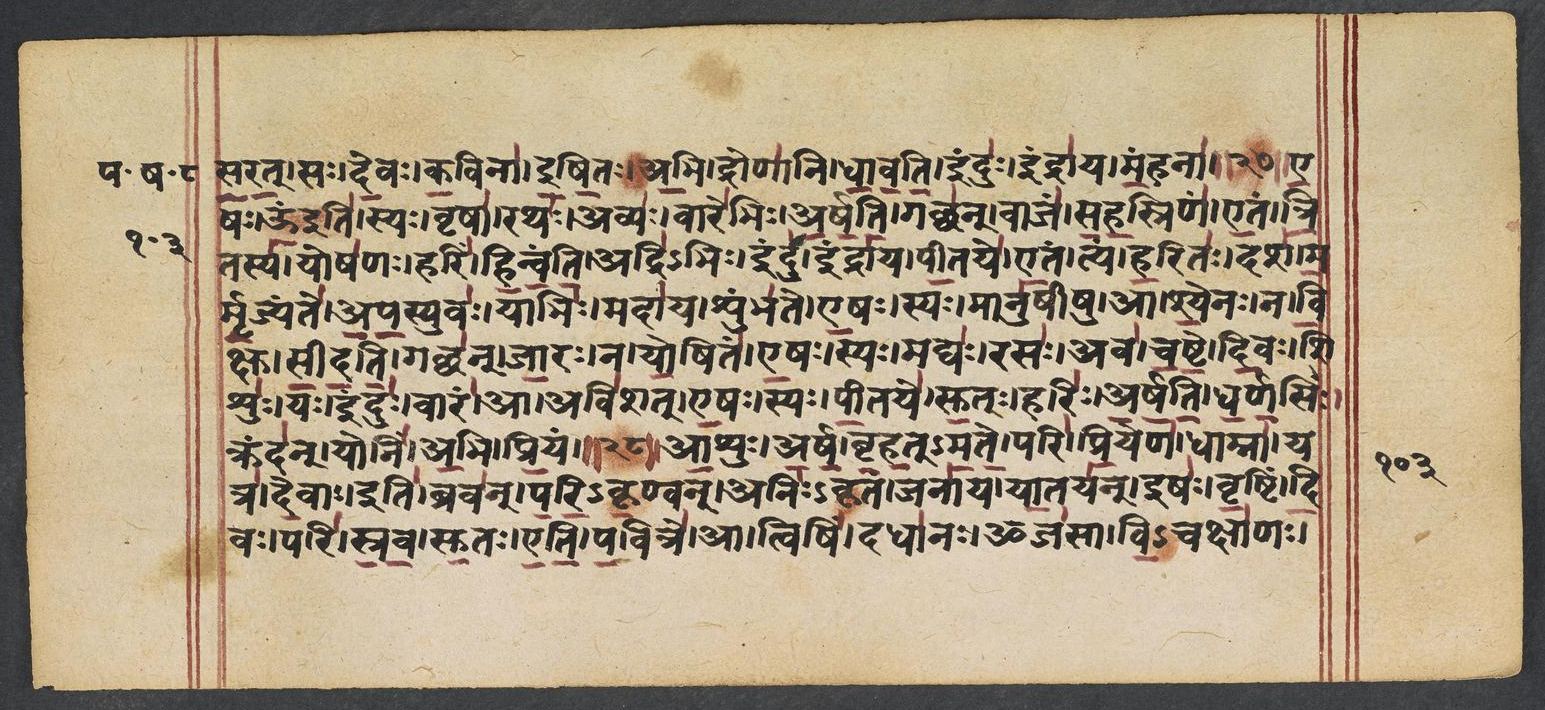
Where on the image
Penn Ms. Coll. 390 Item 41, fol. 681v (numbered 103v by the scribe) (OPenn image 682, upper leaf). Checked on the image: the Rigveda text on this page begins in RV 9.37.5 ‹-asarat›. The next page with Rigveda text, fol. 682r (numbered 104r by the scribe), begins in RV 9.39.3 ‹vi-rocayan›. Verses 9.38.1-6 end on this page.
1e̱ṣa u̱ sya vṛṣā̱ ratho 'vyo̱ vāre̍bhir arṣati | gaccha̱n vāja̍ṁ saha̱sriṇa̍m ||
2e̱taṁ tri̱tasya̱ yoṣa̍ṇo̱ hari̍ṁ hinva̱nty adri̍bhiḥ | indu̱m indrā̍ya pī̱taye̍ ||
3e̱taṁ tyaṁ ha̱rito̱ daśa̍ marmṛ̱jyante̍ apa̱syuva̍ḥ | yābhi̱r madā̍ya̱ śumbha̍te ||
4e̱ṣa sya mānu̍ṣī̱ṣv ā śye̱no na vi̱kṣu sī̍dati | gaccha̍ñ jā̱ro na yo̱ṣita̍m ||
5e̱ṣa sya madyo̱ raso 'va̍ caṣṭe di̱vaḥ śiśu̍ḥ | ya indu̱r vāra̱m āvi̍śat ||
6e̱ṣa sya pī̱taye̍ su̱to hari̍r arṣati dharṇa̱siḥ | kranda̱n yoni̍m a̱bhi pri̱yam ||
Compare: Padapāṭha (word-by-word text written in the manuscript; Sansknet e-text via GRETIL)
1eṣaḥ | oṃ iti | syaḥ | vṛṣā | rathaḥ | avyaḥ | vārebhiḥ | arṣati | gacchan | vājam | sahasriṇam
2etam | tritasya | yoṣaṇaḥ | harim | hinvanti | adri-bhiḥ | indum | indrāya | pītaye
3etam | tyam | haritaḥ | daśa | marmṛjyante | apasyuvaḥ | yābhiḥ | madāya | śumbhate
4eṣaḥ | syaḥ | mānuṣīṣu | ā | śyenaḥ | na | vikṣu | sīdati | gacchan | jāraḥ | na | yoṣitam
5eṣaḥ | syaḥ | madyaḥ | rasaḥ | ava | caṣṭe | divaḥ | śiśuḥ | yaḥ | induḥ | vāram | ā | aviśat
6eṣaḥ | syaḥ | pītaye | sutaḥ | hariḥ | arṣati | dharṇasiḥ | krandan | yonim | abhi | priyam
1THIS Steer, this Chariot, rushes through the woollen filter, as he goes To war that wins a thousand spoils.
2The Dames of Trita with the stones onward impel this Tawny One Indu to Indra for his drink.
3Ten active fingers carefully adorn him here; they make him bright And beauteous for the gladdening draught.
4He like a falcon settles down amid the families of men. Speeding like lover to his love.
5This young exhilarating juice looks downward from its place in heaven, This Soma-drop that pierced the sieve.
6Poured for the draught, this tawny juice flows forth, intelligent, crying out, Unto the well-beloved place.
Notes
- Sanskrit: Aufrecht's edition (1877) with the Vedic accents, as entered by van Nooten and Holland (GRETIL).
- English: Ralph T. H. Griffith, The Hymns of the Rigveda (1889-1892; 2nd ed. 1896-1897), from the VedaWeb digital text; OCR slips in that text were corrected against the printed 2nd edition (data/sources/rigveda/griffith_errata.json).
- Padapāṭha (edition text): Sansknet e-text via GRETIL (CC BY-NC-SA 4.0).
Cite
Sources
- Source: Penn Ms. Coll. 390 Item 41 (undated (catalogued with Penn's 18th-19th c. Vedic manuscripts)), OPenn, Public Domain Mark + Aufrecht's accented text (GRETIL) + Griffith's English (VedaWeb) (holding institution)
- Critical edition: Aufrecht (1877), accented e-text via GRETIL
← previous · → next · v cycle view · l back to library