Rigveda 9.45: To Soma
Introduction
Rigveda 9.45 is a hymn of 6 verses addressed to Soma. It stands in book (maṇḍala) 9, the hymns to Soma Pavamāna. The Rigveda is the oldest collection of Sanskrit hymns, composed in the second half of the second millennium BCE and handed down orally for many centuries before it was written down.
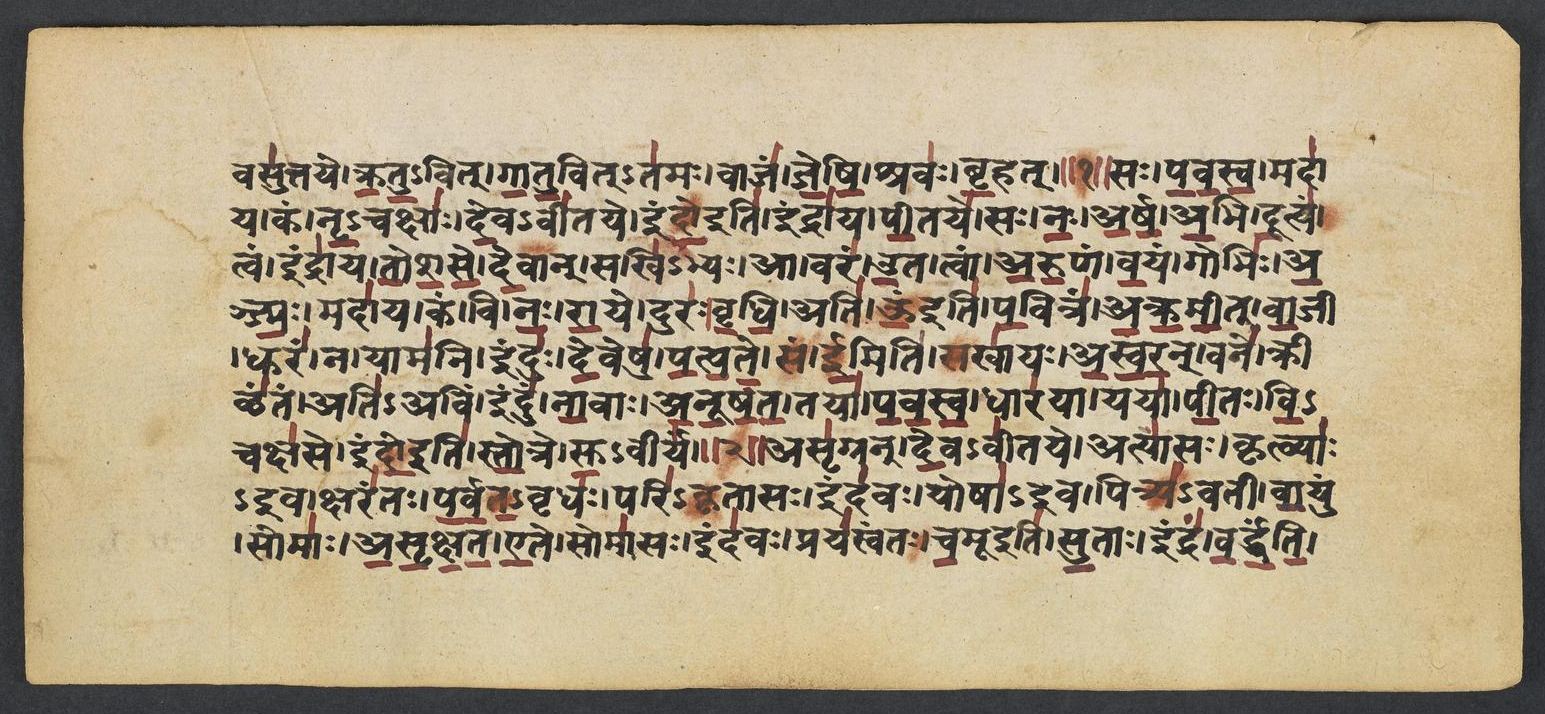
The manuscript shown is Penn Ms. Coll. 390 Item 41 (University of Pennsylvania), an undated paper manuscript of the padapāṭha (the word-by-word recitation text, in which every word is written separately and compounds are split) of the whole Ṛgveda in Devanāgarī, 884 leaves in fascicles, 7-9 lines to the page, accents in red; this hymn stands on fol. 685r. Each section below gives the verses that end on one page; the page boundaries were read on the images (the opening words of every page), not counted out. Where the manuscript is a padapāṭha (the word-by-word recitation text), the section shows Aufrecht's continuous (saṃhitā) text first and, as the edition text, the padapāṭha of the same verses, which is the form written on the page.
How was this verified? (Provenance)
Where on the image
Penn Ms. Coll. 390 Item 41, fol. 685r (numbered 2r by the scribe) (OPenn image 685, lower leaf). Checked on the image: the Rigveda text on this page begins in RV 9.44.6 ‹vasuttaye kratu-vit gātuvit-tamaḥ vājam›. The next page with Rigveda text, fol. 685v (numbered 2v by the scribe), begins in RV 9.46.3 ‹karma-bhiḥ›. Verses 9.45.1-6 end on this page.
1sa pa̍vasva̱ madā̍ya̱ kaṁ nṛ̱cakṣā̍ de̱vavī̍taye | inda̱v indrā̍ya pī̱taye̍ ||
2sa no̍ arṣā̱bhi dū̱tya1̱̍ṁ tvam indrā̍ya tośase | de̱vān sakhi̍bhya̱ ā vara̍m ||
3u̱ta tvām a̍ru̱ṇaṁ va̱yaṁ gobhi̍r añjmo̱ madā̍ya̱ kam | vi no̍ rā̱ye duro̍ vṛdhi ||
4aty ū̍ pa̱vitra̍m akramīd vā̱jī dhura̱ṁ na yāma̍ni | indu̍r de̱veṣu̍ patyate ||
5sam ī̱ sakhā̍yo asvara̱n vane̱ krīḻa̍nta̱m atya̍vim | indu̍ṁ nā̱vā a̍nūṣata ||
6tayā̍ pavasva̱ dhāra̍yā̱ yayā̍ pī̱to vi̱cakṣa̍se | indo̍ sto̱tre su̱vīrya̍m ||
Compare: Padapāṭha (word-by-word text written in the manuscript; Sansknet e-text via GRETIL)
1saḥ | pavasva | madāya | kam | nṛ-cakṣā | deva-vītaye | indo iti | indrāya | pītaye
2saḥ | naḥ | arṣa | abhi | dūtyam | tvam | indrāya | tośase | devān | sakhi-bhyaḥ | ā | varam
3uta | tvām | aruṇam | vayam | gobhiḥ | añjmaḥ | madāya | kam | vi | naḥ | rāye | duraḥ | vṛdhi
4ati | oṃ iti | pavitram | akramīt | vājī | dhuram | na | yāmani | induḥ | deveṣu | patyate
5sam | īm iti | sakhāyaḥ | asvaran | vane | krīḷantam | ati-avim | indum | nāvāḥ | ānūṣata
6tayā | pavasva | dhārayā | yayā | pītaḥ | vi-cakṣase | indo iti | stotre | su-vīryam
1FLOW, thou who viewest men, to give delight, to entertain the Gods, Indu, to Indra for his drink.
2Stream to thine embassy for us: thou hastenest, for Indra, to The Gods, O better than our friends.
3We balm thee, red of hue, with milk to fit thee for the rapturous joy: Unbar for us the doors of wealth.
4He through the sieve hath passed, as comes a courser to the pole, to run Indu belongs unto the Gods.
5All friends have lauded him as he sports in the wood, beyond the fleece: Singers have chanted Indu's praise.
6Flow, Indu, with that stream wherein steeped thou announcest to the man Who worships thee heroic strength.
Notes
- Sanskrit: Aufrecht's edition (1877) with the Vedic accents, as entered by van Nooten and Holland (GRETIL).
- English: Ralph T. H. Griffith, The Hymns of the Rigveda (1889-1892; 2nd ed. 1896-1897), from the VedaWeb digital text; OCR slips in that text were corrected against the printed 2nd edition (data/sources/rigveda/griffith_errata.json).
- Padapāṭha (edition text): Sansknet e-text via GRETIL (CC BY-NC-SA 4.0).
Cite
Sources
- Source: Penn Ms. Coll. 390 Item 41 (undated (catalogued with Penn's 18th-19th c. Vedic manuscripts)), OPenn, Public Domain Mark + Aufrecht's accented text (GRETIL) + Griffith's English (VedaWeb) (holding institution)
- Critical edition: Aufrecht (1877), accented e-text via GRETIL
← previous · → next · v cycle view · l back to library