Rigveda 9.5: Apri hymn
Introduction
Rigveda 9.5 is a hymn of 11 verses addressed to Apri hymn. It stands in book (maṇḍala) 9, the hymns to Soma Pavamāna. The Rigveda is the oldest collection of Sanskrit hymns, composed in the second half of the second millennium BCE and handed down orally for many centuries before it was written down.
The manuscript shown is Penn Ms. Coll. 390 Item 41 (University of Pennsylvania), an undated paper manuscript of the padapāṭha (the word-by-word recitation text, in which every word is written separately and compounds are split) of the whole Ṛgveda in Devanāgarī, 884 leaves in fascicles, 7-9 lines to the page, accents in red; this hymn stands on fol. 669r-669v. Each section below gives the verses that end on one page; the page boundaries were read on the images (the opening words of every page), not counted out. Where the manuscript is a padapāṭha (the word-by-word recitation text), the section shows Aufrecht's continuous (saṃhitā) text first and, as the edition text, the padapāṭha of the same verses, which is the form written on the page.
How was this verified? (Provenance)
Where on the image
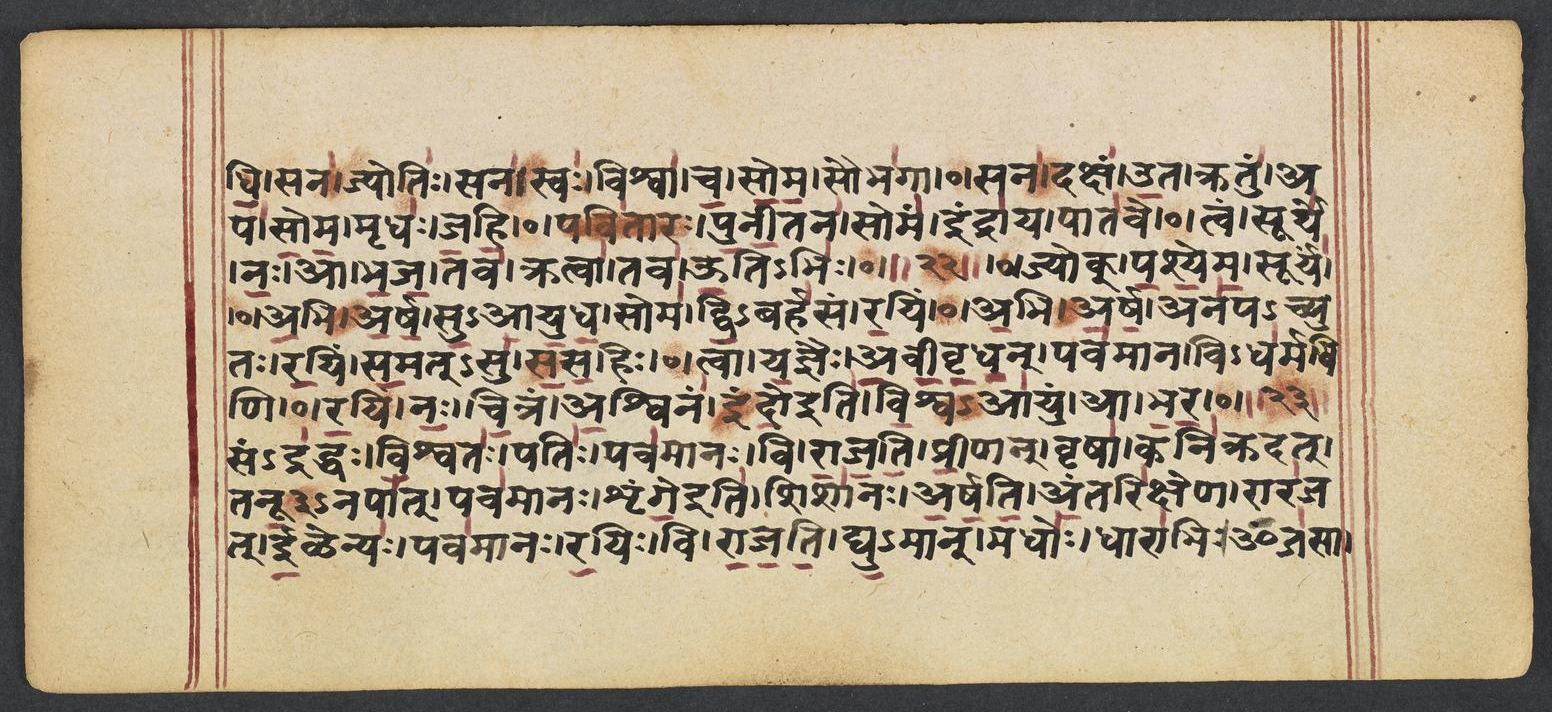
Penn Ms. Coll. 390 Item 41, fol. 669r (numbered 91r by the scribe) (OPenn image 669, lower leaf). Checked on the image: the Rigveda text on this page begins in RV 9.4.1 ‹-kṛdhi›. The next page with Rigveda text, fol. 669v (numbered 91v by the scribe), begins in RV 9.5.4 ‹barhiḥ prācīnam ojasā pavamānaḥ›. Verses 9.5.1-3 end on this page.
1sami̍ddho vi̱śvata̱s pati̱ḥ pava̍māno̱ vi rā̍jati | prī̱ṇan vṛṣā̱ kani̍kradat ||
2tanū̱napā̱t pava̍māna̱ḥ śṛṅge̱ śiśā̍no arṣati | a̱ntari̍kṣeṇa̱ rāra̍jat ||
3ī̱ḻenya̱ḥ pava̍māno ra̱yir vi rā̍jati dyu̱mān | madho̱r dhārā̍bhi̱r oja̍sā ||
Compare: Padapāṭha (word-by-word text written in the manuscript; Sansknet e-text via GRETIL)
1sam-iddhaḥ | viśvataḥ | patiḥ | pavamānaḥ | vi | rājati | prīṇan | vṛṣā | kanikradat
2tanūnapāt | pavamānaḥ | śṛṅgeiti | śiśānaḥ | arṣati | antarikṣeṇa | rārajat
3īḷenyaḥ | pavamānaḥ | rayiḥ | vi | rājati | dyu-mān | madhoḥ | dhārābhiḥ | ojasā
1ENKINDLED, Pavamâna, Lord, sends forth his light on, every side In friendly show, the bellowing Bull.
2He, Pavamâna, Self-produced, speeds onward sharpening his horns: He glitters through the firmament.
3Brilliant like wealth, adorable, with splendour Pavamâna shines, Mightily with the streams of meath.
Where on the image
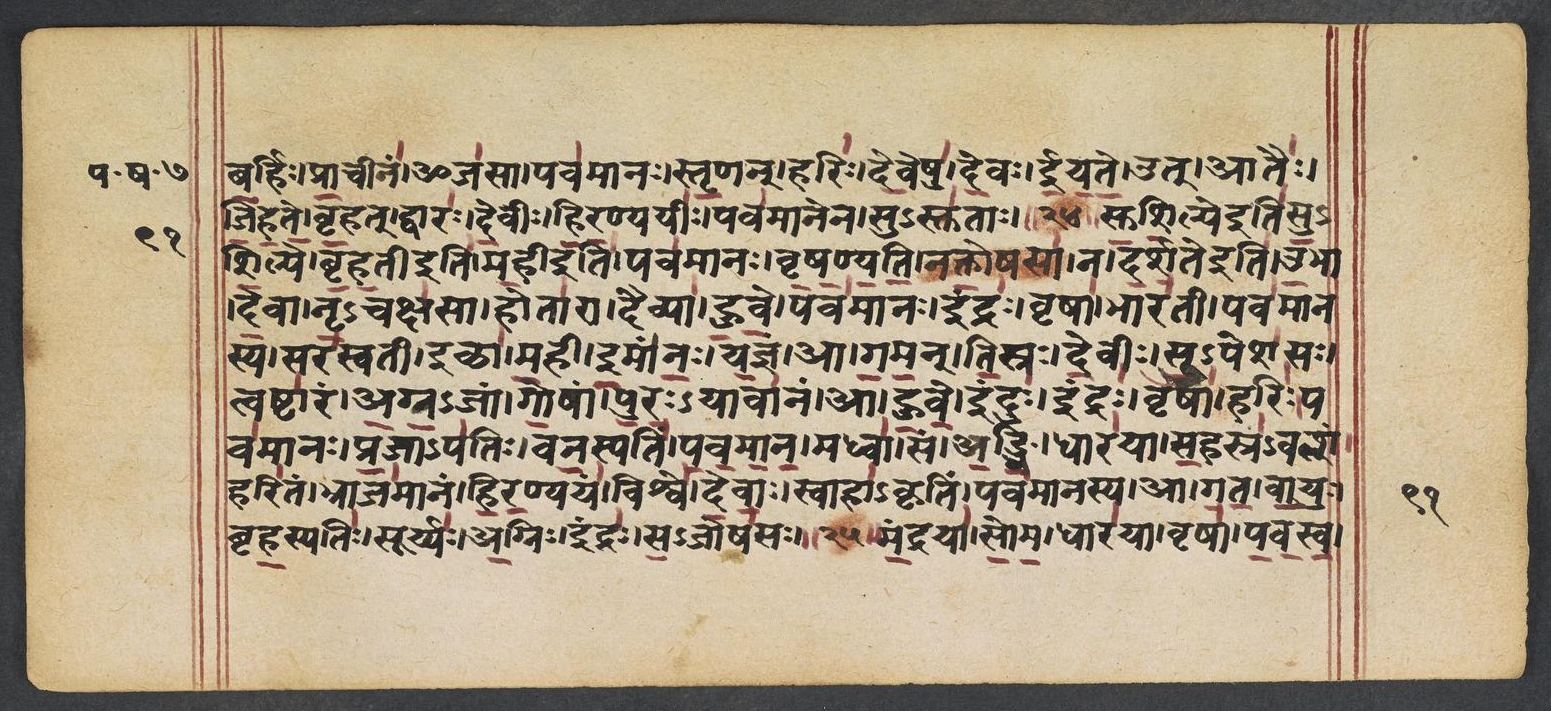
Penn Ms. Coll. 390 Item 41, fol. 669v (numbered 91v by the scribe) (OPenn image 670, upper leaf). Checked on the image: the Rigveda text on this page begins in RV 9.5.4 ‹barhiḥ prācīnam ojasā pavamānaḥ›. The next page with Rigveda text, fol. 670r (numbered 92r by the scribe), begins in RV 9.6.1 ‹deva-yuḥ avyaḥ vāreṣu asma-yuḥ›. Verses 9.5.4-11 end on this page.
4ba̱rhiḥ prā̱cīna̱m oja̍sā̱ pava̍mānaḥ stṛ̱ṇan hari̍ḥ | de̱veṣu̍ de̱va ī̍yate ||
5ud ātai̍r jihate bṛ̱had dvāro̍ de̱vīr hi̍ra̱ṇyayī̍ḥ | pava̍mānena̱ suṣṭu̍tāḥ ||
6su̱śi̱lpe bṛ̍ha̱tī ma̱hī pava̍māno vṛṣaṇyati | nakto̱ṣāsā̱ na da̍rśa̱te ||
7u̱bhā de̱vā nṛ̱cakṣa̍sā̱ hotā̍rā̱ daivyā̍ huve | pava̍māna̱ indro̱ vṛṣā̍ ||
8bhāra̍tī̱ pava̍mānasya̱ sara̍sva̱tīḻā̍ ma̱hī | i̱maṁ no̍ ya̱jñam ā ga̍man ti̱sro de̱vīḥ su̱peśa̍saḥ ||
9tvaṣṭā̍ram agra̱jāṁ go̱pām pu̍ro̱yāvā̍na̱m ā hu̍ve | indu̱r indro̱ vṛṣā̱ hari̱ḥ pava̍mānaḥ pra̱jāpa̍tiḥ ||
10vana̱spati̍m pavamāna̱ madhvā̱ sam a̍ṅgdhi̱ dhāra̍yā | sa̱hasra̍valśa̱ṁ hari̍ta̱m bhrāja̍mānaṁ hira̱ṇyaya̍m ||
11viśve̍ devā̱ḥ svāhā̍kṛti̱m pava̍māna̱syā ga̍ta | vā̱yur bṛha̱spati̱ḥ sūryo̱ 'gnir indra̍ḥ sa̱joṣa̍saḥ ||
Compare: Padapāṭha (word-by-word text written in the manuscript; Sansknet e-text via GRETIL)
4barhiḥ | prācīnam | ojasā | pavamānaḥ | stṛṇan | hariḥ | deveṣu | devaḥ | īyate
5ut | ātaiḥ | jihate | bṛhat | dvāraḥ | devīḥ | hiraṇyayīḥ | pavamānena | su-stutāḥ
6suśilpe itisu-śilpe | bṛhatī iti | mahī iti | pavamānaḥ | vṛṣaṇyati | naktoṣasā | na | darśate iti
7ubhā | devā | nṛ-cakṣasā | hotārā | daivyā | huve | pavamānaḥ | indraḥ | vṛṣā
8bhāratī | pavamānasya | sarasvatī | iḷā | mahī | imam | naḥ | yajñam | ā | gaman | tisraḥ | devīḥ | su-peśasaḥ
9tvaṣṭāram | agra-jām | gopām | puraḥ-yāvānam | ā | huve | induḥ | indraḥ | vṛṣā | hariḥ | pavamānaḥ | prajāpatiḥ
10vanaspatim | pavamāna | madhvā | sam | aṅgdhi | dhārayā | sahasra-valśam | haritam | bhrājamānam | hiraṇyayam
11viśve | devāḥ | svāhā-kṛtim | pavamānasya | ā | gata | vāyuḥ | bṛhaspatiḥ | sūryaḥ | agniḥ | indraḥ | sajoṣasaḥ
4The tawny Pavamâna, who strews from of old the grass with might, Is worshipped, God amid the Gods.
5The golden, the Celestial Doors are lifted with their frames on high, By Pavamâna glorified.
6With passion Pavamâna longs for the great lofty pair, well-formed Like beauteous maidens, Night and Dawn
7Both Gods who look on men I call, Celestial Heralds: Indra's Self Is Pavamâna, yea, the Bull.
8This, Pavamâna's sacrifice, shall the three beauteous Goddesses, Sarasvatî and Bhâratî and Iḷâ, Mighty One, attend.
9I summon Tvashṭar hither, our protector, champion, earliest-born, Indu is Indra, tawny Steer; Pavamâna is Prajâpati.
10O Pavamâna, with the meath in streams anoint Vanaspati, The ever-green. the golden-hued, refulgent, with a thousand boughs.
11Come to the consecrating rite of Pavamâna, all ye Gods,– Vâyu, Sûrya, Br̥ihaspati, Indra, and Agni, in accord.
Notes
- Sanskrit: Aufrecht's edition (1877) with the Vedic accents, as entered by van Nooten and Holland (GRETIL).
- English: Ralph T. H. Griffith, The Hymns of the Rigveda (1889-1892; 2nd ed. 1896-1897), from the VedaWeb digital text; OCR slips in that text were corrected against the printed 2nd edition (data/sources/rigveda/griffith_errata.json).
- Padapāṭha (edition text): Sansknet e-text via GRETIL (CC BY-NC-SA 4.0).
Cite
Sources
- Source: Penn Ms. Coll. 390 Item 41 (undated (catalogued with Penn's 18th-19th c. Vedic manuscripts)), OPenn, Public Domain Mark + Aufrecht's accented text (GRETIL) + Griffith's English (VedaWeb) (holding institution)
- Critical edition: Aufrecht (1877), accented e-text via GRETIL
← previous · → next · v cycle view · l back to library