Rigveda 9.50: To Soma
Introduction
Rigveda 9.50 is a hymn of 5 verses addressed to Soma. It stands in book (maṇḍala) 9, the hymns to Soma Pavamāna. The Rigveda is the oldest collection of Sanskrit hymns, composed in the second half of the second millennium BCE and handed down orally for many centuries before it was written down.
The manuscript shown is Penn Ms. Coll. 390 Item 41 (University of Pennsylvania), an undated paper manuscript of the padapāṭha (the word-by-word recitation text, in which every word is written separately and compounds are split) of the whole Ṛgveda in Devanāgarī, 884 leaves in fascicles, 7-9 lines to the page, accents in red; this hymn stands on fol. 686r-686v. Each section below gives the verses that end on one page; the page boundaries were read on the images (the opening words of every page), not counted out. Where the manuscript is a padapāṭha (the word-by-word recitation text), the section shows Aufrecht's continuous (saṃhitā) text first and, as the edition text, the padapāṭha of the same verses, which is the form written on the page.
How was this verified? (Provenance)
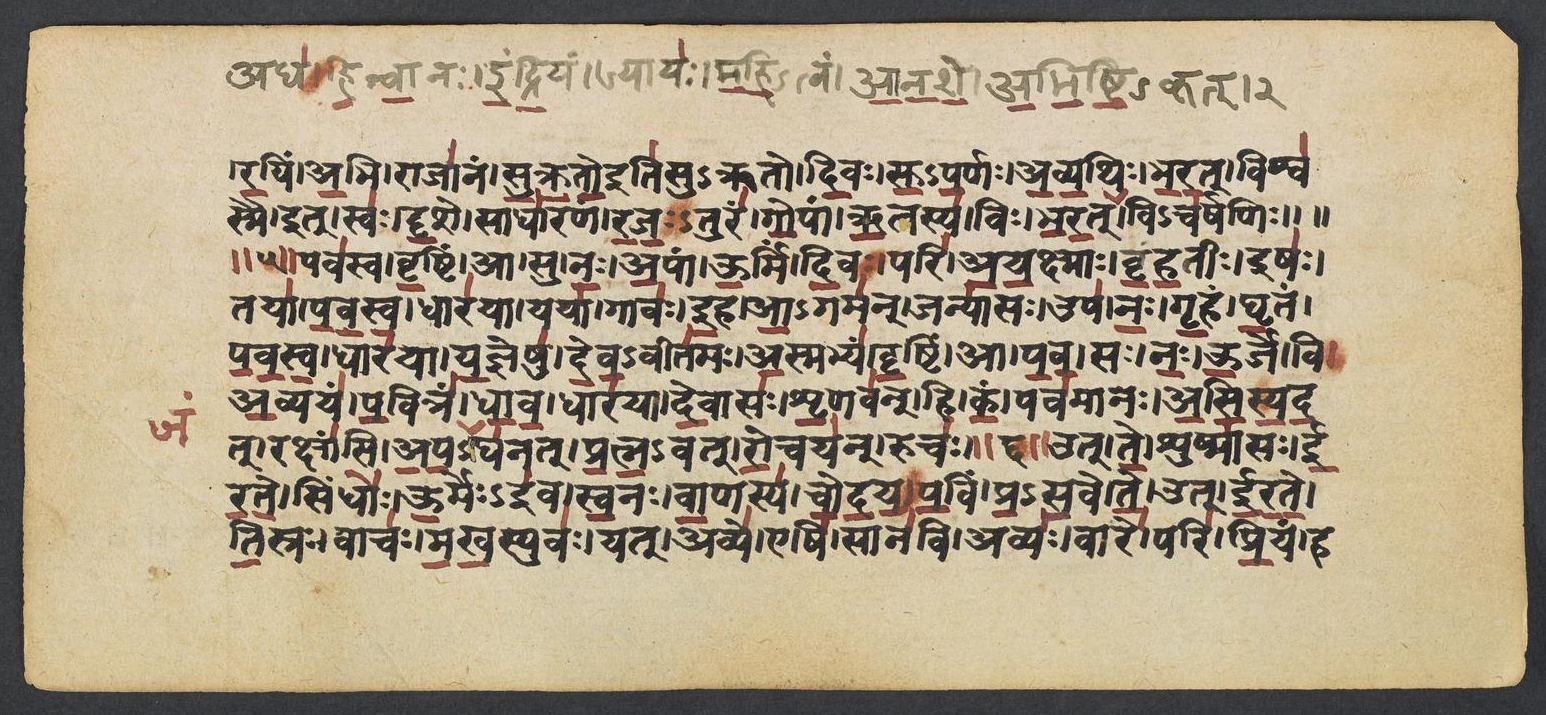
Where on the image
Penn Ms. Coll. 390 Item 41, fol. 686r (numbered 3r by the scribe) (OPenn image 686, lower leaf). Checked on the image: the Rigveda text on this page begins in RV 9.48.3 ‹rayim abhi rājānam sukrato›. The next page with Rigveda text, fol. 686v (numbered 3v by the scribe), begins in RV 9.50.3 ‹-harim hinvanti adri-bhiḥ pavamānam›. Verses 9.50.1-2 end on this page.
1ut te̱ śuṣmā̍sa īrate̱ sindho̍r ū̱rmer i̍va sva̱naḥ | vā̱ṇasya̍ codayā pa̱vim ||
2pra̱sa̱ve ta̱ ud ī̍rate ti̱sro vāco̍ makha̱syuva̍ḥ | yad avya̱ eṣi̱ sāna̍vi ||
Compare: Padapāṭha (word-by-word text written in the manuscript; Sansknet e-text via GRETIL)
1ut | te | śuṣmāsaḥ | īrate | sindhoḥ | ūrmeḥ-iva | svanaḥ | vāṇasya | codaya | pavim
2pra-save | te | ut | īrate | tisraḥ | vācaḥ | makhasyuvaḥ | yat | avye | eṣi | sānavi
1LOUD as a river's roaring wave thy powers have lifted up themselves: Urge on thine arrow's sharpened point.
2At thine effusion upward rise three voices full of joy, when thou Flowest upon the fleecy ridge.
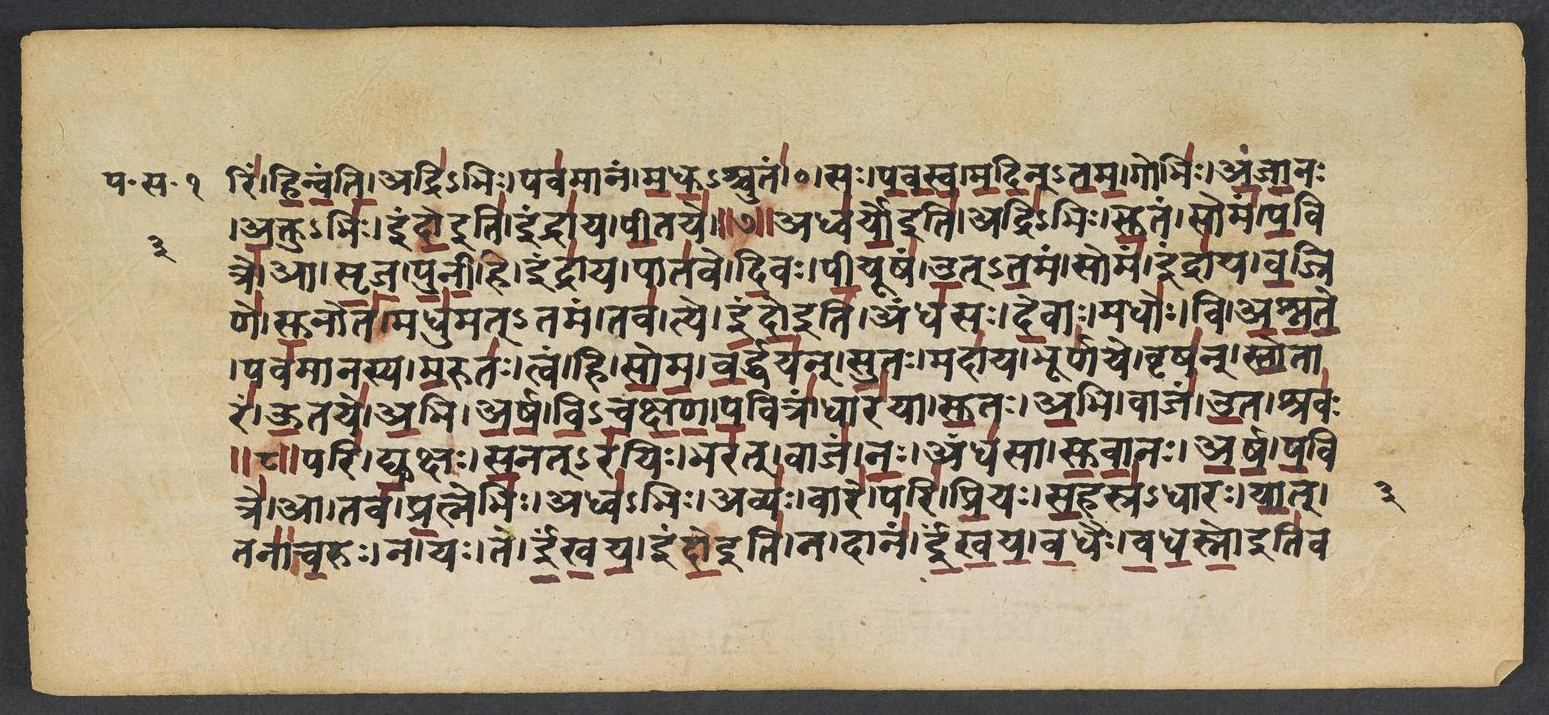
Where on the image
Penn Ms. Coll. 390 Item 41, fol. 686v (numbered 3v by the scribe) (OPenn image 687, upper leaf). Checked on the image: the Rigveda text on this page begins in RV 9.50.3 ‹-harim hinvanti adri-bhiḥ pavamānam›. The next page with Rigveda text, fol. 687r (numbered 4r by the scribe), begins in RV 9.52.3 ‹-itivadha-sno īṅkhaya›. Verses 9.50.3-5 end on this page; 9.50.3 begins on fol. 686r (numbered 3r by the scribe).
3avyo̱ vāre̱ pari̍ pri̱yaṁ hari̍ṁ hinva̱nty adri̍bhiḥ | pava̍mānam madhu̱ścuta̍m ||
4ā pa̍vasva madintama pa̱vitra̱ṁ dhāra̍yā kave | a̱rkasya̱ yoni̍m ā̱sada̍m ||
5sa pa̍vasva madintama̱ gobhi̍r añjā̱no a̱ktubhi̍ḥ | inda̱v indrā̍ya pī̱taye̍ ||
Compare: Padapāṭha (word-by-word text written in the manuscript; Sansknet e-text via GRETIL)
3avyaḥ | vāre | pari | priyam | harim | hinvanti | adri-bhiḥ | pavamānam | madhu-ścutam
4ā | pavasva | madin-tama | pavitram | dhārayā | kave | arkasya | yonim | āsadam
5saḥ | pavasva | madin-tama | gobhiḥ | añjānaḥ | aktu-bhiḥ | indo iti | indrāya | pītaye
3On to the fleece they urge with stone the tawny well-beloved One, Even Pavamâna, dropping meath.
4Flow with thy current to the sieve, O Sage most powerful to cheer, To seat thee in the place of song.
5Flow, Most Exhilarating! flow anointed with the milk for balm, Indu, for Indra, for his drink.
Notes
- Sanskrit: Aufrecht's edition (1877) with the Vedic accents, as entered by van Nooten and Holland (GRETIL).
- English: Ralph T. H. Griffith, The Hymns of the Rigveda (1889-1892; 2nd ed. 1896-1897), from the VedaWeb digital text; OCR slips in that text were corrected against the printed 2nd edition (data/sources/rigveda/griffith_errata.json).
- Padapāṭha (edition text): Sansknet e-text via GRETIL (CC BY-NC-SA 4.0).
Cite
Sources
- Source: Penn Ms. Coll. 390 Item 41 (undated (catalogued with Penn's 18th-19th c. Vedic manuscripts)), OPenn, Public Domain Mark + Aufrecht's accented text (GRETIL) + Griffith's English (VedaWeb) (holding institution)
- Critical edition: Aufrecht (1877), accented e-text via GRETIL
← previous · → next · v cycle view · l back to library