Rigveda 9.53: To Soma
Introduction
Rigveda 9.53 is a hymn of 4 verses addressed to Soma. It stands in book (maṇḍala) 9, the hymns to Soma Pavamāna. The Rigveda is the oldest collection of Sanskrit hymns, composed in the second half of the second millennium BCE and handed down orally for many centuries before it was written down.
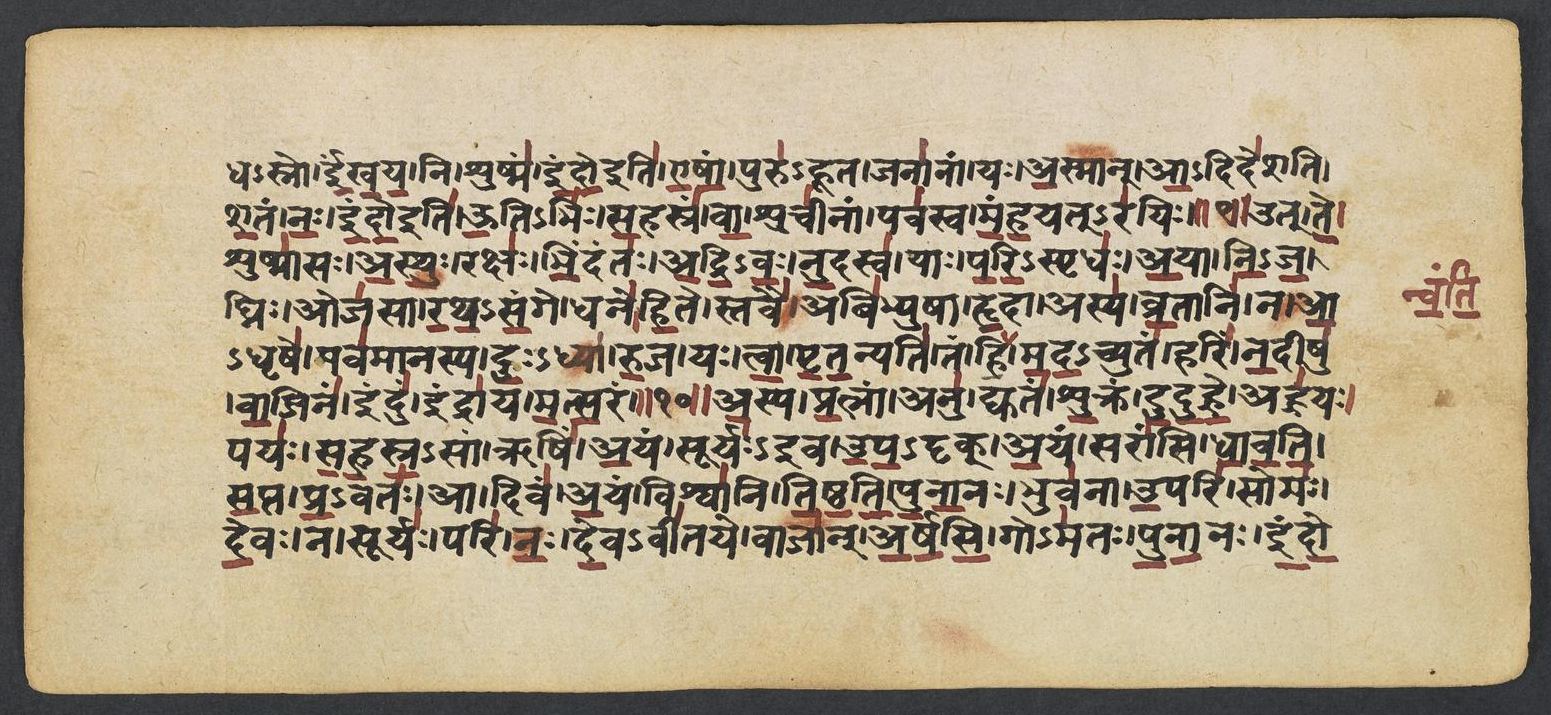
The manuscript shown is Penn Ms. Coll. 390 Item 41 (University of Pennsylvania), an undated paper manuscript of the padapāṭha (the word-by-word recitation text, in which every word is written separately and compounds are split) of the whole Ṛgveda in Devanāgarī, 884 leaves in fascicles, 7-9 lines to the page, accents in red; this hymn stands on fol. 687r. Each section below gives the verses that end on one page; the page boundaries were read on the images (the opening words of every page), not counted out. Where the manuscript is a padapāṭha (the word-by-word recitation text), the section shows Aufrecht's continuous (saṃhitā) text first and, as the edition text, the padapāṭha of the same verses, which is the form written on the page.
How was this verified? (Provenance)
Where on the image
Penn Ms. Coll. 390 Item 41, fol. 687r (numbered 4r by the scribe) (OPenn image 687, lower leaf). Checked on the image: the Rigveda text on this page begins in RV 9.52.3 ‹-itivadha-sno īṅkhaya›. The next page with Rigveda text, fol. 687v (numbered 4v by the scribe), begins in RV 9.54.4 ‹iti indra-yuḥ›. Verses 9.53.1-4 end on this page.
1ut te̱ śuṣmā̍so asthū̱ rakṣo̍ bhi̱ndanto̍ adrivaḥ | nu̱dasva̱ yāḥ pa̍ri̱spṛdha̍ḥ ||
2a̱yā ni̍ja̱ghnir oja̍sā rathasa̱ṁge dhane̍ hi̱te | stavā̱ abi̍bhyuṣā hṛ̱dā ||
3asya̍ vra̱tāni̱ nādhṛṣe̱ pava̍mānasya dū̱ḍhyā̍ | ru̱ja yas tvā̍ pṛta̱nyati̍ ||
4taṁ hi̍nvanti mada̱cyuta̱ṁ hari̍ṁ na̱dīṣu̍ vā̱jina̍m | indu̱m indrā̍ya matsa̱ram ||
Compare: Padapāṭha (word-by-word text written in the manuscript; Sansknet e-text via GRETIL)
1ut | te | śuṣmāsaḥ | asthuḥ | rakṣaḥ | bhindantaḥ | adri-vaḥ | nudasva | yāḥ | pari-spṛdhaḥ
2ayā | ni-jaghniḥ | ojasā | ratha-saṅge | dhane | hite | stavai | abibhyuṣā | hṛdā
3asya | vratāni | na | ādhṛṣe | pavamānasya | duḥ-dhyā | ruja | yaḥ | tvā | pṛtanyati
4tam | hinvanti | mada-cyutam | harim | nadīṣu | vājinam | indum | indrāya | matsaram
1O THOU with stones for arms, thy powers, crushing the fiends, have raised themselves: Chase thou the foes who compass us.
2Thou conquerest thus with might when car meets car, and when the prize is staked: With fearless heart will I sing praise.
3No one with evil thought assails this Pavamâna's holy laws: Crush him who fain would fight with thee.
4For Indra to the streams they drive the tawny rapture-dropping Steed, Indu the bringer of delight.
Notes
- Sanskrit: Aufrecht's edition (1877) with the Vedic accents, as entered by van Nooten and Holland (GRETIL).
- English: Ralph T. H. Griffith, The Hymns of the Rigveda (1889-1892; 2nd ed. 1896-1897), from the VedaWeb digital text; OCR slips in that text were corrected against the printed 2nd edition (data/sources/rigveda/griffith_errata.json).
- Padapāṭha (edition text): Sansknet e-text via GRETIL (CC BY-NC-SA 4.0).
Cite
Sources
- Source: Penn Ms. Coll. 390 Item 41 (undated (catalogued with Penn's 18th-19th c. Vedic manuscripts)), OPenn, Public Domain Mark + Aufrecht's accented text (GRETIL) + Griffith's English (VedaWeb) (holding institution)
- Critical edition: Aufrecht (1877), accented e-text via GRETIL
← previous · → next · v cycle view · l back to library