Rigveda 9.7: To Soma
Introduction
Rigveda 9.7 is a hymn of 9 verses addressed to Soma. It stands in book (maṇḍala) 9, the hymns to Soma Pavamāna. The Rigveda is the oldest collection of Sanskrit hymns, composed in the second half of the second millennium BCE and handed down orally for many centuries before it was written down.
The manuscript shown is Penn Ms. Coll. 390 Item 41 (University of Pennsylvania), an undated paper manuscript of the padapāṭha (the word-by-word recitation text, in which every word is written separately and compounds are split) of the whole Ṛgveda in Devanāgarī, 884 leaves in fascicles, 7-9 lines to the page, accents in red; this hymn stands on fol. 670r-670v. Each section below gives the verses that end on one page; the page boundaries were read on the images (the opening words of every page), not counted out. Where the manuscript is a padapāṭha (the word-by-word recitation text), the section shows Aufrecht's continuous (saṃhitā) text first and, as the edition text, the padapāṭha of the same verses, which is the form written on the page.
How was this verified? (Provenance)
Where on the image
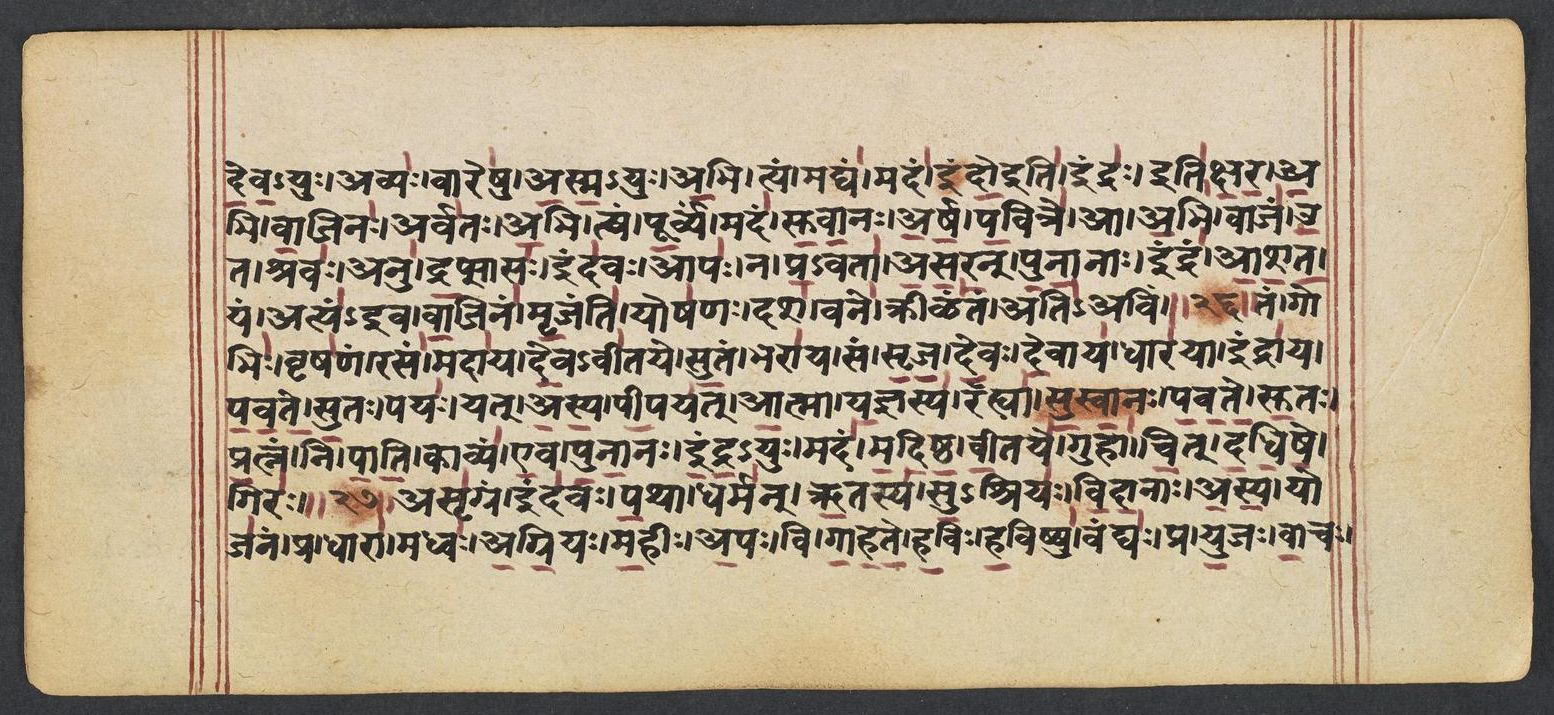
Penn Ms. Coll. 390 Item 41, fol. 670r (numbered 92r by the scribe) (OPenn image 670, lower leaf). Checked on the image: the Rigveda text on this page begins in RV 9.6.1 ‹deva-yuḥ avyaḥ vāreṣu asma-yuḥ›. The next page with Rigveda text, fol. 670v (numbered 92v by the scribe), begins in RV 9.7.3 ‹agriyaḥ vṛṣā ava cakradat›. Verses 9.7.1-2 end on this page.
1asṛ̍gra̱m inda̍vaḥ pa̱thā dharma̍nn ṛ̱tasya̍ su̱śriya̍ḥ | vi̱dā̱nā a̍sya̱ yoja̍nam ||
2pra dhārā̱ madhvo̍ agri̱yo ma̱hīr a̱po vi gā̍hate | ha̱vir ha̱viṣṣu̱ vandya̍ḥ ||
Compare: Padapāṭha (word-by-word text written in the manuscript; Sansknet e-text via GRETIL)
1asṛgram | indavaḥ | pathā | dharman | ṛtasya | su-śriyah | vidānāḥ | asya | yojanam
2pra | dhārā | madhvaḥ | agriyaḥ | mahīḥ | apaḥ | vi | gāhate | haviḥ | haviṣṣu | vandyaḥ
1FORTH on their way the glorious drops have flowed for maintenance of Law, Knowing this sacrifice's course.
2Down in the mighty waters sinks the stream of meath, most excellent, Oblation best of all in worth.
Where on the image
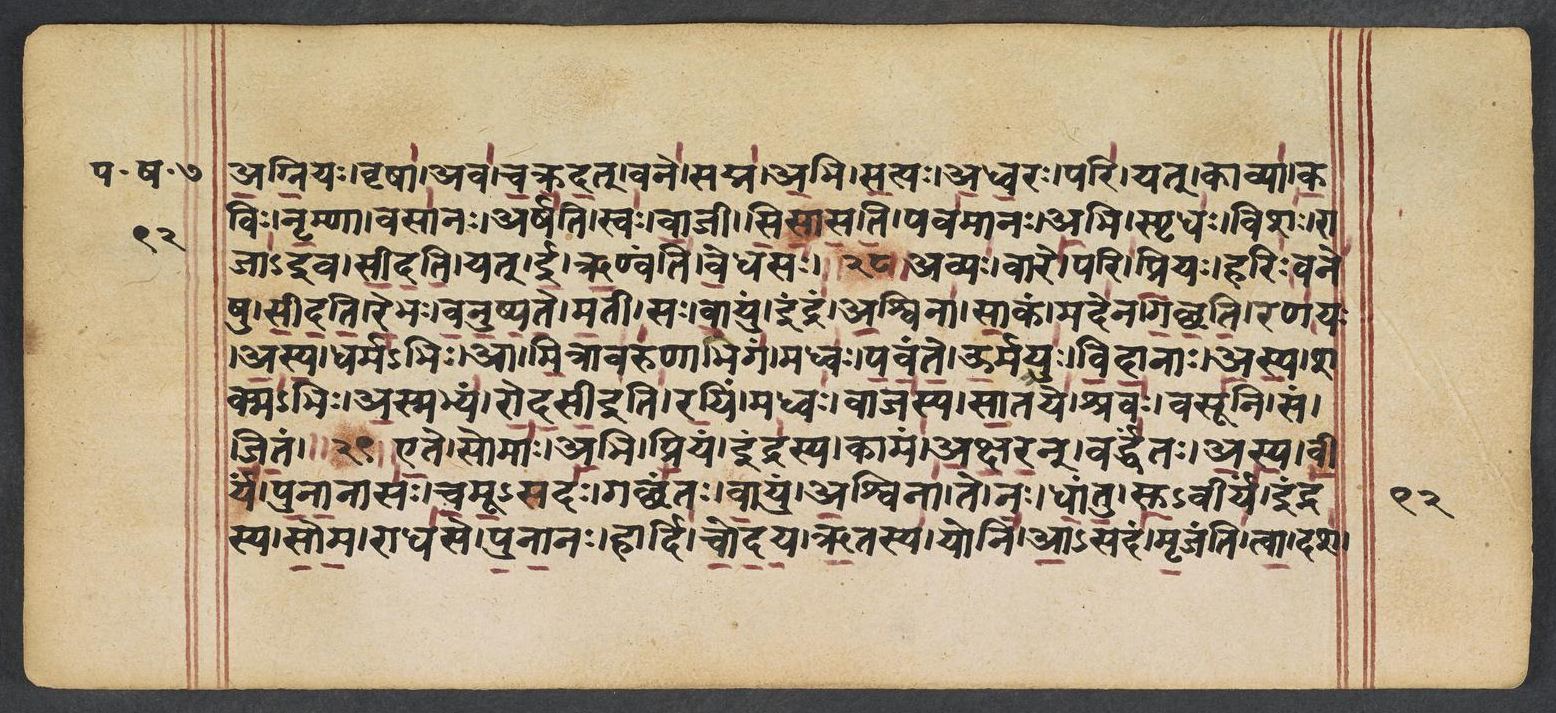
Penn Ms. Coll. 390 Item 41, fol. 670v (numbered 92v by the scribe) (OPenn image 671, upper leaf). Checked on the image: the Rigveda text on this page begins in RV 9.7.3 ‹agriyaḥ vṛṣā ava cakradat›. The next page with Rigveda text, fol. 671r (numbered 93r by the scribe), begins in RV 9.8.4 ‹kṣipaḥ hinvanti sapta dhītayaḥ›. Verses 9.7.3-9 end on this page; 9.7.3 begins on fol. 670r (numbered 92r by the scribe).
3pra yu̱jo vā̱co a̍gri̱yo vṛṣāva̍ cakrada̱d vane̍ | sadmā̱bhi sa̱tyo a̍dhva̱raḥ ||
4pari̱ yat kāvyā̍ ka̱vir nṛ̱mṇā vasā̍no̱ arṣa̍ti | sva̍r vā̱jī si̍ṣāsati ||
5pava̍māno a̱bhi spṛdho̱ viśo̱ rāje̍va sīdati | yad ī̍m ṛ̱ṇvanti̍ ve̱dhasa̍ḥ ||
6avyo̱ vāre̱ pari̍ pri̱yo hari̱r vane̍ṣu sīdati | re̱bho va̍nuṣyate ma̱tī ||
7sa vā̱yum indra̍m a̱śvinā̍ sā̱kam made̍na gacchati | raṇā̱ yo a̍sya̱ dharma̍bhiḥ ||
8ā mi̱trāvaru̍ṇā̱ bhaga̱m madhva̍ḥ pavanta ū̱rmaya̍ḥ | vi̱dā̱nā a̍sya̱ śakma̍bhiḥ ||
9a̱smabhya̍ṁ rodasī ra̱yim madhvo̱ vāja̍sya sā̱taye̍ | śravo̱ vasū̍ni̱ saṁ ji̍tam ||
Compare: Padapāṭha (word-by-word text written in the manuscript; Sansknet e-text via GRETIL)
3pra | yujaḥ | vācaḥ | agriyaḥ | vṛṣā | ava | cakradat | vane | sadma | abhi | satyaḥ | adhvaraḥ
4pari | yat | kāvyā | kaviḥ | nṛmṇā | vasānaḥ | arṣati | svaḥ | vājī | sisāsati
5pavamānaḥ | abhi | spṛdhaḥ | viśaḥ | rājā-iva | sīdati | yat | īm | ṛṇvanti | vedhasaḥ
6avyaḥ | vāre | pari | priyaḥ | hariḥ | vaneṣu | sīdati | rebhaḥ | vanuṣyate | matī
7saḥ | vāyum | indram | aśvinā | sākam | madena | gacchati | raṇa | yaḥ | asya | dharma-bhiḥ
8ā | mitrāvaruṇā | bhagam | madhvaḥ | pavante | ūrmayaḥ | vidānāḥ | asya | śakma-bhiḥ
9asmabhyam | rodasī iti | rayim | madhvaḥ | vājasya | sātaye | śravaḥ | vasūni | sam | jitam
3About the holy place, the Steer true, guileless, noblest, hath sent forth Continuous voices in the wood.
4When, clothed in manly strength, the Sage flows in celestial wisdom round, The Strong would win the light of heaven.
5When purified, he sits as King above the hosts, among his folk, What time the sages bring him nigh.
6Dear, golden-coloured, in the fleece he sinks and settles in the wood: The Singer shows his zeal in hymns.
7He goes to Indra, Vâyu, to the Aṣvins, as his custom is, With gladdening juice which gives them joy.
8Tle streams of pleasant Soma flow to Bhaga, Mitra-Varuṇa,– Well-knowing through his mighty powers. Heaven and Earth, riches of meath to win us wealth: Gain for us treasures and renown.
9Heaven and Earth, riches of meath to win us wealth: Gain for us treasures and renown.
Notes
- Sanskrit: Aufrecht's edition (1877) with the Vedic accents, as entered by van Nooten and Holland (GRETIL).
- English: Ralph T. H. Griffith, The Hymns of the Rigveda (1889-1892; 2nd ed. 1896-1897), from the VedaWeb digital text; OCR slips in that text were corrected against the printed 2nd edition (data/sources/rigveda/griffith_errata.json).
- Padapāṭha (edition text): Sansknet e-text via GRETIL (CC BY-NC-SA 4.0).
Cite
Sources
- Source: Penn Ms. Coll. 390 Item 41 (undated (catalogued with Penn's 18th-19th c. Vedic manuscripts)), OPenn, Public Domain Mark + Aufrecht's accented text (GRETIL) + Griffith's English (VedaWeb) (holding institution)
- Critical edition: Aufrecht (1877), accented e-text via GRETIL
← previous · → next · v cycle view · l back to library