The Rosetta Stone: Greek text of the Memphis decree (complete, lines 1-54)
Introduction
The Rosetta Stone (British Museum EA 24) is a granodiorite stela found in 1799 at Rashid (Rosetta) in the western Nile Delta. It carries one decree in three scripts: Egyptian hieroglyphs at the top (14 surviving lines), Egyptian Demotic in the middle (32 lines) and Greek at the bottom (54 lines). The decree was passed by a synod of Egyptian priests at Memphis on 27 March 196 BCE (4 Xandikos, 18 Mecheir, year 9) to honour the young king Ptolemy V Epiphanes after his coronation. Because the Greek could be read, the stone gave the key to the decipherment of hieroglyphs (Thomas Young, Jean-Francois Champollion, 1814-1822).
The Greek text lists the king's benefactions to the temples (tax remissions, release of prisoners, gifts to the sacred bulls Apis and Mnevis, the siege of rebel Lykopolis) and then the priests' resolutions: statues and golden shrines of the king in every temple, monthly and yearly festivals, a new priestly title, and the order to set up the decree on stelae of hard stone 'in holy, native and Greek letters', which is the stone itself.
This entry gives the complete Greek text, all 54 lines, in nine sections of six lines. The Greek is the line-by-line transcript printed by E. A. Wallis Budge in The Decrees of Memphis and Canopus (1904), with the stone's line numbers; letters in square brackets are restorations where the right-hand and lower edges of the stone are broken. The English is Budge's own rendering of the Greek in the same book, numbered by the same lines; words in square brackets there are Budge's additions for sense. Each section is shown on the British Museum's 1922 photograph of the stone, cut and straightened to the six lines of that section, together with the whole Greek register. The hieroglyphic and Demotic versions are not given here because no openly licensed digital text of them was found.
How was this verified? (Provenance)
Where on the image
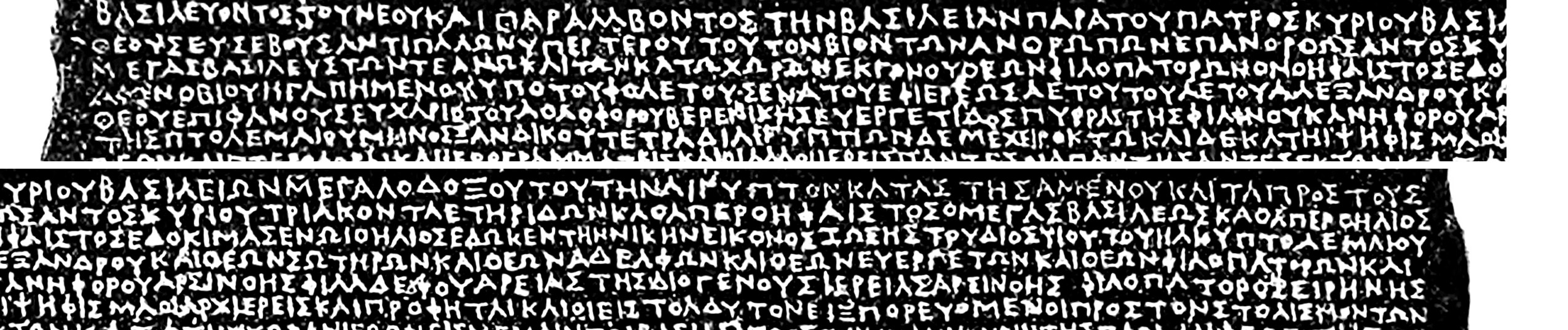
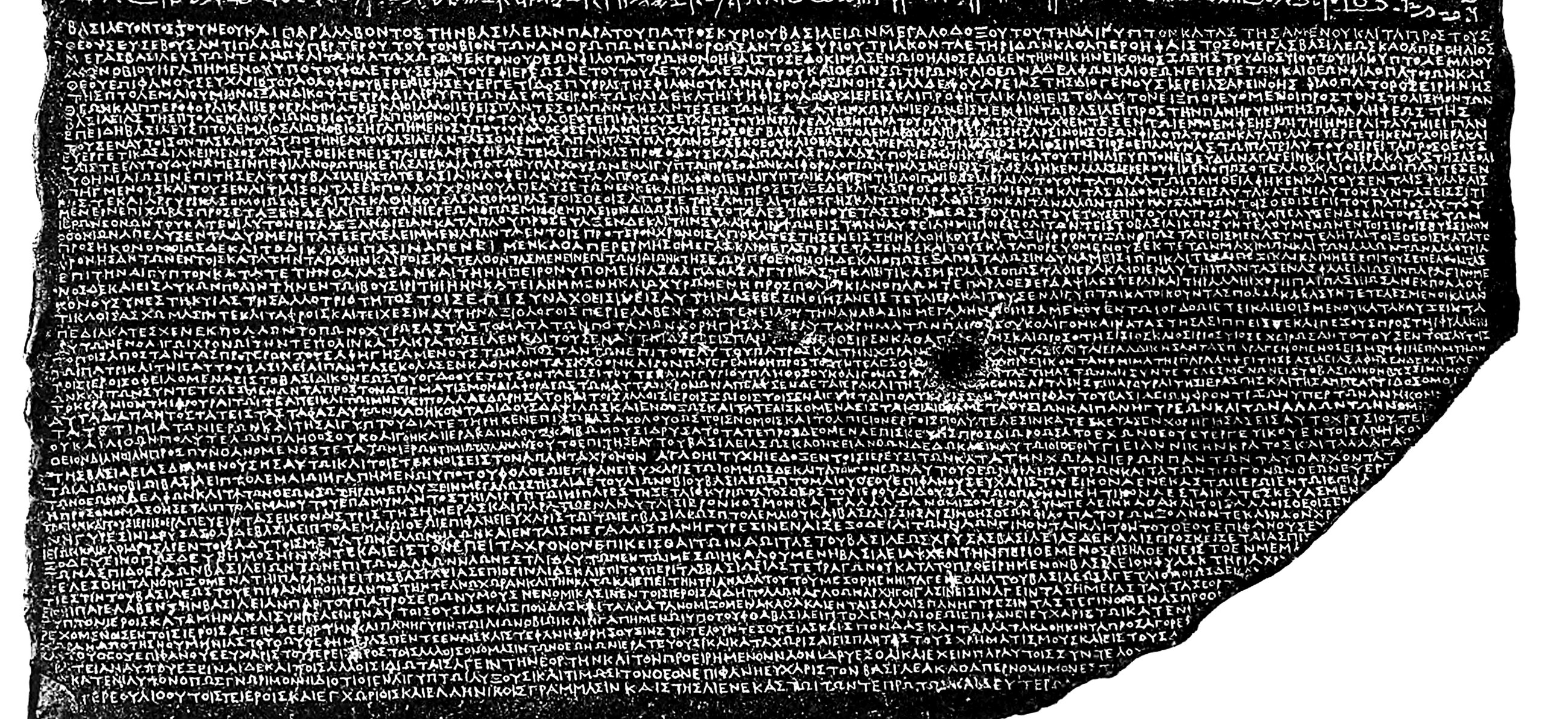
Greek lines 1-6 of 54. The first image shows these six lines on the British Museum photograph of 1922: the left half of each line above, the right half below (the halves overlap); the strip has been straightened by shifting pixel columns up or down, nothing else is changed. The second image is the whole Greek register on the same photograph, turned 0.4 degrees and not straightened. Line positions were read by eye at the left, middle and right of the register. Checked on the image: line 1 begins ΒΑΣΙΛΕΥΟΝΤΟΣΤΟΥΝΕΟΥΚΑΙ and ends ΚΑΙΤΑΠΡΟΣΤΟΥΣ; line 6 begins ΤΗΣΠΤΟΛΕΜΑΙΟΥΜΗΝΟΣΞΑΝΔΙΚΟΥ and ends ΠΡΟΣΤΟΝΣΤΟΛΙΣΜΟΝΤΩΝ. Square brackets in the Greek mark letters restored where the stone is broken (Budge's text); Budge's English also translates these restorations.
1Βασιλεύοντος τοῦ νέου, καὶ παραλαβόντος τὴν βασιλείαν παρὰ τοῦ πατρός, κυρίου βασιλειῶν, μεγαλοδόξου, τοῦ τὴν Αἴγυπτον καταστησαμένου καὶ τὰ πρὸς τοὺς
2θεοὺς εὐσεβοῦς, ἀντιπάλων ὑπερτέρου, τοῦ τὸν βίον τῶν ἀνθρώπων ἐπανορθώσαντος, κυρίου τριακονταετηρίδων, καθάπερ ὁ Ἥφαιστος ὁ μέγας· βασιλέως, καθάπερ ὁ Ἥλιος
3μέγας βασιλεὺς τῶν τε ἄνω καὶ τῶν κάτω χωρῶν· ἐκγόνου θεῶν Φιλοπατόρων· ὃν ὁ Ἥφαιστος ἐδοκίμασεν· ᾧ ὁ Ἥλιος ἔδωκεν τὴν νίκην· εἰκόνος ζώσης τοῦ Διὸς, υἱοῦ τοῦ Ἡλίου, Πτολεμαίου,
4αἰωνοβίου, ἠγαπημένου ὑπὸ τοῦ Φθᾶ. ἔτους ἐνάτου, ἐφ’ ἱερέως Ἀέτου τοῦ Ἀέτου Ἀλεξάνδρου, καὶ θεῶν Σωτήρων, καὶ θεῶν Ἀδελφῶν, καὶ θεῶν Εὐεργετῶν, καὶ θεῶν Φιλοπατόρων καὶ
5θεοῦ Ἐπιφανοῦς Εὐχαρίστου· ἀθλοφόρου Βερενίκης Εὐεργέτιδος, Πύῤῥας τῆς Φιλίνου· κανηφόρου Ἀρσινόης Φιλαδέλφου, Ἀρείας τῆς Διογένους· ἱερείας Ἀρσινόης Φιλοπάτορος, Εἰρήνης
6τῆς Πτολεμαίου, μηνὸς Ξανδικοῦ τετράδι, Αἰγυπτίων δὲ Μεχεὶρ ὀκτωκαιδεκάτῃ· Ψήφισμα. οἱ ἀρχιερεῖς καὶ προφῆται καὶ οἱ εἰς τὸ ἄδυτον εἰ[σ]πορευόμενοι πρὸς τὸν στολισμὸν τῶν
1Under the reign of the young [god], who hath received the sovereignty from his father, the lord of diadems, who is exceedingly glorious, who hath stablished Egypt firmly, who holdeth
2the gods in reverence, who hath vanquished his enemies, who hath made straight the life of men, lord of the thirty-year festivals, like Hephaistos the Great, of the king, like Helios,
3great king, both of the Upper Country, and of the Lower Country, of offspring of the gods, Philopatores, whom Hephaistos hath chosen, to whom Helios hath given victory, the living Image of Zeus, son of Helios, of Ptolemy,
4the everliving, the beloved of Ptaḥ, in the ninth year, when Aetos, the son of Aetos, was priest of Alexander, and of the gods Soteres, and of the gods Adelphi, and of the gods Euergetes, and of the gods Philopatores, and
5of the god Epiphanes Eucharistos; Pyrrha, daughter of Philinos, being the Athlophoros of Berenike Euergetes, [and] Areia, daughter of Diogenes, the Kanephoros of Arsinoë Philadelphos, and Eirene,
6the daughter of Ptolemy, being priestess of Arsinoë Philopator; the fourth day of the month Xandikos, which corresponds to the eighteenth day of the Egyptian month of Mekhir. Decree. The High-priests, and the Prophets, and those who go into the sanctuary for [the purpose of] dressing the

Where on the image
Greek lines 7-12 of 54. The first image shows these six lines on the British Museum photograph of 1922: the left half of each line above, the right half below (the halves overlap); the strip has been straightened by shifting pixel columns up or down, nothing else is changed. The second image is the whole Greek register on the same photograph, turned 0.4 degrees and not straightened. Line positions were read by eye at the left, middle and right of the register. Checked on the image: line 7 begins (Θ)ΕΩΝΚΑΙΠΤΕΡΟΦΟΡΑΙΚΑΙΙΕΡΟΓΡΑΜΜΑΤΕΙΣ and ends ΠΑΡΑΛΗΨΕΩΣΤΗΣ; line 12 begins ΤΑΙΣΤΕΕΑΥΤΟΥΔΥΝΑΜΕΣΙΝ and ends ΟΙΑΛΛΟΙΠΑΝΤΕΣΕΝ. Square brackets in the Greek mark letters restored where the stone is broken (Budge's text); Budge's English also translates these restorations.
7θεῶν, καὶ πτεροφόρ[α]ι καὶ ἱερογραμματεῖς, καὶ οἱ ἄλλοι ἱερεῖς πάντες, οἱ ἀπαντήσαντες ἐκ τῶν κατὰ τὴν χώραν ἱερῶν εἰς Μέμφιν τῷ βασιλεῖ, πρὸς τὴν πανήγυριν τῆς παραλήψεως τῆς
8βασιλείας, τῆς Πτολεμαίου, αἰωνοβίου, ἠγαπημένου ὑπὸ τοῦ Φθᾶ, θεοῦ Ἐπιφανοῦς Εὐχαρίστου, ἣν παρελαβεν παρὰ τοῦ πατρὸς αὐτοῦ, συναχθέντες ἐν τῷ ἐν Μέμφει ἱερῷ, τῇ ἡμέρᾳ ταύτῃ εἶπαν·
9Ἐπειδὴ βασιλεὺς Πτολεμαῖος, αἰωνόβιος, ἠγαπημένος ὑπὸ τοῦ Φθᾶ, θεὸς Ἐπιφανὴς Εὐχάριστος, ὁ ἐγ βασιλέως Πτολεμαίου καὶ βασιλίσσης Ἀρσινόης, θεῶν Φιλοπατόρων, κατὰ πολλὰ εὐεργέτηκεν τὰ θ’ ἱερὰ καὶ
10τοὺς ἐν αὐτοῖς ὄντας, καὶ τοὺς ὑπὰ τὴν ἑαυτοῦ βασιλείαν τασσομένους ἅπαντας· ὑπάρχων θεὸς ἐκ θεοῦ καὶ θεᾶς, καθάπερ Ὧρος, ὁ τῆς Ἴσιος καὶ Ὀσίριος υἱός, ὁ ἐπαμύνας τῷ πατρὶ αὐτοῦ Ὀσίρει, τά [τε] πρὸς θεοὺς
11εὐεργετικῶς διακείμενος, ἀνατέθεικεν εἰς τὰ ἱερὰ ἀργυρικάς τε καὶ σιτι[κ]ὰς προσόδους· καὶ δαπάνας πολλὰς ὑπομεμένηκεν, ἕνεκα τοῦ τὴν Αἴγυπτον εἰς εὐδίαν ἀγαγεῖν, καὶ τὰ ἱερὰ καταστήσασθαι,
12ταῖς τε ἑαυτοῦ δυνάμεσιν πεφιλανθρώπηκε πάσαις, καὶ ἀπὸ τῶν ὑπαρχουσῶν ἐν Αἰγύπτῳ προσόδων καὶ φορολογιῶν τινὰς μὲν εἰς τέλος ἀφῆκεν, ἄλλας δὲ κεκούφικεν, ὅπως ὅ τε λαὸς καὶ οἱ ἄλλοι πάντες ἐν
7gods, and the Bearers of feathers, and the Sacred Scribes, and all the other priests, who have gathered themselves together from the temples throughout the country before the king in Memphis, for the [commemorative] festival of the reception of the
8kingdom, by Ptolemy, the everliving, the beloved of Ptaḥ, the God Epiphanes Eucharistos, which he received from his father, being gathered together in the temple of Memphis, on this day, decreed [thus]:—
9Inasmuch as King Ptolemy, the beloved of Ptaḥ, the God Epiphanes Eucharistos, the Offspring of King Ptolemy and Queen Arsinoë, the Gods Philopatores, hath given many benefactions, both to the temples, and
10to those that dwell therein, and unto all those who are subject to his dominion, being a God, [and] born of a God and Goddess, even like Horus, the son of Isis and Osiris, who avenged his father Osiris; and towards the gods
11being full of benevolent piety, hath dedicated to the temple revenues in money and in provisions; and hath incurred great expenses in order that he might bring Egypt into a state of prosperity, and might establish the temples;
12and hath given away freely of all the moneys which were his own; and of the taxes and dues which come to him in Egypt, some he hath finally suppressed, and others he hath diminished, so that the people (i.e., natives) and all the others (i.e., the foreigners and foreign settlers)

Where on the image
Greek lines 13-18 of 54. The first image shows these six lines on the British Museum photograph of 1922: the left half of each line above, the right half below (the halves overlap); the strip has been straightened by shifting pixel columns up or down, nothing else is changed. The second image is the whole Greek register on the same photograph, turned 0.4 degrees and not straightened. Line positions were read by eye at the left, middle and right of the register. Checked on the image: line 13 begins (ΕΥ)ΘΗΝΙΑΙΩΣΙΝΕΠΙΤΗΣΕΑΥΤΟΥ and ends ΤΟΥΣΕΝΤΑΙΣΦΥΛΑΚΑΙΣ; line 18 begins ΟΘΟΝΙΩΝΑΠΕΛΥΣΕΝ and ends ΤΟΙΣΘΕΟΙΣΚΑΤΑΤΟ. Square brackets in the Greek mark letters restored where the stone is broken (Budge's text); Budge's English also translates these restorations.
13εὐθηνίᾳ ὦσιν ἐπὶ τῆς ἑαυτοῦ βασιλείας· τά τε βασιλικὰ ὀφειλήματα, ἃ προσώφειλον οἱ ἐν Αἰγύπτῳ καὶ οἱ ἐν τῇ λοιπῇ βασιλείᾳ αὐτοῦ, ὄντα πολλὰ, τῷ πλήθει ἀφῆκεν, καὶ τοὺς ἐν ταῖς φυλακαῖς
14ἀπηγμένους, καὶ τοὺς ἐν αἰτίαις ὄντας ἐκ πολλοῦ χρόνου, ἀπέλυσε τῶν ἐνκεκλημένων· προσέταξε δὲ καὶ τὰς προσόδους τῶν ἱερῶν, καὶ τὰς διδομένας εἰς αὐτὰ κατ’ ἐνιαυτὸν συντάξεις, σιτι-
15κάς τε καὶ ἀργυρικάς, ὁμοίως δὲ καὶ τὰς καθηκούσας ἀπομοίρας τοῖς θεοῖς, ἀπό τε τῆς ἀμπελίτιδος γῆς, καὶ τῶν παραδείσων, καὶ τῶν ἄλλων τῶν ὑπαρξάντων τοῖς θεοῖς, ἐπὶ τοῦ πατρὸς αὐτοῦ,
16μένειν ἐπὶ χώρας· προσέταξεν δὲ καὶ περὶ τῶν ἱερέων, ὅπως μηθὲν πλεῖον διδῶσιν εἰς τὸ τελεστικὸν, οὗ ἐτάσσοντα ἕως τοῦ πρώτου ἔτους, ἐπὶ τοῦ πατρὸς αὐτοῦ· ἀπέλυσεν δὲ καὶ τοὺς ἐκ τῶν
17ἱερῶν ἐθνῶν τοῦ κατ’ ἐνιαυτὸν εἰς Ἀλεξάνδρειαν κατάπλου· προσεταξεν δὲ καὶ τὴν σύλληψιν τῶν εἰς τὴν ναυτείαν μὴ ποιεῖσθαι· τῶν τ’ εἰς τὸ βασιλικὸν συντελουμένων ἐν τοῖς ἱεροῖς βυσσίνων
18ὀθονίων ἀπέλυσεν τὰ δύο μέρη· τά τε ἐγλελειμμένα πάντα ἐν τοῖς πρότερον χρόνοις ἀποκατέστηοεν εἰς τὴν καθήκουσαν τάξιν, φροντίζων ὅπως τὰ εἰθισμένα συντελῆται τοῖ[ς] θεοῖς, κατὰ τὸ
13might be prosperous during his reign; and hath remitted to the inhabitants of Egypt, and to those who were in the rest of his kingdom, the debts which were due to the royal treasury, and were very many indeed in number; and those who were in the prisons,
14and who were there because of the [non-settlement of the cases] in which they were parties, and which were of long standing, he hath set free from the charges which had been made against them; and hath ordered that the revenues of the temples and the grant which is made to them each year, both in corn
15and money, and also the proper portion [which is assigned] to the gods from the vineyards, and from the gardens and the other things which belonged to the gods, should, as in the reign of his father,
16remain the same; and, in respect of the priests also, he hath commanded that they should pay no more as their fee for consecration than what they had been assessed up to the first year of the reign of his father; and he hath further released
17those who belong to the priestly class from sailing down [the Nile] each year to Alexandria; and he hath likewise commanded that men shall no longer be seized [and compelled to serve] in the navy; and of the tax upon byssus cloth which is paid to the royal treasury by the temples
18he hath remitted two-thirds; and whatsoever things had been neglected in times past he hath restored and set in the order in which they should be; and he hath taken care that the things which ought to be performed for the gods should be

Where on the image
Greek lines 19-24 of 54. The first image shows these six lines on the British Museum photograph of 1922: the left half of each line above, the right half below (the halves overlap); the strip has been straightened by shifting pixel columns up or down, nothing else is changed. The second image is the whole Greek register on the same photograph, turned 0.4 degrees and not straightened. Line positions were read by eye at the left, middle and right of the register. Checked on the image: line 19 begins ΠΡΟΣΗΚΟΝΟΜΟΙΩΣΔΕΚΑΙΤΟΔΙΚΑΙΟΝ and ends ΤΩΝΑΛΛΟΤΡΙΑ; line 24 begins ΤΙΚΑΘΙΣΑΣΧΩΜΑΣΙΝ and ends ΚΑΤΑΚΛΥΖΕΙΝΤΑ. Square brackets in the Greek mark letters restored where the stone is broken (Budge's text); Budge's English also translates these restorations.
19προσῆκον· ὁμοίως δὲ καὶ τὸ δίκαιον πᾶσιν ἀπένειμεν, καθάπερ Ἑρμῆς ὁ μέγας καὶ μέγας· πρ[ο]σέταξεν δὲ καὶ τοὺς καταπορευομένος ἔκ τε τῶν μαχίμων, καὶ τῶν ἄλλῶν, τῶν ἀλλότρια
20φρονησάντων, ἐν τοῖς κατὰ τὴν ταραχὴν καιροῖς, κατελθόντας μένειν ἐπὶ τῶν ἰδίων κτήσεων· προενοήθη δὲ καὶ ὅπως ἐξαποσταλῶσιν δυνάμεις ἱππικαί τε καὶ πεζικαὶ, καὶ νῆες, ἐπὶ τοὺς ἐπελθόντας
21ἐπὶ τὴν Αἴγυπτον κατά τε τὴν θάλασσαν καὶ τὴν ἤπειρον, ὑπομείνας δαπάνας ἀργυρικάς τε καὶ σιτικὰς μεγάλας, ὅπως τὰ θ’ ἱερὰ, καὶ οἱ ἐν αὐτῇ πάντ[ε]ς, ἐν ἀσφαλείᾳ ὦσιν· παραγινόμε-
22νος δὲ καὶ εἰς Λύκων πόλιν, τὴν ἐν τῷ Βουσιρίτη, ἥ ἦν κατειλημμένη καὶ ὠχυρωμένη πρὸς πολιορκίαν ὅπλων τε παραθέσει δαψιλεστέρᾳ καὶ τῇ ἄλλῃ χορηγίᾳ πάσῃ, ὡς ἂν ἐκ πολλοῦ
23χ[ρ]όνου συνεστηκυίας τῆς ἀλλοτριότητος τοῖς ἐπισυναχθεῖσιν εἰς αὐτὴν ἀσεβέσιν, οἳ ἦσαν εἴς τε τὰ ἱερὰ, καὶ τοὺς ἐν Αἰγύπτῳ κατοικοῦντας πολλὰ κακὰ συντετελεσμένοι, καὶ ἀν-
24τικαθίσας, χώμασίν τε καὶ τάφροις καὶ τείχεσιν αὐτὴν ἀξιολόγοις περιέλαβεν· τοῦ τε Νείλου τὴν ἀνάβασιν μεγάλην ποιησαμένου ἐν τῷ ὀγδόῳ ἔτει, καὶ εἰθισμένου κατακλύζειν τὰ
19rightly carried out; and moreover, he hath administered justice unto every man, even like Hermes, the great and great; and he hath further ordered that those of the soldiers who had returned, and of the others
20who had held rebellious opinions in the troubled times, should, having come back, be allowed to keep possession of their own property; and he made provision that forces of cavalry and infantry should be despatched, and ships also, against those who were about to invade
21Egypt, both by sea and by land, incurring [in the work] great expenses in money and in corn, so that the temples and all that were in the country might be in a state of security; and having gone
22to Lycopolis, that [city] which is in the Busirite nome, which had been taken and fortified against a siege with an arsenal which was full of weapons of war and supplies of every kind, of long standing
23being the disaffection of the impious men who were gathered together into it, who had wrought much evil on the temples and on all those who dwelt in Egypt, and having encamped
24against them, he surrounded it with mounds, and trenches, and marvellous walls; and when the Nile made a great rise in the eighth year, and being about, as usual, to flood out
Where on the image
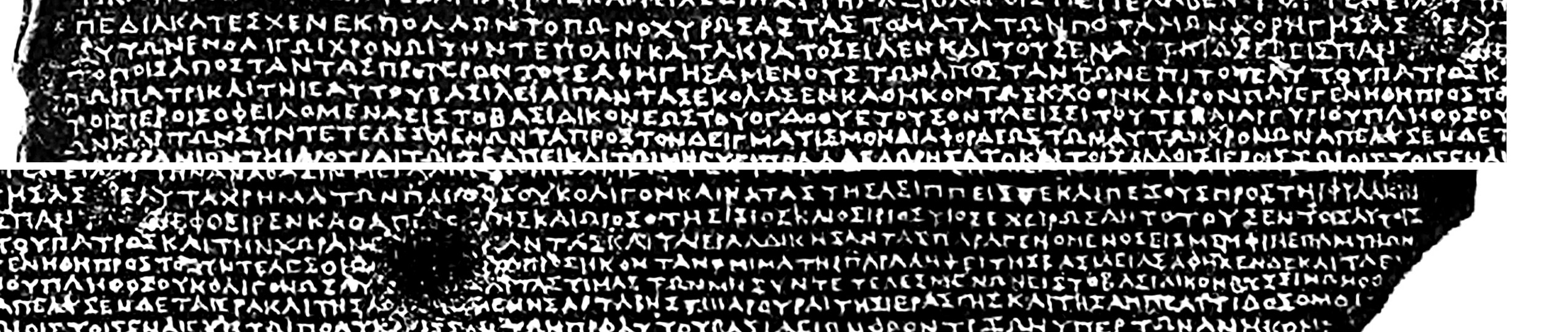
Greek lines 25-30 of 54. The first image shows these six lines on the British Museum photograph of 1922: the left half of each line above, the right half below (the halves overlap); the strip has been straightened by shifting pixel columns up or down, nothing else is changed. The second image is the whole Greek register on the same photograph, turned 0.4 degrees and not straightened. Line positions were read by eye at the left, middle and right of the register. Checked on the image: line 25 begins ΠΕΔΙΑΚΑΤΕΣΧΕΝΕΚΠΟΛΛΩΝΤΟΠΩΝ and ends ΠΡΟΣΤΗΙΦΥΛΑΚΗΙ; line 30 begins ΩΝΚΑΙΤΩΝΣΥΝΤΕΤΕΛΕΣΜΕΝΩΝ and ends ΤΗΣΑΜΠΕΛΙΤΙΔΟΣΟΜΟΙ. Square brackets in the Greek mark letters restored where the stone is broken (Budge's text); Budge's English also translates these restorations.
25πεδία, κατέσχεν, ἐκ πολλῶν τόπων ὀχυρώσας τὰ στόματα τῶν ποταμῶν, χορηγήσας εἰς αὐτὰ χρημάτων πλῆθος οὐκ ὀλίγον· καὶ, καταστήσας ἱππεῖς τε καὶ πεζοὺς πρὸς τῇ φυλακῇ
26αὐτῶν, ἐν ὀλίγῳ χρόνῳ τήν τε πόλιν κατὰ κράτος εἷλεν, καὶ τοὺς ἐν αὐτῇ ἀσεβεῖς πάντας διέφθειρεν· καθάπερ [Ἑρμ]ῆς καὶ Ὧρος, ὁ τῆς Ἴσιος καὶ Ὀσίριος υἱὸς, ἐχειρώσαντο τοὺς ἐν τοῖς αὐτοῖς
27τόποις ἀποστάντας πρότερον· τοὺς [δ’] ἀφηγησαμένους τῶν ἀποστάντων ἐπὶ τοῦ ἑαυτοῦ πατρὸς, καὶ τὴν χώραν ἐ[νοχλήσ]αντας, καὶ τὰ ἱερὰ ἀδικήσαντας, παραγενόμενος εἰς Μέμφιν, ἐπαμυνῶν
28τῷ πατρὶ καὶ τῇ ἑαυτοῦ βασιλείᾳ, πάντας ἐκόλασεν καθηκόντως, καθ’ ὃν καιρὸν παρεγενήθη πρὸς τὸ συντελεσθη[ναι αὐτῷ τὰ] προσήκοντα νόμιμα τῇ παραλήψει τῆς βασιλείας· ἀφῆκεν δὲ καὶ τὰ ἐ[ν]
29τοῖς ἱεροῖς ὀφειλόμενα εἰς τὸ βασιλικὸν ἕως τοῦ ἀγδόου ἔτους, ὄντα εἰς σίτου τε καὶ ἀργυρίου πλῆθος οὐκ ὀλίγον· ὡσαύ[τως δὲ κ]αὶ τὰς τιμὰς τῶν μὴ συντετελεσμένων εἰς τὸ βασιλικὸν βυσσίνων ὀθ[ονί]-
30ων, καὶ τῶν συντετελεσμένων τὰ πρὸς τὸν δειγματισμὸν διάφορα ἕως τῶν αὐτῶν χρόνων· ἀπέλυσεν δὲ τὰ ἱερὰ καὶ τῆς [ἀποτεταγ]μένης ἀρτάβης τῇ ἀρούρᾳ τῆς ἱερᾶς γῆς, καὶ τῆς ἀμπελίτιδος ὁμοί[ως]
25the plains, he held in check [the river], having dammed up in many places the mouths of the canals [which flow from it], and in the carrying out of this work, spent no small sum of money; and having established both cavalry and infantry to keep guard over [the canals],
26he took by storm the city in a very short time, and destroyed all the impious men who were therein, even as Hermes and Horus, the son of Isis and Osiris, brought into subjection in these very same places
27those who had rebelled; and the men who had led astray the rebels in the time of his father, who had made trouble in the country, and had treated the temples sacrilegiously, having come into Memphis for the purpose of avenging
28his father and his own sovereignty, he punished according to their deserts at the time when he came there to perform the duly appointed ceremonies for his receiving the crown; and moreover, he hath remitted in
29the temples that which was due to the royal treasury up to the viiith year [of his reign], which was no small amount of corn and money; and moreover, he hath remitted the dues upon the byssus cloth[s] which had not been paid into the royal treasury,
30and also the charges made for the examination (?) of these which had been sent in for the same period; and he hath freed the temples from [the tax of] one artaba for each aroura of [temple-] land, and also the [tax of one] jar of wine

Where on the image
Greek lines 31-36 of 54. The first image shows these six lines on the British Museum photograph of 1922: the left half of each line above, the right half below (the halves overlap); the strip has been straightened by shifting pixel columns up or down, nothing else is changed. The second image is the whole Greek register on the same photograph, turned 0.4 degrees and not straightened. Line positions were read by eye at the left, middle and right of the register. Checked on the image: line 31 begins ΤΟΚΕΡΑΜΙΟΝΤΗΙΑΡΟΥΡΑΙ and ends ΥΠΕΡΤΩΝΑΝΗΚΟ; line 36 begins ΤΗΣΒΑΣΙΛΕΙΑΣΔΙΑΜΕΝΟΥΣΗΣ and ends ΤΑΥΠΑΡΧΟΝΤΑ, with ΑΓΑΘΗΙΤΥΧΗΙΕΔΟΞΕΝ in the middle. Square brackets in the Greek mark letters restored where the stone is broken (Budge's text); Budge's English also translates these restorations.
31τὸ κεράμιον τῇ ἀρούρᾳ· τῷ τε Ἄπει καὶ τῷ Μνεύει πολλὰ ἐδωρήσατο, καὶ τοῖς ἄλλοις ἱεροῖς ζῴοις, τοῖς ἐν Αἰγύπτῳ, πολὺ κ[ρε]ῖσσον τῶν πρὸ αὐτοῦ βασιλέων φροντίζων ὑπὲρ τῶν ἀνηκόν[των εἰς]
32αὐτὰ διὰπαντός, τά τ’ εἰς τὰς ταφὰς αὐτῶν καθήκοντα διδοὺς δαψιλῶς καὶ ἐνδόξως, καὶ τὰ τελισκόμενα εἰς τὰ ἴδια ἱερὰ, μετὰ θυσιῶν καὶ πανηγύρεων καὶ τῶν ἄλλων τῶν νομι[ζομένων·]
33τά τε τίμια τῶν ἱερῶν καὶ τῆς Αἰγύπτου, διατετήρηκεν ἐπὶ χώρας ἀκολούθως τοῖς νόμοις· καὶ τὸ Ἀπιεῖον ἔργοις πολυτελέσιν κατεσκεύασεν, χορηγήσας εἰς αὐτὸ χρυσίου τε κ[αὶ ἀργυρί]-
34ου καὶ λίθων πολυτελῶν, πλῆθος οὐκ ὀλίγον· καὶ ἱερὰ καὶ ναοὺς καὶ βωμοὺς ἱδρύσατο· τά τε προσδεόμενα ἐπισκευῆς προσδιωρθώσατο, ἔχων θεοῦ εὐεργετικοῦ ἐν τοῖς ἀνήκο[υσιν εἰς τὸ]
35θεῖον διάνοιαν· προσπυνθανόμενός τε τὰ τῶν ἱ[ε]ρῶν τιμιώτατα ἀν[ε]νεοῦτο ἐπὶ τῆς ἑαυτοῦ βασιλείας, ὡς καθήκει· ἀνθ’ ὧν δεδώκασιν αὐτῷ οἱ θεοὶ ὑγίειαν, νίκην, κράτος καὶ τἄλλ’ ἀγαθ[ὰ πάντα]
36τῆς βασιλείας διαμενούσης αὐτῷ καὶ τοῖς τέκνοις εἰς τὸν ἅπαντα χρόνον. ἀγαθῇ τύχῃ ἔδοξεν τοῖς ἱερεῦσι τῶν κατὰ τὴν χώραν ἱερῶν πάντων τὰ ὑπάρχοντα τ[ίμια συντελέσαι]
31for each aroura of vineyard; and to [the Bull] Apis and to [the Bull] Mnevis, and to the other sacred animals in Egypt, he dedicated many gifts, far more indeed than the kings who were before him, and he was careful in respect of what belonged to them in
32every particular; and for their burials he gave all that was needed with magnificent generosity, and that which was necessary for private shrines and for sacrifices, and for commemorative feasts, and for the ordinances by law prescribed;
33and the honourable estate of the temples and of Egypt he hath maintained in a proper manner, according to traditional custom; and he hath decorated the Temple of Apis with fine work, expending upon it gold, and silver, and
34precious stones, in no small quantities; and he hath founded temples, and shrines, and altars; and he hath restored those which needed repairs, having the zeal of a beneficent god in the matters which relate to
35the divine service, and having discovered which of the temples were most held in honour, he restored them during his reign, as was meet.—In return for all these things the gods have given him health, and victory, and power, and all other good things, and may his royal
36dominion remain with him, and with his children for all time, with the fortune which favoureth. And it seemed good to the priests of all the temples in the land, that all the honours which have been bestowed upon

Where on the image
Greek lines 37-42 of 54. The first image shows these six lines on the British Museum photograph of 1922: the left half of each line above, the right half below (the halves overlap); the strip has been straightened by shifting pixel columns up or down, nothing else is changed. The second image is the whole Greek register on the same photograph, turned 0.4 degrees and not straightened. Line positions were read by eye at the left, middle and right of the register. Checked on the image: line 37 begins ΤΩΙΑΙΩΝΟΒΙΩΙΒΑΣΙΛΕΙ and ends ΘΕΩΝΕΥΕΡΓ; line 42 begins ΙΕΡΩΝΚΑΙΚΑΘΙΔΡΥΣΑΙ and ends ΤΟΥΘΕΟΥΕΠΙΦΑΝΟΥΣΕ at the break. Square brackets in the Greek mark letters restored where the stone is broken (Budge's text); Budge's English also translates these restorations.
37τῷ αἰωνοβίῳ βασιλεῖ Πτολεμαίῳ, ἠγαπημένῳ ὑπὸ τοῦ Φθᾶ, θεῷ Ἐ[π]ιφανεῖ Εὐχαρίστῳ, ὁμοίως δὲ καὶ τὰ τῶν γονέων αὐτοῦ, θεῶν Φιλ[ο]πατόρων, καὶ τὰ τῶν προγόνων, θεῶν Εὐεργ[ετῶν, καὶ τὰ]
38τῶν θεῶν Ἀδελφῶν καὶ τὰ τῶν θεῶν Σωτήρων ἐπαύξειν μεγάλως· στῆσαι δὲ τοῦ αἰωνοβίου βασιλέως Πτο[λε]μαίου θεοῦ Ἐπιφανοῦς Εὐχαρίστου εἰκόνα ἐν ἑκάστῳ ἱερῷ, ἐν τῷ ἐπιφα[νεστάτῳ τόπῳ]
39ἡ προσονομασθήσεται Πτολεμαίου, τοῦ ἐπαμύναντος τῇ Αἰγύπτῳ· ᾗ παρεστήξεται ὁ κυριώτατος θεὸς τοῦ ἱεροῦ, διδοὺς αὐτῷ ὅπλον νικητικόν· ἃ ἔσται κατεσκευασμέν[α τὸν τῶν Αἰγυπτίων]
40τρόπον· καὶ τοὺς ἱερεῖς θεραπεύειν τὰς εἰκόνας τρὶς τῆς ἡμέρας· καὶ παρατιθέναι αὐταῖς ἱερὸν κόσμον καὶ τἄλλα τὰ νομιζόμενα συντελεῖν, καθὰ καὶ τοῖς ἄλλοις θεοῖς ἐν [ταῖς κατὰ τὴν χώραν πα]
41νηγύρεσιν· ἱδρύσασθαι δὲ βασιλεῖ Πτολεμαίῳ, θεῷ Ἐπιφανεῖ Εὐχαρίστῳ, τῷ ἐγ βασιλέως Πτολεμαίου καὶ βασιλίσσης Ἀρσινόης, θεῶν Φιλοπατόρων, ξόανόν τε καὶ ναὸν χρ[υσοῦν ἐν ἑκάστῳ τῶν]
42ἱε[ρ]ῶν· καὶ καθιδρῦσαι ἐν τοῖς ἀδύτοις μετὰ τῶν ἄλλων ναῶν· καὶ ἐν ταῖς μεγάλαις πανηγύρεσιν, ἐν αἷς ἐξοδεῖαι τῶν ναῶν γίνονται, καὶ τὸν τοῦ θεοῦ Ἐπιφανοῦς Εὐ[χαρίστου ναὸν συνε]-
37King Ptolemy, the everliving, the beloved of Ptaḥ, the God Epiphanes Eucharistos, and likewise those of his parents, the Gods Philopatores, and those of his ancestors the Gods Euergetes, and the
38Gods Adelphi, and the Gods Soteres, should be greatly increased; and to set up to the God Ptolemy, the everliving, the God Epiphanes Eucharistos, an image in the most prominent part of every temple,
39which shall be called ‘Ptolemy, the Avenger of Egypt’; and close by this statue shall stand [an image of] the dominant god of the temple, who shall present to him a weapon of victory, which shall be prepared after the Egyptian
40fashion; and the priests shall do homage to the images three times each day, and they shall array them in sacred apparel, and shall perform [for them] all the ceremonies which they are accustomed [to perform in honour] of the other gods during the festivals which are celebrated throughout the country;
41and they shall stablish for King Ptolemy, the God Epiphanes Eucharistos, the offspring of King Ptolemy and Queen Arsinoë, the Gods Philopatores, a statue and a golden shrine in each of the temples,
42and they shall place it in the inner chambers with the other shrines; and in the great commemorative festivals, wherein the shrines go forth [in procession], the shrine of the God Epiphanes Eucharistos shall

Where on the image
Greek lines 43-48 of 54. The first image shows these six lines on the British Museum photograph of 1922: the left half of each line above, the right half below (the halves overlap); the strip has been straightened by shifting pixel columns up or down, nothing else is changed. The second image is the whole Greek register on the same photograph, turned 0.4 degrees and not straightened. Line positions were read by eye at the left, middle and right of the register. Checked on the image: line 43 begins ΞΟΔΕΥΕΙΝ and ends ΑΣΠΙ at the break; line 48 begins ΓΥΠΤΟΝΙΕΡΟΙΣΚΑΤΑΜΗΝΑ and ends ΤΑΣΤΕΓΙΝΟΜΕΝΑΣΠΡΟΘ at the break. Square brackets in the Greek mark letters restored where the stone is broken (Budge's text); Budge's English also translates these restorations.
43ξοδεύειν· ὅπως δ’ εὔσημος ᾖ νῦν τε καὶ εἰς τὸν ἔπειτα χρόνον, ἐπικεῖσθαι τῷ ναῷ τὰς τοῦ βασιλέως χρυσᾶς βασιλείας δέκα, αἷς προσκείσεται ἀσπὶς [καθάπερ καὶ ἐπὶ πασῶν]
44τῶν ἀσπιδοειδῶν βασιλειῶν, τῶν ἐπὶ τῶν ἄλλων ναῶν· ἔσται δ’ αὐτῶν ἐν τῷ μέσῳ ἡ καλουμένη βασιλεία Ψχέντ, ἣν περιθέμενος εἰσῆλθεν εἰς τὸ ἐν Μέμφ[ει ἱερὸν, ὅπως ἐν αὐτῷ συν]-
45τελεσθῇ τὰ νομιζόμενα τῇ παραλήψει τῆς βασιλείας· ἐπιθεῖναι δὲ καὶ ἐπὶ τοῦ περὶ τὰς βασιλείας τετραγώνου, κατὰ τὸ προειρημένον βασίλειον, φυλακτήρια χρ[υσᾶ δέκα, οἷς ἐγγραφθήσεται ὅ-]
46τι ἐστὶν τοῦ βασιλέως, τοῦ ἐπιφανῆ ποιήσαντος τήν τε ἄνω χώραν καὶ τὴν κάτω· καὶ ἐπεὶ τὴν τρια[κ]άδα τοῦ Μεσορῆ, ἐν ᾗ τὰ γενέθλια τοῦ βασιλέως ἄγεται, ὁμοίως δὲ καὶ [τὴν ἑπτακαιδεκάτην τοῦ Μεχείρ]
47ἐν ᾗ παρέλαβεν τὴν βασιλείαν παρ[ὰ] τοῦ πατρός, ἐπωνύμους νενομίκασιν ἐν τοῖς ἱεροῖς, ἅι δὴ πολλῶν ἀγαθῶν ἀρχηγοὶ [π]ᾶσίν εἰσιν, ἄγειν τὰς ἡμέρας ταύτας ἑορτ[ὴν καὶ πανήγυριν ἐν τοῖς κατὰ τὴν Αἴ]-
48γυπτον ἱεροῖς κατὰ μῆνα· καὶ συντελεῖν ἐν αὐτοῖς θυσίας καὶ σπονδὰς καὶ τἄλλα τὰ νομιζόμενα, καθὰ καὶ ἐν ταῖς ἄλλαις πανηγύρεσιν· τάς τε γινομένας προθέ[σεις ....... πα]-
43go forth with them; and in order that it may be readily distinguished, now and in after time, the shrine shall be surmounted by the ten golden crowns of the King, and an asp shall be affixed thereto, even as is done to all the other
44crowns which have asps upon them and are upon other shrines, but in the centre of them shall be [placed] the crown which is called Pskhent, which he put on when he went into the temple at Memphis to perform therein
45the prescribed ceremonies connected with the assumption of sovereignty; and there shall be placed on the [faces of] the square which is round about the crowns, close to the above-mentioned crown, ten golden phylacteries, whereon shall be inscribed
46that it is [the shrine] of the King, who maketh manifest the Upper and the Lower Country. And inasmuch as the xxxth day of Mesore, whereon the birthday of the King is celebrated, and likewise the xviith day of the month Paophi
47whereon he received the sovereignty from his father, they have recognized as name-days in the temples, for they were the sources of many good things for all, on these days a festival and a panegyry shall be celebrated in the temples of
48Egypt each month, and sacrifices shall be [offered up] and libations [made], and all the other things which are prescribed shall be duly per-
Where on the image
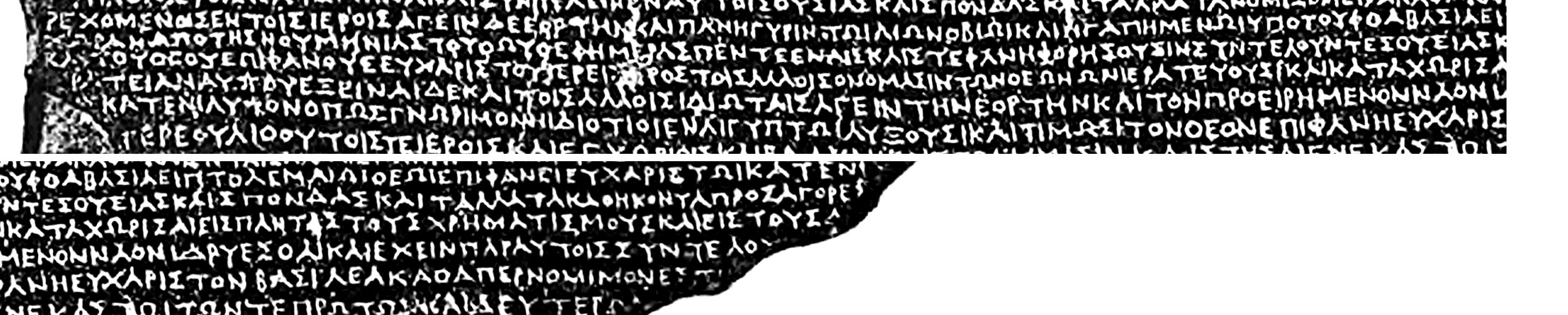
Greek lines 49-54 of 54. The first image shows these six lines on the British Museum photograph of 1922: the left half of each line above, the right half below (the halves overlap); the strip has been straightened by shifting pixel columns up or down, nothing else is changed. The second image is the whole Greek register on the same photograph, turned 0.4 degrees and not straightened. Line positions were read by eye at the left, middle and right of the register. Checked on the image: line 49 begins ΡΕΧΟΜΕΝΟΙΣΕΝΤΟΙΣΙΕΡΟΙΣ and ends ΚΑΤΕΝΙ at the break; line 54 begins ΤΕΡΕΟΥΛΙΘΟΥΤΟΙΣΤΕΙΕΡΟΙΣ and ends ΤΕΠΡΩΤΩΝΚΑΙΔΕΥΤΕΡΩ at the break. Square brackets in the Greek mark letters restored where the stone is broken (Budge's text); Budge's English also translates these restorations.
49ρεχομένοις ἐν τοῖς ἱεροῖς· ἄγειν δὲ ἑορτὴν καὶ πανήγυριν τῷ αἰωνοβίῳ καὶ ἠγαπημένῳ ὑπὸ τοῦ Φθᾶ, βασιλεῖ Πτολεμαίῳ, θεῷ Ἐπιφανεῖ Εὐχαρίστῳ κατ’ ἐνι[αυτὸν ἐν τοῖς ἱεροῖς τοῖς κατὰ τὴν]
50χώραν ἀπὸ τῆς νουμηνίας τοῦ θωῢθ ἐφ’ ἡμέρας πέντε· ἐν αἷς καὶ στεφανηφορήσουσιν, συντελοῦντες θυσίας καὶ σπονδὰς καὶ τἄλλα τὰ καθήκοντα· προσαγορε[ύεσθαι δὲ τοὺς ἱερεῖς τῶν ἄλλων θεῶν]
51καὶ τοῦ θεοῦ Ἐπιφανοῦς Εὐχαρίστου ἱερεῖς [π]ρὸς τοῖς ἄλλοις ὀνόμασιν τῶν θεῶν, ὧν ἱερατεύουσι, καὶ καταχωρίσαι εἰς πάντας τοὺς χρηματισμοὺς καὶ εἰς τοὺς ἄ[λλους ....... τὴν]
52ἳερατείαν αὐτοῦ· ἐξεῖναι δὲ καὶ τοῖς ἀλλοῖς ἰδιώταις ἄγειν τὴν ἑορτὴν καὶ τὸν προειρημένον ναὸν ἱδρύεσθαι καὶ ἔχειν παρ’ αὐτοῖς συντελο[ῦντας τὰ νόμιμα ἐν ἑορταῖς, ταῖς τε κατὰ μῆνα καὶ τ]
53[αῖ]ς κατ’ ἐνιαυτόν, ὅπως γνώριμον ᾖ, διότι οἱ ἐν Αἰγύπτῳ αὔξουσι καὶ τιμῶσι τὸν θεὸν Ἐπιφανῆ Εὐχάριστον βασιλέα, καθάπερ νόμιμόν ἐστ[ιν αὐτοῖς· τὸ δὲ ψήφισμα τοῦτο ἀναγράψαι εἰσ στήλας σ]-
54τερεοῦ λίθου, τοῖς τε ἱεροῖς καὶ ἐγχωρίοις καὶ Ἑλληνικοῖς γράμμασιν, καὶ στῆσαι ἐν ἑκάστῳ τῶν τε πρώτων καὶ δευτέρων [καὶ τρίτων ἱερῶν πρὸς τῇ τοῦ αἰωνοβίου βασιλέως εἰκόνι]
49formed as at the other festivals . . . . . . . . . ; and a festival and a panegyry shall be celebrated yearly to King Ptolemy, the everliving, the beloved of Ptaḥ, the God Epiphanes Eucharistos, in all the temples throughout the
50country, from the first day of the month Thoth, for five days; and they (i.e., the people) shall bear (i.e., wear) crowns, and shall offer up sacrifices, and shall make libations, and do all that is proper [to do]; and the priests of the other gods shall receive the name of
51‘Priests of the God Epiphanes Eucharistos,’ in addition to the names of the other gods to whom they minister; and in all the decrees and in all the [declarations] promulgated by them shall be mentioned
52his grade of priests; and men who are not priests shall be permitted to celebrate the festival, and to set up the aforesaid shrine, and to keep them in their houses, and to perform the ceremonies which are prescribed for the festivals, both monthly
53and annually, in order that it may be well known that in Egypt men magnify and honour the God Epiphanes Eucharistos the King, as they are bound to do by law. And this decree shall be inscribed upon stelae
54of hard stone, in holy, and in native, and in Greek letters, and [a stela] shall be set up in each of the temples of the first, second, and third class, near the image of the Everliving King.
Notes
- Budge's Greek is printed as in his book, including his misprints (line 10 ὑπὰ for ὑπὸ, 16 ἐτάσσοντα, 18 ἀποκατέστηοεν, 19 καταπορευομένος, 29 ἀγδόου, 52 ἀλλοῖς) and missing accents (8 παρελαβεν, 17 προσεταξεν).
- Budge prints each Greek line and its English with the same line number; a line of English can end in the middle of a phrase because the Greek line does.
- Budge's footnote markers and the quotation marks that open each of his printed lines are left out.
- Dotted lines (line 49) and gaps marked ....... (lines 48 and 51) are Budge's, where he gives no restoration.
Cite
Sources
- Source: Rosetta Stone, British Museum EA 24 (British Museum photograph of 1922, public domain, via Wikimedia Commons) + Greek transcript and English rendering of E. A. Wallis Budge, The Decrees of Memphis and Canopus, vol. 2 (1904, public domain) (holding institution)
- Critical edition: E. A. Wallis Budge, The Decrees of Memphis and Canopus (1904)
← previous · → next · v cycle view · l back to library