Book of Odes, Mao 101: Nan shan 南山 (Keicho-era print)
Introduction
南山 (Nan shan, Mao 101) is ode VI of 齊風 Qi feng ("the Airs of Qi"), the eighth book of the Airs of the States (國風 Guofeng), the 160 songs of the regional states that open the Book of Odes (詩經 Shijing). The Airs are generally dated to the Western and early Eastern Zhou (about the 10th to 7th century BCE). It has 4 stanzas.
The photographs are of a copy of the Book of Odes in the National Diet Library, Tokyo (call no. WA7-183), printed with movable type in Japan in the Keicho era (1596-1615): main text only, seven columns of seventeen characters to the page, with Japanese reading marks added by hand. Each stanza begins a new column, and a line giving the count of stanzas and lines follows each ode. In this copy the ode runs from canvas 59, left-hand page to canvas 60, right-hand page of the first volume. Each section gathers the stanzas that begin on one page and links to that page and to any page the last stanza runs onto; the page boundaries were found by reading the first characters of every column on the photographs.
The Chinese is the Mao text from Wikisource. The English is James Legge's prose translation in The Chinese Classics, volume IV, part I (1871), Part I, Book 8, ode VI (Nan shan), page 155-157; his notes are not reproduced. Words in square brackets are Legge's own additions.
How was this verified? (Provenance)
Where on the image
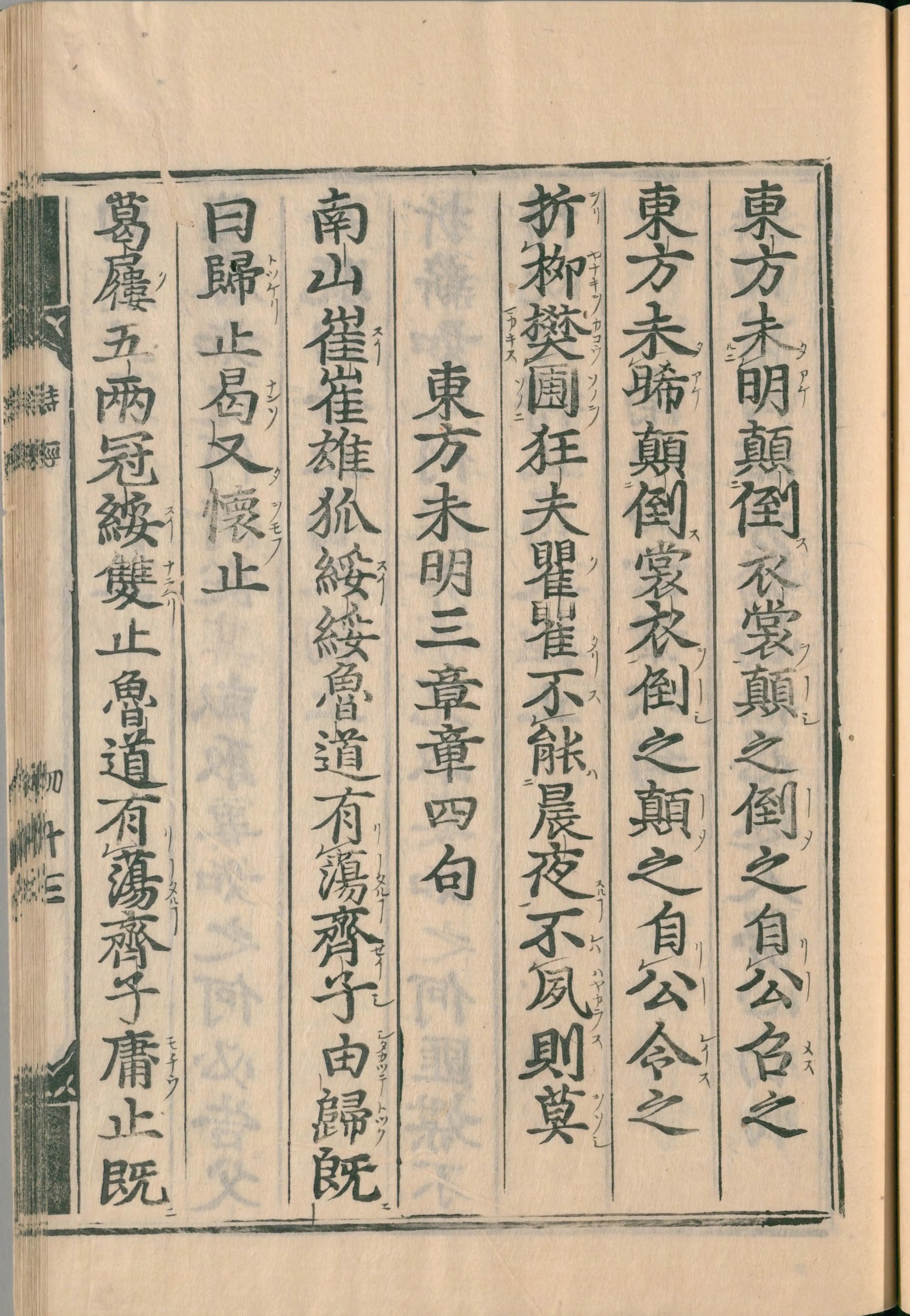
National Diet Library WA7-183, vol. [1], IIIF canvas 59, left-hand page: 7 columns of up to 17 characters, main text only, with Japanese reading marks. Checked on the image: stanza 1 opens column 5 ‹南山崔崔›; stanza 2 opens column 7 ‹葛屨五兩›. Other columns on this page: column 4 is the count line of 東方未明 (stanzas and lines). Stanza 2 runs on to canvas 60, right-hand page (first column ‹曰庸止曷›). The Chinese shown is the Wikisource Mao text, not a transcription of this print; Legge's English translates the same text.
1南山崔崔,雄狐綏綏。魯道有蕩,齊子由歸。既曰歸止,曷又懷止!
2葛屨五兩,冠緌雙止。魯道有蕩,齊子庸止。既曰庸止,曷又從止!
1High and large is the south hill,
And a male fox is on it, solitary and suspicious.
The way to Loo is easy and plain,
And the daughter of Ts'e went by it to her husband's.
Since she went to her husband's,
Why do you further think of her?
2The five kinds of dolichos shoes are [made] in pairs,
And the string-ends of a cap are made to match;
The way to Loo is easy and plain,
And the daughter of Ts'e travelled it.
Since she travelled it,
Why do you still follow her?
Where on the image
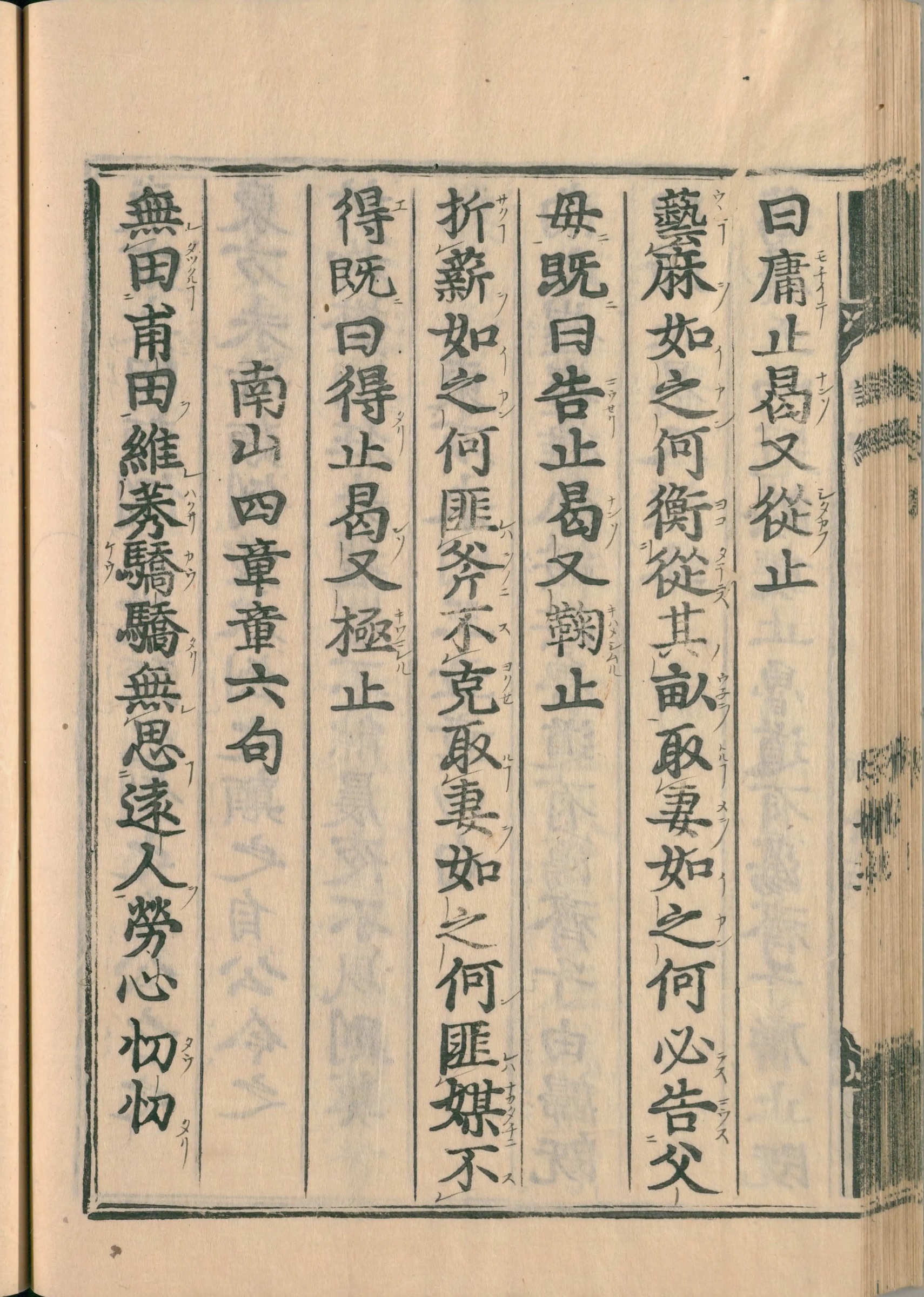
National Diet Library WA7-183, vol. [1], IIIF canvas 60, right-hand page: 7 columns of up to 17 characters, main text only, with Japanese reading marks. Checked on the image: stanza 3 opens column 2 ‹蓺麻如之›; stanza 4 opens column 4 ‹析薪如之›. Other columns on this page: column 6 is the count line of 南山 (stanzas and lines). The Chinese shown is the Wikisource Mao text, not a transcription of this print; Legge's English translates the same text.
3蓺麻如之何?衡從其畝。取妻如之何?必告父母,既曰告止,曷又鞠止!
4析薪如之何?匪斧不克。取妻如之何?匪媒不得,既曰得止,曷又極止!
3How do we proceed in planting hemp?
The acres must be dressed lengthwise and crosswise.
How do we proceed in taking a wife?
Announcement must first be made to our parents.
Since such announcement was made,
Why do you still indulge her desires?
4How do we proceed in splitting firewood?
Without an axe it cannot be done.
How do we proceed in taking a wife?
Without a go-between it cannot be done.
Since this was done,
Why do you still allow her to go to this extreme?
Notes
- English: James Legge, The She King, The Chinese Classics vol. IV part I (1871), Part I, Lessons from the States, Book 8, ode VI (Nan shan). Stanzas are numbered as in Legge and the Mao text.
- Transcribed for this library from the page images: lines read alike by two OCR programs were kept, and every other line was read on the image (data/sources/shijing/legge1871/). Legge's notes are left out.
Cite
Sources
- Source: National Diet Library WA7-183 (Keicho-era movable-type print of the Shijing, vol. 1) + Wikisource Mao text + James Legge, The She King (Chinese Classics IV, 1871) (holding institution)
- Critical edition: Mao text (Wikisource)
← previous · → next · v cycle view · l back to library