Book of Odes, Mao 110: Zhi hu 陟岵 (Keicho-era print)
Introduction
陟岵 (Zhi hu, Mao 110) is ode IV of 魏風 Wei feng ("the Airs of Wei (the northern state)"), the ninth book of the Airs of the States (國風 Guofeng), the 160 songs of the regional states that open the Book of Odes (詩經 Shijing). The Airs are generally dated to the Western and early Eastern Zhou (about the 10th to 7th century BCE). It has 3 stanzas.
The photographs are of a copy of the Book of Odes in the National Diet Library, Tokyo (call no. WA7-183), printed with movable type in Japan in the Keicho era (1596-1615): main text only, seven columns of seventeen characters to the page, with Japanese reading marks added by hand. Each stanza begins a new column, and a line giving the count of stanzas and lines follows each ode. In this copy the ode runs from canvas 63, left-hand page to canvas 64, right-hand page of the first volume. Each section gathers the stanzas that begin on one page and links to that page and to any page the last stanza runs onto; the page boundaries were found by reading the first characters of every column on the photographs.
The Chinese is the Mao text from Wikisource. The English is James Legge's prose translation in The Chinese Classics, volume IV, part I (1871), Part I, Book 9, ode IV (Chih hoo), page 167-168; his notes are not reproduced. Words in square brackets are Legge's own additions.
How was this verified? (Provenance)
Where on the image
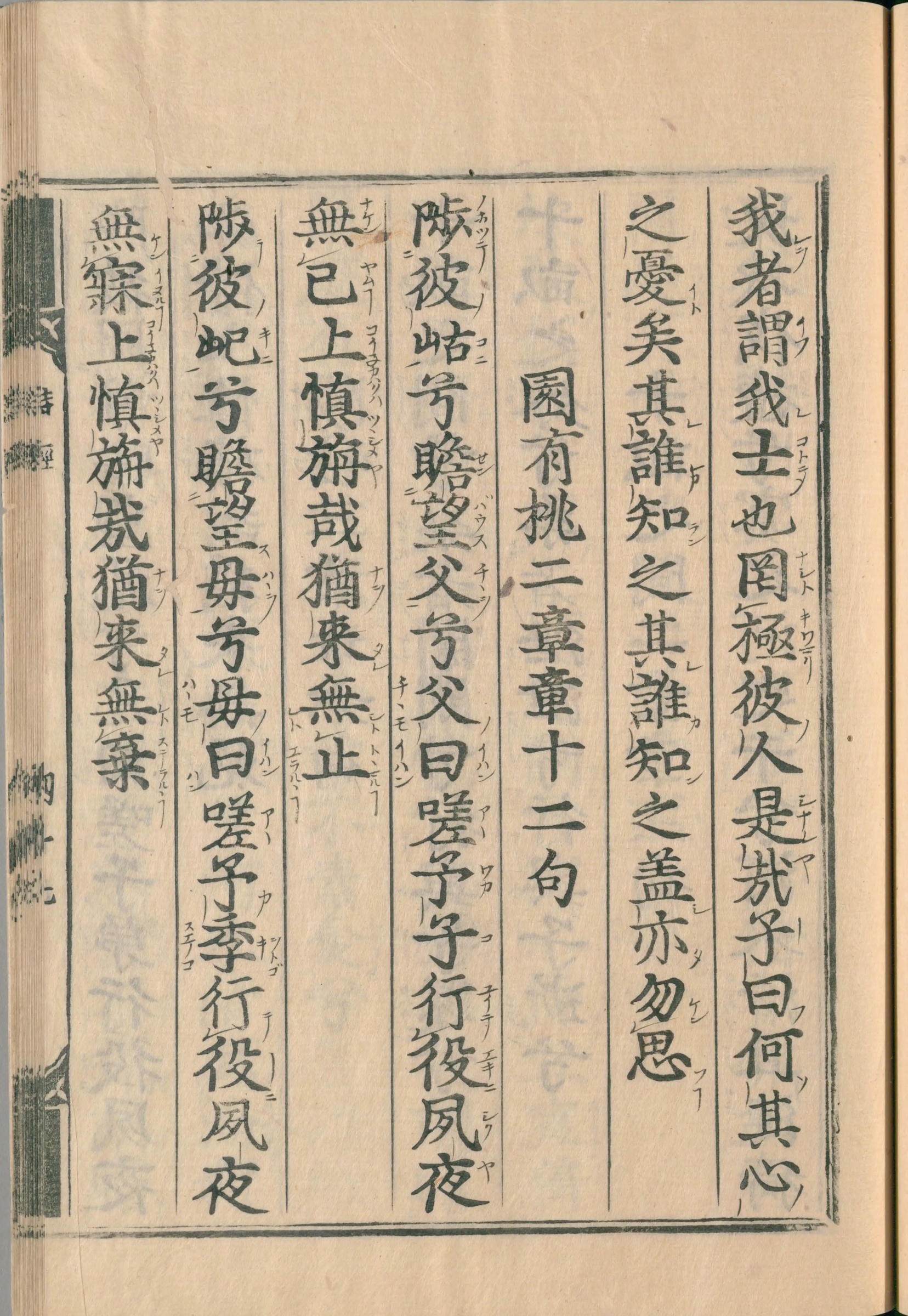
National Diet Library WA7-183, vol. [1], IIIF canvas 63, left-hand page: 7 columns of up to 17 characters, main text only, with Japanese reading marks. Checked on the image: stanza 1 opens column 4 ‹陟彼岵兮›; stanza 2 opens column 6 ‹陟彼屺兮›. Other columns on this page: column 3 is the count line of 園有桃 (stanzas and lines). The Chinese shown is the Wikisource Mao text, not a transcription of this print; Legge's English translates the same text.
1陟彼岵兮,瞻望父兮。父曰:「嗟予子!行役夙夜無已。上慎旃哉,猶來無止!」
2陟彼屺兮,瞻望母兮。母曰:「嗟予季!行役夙夜無寐。上慎旃哉!猶來無棄!」
1I ascend that tree-clad hill,
And look towards [the residence of] my father.
My father is saying, 'Alas! my son, abroad on the public service,
Morning and night never rests.
May he be careful,
That he may come [back], and not remain there!'
2I ascend that bare hill,
And look towards [the residence of] my mother.
My mother is saying, 'Alas! my child, abroad on the public service,
Morning and night has no sleep.
May he be careful,
That he may come [back], and not leave his body there!'
Where on the image
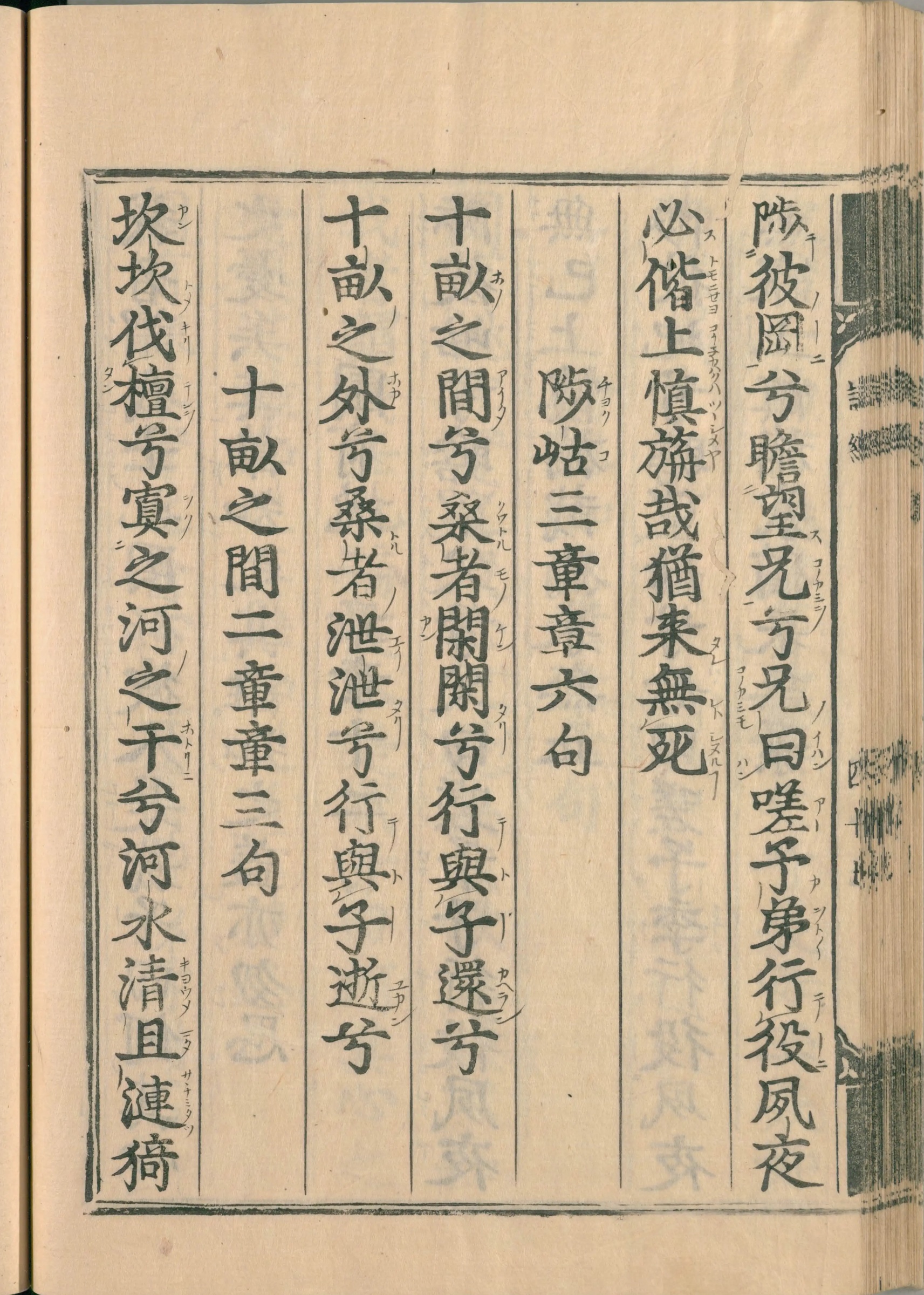
National Diet Library WA7-183, vol. [1], IIIF canvas 64, right-hand page: 7 columns of up to 17 characters, main text only, with Japanese reading marks. Checked on the image: stanza 3 opens column 1 ‹陟彼岡兮›. Other columns on this page: column 3 is the count line of 陟岵 (stanzas and lines); column 6 is the count line of 十畝之間 (stanzas and lines). The Chinese shown is the Wikisource Mao text, not a transcription of this print; Legge's English translates the same text.
3陟彼岡兮,瞻望兄兮。兄曰:「嗟予弟!行役夙夜必偕。上慎旃哉!猶來無死!」
3I ascend that ridge,
And look towards [the residence of] my elder brother.
My brother is saying, 'Alas! my younger brother, abroad on the public service,
Morning and night must consort with his comrades.
May he be careful,
That he may come back, and not die!'
Notes
- English: James Legge, The She King, The Chinese Classics vol. IV part I (1871), Part I, Lessons from the States, Book 9, ode IV (Chih hoo). Stanzas are numbered as in Legge and the Mao text.
- Transcribed for this library from the page images: lines read alike by two OCR programs were kept, and every other line was read on the image (data/sources/shijing/legge1871/). Legge's notes are left out.
Cite
Sources
- Source: National Diet Library WA7-183 (Keicho-era movable-type print of the Shijing, vol. 1) + Wikisource Mao text + James Legge, The She King (Chinese Classics IV, 1871) (holding institution)
- Critical edition: Mao text (Wikisource)
← previous · → next · v cycle view · l back to library