Book of Odes, Mao 112: Fa tan 伐檀 (Keicho-era print)
Introduction
伐檀 (Fa tan, Mao 112) is ode VI of 魏風 Wei feng ("the Airs of Wei (the northern state)"), the ninth book of the Airs of the States (國風 Guofeng), the 160 songs of the regional states that open the Book of Odes (詩經 Shijing). The Airs are generally dated to the Western and early Eastern Zhou (about the 10th to 7th century BCE). It has 3 stanzas.
The photographs are of a copy of the Book of Odes in the National Diet Library, Tokyo (call no. WA7-183), printed with movable type in Japan in the Keicho era (1596-1615): main text only, seven columns of seventeen characters to the page, with Japanese reading marks added by hand. Each stanza begins a new column, and a line giving the count of stanzas and lines follows each ode. In this copy the ode runs from canvas 64, right-hand page to canvas 65, right-hand page of the first volume. Each section gathers the stanzas that begin on one page and links to that page and to any page the last stanza runs onto; the page boundaries were found by reading the first characters of every column on the photographs.
The Chinese is the Mao text from Wikisource. The English is James Legge's prose translation in The Chinese Classics, volume IV, part I (1871), Part I, Book 9, ode VI (Fah t'an), page 169-171; his notes are not reproduced. Words in square brackets are Legge's own additions.
How was this verified? (Provenance)
Where on the image
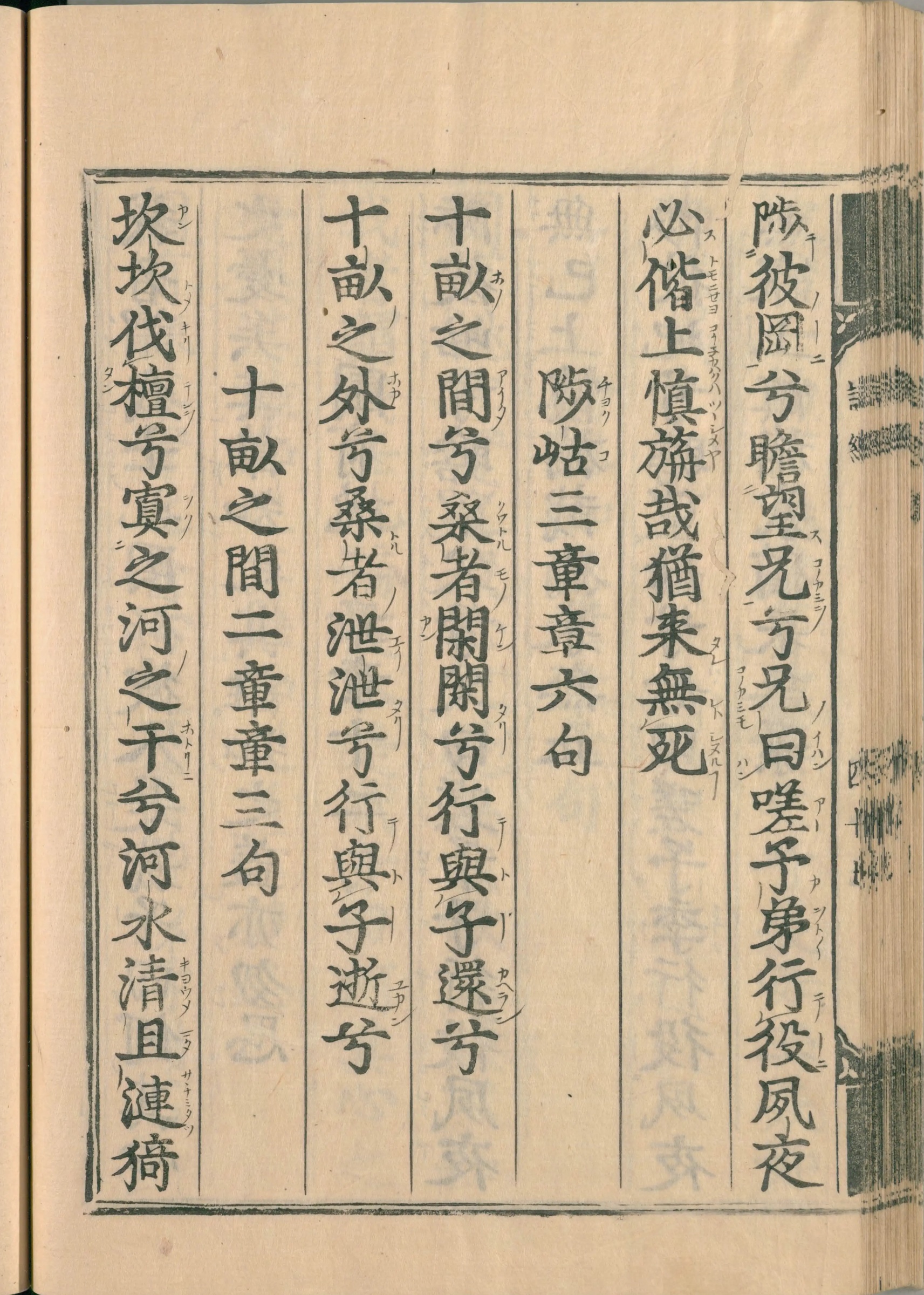
National Diet Library WA7-183, vol. [1], IIIF canvas 64, right-hand page: 7 columns of up to 17 characters, main text only, with Japanese reading marks. Checked on the image: stanza 1 opens column 7 ‹坎坎伐檀›. Other columns on this page: column 3 is the count line of 陟岵 (stanzas and lines); column 6 is the count line of 十畝之間 (stanzas and lines). Stanza 1 runs on to canvas 64, left-hand page (first column ‹不稼不穡›). The Chinese shown is the Wikisource Mao text, not a transcription of this print; Legge's English translates the same text.
1坎坎伐檀兮,寘之河之干兮,河水清且漣猗。不稼不穡,胡取禾三百廛兮!不狩不獵,胡瞻爾庭有縣貆兮。彼君子兮,不素餐兮。
1K'an-k'an go his blows on the sandal trees,
And he places what he hews on the river's bank,
Whose waters flow clear and rippling.
You sow not nor reap;—
How do you get the produce of those three hundred farms?
You do not follow the chase;—
How do we see the badgers hanging up in your court-yards?
O that superior man!
He would not eat the bread of idleness!
Where on the image
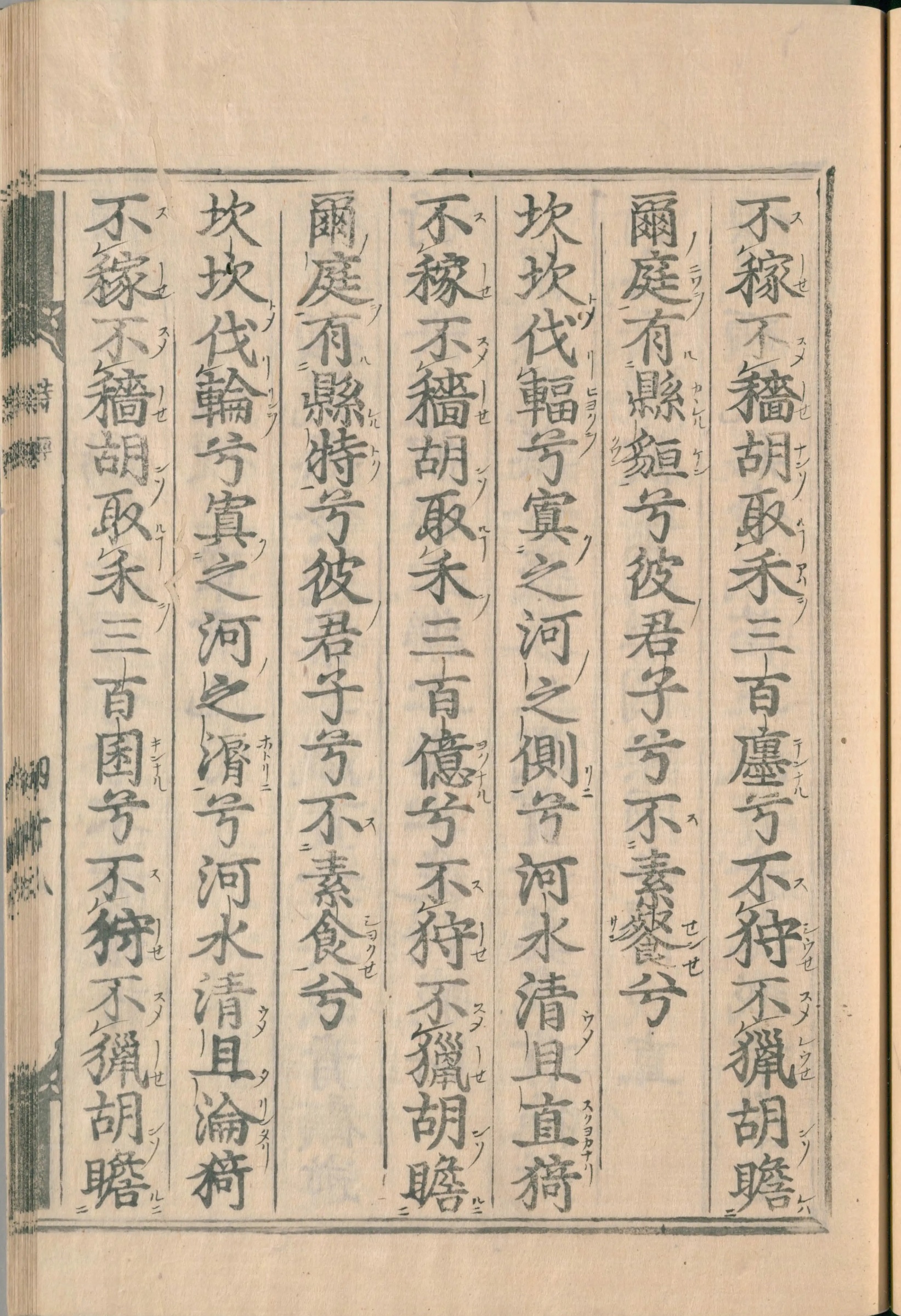
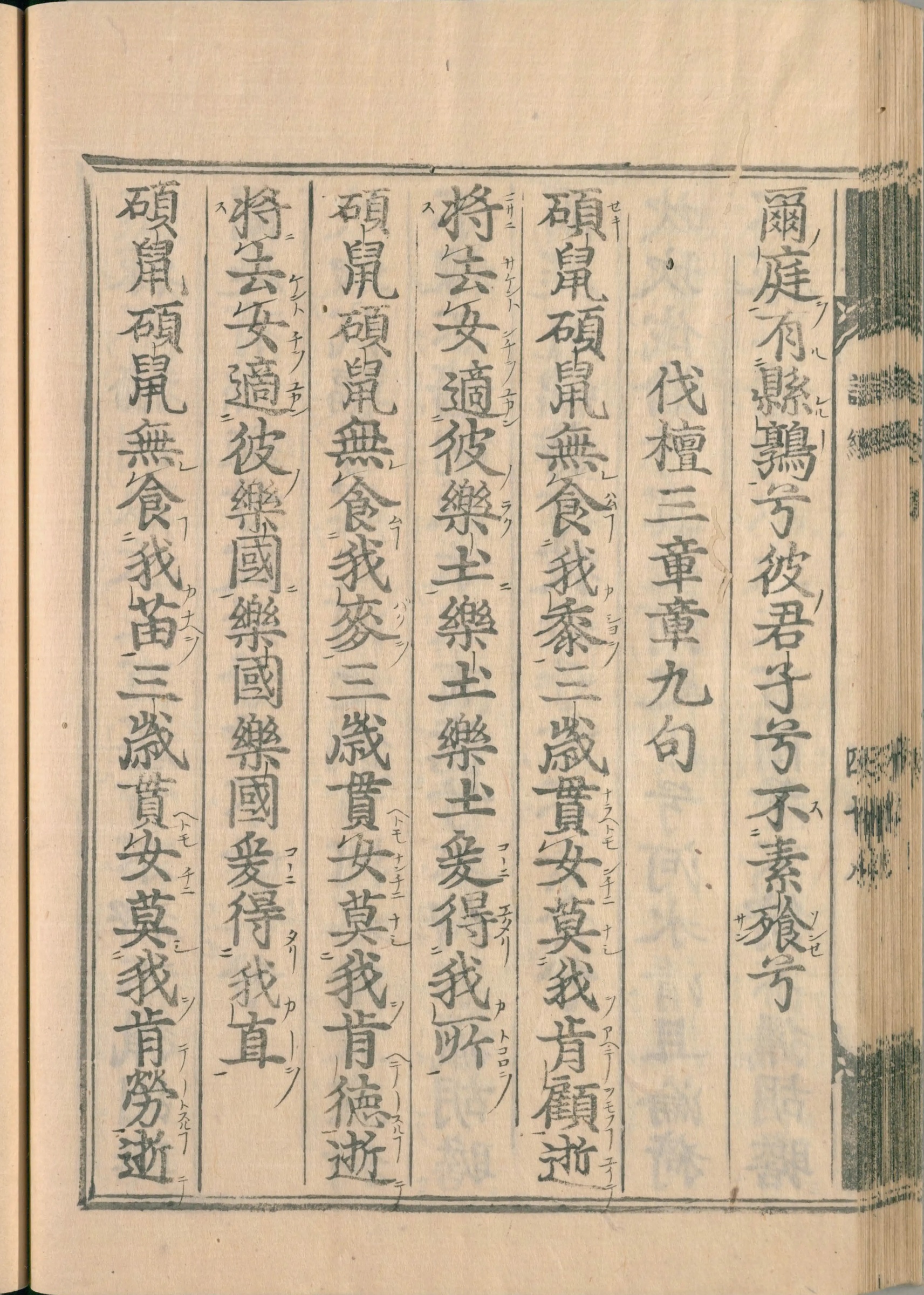
National Diet Library WA7-183, vol. [1], IIIF canvas 64, left-hand page: 7 columns of up to 17 characters, main text only, with Japanese reading marks. Checked on the image: stanza 2 opens column 3 ‹坎坎伐輻›; stanza 3 opens column 6 ‹坎坎伐輪›. Stanza 3 runs on to canvas 65, right-hand page (first column ‹爾庭有縣›). The Chinese shown is the Wikisource Mao text, not a transcription of this print; Legge's English translates the same text.
2坎坎伐輻兮,寘之河之側兮,河水清且直猗。不稼不穡,胡取禾三百億兮!不狩不獵,胡瞻爾庭有縣特兮。彼君子兮,不素食兮。
3坎坎伐輪兮,寘之河之漘兮,河水清且淪猗。不稼不穡,胡取禾三百囷兮!不狩不獵,胡瞻爾庭有縣鶉兮。彼君子兮,不素飧兮。
2K'an-k'an go his blows on the wood for his spokes,
And he places it by the side of the river,
Whose waters flow clear and even.
You sow not nor reap;—
How do you get your three millions of sheaves?
You do not follow the chase;—
How do we see those three-year-olds hanging in your court- yards.
O that superior man!
He would not eat the bread of idleness!
3K'an-k'an go his blows on the wood for his wheels,
And he places it by the lip of the river,
Whose waters flow clear in rippling circles.
You sow not nor reap;—
How do you get the paddy for your three hundred round binns?
You do not follow the chase;—
How do we see the quails hanging in your court-yards?
O that superior man!
He would not eat the bread of idleness!
Notes
- English: James Legge, The She King, The Chinese Classics vol. IV part I (1871), Part I, Lessons from the States, Book 9, ode VI (Fah t'an). Stanzas are numbered as in Legge and the Mao text.
- Transcribed for this library from the page images: lines read alike by two OCR programs were kept, and every other line was read on the image (data/sources/shijing/legge1871/). Legge's notes are left out.
Cite
Sources
- Source: National Diet Library WA7-183 (Keicho-era movable-type print of the Shijing, vol. 1) + Wikisource Mao text + James Legge, The She King (Chinese Classics IV, 1871) (holding institution)
- Critical edition: Mao text (Wikisource)
← previous · → next · v cycle view · l back to library