Book of Odes, Mao 115: Shan you shu 山有樞 (Keicho-era print)
Introduction
山有樞 (Shan you shu, Mao 115) is ode II of 唐風 Tang feng ("the Airs of Tang"), the tenth book of the Airs of the States (國風 Guofeng), the 160 songs of the regional states that open the Book of Odes (詩經 Shijing). The Airs are generally dated to the Western and early Eastern Zhou (about the 10th to 7th century BCE). It has 3 stanzas.
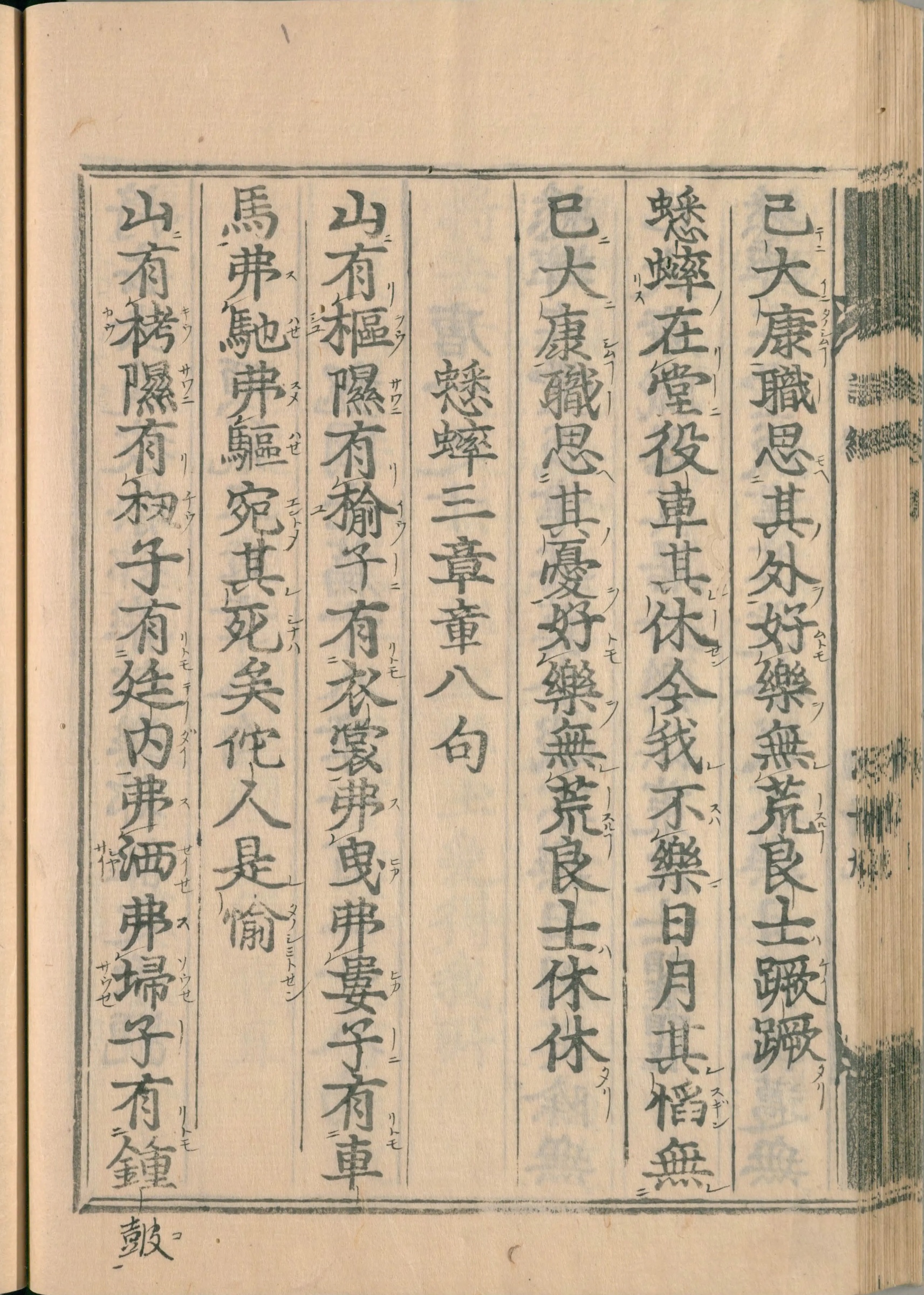
The photographs are of a copy of the Book of Odes in the National Diet Library, Tokyo (call no. WA7-183), printed with movable type in Japan in the Keicho era (1596-1615): main text only, seven columns of seventeen characters to the page, with Japanese reading marks added by hand. Each stanza begins a new column, and a line giving the count of stanzas and lines follows each ode. In this copy the ode runs from canvas 66, right-hand page to canvas 66, left-hand page of the first volume. Each section gathers the stanzas that begin on one page and links to that page and to any page the last stanza runs onto; the page boundaries were found by reading the first characters of every column on the photographs.
The Chinese is the Mao text from Wikisource. The English is James Legge's prose translation in The Chinese Classics, volume IV, part I (1871), Part I, Book 10, ode II (Shan yëw ch'oo), page 176-177; his notes are not reproduced. Words in square brackets are Legge's own additions.
How was this verified? (Provenance)
Where on the image
National Diet Library WA7-183, vol. [1], IIIF canvas 66, right-hand page: 7 columns of up to 17 characters, main text only, with Japanese reading marks. Checked on the image: stanza 1 opens column 5 ‹山有樞隰›; stanza 2 opens column 7 ‹山有栲隰›. Other columns on this page: column 4 is the count line of 蟋蟀 (stanzas and lines). Stanza 2 runs on to canvas 66, left-hand page (first column ‹鼓弗鼓弗›). The Chinese shown is the Wikisource Mao text, not a transcription of this print; Legge's English translates the same text.
1山有樞,隰有榆。子有衣裳,弗曳弗婁。子有車馬,弗馳弗驅。宛其死矣,他人是愉。
2山有栲,隰有杻。子有廷內,弗洒弗埽。子有鐘鼓,弗鼓弗考。宛其死矣,他人是保。
1On the mountains are the thorny elms,
In the low, wet grounds are the white elms.
You have suits of robes,
But you will not wear them;
You have carriages and horses,
But you will not drive them.
You will drop off in death,
And another person will enjoy them.
2On the mountains is the k'aou,
In the low wet grounds is the nëw.
You have courtyards and inner rooms,
But you will not have them sprinkled or swept;
You have drums and bells,
But you will not have them beat or struck,
You will drop off in death,
And another person will possess them.
Where on the image
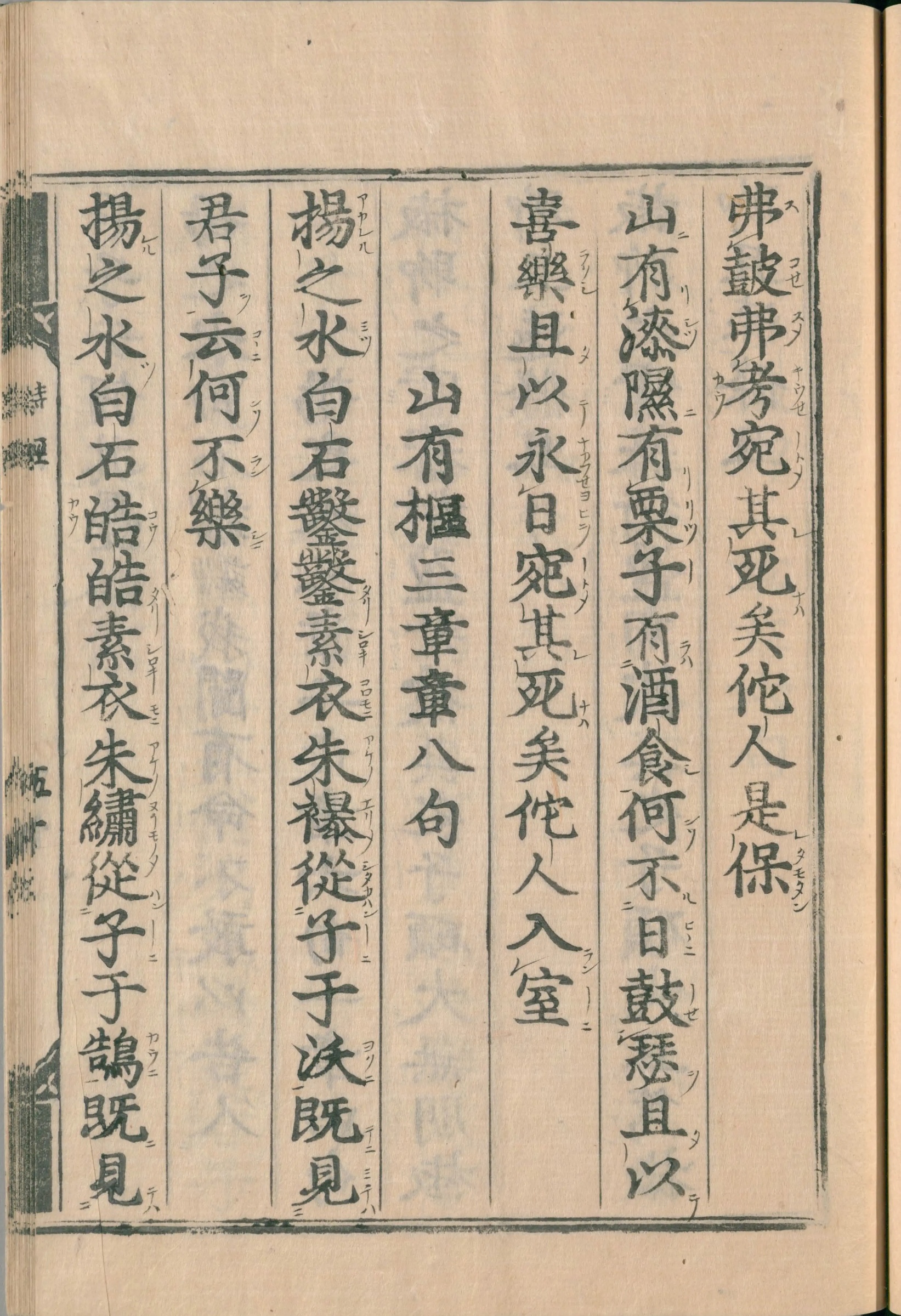
National Diet Library WA7-183, vol. [1], IIIF canvas 66, left-hand page: 7 columns of up to 17 characters, main text only, with Japanese reading marks. Checked on the image: stanza 3 opens column 2 ‹山有漆隰›. Other columns on this page: column 4 is the count line of 山有樞 (stanzas and lines). The Chinese shown is the Wikisource Mao text, not a transcription of this print; Legge's English translates the same text.
3山有漆,隰有栗。子有酒食,何不日鼓瑟?且以喜樂,且以永日。宛其死矣,他人入室。
3On the mountains are the varnish trees,
In the low wet grounds are the chestnuts.
You have spirits and viands;—
Why not daily play your lute,
Both to give a zest to your joy,
And to prolong the day?
You will drop off in death,
And another person will enter your chamber.
Notes
- English: James Legge, The She King, The Chinese Classics vol. IV part I (1871), Part I, Lessons from the States, Book 10, ode II (Shan yëw ch'oo). Stanzas are numbered as in Legge and the Mao text.
- Transcribed for this library from the page images: lines read alike by two OCR programs were kept, and every other line was read on the image (data/sources/shijing/legge1871/). Legge's notes are left out.
Cite
Sources
- Source: National Diet Library WA7-183 (Keicho-era movable-type print of the Shijing, vol. 1) + Wikisource Mao text + James Legge, The She King (Chinese Classics IV, 1871) (holding institution)
- Critical edition: Mao text (Wikisource)
← previous · → next · v cycle view · l back to library