Book of Odes, Mao 121: Bao yu 鴇羽 (Keicho-era print)
Introduction
鴇羽 (Bao yu, Mao 121) is ode VIII of 唐風 Tang feng ("the Airs of Tang"), the tenth book of the Airs of the States (國風 Guofeng), the 160 songs of the regional states that open the Book of Odes (詩經 Shijing). The Airs are generally dated to the Western and early Eastern Zhou (about the 10th to 7th century BCE). It has 3 stanzas.
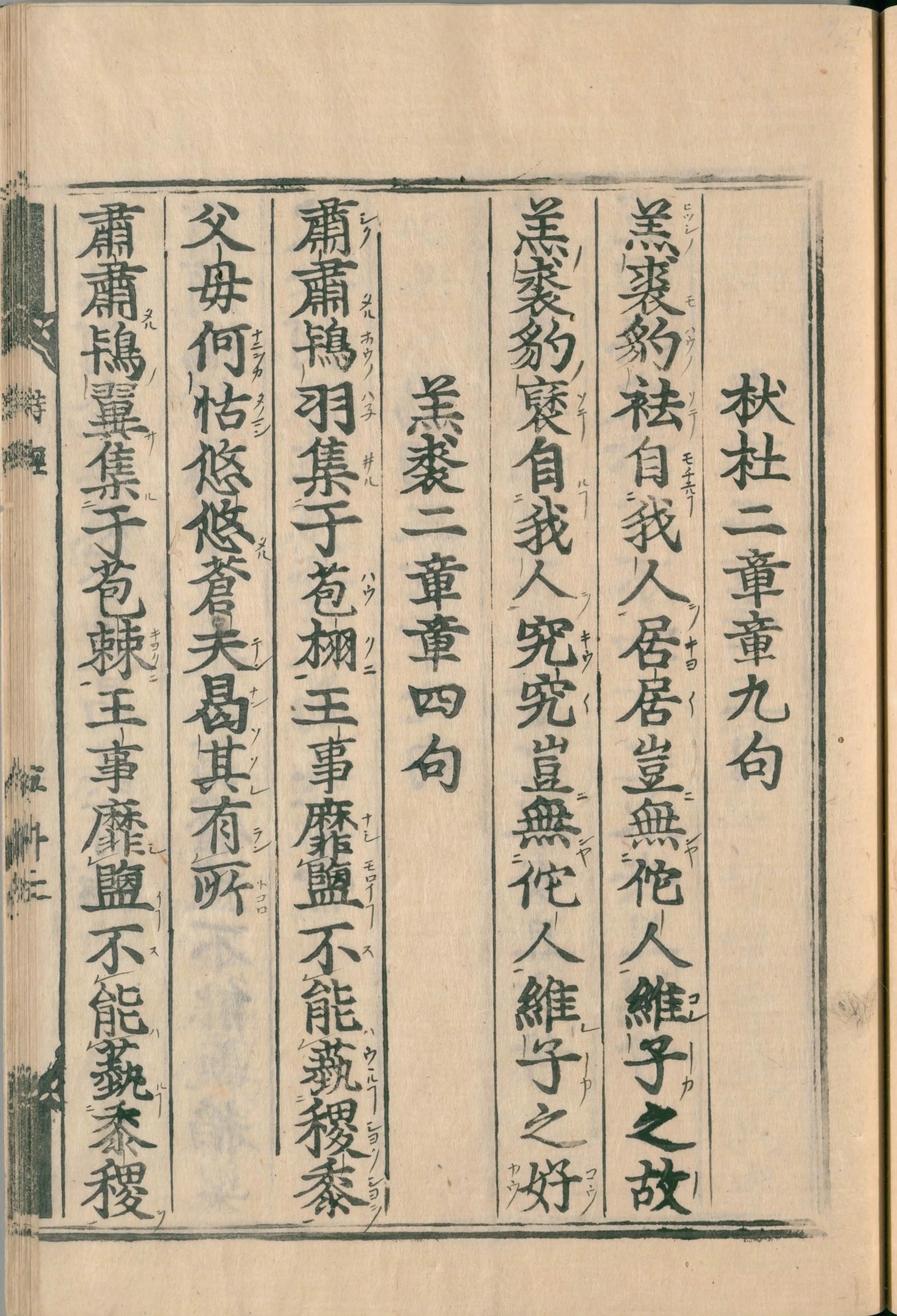
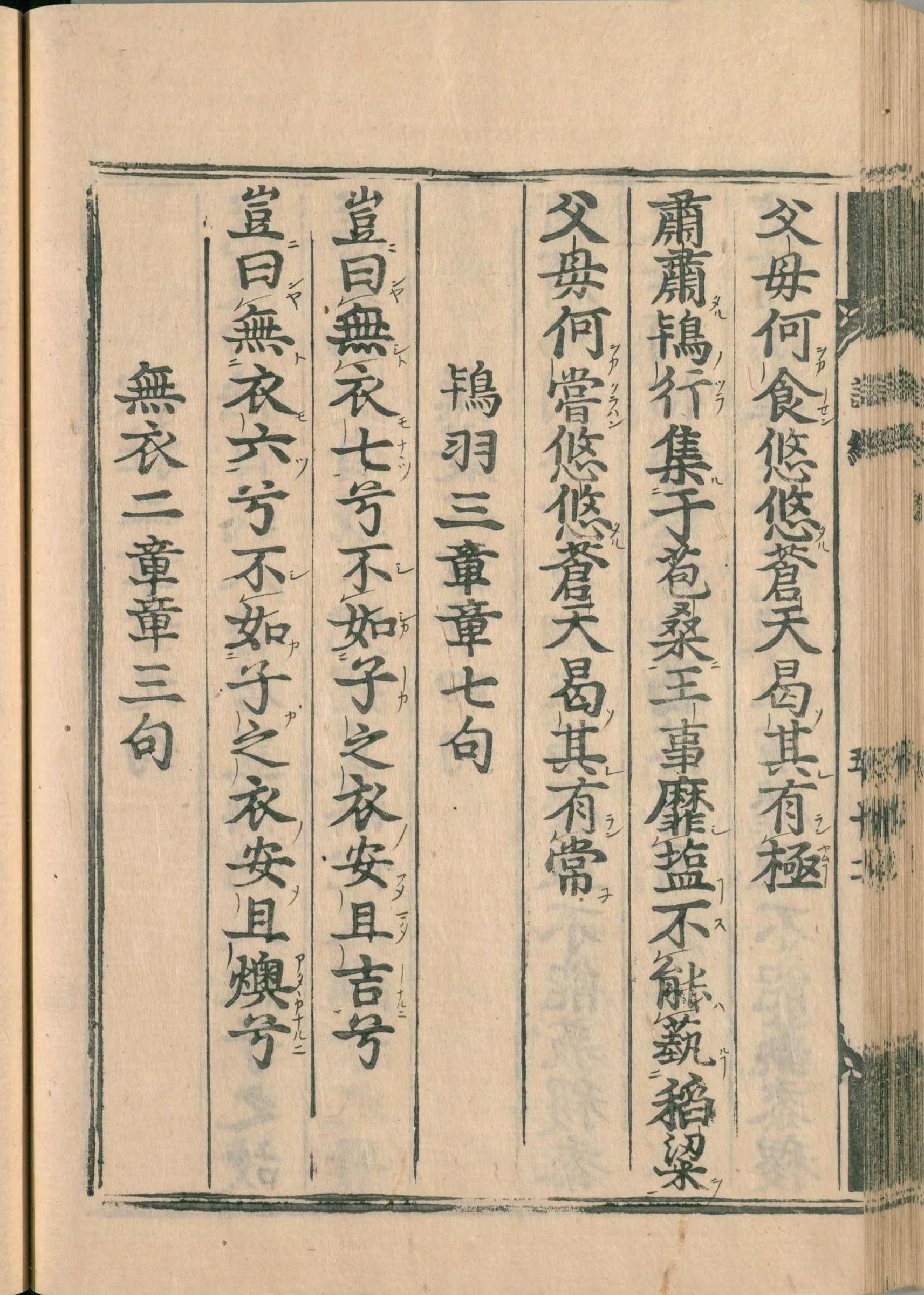
The photographs are of a copy of the Book of Odes in the National Diet Library, Tokyo (call no. WA7-183), printed with movable type in Japan in the Keicho era (1596-1615): main text only, seven columns of seventeen characters to the page, with Japanese reading marks added by hand. Each stanza begins a new column, and a line giving the count of stanzas and lines follows each ode. In this copy the ode runs from canvas 68, left-hand page to canvas 69, right-hand page of the first volume. Each section gathers the stanzas that begin on one page and links to that page and to any page the last stanza runs onto; the page boundaries were found by reading the first characters of every column on the photographs.
The Chinese is the Mao text from Wikisource. The English is James Legge's prose translation in The Chinese Classics, volume IV, part I (1871), Part I, Book 10, ode VIII (Paou yu), page 183-184; his notes are not reproduced. Words in square brackets are Legge's own additions.
How was this verified? (Provenance)
Where on the image
National Diet Library WA7-183, vol. [1], IIIF canvas 68, left-hand page: 7 columns of up to 17 characters, main text only, with Japanese reading marks. Checked on the image: stanza 1 opens column 5 ‹肅肅鴇羽›; stanza 2 opens column 7 ‹肅肅鴇翼›. Other columns on this page: column 1 is the count line of 杕杜 (stanzas and lines); column 4 is the count line of 羔裘 (stanzas and lines). Stanza 2 runs on to canvas 69, right-hand page (first column ‹父母何食›). The Chinese shown is the Wikisource Mao text, not a transcription of this print; Legge's English translates the same text.
1肅肅鴇羽,集于苞栩。王事靡盬,不能蓺稷黍。父母何怙?悠悠蒼天,曷其有所。
2肅肅鴇翼,集于苞棘。王事靡盬,不能蓺黍稷。父母何食?悠悠蒼天,曷其有極。
1Suh-suh go the feathers of the wild geese,
As they settle on the bushy oaks.
The king's affairs must not be slackly discharged,
And [so] we cannot plant our sacrificial millet and millet;—
What will our parents have to rely on?
O thou distant and azure Heaven!
When shall we be in our places again?
2Suh-suh go the wings of the wild geese,
As they settle on the bushy jujube trees.
The king's affairs must not be slackly discharged,
And [so] we cannot plant our millet and sacrificial millet;—
How shall our parents be supplied with food?
O thou distant and azure Heaven!
When shall [our service] have an end?
Where on the image
National Diet Library WA7-183, vol. [1], IIIF canvas 69, right-hand page: 7 columns of up to 17 characters, main text only, with Japanese reading marks. Checked on the image: stanza 3 opens column 2 ‹肅肅鴇行›. Other columns on this page: column 4 is the count line of 鴇羽 (stanzas and lines); column 7 is the count line of 無衣 (stanzas and lines). The Chinese shown is the Wikisource Mao text, not a transcription of this print; Legge's English translates the same text.
3肅肅鴇行,集于苞桑。王事靡盬,不能蓺稻粱。父母何嘗?悠悠蒼天,曷其有常。
3Suh-suh go the rows of the wild geese,
As they rest on the bushy mulberry trees.
The king's business must not be slackly discharged,
And [so] we cannot plant our rice and maize;—
How shall our parents get food?
O thou distant and azure Heaven!
When shall we get [back] to our ordinary lot?
Notes
- English: James Legge, The She King, The Chinese Classics vol. IV part I (1871), Part I, Lessons from the States, Book 10, ode VIII (Paou yu). Stanzas are numbered as in Legge and the Mao text.
- Transcribed for this library from the page images: lines read alike by two OCR programs were kept, and every other line was read on the image (data/sources/shijing/legge1871/). Legge's notes are left out.
Cite
Sources
- Source: National Diet Library WA7-183 (Keicho-era movable-type print of the Shijing, vol. 1) + Wikisource Mao text + James Legge, The She King (Chinese Classics IV, 1871) (holding institution)
- Critical edition: Mao text (Wikisource)
← previous · → next · v cycle view · l back to library