Book of Odes, Mao 128: Xiao rong 小戎 (Keicho-era print)
Introduction
小戎 (Xiao rong, Mao 128) is ode III of 秦風 Qin feng ("the Airs of Qin"), the eleventh book of the Airs of the States (國風 Guofeng), the 160 songs of the regional states that open the Book of Odes (詩經 Shijing). The Airs are generally dated to the Western and early Eastern Zhou (about the 10th to 7th century BCE). It has 3 stanzas.
The photographs are of a copy of the Book of Odes in the National Diet Library, Tokyo (call no. WA7-183), printed with movable type in Japan in the Keicho era (1596-1615): main text only, seven columns of seventeen characters to the page, with Japanese reading marks added by hand. Each stanza begins a new column, and a line giving the count of stanzas and lines follows each ode. In this copy the ode runs from canvas 71, left-hand page to canvas 72, right-hand page of the first volume. Each section gathers the stanzas that begin on one page and links to that page and to any page the last stanza runs onto; the page boundaries were found by reading the first characters of every column on the photographs.
The Chinese is the Mao text from Wikisource. The English is James Legge's prose translation in The Chinese Classics, volume IV, part I (1871), Part I, Book 11, ode III (Sëaou jung), page 193-195; his notes are not reproduced. Words in square brackets are Legge's own additions.
How was this verified? (Provenance)
Where on the image
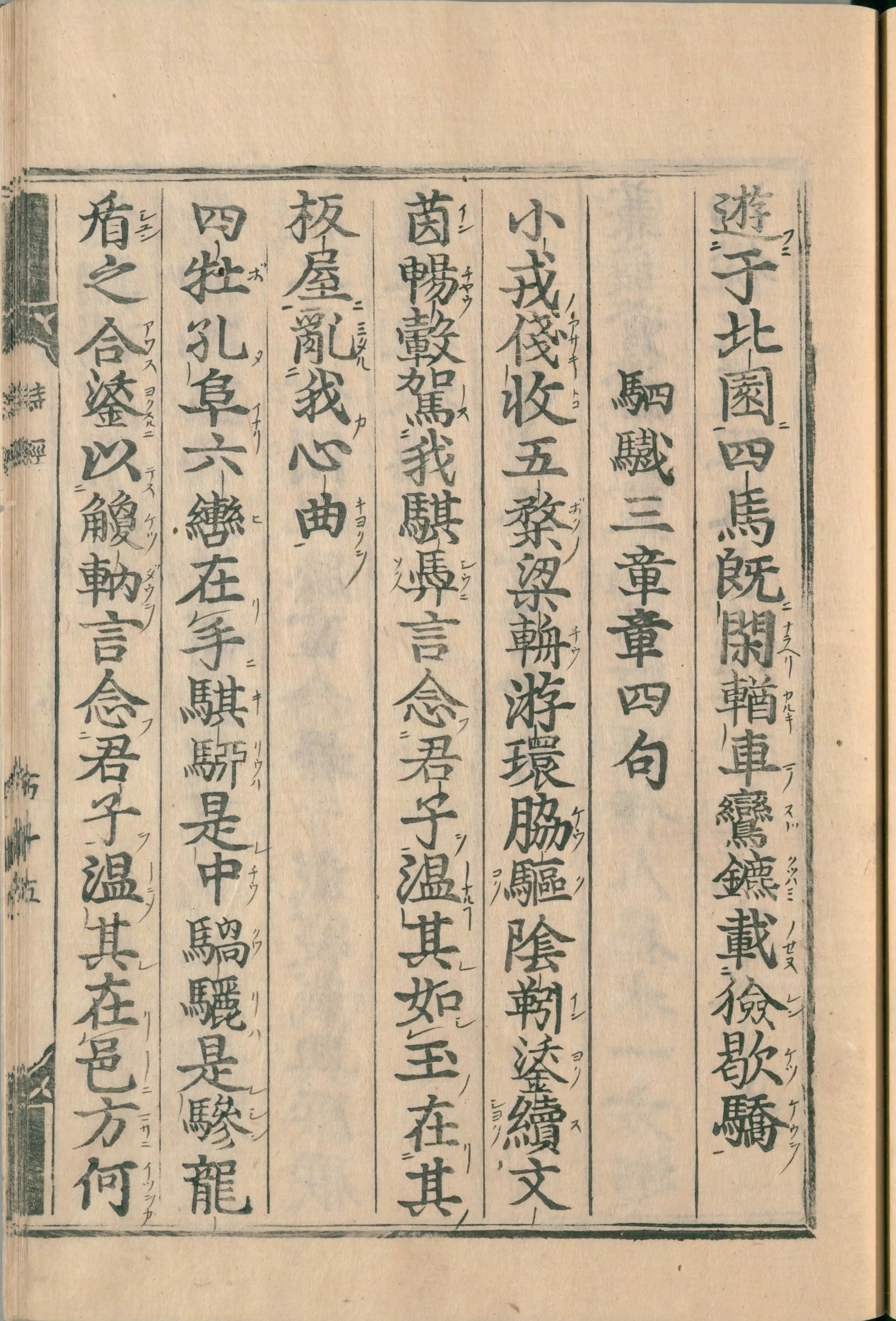
National Diet Library WA7-183, vol. [1], IIIF canvas 71, left-hand page: 7 columns of up to 17 characters, main text only, with Japanese reading marks. Checked on the image: stanza 1 opens column 3 ‹小戎俴收›; stanza 2 opens column 6 ‹四牡孔阜›. Other columns on this page: column 2 is the count line of 駟驖 (stanzas and lines). Stanza 2 runs on to canvas 72, right-hand page (first column ‹爲期胡然›). The Chinese shown is the Wikisource Mao text, not a transcription of this print; Legge's English translates the same text.
1小戎俴收,五楘梁輈,游環脅驅,陰靷鋈續,文茵暢轂,駕我騏馵。言念君子,溫其如玉。在其板屋,亂我心曲。
2四牡孔阜,六轡在手,騏駵是中,騧驪是驂,龍盾之合,鋈以觼軜。言念君子,溫其在邑。方何為期,胡然我念之。
1[There is] his short war carriage;—
With the ridge-like end of its pole, elegantly bound in five places;
With its slip rings and side straps;
And the traces attached by gilt rings to the masked transverse;
With its beautiful mat of tiger's skin, and its long naves;
With its piebalds, and horses with white left feet.
When I think of my husband [thus],
Looking bland and soft as a piece of jade;
It sends confusion into all the corners of my heart.
2His four horses are in very fine condition,
And the six reins are in the hand [of the charioteer].
Piebald, and bay with black mane, are the insides;
Yellow with black mouth, and black, are the outsides;
Side by side are placed the dragon-figured shields;
Gilt are the buckles for the inner reins.
I think of my husband [thus],
Looking so mild in the cities there.
What time can be fixed for his return?
Oh! how I think of him!
Where on the image
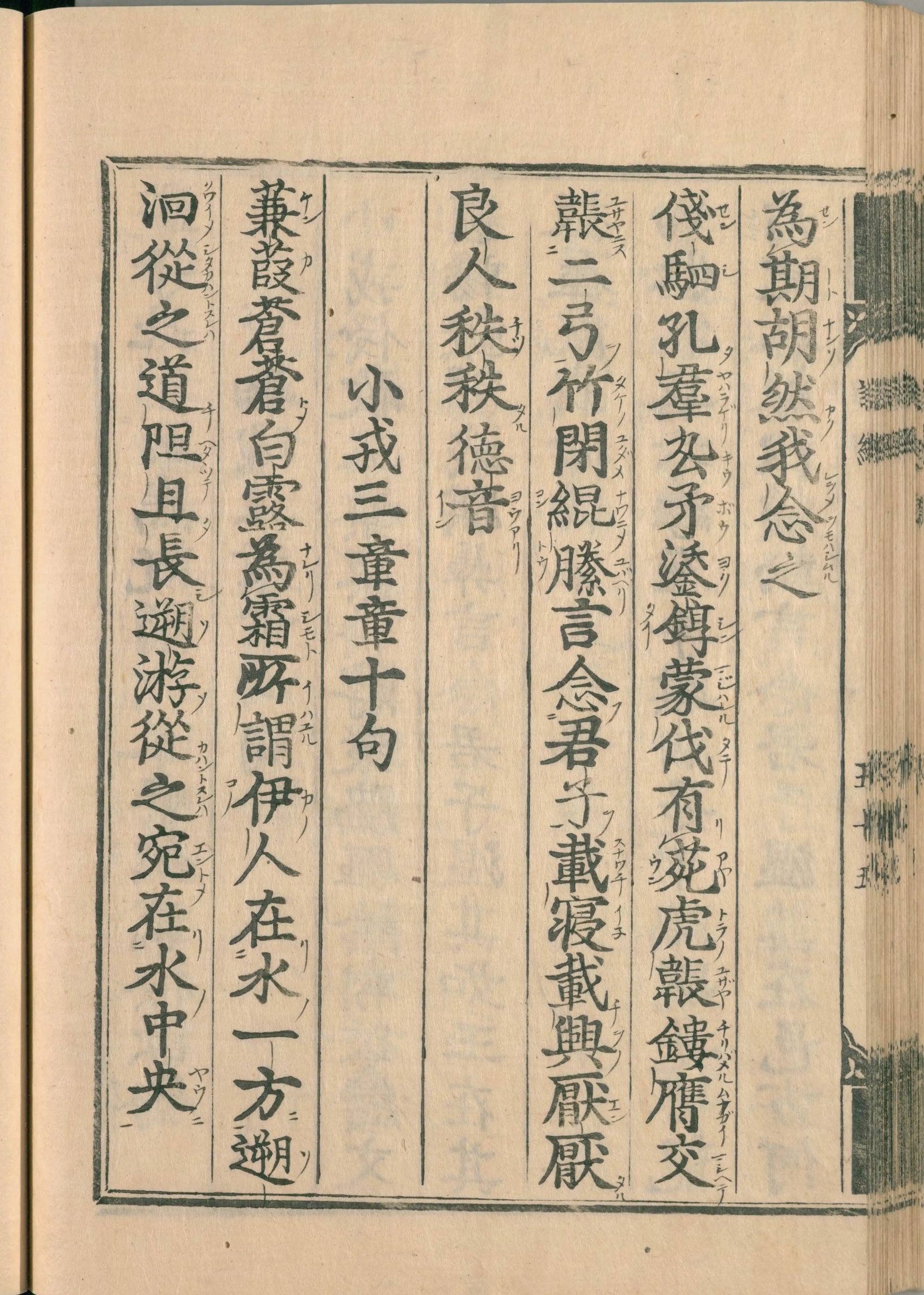
National Diet Library WA7-183, vol. [1], IIIF canvas 72, right-hand page: 7 columns of up to 17 characters, main text only, with Japanese reading marks. Checked on the image: stanza 3 opens column 2 ‹俴駟孔羣›. Other columns on this page: column 5 is the count line of 小戎 (stanzas and lines). The Chinese shown is the Wikisource Mao text, not a transcription of this print; Legge's English translates the same text.
3俴駟孔羣,厹矛鋈錞,蒙伐有苑,虎韔鏤膺,交韔二弓,竹閉緄縢。言念君子,載寢載興。厭厭良人,秩秩德音。
3His mail-covered team moves in great harmony;
There are the trident spears with their gilt ends;
And the beautiful feather-figured shield;
With the tiger-skin bow-case, and the carved metal ornaments on its front.
The two bows are placed in the case,
Bound with string to their bamboo frames.
I think of my husband,
When I lie down and rise up.
Tranquil and serene is the good man,
With his virtuous fame spread far and near.
Notes
- English: James Legge, The She King, The Chinese Classics vol. IV part I (1871), Part I, Lessons from the States, Book 11, ode III (Sëaou jung). Stanzas are numbered as in Legge and the Mao text.
- Transcribed for this library from the page images: lines read alike by two OCR programs were kept, and every other line was read on the image (data/sources/shijing/legge1871/). Legge's notes are left out.
Cite
Sources
- Source: National Diet Library WA7-183 (Keicho-era movable-type print of the Shijing, vol. 1) + Wikisource Mao text + James Legge, The She King (Chinese Classics IV, 1871) (holding institution)
- Critical edition: Mao text (Wikisource)
← previous · → next · v cycle view · l back to library