Book of Odes, Mao 13: Cai fan 采蘩 (Keicho-era print)
Introduction
采蘩 (Cai fan, Mao 13) is ode II of 召南 Shao nan ("the South of Shao"), the second book of the Airs of the States (國風 Guofeng), the 160 songs of the regional states that open the Book of Odes (詩經 Shijing). The Airs are generally dated to the Western and early Eastern Zhou (about the 10th to 7th century BCE). It has 3 stanzas.
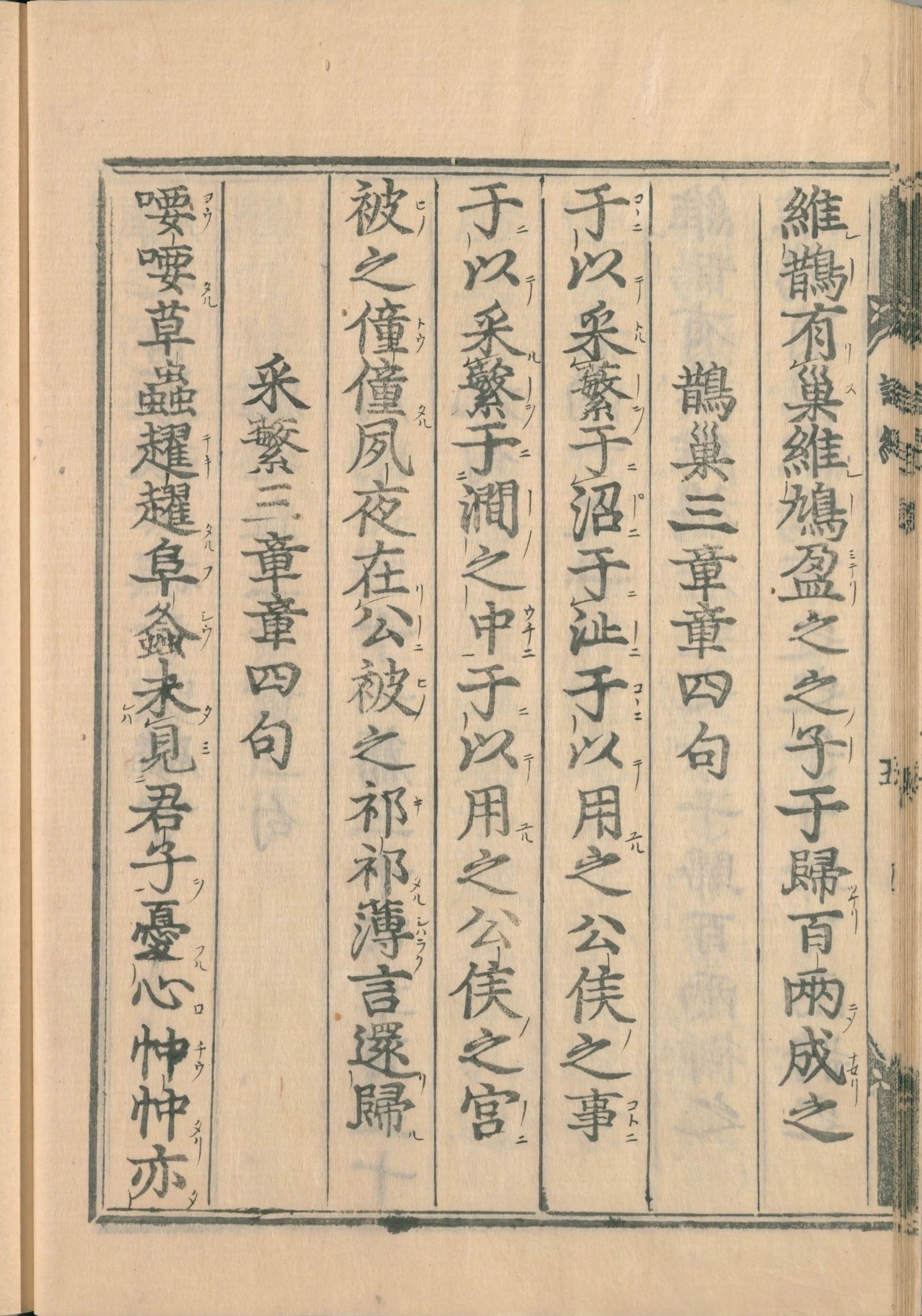
The photographs are of a copy of the Book of Odes in the National Diet Library, Tokyo (call no. WA7-183), printed with movable type in Japan in the Keicho era (1596-1615): main text only, seven columns of seventeen characters to the page, with Japanese reading marks added by hand. Each stanza begins a new column, and a line giving the count of stanzas and lines follows each ode. In this copy the ode runs from canvas 22, right-hand page to canvas 22, right-hand page of the first volume. Each section gathers the stanzas that begin on one page and links to that page and to any page the last stanza runs onto; the page boundaries were found by reading the first characters of every column on the photographs.
The Chinese is the Mao text from Wikisource. The English is James Legge's prose translation in The Chinese Classics, volume IV, part I (1871), Part I, Book 2, ode II (Ts'ae fan), page 22-22; his notes are not reproduced. Words in square brackets are Legge's own additions.
How was this verified? (Provenance)
Where on the image
National Diet Library WA7-183, vol. [1], IIIF canvas 22, right-hand page: 7 columns of up to 17 characters, main text only, with Japanese reading marks. Checked on the image: stanza 1 opens column 3 ‹于以采蘩›; stanza 2 opens column 4 ‹于以采蘩›; stanza 3 opens column 5 ‹被之僮僮›. Other columns on this page: column 2 is the count line of 鵲巢 (stanzas and lines); column 6 is the count line of 采蘩 (stanzas and lines). The Chinese shown is the Wikisource Mao text, not a transcription of this print; Legge's English translates the same text.
1于以采蘩,于沼于沚,于以用之,公侯之事。
2于以采蘩,于澗之中,于以用之,公侯之宮。
3被之僮僮,夙夜在公,被之祁祁,薄言還歸。
1She gathers the white southernwood,
By the ponds, on the islets.
She employs it,
In the business of our prince.
2She gathers the white southernwood,
Along the streams in the valleys.
She employs it,
In the temple of our prince.
3With head-dress reverently rising aloft,
Early, while yet it is night, she is in the prince's temple;
In her head-dress, slowly retiring,
She returns to her own apartments.
Notes
- English: James Legge, The She King, The Chinese Classics vol. IV part I (1871), Part I, Lessons from the States, Book 2, ode II (Ts'ae fan). Stanzas are numbered as in Legge and the Mao text.
- Transcribed for this library from the page images: lines read alike by two OCR programs were kept, and every other line was read on the image (data/sources/shijing/legge1871/). Legge's notes are left out.
Cite
Sources
- Source: National Diet Library WA7-183 (Keicho-era movable-type print of the Shijing, vol. 1) + Wikisource Mao text + James Legge, The She King (Chinese Classics IV, 1871) (holding institution)
- Critical edition: Mao text (Wikisource)
← previous · → next · v cycle view · l back to library