Book of Odes, Mao 159: Jiu yu 九罭 (Keicho-era print)
Introduction
九罭 (Jiu yu, Mao 159) is ode VI of 豳風 Bin feng ("the Airs of Bin"), the fifteenth book of the Airs of the States (國風 Guofeng), the 160 songs of the regional states that open the Book of Odes (詩經 Shijing). The Airs are generally dated to the Western and early Eastern Zhou (about the 10th to 7th century BCE). It has 4 stanzas.
The photographs are of a copy of the Book of Odes in the National Diet Library, Tokyo (call no. WA7-183), printed with movable type in Japan in the Keicho era (1596-1615): main text only, seven columns of seventeen characters to the page, with Japanese reading marks added by hand. Each stanza begins a new column, and a line giving the count of stanzas and lines follows each ode. In this copy the ode runs from canvas 85, left-hand page to canvas 86, right-hand page of the first volume. Each section gathers the stanzas that begin on one page and links to that page and to any page the last stanza runs onto; the page boundaries were found by reading the first characters of every column on the photographs.
The Chinese is the Mao text from Wikisource. The English is James Legge's prose translation in The Chinese Classics, volume IV, part I (1871), Part I, Book 15, ode VI (Këw yih), page 241-242; his notes are not reproduced. Words in square brackets are Legge's own additions.
How was this verified? (Provenance)
Where on the image
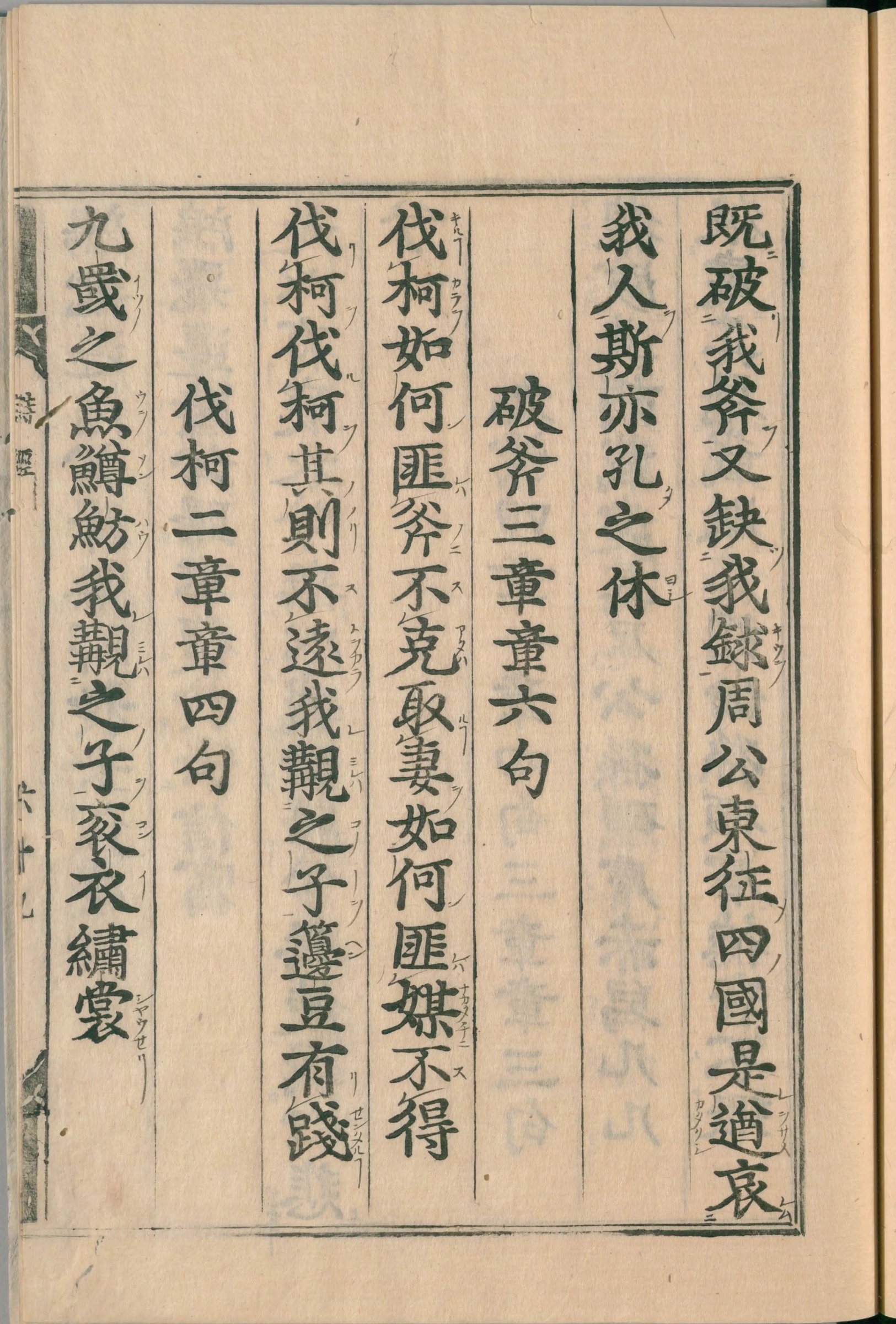
National Diet Library WA7-183, vol. [1], IIIF canvas 85, left-hand page: 7 columns of up to 17 characters, main text only, with Japanese reading marks. Checked on the image: stanza 1 opens column 7 ‹九罭之魚›. Other columns on this page: column 3 is the count line of 破斧 (stanzas and lines); column 6 is the count line of 伐柯 (stanzas and lines). The Chinese shown is the Wikisource Mao text, not a transcription of this print; Legge's English translates the same text.
1九罭之魚,鱒魴。我覯之子,袞衣繡裳。
1In the net with its nine bags
Are rud and bream.
We see this prince
With his grand-ducal robe and embroidered skirt.
Where on the image
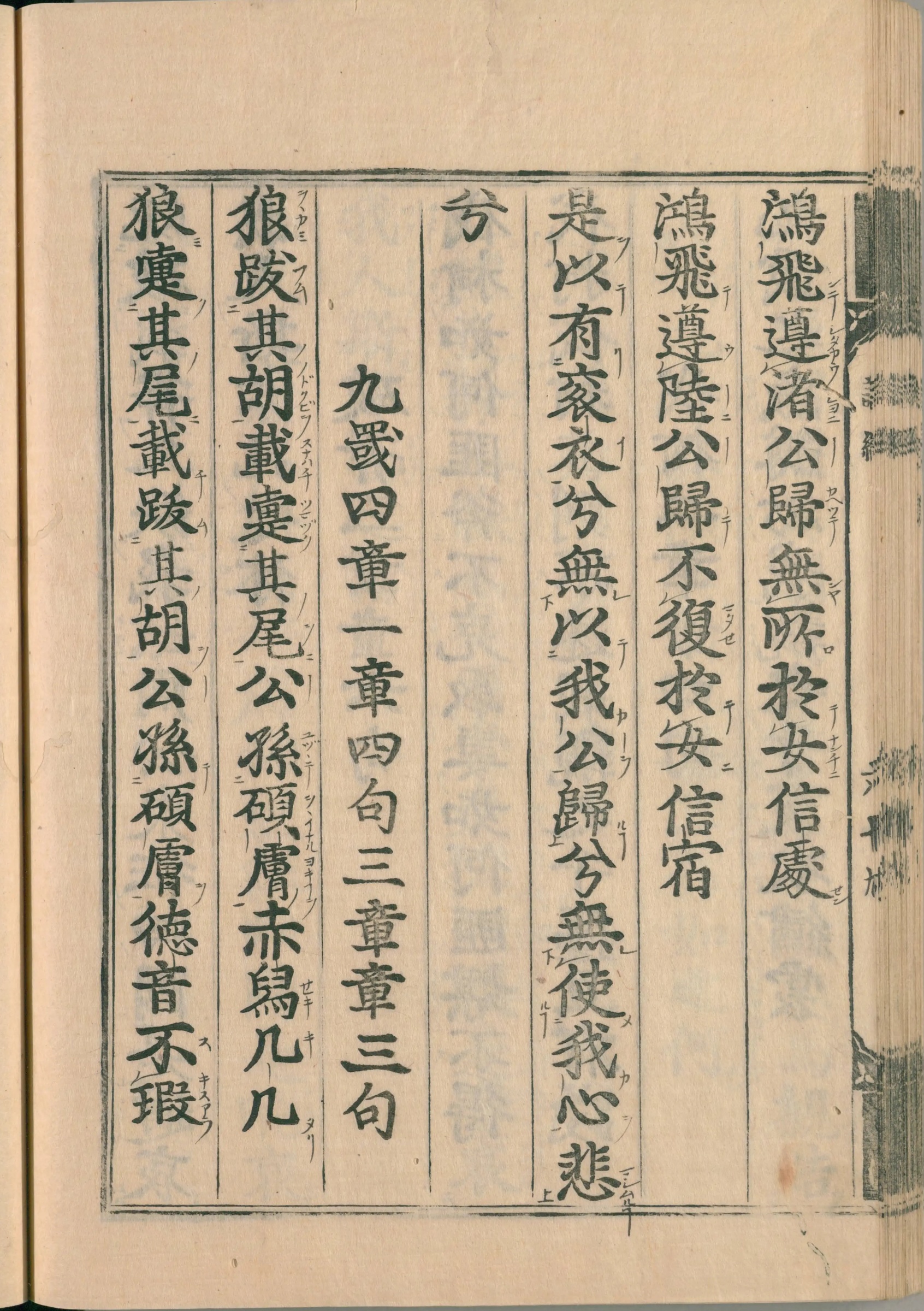
National Diet Library WA7-183, vol. [1], IIIF canvas 86, right-hand page: 7 columns of up to 17 characters, main text only, with Japanese reading marks. Checked on the image: stanza 2 opens column 1 ‹鴻飛遵渚›; stanza 3 opens column 2 ‹鴻飛遵陸›; stanza 4 opens column 3 ‹是以有袞›. Other columns on this page: column 5 is the count line of 九罭 (stanzas and lines). The Chinese shown is the Wikisource Mao text, not a transcription of this print; Legge's English translates the same text.
2鴻飛遵渚,公歸無所。於女信處。
3鴻飛遵陸,公歸不復。於女信宿。
4是以有袞衣兮,無以我公歸兮,無使我心悲兮。
2The wild geese fly [only] about the islets.
The duke is returning;—is it not to his proper place?
He was stopping with you [and me] but for a couple of nights.
3The wild geese fly about the land.
The duke is returning, and will not come back here?
He was lodging with you [and me] but for a couple of nights.
4Thus have we had the grand-ducal robe among us.
Do not take our duke back [to the west];
Do not cause us such sorrow of heart.
Notes
- English: James Legge, The She King, The Chinese Classics vol. IV part I (1871), Part I, Lessons from the States, Book 15, ode VI (Këw yih). Stanzas are numbered as in Legge and the Mao text.
- Transcribed for this library from the page images: lines read alike by two OCR programs were kept, and every other line was read on the image (data/sources/shijing/legge1871/). Legge's notes are left out.
Cite
Sources
- Source: National Diet Library WA7-183 (Keicho-era movable-type print of the Shijing, vol. 1) + Wikisource Mao text + James Legge, The She King (Chinese Classics IV, 1871) (holding institution)
- Critical edition: Mao text (Wikisource)
← previous · → next · v cycle view · l back to library