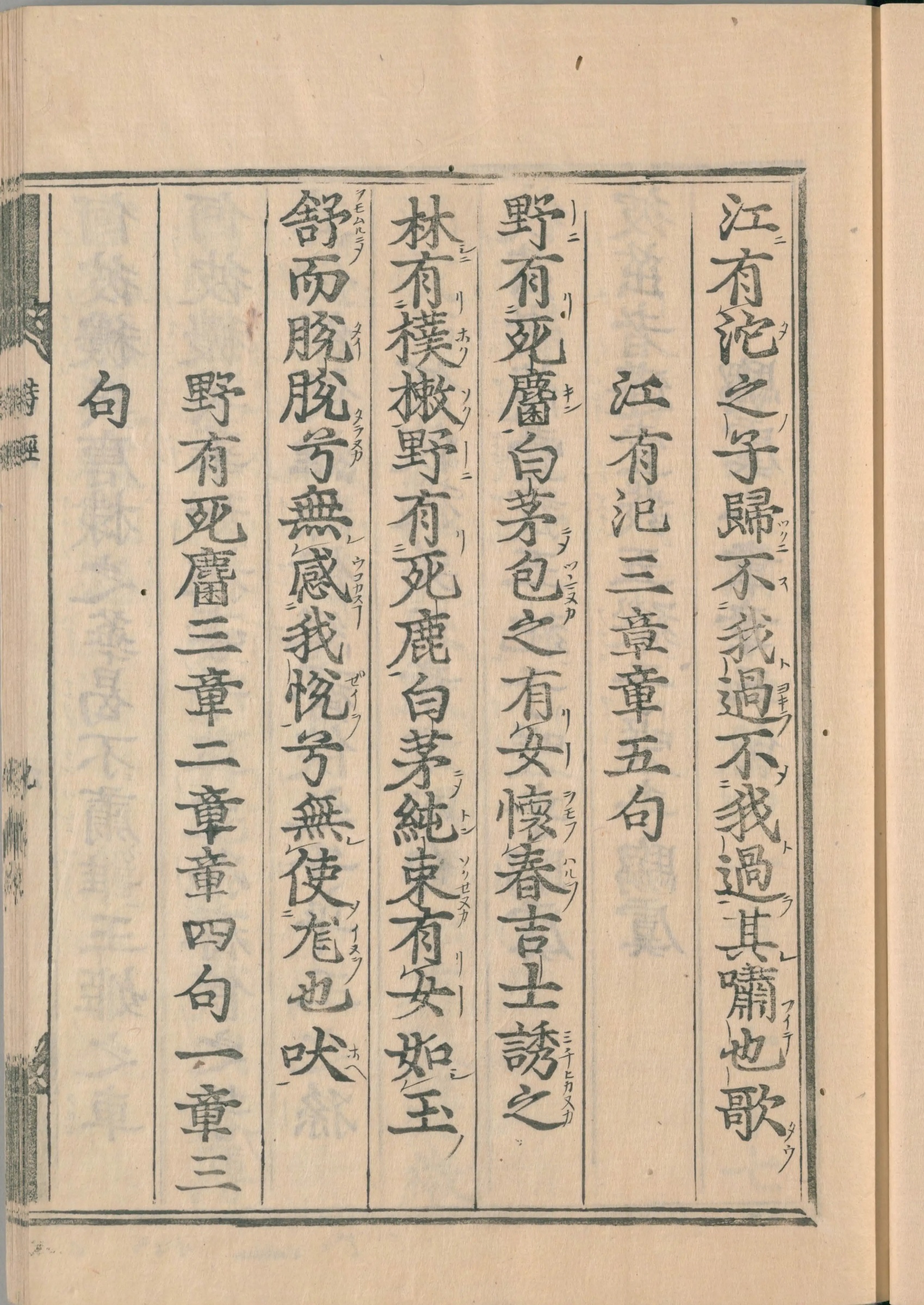
Book of Odes, Mao 23: Ye you si jun 野有死麕 (Keicho-era print)
Introduction
野有死麕 (Ye you si jun, Mao 23) is ode XII of 召南 Shao nan ("the South of Shao"), the second book of the Airs of the States (國風 Guofeng), the 160 songs of the regional states that open the Book of Odes (詩經 Shijing). The Airs are generally dated to the Western and early Eastern Zhou (about the 10th to 7th century BCE). It has 3 stanzas.
The photographs are of a copy of the Book of Odes in the National Diet Library, Tokyo (call no. WA7-183), printed with movable type in Japan in the Keicho era (1596-1615): main text only, seven columns of seventeen characters to the page, with Japanese reading marks added by hand. Each stanza begins a new column, and a line giving the count of stanzas and lines follows each ode. In this copy the ode runs from canvas 25, left-hand page to canvas 25, left-hand page of the first volume. Each section gathers the stanzas that begin on one page and links to that page and to any page the last stanza runs onto; the page boundaries were found by reading the first characters of every column on the photographs.
The Chinese is the Mao text from Wikisource. The English is James Legge's prose translation in The Chinese Classics, volume IV, part I (1871), Part I, Book 2, ode XII (Yay yew sze keun), page 34-34; his notes are not reproduced. Words in square brackets are Legge's own additions.
How was this verified? (Provenance)
Where on the image
National Diet Library WA7-183, vol. [1], IIIF canvas 25, left-hand page: 7 columns of up to 17 characters, main text only, with Japanese reading marks. Checked on the image: stanza 1 opens column 3 ‹野有死麕›; stanza 2 opens column 4 ‹林有樸樕›; stanza 3 opens column 5 ‹舒而脫脫›. Other columns on this page: column 2 is the count line of 江有汜 (stanzas and lines); column 6 is the count line of 野有死麕 (stanzas and lines); column 7 ‹句› ends the preceding count line. The Chinese shown is the Wikisource Mao text, not a transcription of this print; Legge's English translates the same text.
1野有死麕,白茅包之,有女懷春,吉士誘之。
2林有樸樕,野有死鹿,白茅純束,有女如玉。
3舒而脫脫兮,無感我帨兮,無使尨也吠。
1In the wild there is a dead antelope,
And it is wrapped up with the white grass.
There is a young lady with thoughts natural to the spring,
And a fine gentleman would lead her astray.
2In the forest there are the scrubby oaks;
In the wild there is a dead deer,
And it is bound round with the white grass.
There is a young lady like a gem.
3[She says], Slowly; gently, gently;
Do not move my handkerchief;
Do not make my dog bark.
Notes
- English: James Legge, The She King, The Chinese Classics vol. IV part I (1871), Part I, Lessons from the States, Book 2, ode XII (Yay yew sze keun). Stanzas are numbered as in Legge and the Mao text.
- Transcribed for this library from the page images: lines read alike by two OCR programs were kept, and every other line was read on the image (data/sources/shijing/legge1871/). Legge's notes are left out.
Cite
Sources
- Source: National Diet Library WA7-183 (Keicho-era movable-type print of the Shijing, vol. 1) + Wikisource Mao text + James Legge, The She King (Chinese Classics IV, 1871) (holding institution)
- Critical edition: Mao text (Wikisource)
← previous · → next · v cycle view · l back to library