Book of Odes, Mao 26: Bo zhou 柏舟 (Keicho-era print)
Introduction
柏舟 (Bo zhou, Mao 26) is ode I of 邶風 Bei feng ("the Airs of Bei"), the third book of the Airs of the States (國風 Guofeng), the 160 songs of the regional states that open the Book of Odes (詩經 Shijing). The Airs are generally dated to the Western and early Eastern Zhou (about the 10th to 7th century BCE). It has 5 stanzas.
The photographs are of a copy of the Book of Odes in the National Diet Library, Tokyo (call no. WA7-183), printed with movable type in Japan in the Keicho era (1596-1615): main text only, seven columns of seventeen characters to the page, with Japanese reading marks added by hand. Each stanza begins a new column, and a line giving the count of stanzas and lines follows each ode. In this copy the ode runs from canvas 26, left-hand page to canvas 27, right-hand page of the first volume. Each section gathers the stanzas that begin on one page and links to that page and to any page the last stanza runs onto; the page boundaries were found by reading the first characters of every column on the photographs.
The Chinese is the Mao text from Wikisource. The English is James Legge's prose translation in The Chinese Classics, volume IV, part I (1871), Part I, Book 3, ode I (Pih chau), page 38-40; his notes are not reproduced. Words in square brackets are Legge's own additions.
How was this verified? (Provenance)
Where on the image
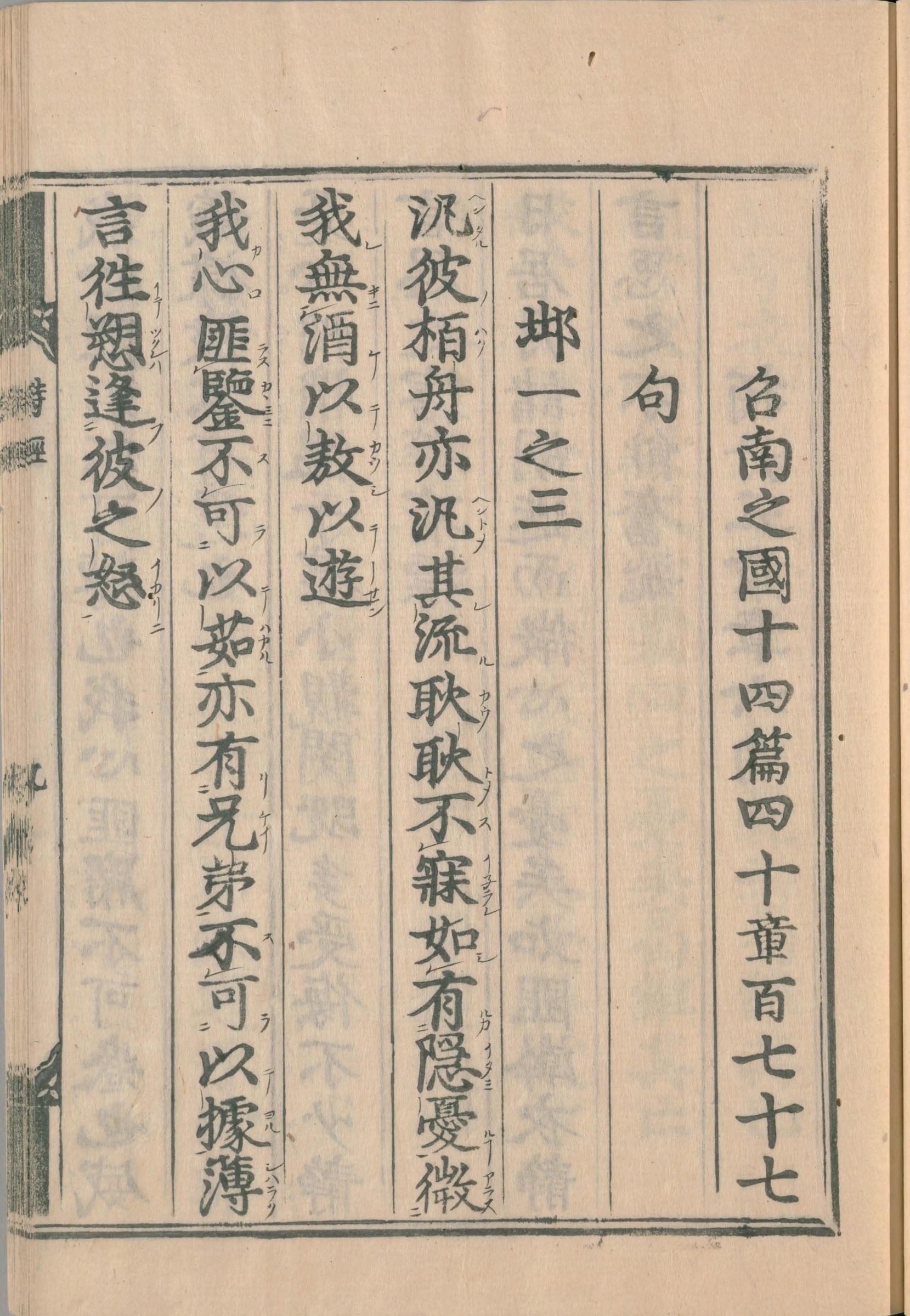
National Diet Library WA7-183, vol. [1], IIIF canvas 26, left-hand page: 7 columns of up to 17 characters, main text only, with Japanese reading marks. Checked on the image: stanza 1 opens column 4 ‹汎彼柏舟›; stanza 2 opens column 6 ‹我心匪鑒›. Other columns on this page: column 1 begins the count of odes, stanzas and lines of the book ‹召南之國›; column 2 ‹句› ends the preceding count line; column 3 is the heading 邶一之三. The Chinese shown is the Wikisource Mao text, not a transcription of this print; Legge's English translates the same text.
1汎彼柏舟,亦汎其流。耿耿不寐,如有隱憂。微我無酒,以敖以遊。
2我心匪鑒,不可以茹。亦有兄弟,不可以據。薄言往愬,逢彼之怒。
1It floats about, that boat of cypress wood;
Yea, it floats about on the current.
Disturbed am I, and sleepless,
As if suffering from a painful wound.
It is not because I have no wine,
And that I might not wander and saunter about.
2My mind is not a mirror;—
It cannot [equally] receive [all impressions].
I, indeed, have brothers,
But I cannot depend on them.
If I go and complain to them,
I meet with their anger.
Where on the image
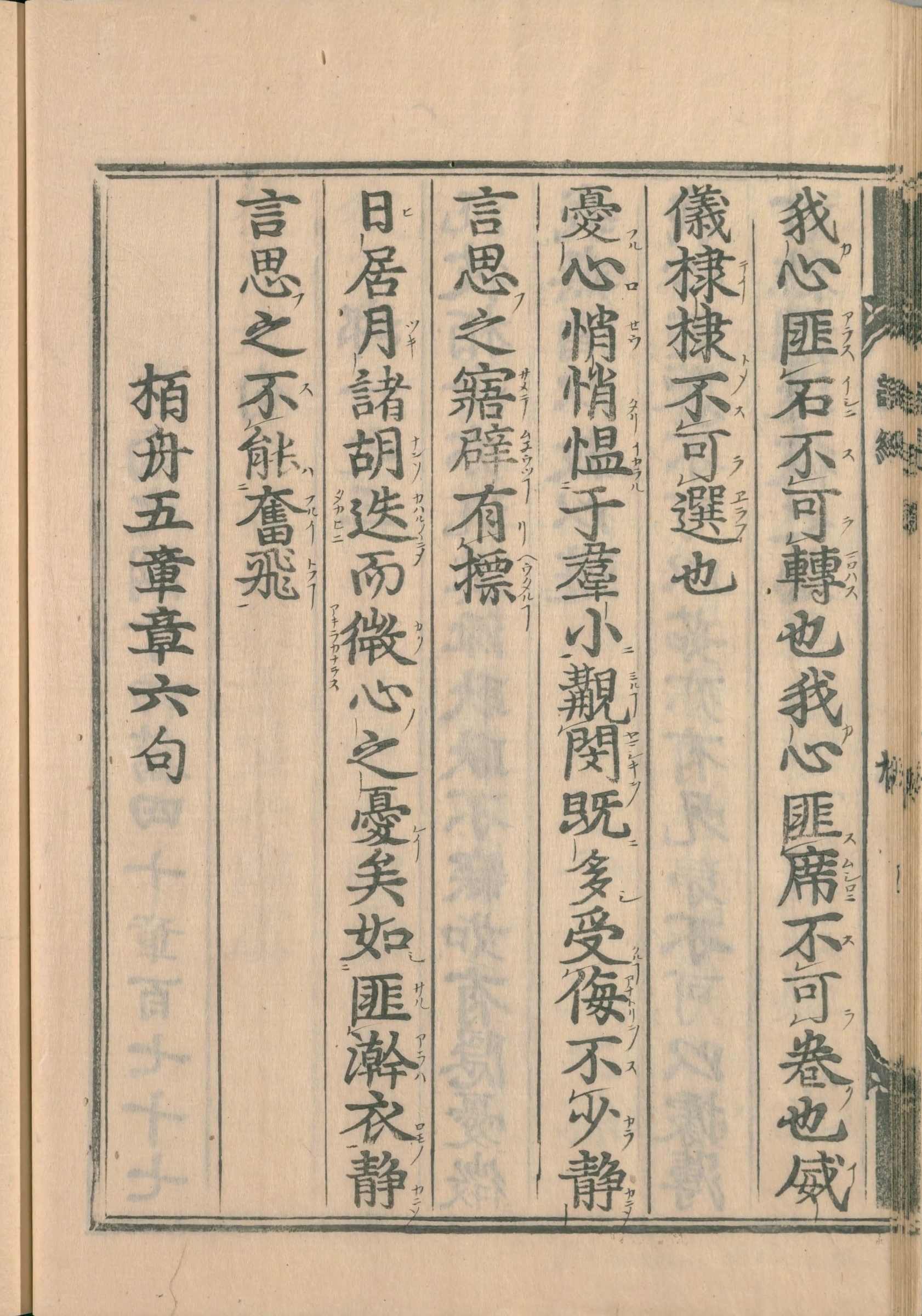
National Diet Library WA7-183, vol. [1], IIIF canvas 27, right-hand page: 7 columns of up to 17 characters, main text only, with Japanese reading marks. Checked on the image: stanza 3 opens column 1 ‹我心匪石›; stanza 4 opens column 3 ‹憂心悄悄›; stanza 5 opens column 5 ‹日居月諸›. Other columns on this page: column 7 is the count line of 柏舟 (stanzas and lines). The Chinese shown is the Wikisource Mao text, not a transcription of this print; Legge's English translates the same text.
3我心匪石,不可轉也。我心匪席,不可卷也。威儀棣棣,不可選也。
4憂心悄悄,慍于群小。覯閔既多,受侮不少。靜言思之,寤辟有摽。
5日居月諸,胡迭而微?心之憂矣,如匪澣衣。靜言思之,不能奮飛!
3My mind is not a stone;—
It cannot be rolled about.
My mind is not a mat;—
It cannot be rolled up.
My deportment has been dignified and good,
With nothing wrong which can be pointed out.
4My anxious heart is full of trouble;
I am hated by the herd of mean creatures;
I meet with many distresses;
I receive insults not a few.
Silently I think of my case,
And, starting as from sleep, I beat my breast.
5There are the sun and the moon,—
How is it that the former has become small, and not the latter?
The sorrow cleaves to my heart,
Like an unwashed dress.
Silently I think of my case,
But I cannot spread my wings and fly away.
Notes
- English: James Legge, The She King, The Chinese Classics vol. IV part I (1871), Part I, Lessons from the States, Book 3, ode I (Pih chau). Stanzas are numbered as in Legge and the Mao text.
- Transcribed for this library from the page images: lines read alike by two OCR programs were kept, and every other line was read on the image (data/sources/shijing/legge1871/). Legge's notes are left out.
Cite
Sources
- Source: National Diet Library WA7-183 (Keicho-era movable-type print of the Shijing, vol. 1) + Wikisource Mao text + James Legge, The She King (Chinese Classics IV, 1871) (holding institution)
- Critical edition: Mao text (Wikisource)
← previous · → next · v cycle view · l back to library