Book of Odes, Mao 66: Junzi yu yi 君子于役 (Keicho-era print)
Introduction
君子于役 (Junzi yu yi, Mao 66) is ode II of 王風 Wang feng ("the Airs of the Royal Domain"), the sixth book of the Airs of the States (國風 Guofeng), the 160 songs of the regional states that open the Book of Odes (詩經 Shijing). The Airs are generally dated to the Western and early Eastern Zhou (about the 10th to 7th century BCE). It has 2 stanzas.
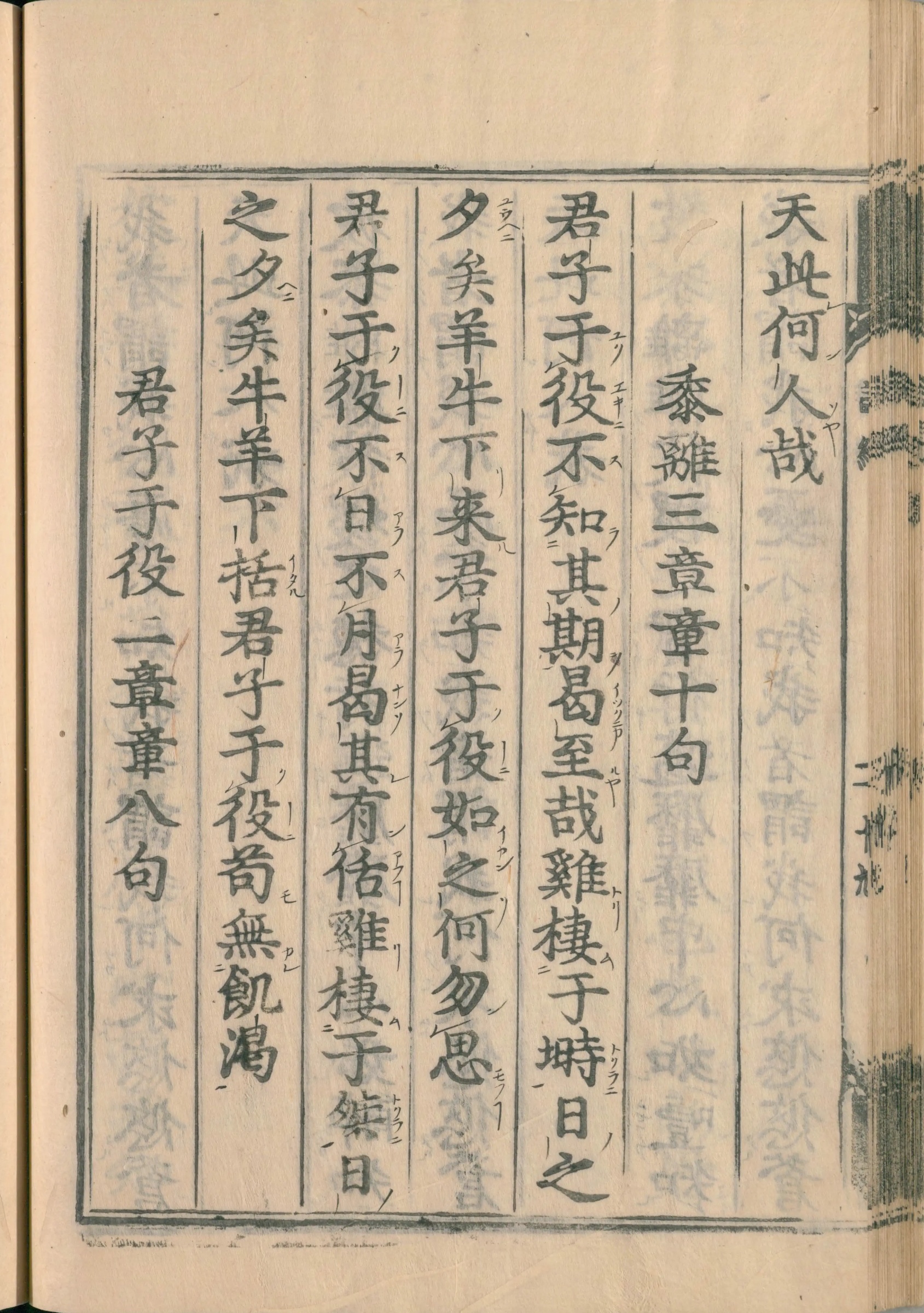
The photographs are of a copy of the Book of Odes in the National Diet Library, Tokyo (call no. WA7-183), printed with movable type in Japan in the Keicho era (1596-1615): main text only, seven columns of seventeen characters to the page, with Japanese reading marks added by hand. Each stanza begins a new column, and a line giving the count of stanzas and lines follows each ode. In this copy the ode runs from canvas 46, right-hand page to canvas 46, right-hand page of the first volume. Each section gathers the stanzas that begin on one page and links to that page and to any page the last stanza runs onto; the page boundaries were found by reading the first characters of every column on the photographs.
The Chinese is the Mao text from Wikisource. The English is James Legge's prose translation in The Chinese Classics, volume IV, part I (1871), Part I, Book 6, ode II (Keun-tsze yu yih), page 112-113; his notes are not reproduced. Words in square brackets are Legge's own additions.
How was this verified? (Provenance)
Where on the image
National Diet Library WA7-183, vol. [1], IIIF canvas 46, right-hand page: 7 columns of up to 17 characters, main text only, with Japanese reading marks. Checked on the image: stanza 1 opens column 3 ‹君子于役›; stanza 2 opens column 5 ‹君子于役›. Other columns on this page: column 2 is the count line of 黍離 (stanzas and lines); column 7 is the count line of 君子于役 (stanzas and lines). The Chinese shown is the Wikisource Mao text, not a transcription of this print; Legge's English translates the same text.
1君子于役,不知其期。曷至哉?雞棲于塒,日之夕矣,羊牛下來。君子于役,如之何勿思!
2君子于役,不日不月。曷其有佸?雞棲于桀,日之夕矣,羊牛下括。君子于役,苟無飢渴。
1My husband is away on service,
And I know not when he will return.
Where is he now?
The fowls roost in their holes in the walls;
And in the evening of the day,
The goats and cows come down [from the hill];
But my husband is away on service.
How can I but keep thinking of him?
2My husband is away on service,
Not for days [merely] or for months.
When will he come back to me?
The fowls roost on their perches;
And in the evening of the day,
The goats and cows come down and home;
But my husband is away on service.
Oh if he be but kept from hunger and thirst!
Notes
- English: James Legge, The She King, The Chinese Classics vol. IV part I (1871), Part I, Lessons from the States, Book 6, ode II (Keun-tsze yu yih). Stanzas are numbered as in Legge and the Mao text.
- Transcribed for this library from the page images: lines read alike by two OCR programs were kept, and every other line was read on the image (data/sources/shijing/legge1871/). Legge's notes are left out.
Cite
Sources
- Source: National Diet Library WA7-183 (Keicho-era movable-type print of the Shijing, vol. 1) + Wikisource Mao text + James Legge, The She King (Chinese Classics IV, 1871) (holding institution)
- Critical edition: Mao text (Wikisource)
← previous · → next · v cycle view · l back to library