Book of Odes, Mao 78: Da shu yu tian 大叔于田 (Keicho-era print)
Introduction
大叔于田 (Da shu yu tian, Mao 78) is ode IV of 鄭風 Zheng feng ("the Airs of Zheng"), the seventh book of the Airs of the States (國風 Guofeng), the 160 songs of the regional states that open the Book of Odes (詩經 Shijing). The Airs are generally dated to the Western and early Eastern Zhou (about the 10th to 7th century BCE). It has 3 stanzas.
The photographs are of a copy of the Book of Odes in the National Diet Library, Tokyo (call no. WA7-183), printed with movable type in Japan in the Keicho era (1596-1615): main text only, seven columns of seventeen characters to the page, with Japanese reading marks added by hand. Each stanza begins a new column, and a line giving the count of stanzas and lines follows each ode. In this copy the ode runs from canvas 51, right-hand page to canvas 51, left-hand page of the first volume. Each section gathers the stanzas that begin on one page and links to that page and to any page the last stanza runs onto; the page boundaries were found by reading the first characters of every column on the photographs.
The Chinese is the Mao text from Wikisource. The English is James Legge's prose translation in The Chinese Classics, volume IV, part I (1871), Part I, Book 7, ode IV (Shuh yu t'een), page 129-131; his notes are not reproduced. Words in square brackets are Legge's own additions.
How was this verified? (Provenance)
Where on the image
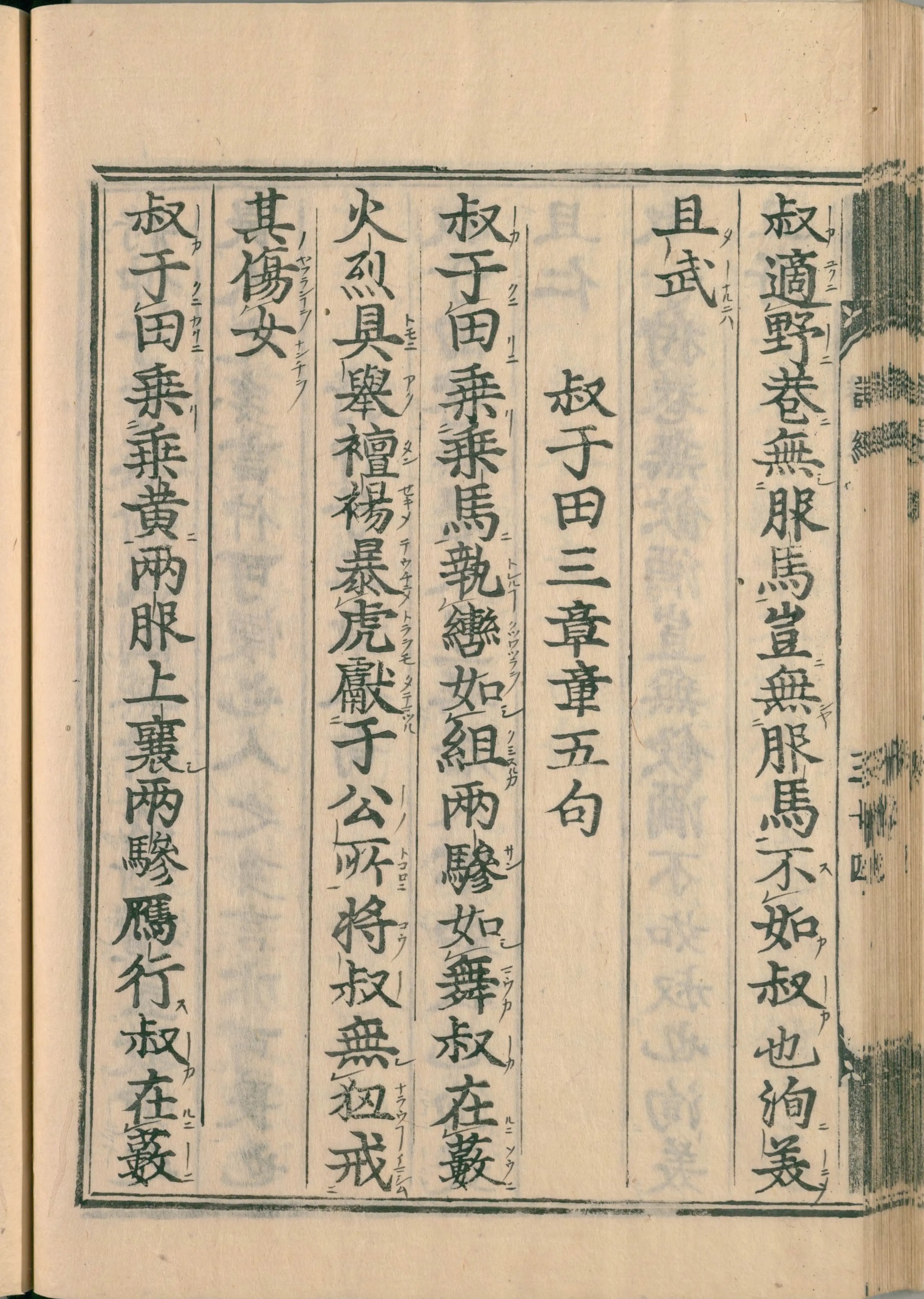
National Diet Library WA7-183, vol. [1], IIIF canvas 51, right-hand page: 7 columns of up to 17 characters, main text only, with Japanese reading marks. Checked on the image: stanza 1 opens column 4 ‹叔于田乘›; stanza 2 opens column 7 ‹叔于田乘›. Other columns on this page: column 3 is the count line of 叔于田 (stanzas and lines). Stanza 2 runs on to canvas 51, left-hand page (first column ‹火烈具揚›). The Chinese shown is the Wikisource Mao text, not a transcription of this print; Legge's English translates the same text.
1叔于田,乘乘馬。執轡如組,兩驂如舞。叔在藪,火烈具舉,襢裼暴虎,獻于公所。將叔無狃,戒其傷女。
2叔于田,乘乘黃。兩服上襄,兩驂鴈行。叔在藪,火烈具揚。叔善射忌,又良御忌,抑磬控忌,抑縱送忌。
1Shuh has gone hunting,
Mounted in his chariot and four.
The reins are in his grasp like ribbons,
While the two outside horses move [with regular steps], as dancers do.
Shuh is at the marshy ground;—
The fire flames out all at once,
And with bared arms he seizes a tiger,
And presents it before the duke.
O Shuh, try not [such sport] again;
Beware of getting hurt.
2Shuh has gone hunting,
Mounted in his chariot with four bay horses.
The two insides are the finest possible animals,
And the two outsides follow them regularly as in a flying flock of wild geese.
Shuh is at the marshy ground;—
The fire blazes up all at once.
A skilful archer is Shuh!
A good charioteer also!
Now he gives his horses the reins; now he brings them up;
Now he discharges his arrow; now he follows it.
Where on the image
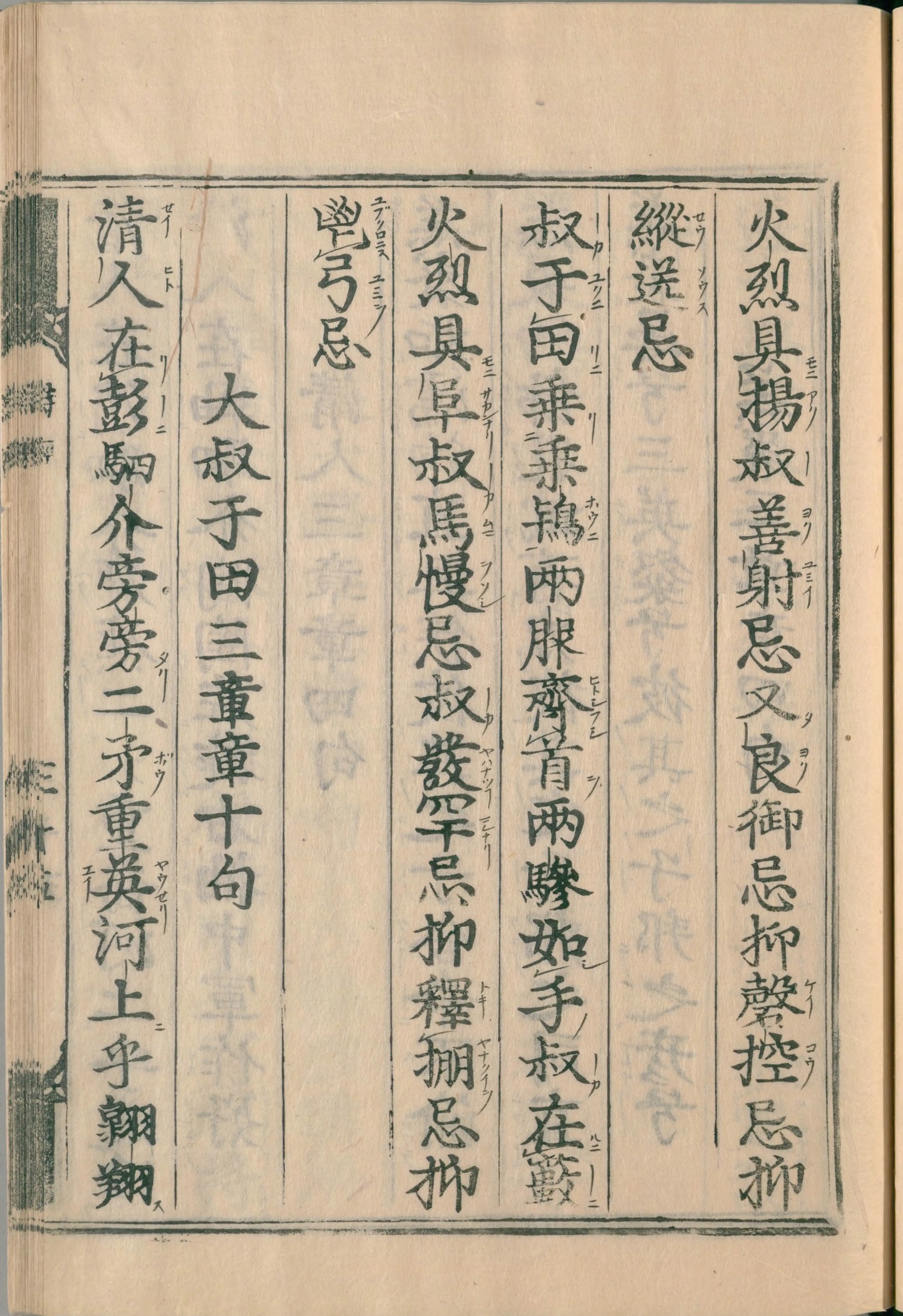
National Diet Library WA7-183, vol. [1], IIIF canvas 51, left-hand page: 7 columns of up to 17 characters, main text only, with Japanese reading marks. Checked on the image: stanza 3 opens column 3 ‹叔于田乘›. Other columns on this page: column 6 is the count line of 大叔于田 (stanzas and lines). The Chinese shown is the Wikisource Mao text, not a transcription of this print; Legge's English translates the same text.
3叔于田,乘乘鴇。兩服齊首,兩驂如手。叔在藪,火烈具阜。叔馬慢忌,叔發罕忌,抑釋掤忌,抑鬯弓忌。
3Shuh has gone hunting,
Mounted in his chariot with four grey horses.
His two insides have their heads in a line,
And the two outsides come after like arms.
Shuh is at the marsh;—
The fire spreads grandly all together.
His horses move slowly;
He shoots but seldom;
Now he lays aside his quiver;
Now he returns his bow to the case.
Notes
- English: James Legge, The She King, The Chinese Classics vol. IV part I (1871), Part I, Lessons from the States, Book 7, ode IV (Shuh yu t'een). Stanzas are numbered as in Legge and the Mao text.
- Transcribed for this library from the page images: lines read alike by two OCR programs were kept, and every other line was read on the image (data/sources/shijing/legge1871/). Legge's notes are left out.
Cite
Sources
- Source: National Diet Library WA7-183 (Keicho-era movable-type print of the Shijing, vol. 1) + Wikisource Mao text + James Legge, The She King (Chinese Classics IV, 1871) (holding institution)
- Critical edition: Mao text (Wikisource)
← previous · → next · v cycle view · l back to library