Book of Odes, Mao 82: Nü yue ji ming 女曰鷄鳴 (Keicho-era print)
Introduction
女曰鷄鳴 (Nü yue ji ming, Mao 82) is ode VIII of 鄭風 Zheng feng ("the Airs of Zheng"), the seventh book of the Airs of the States (國風 Guofeng), the 160 songs of the regional states that open the Book of Odes (詩經 Shijing). The Airs are generally dated to the Western and early Eastern Zhou (about the 10th to 7th century BCE). It has 3 stanzas.
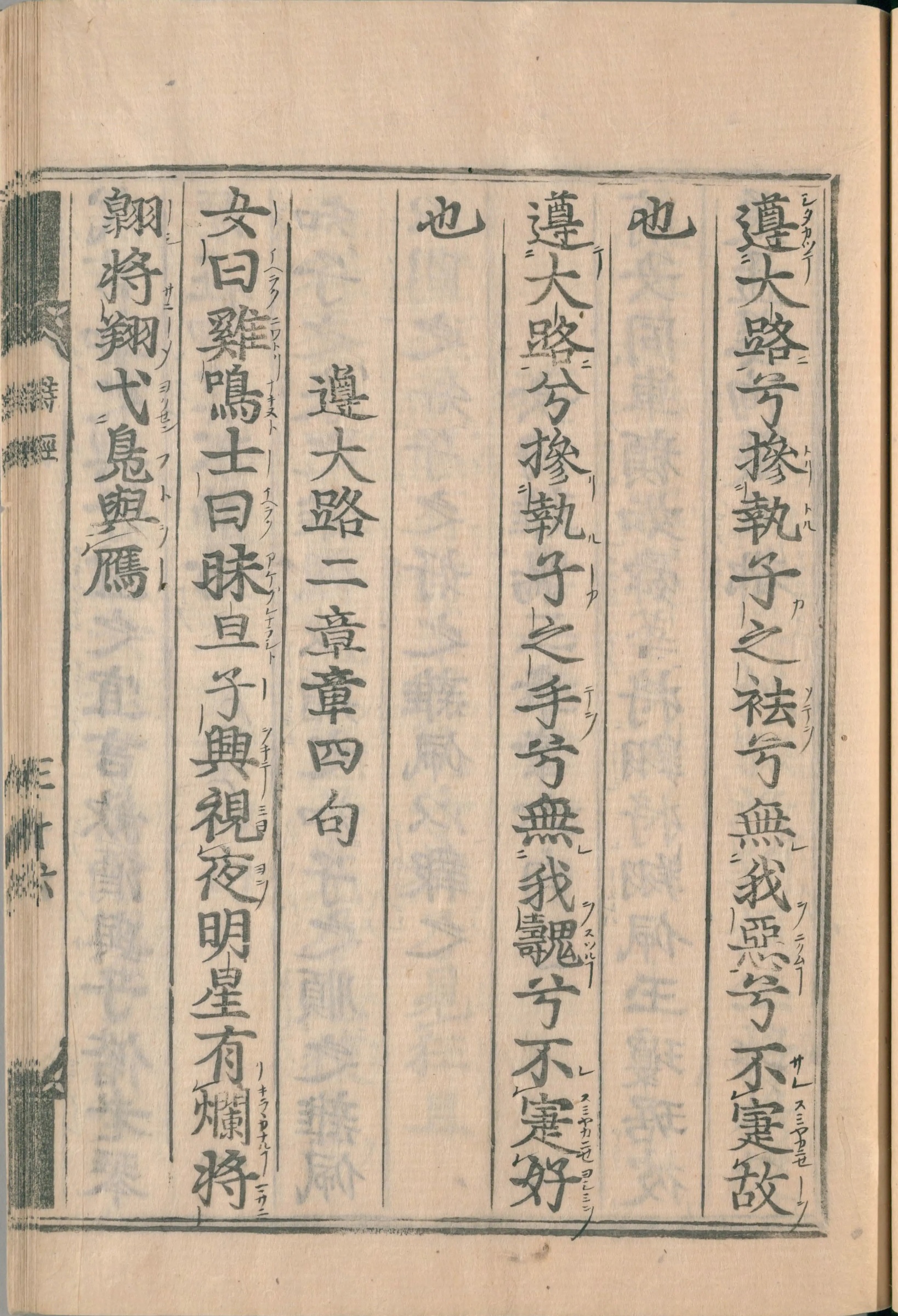
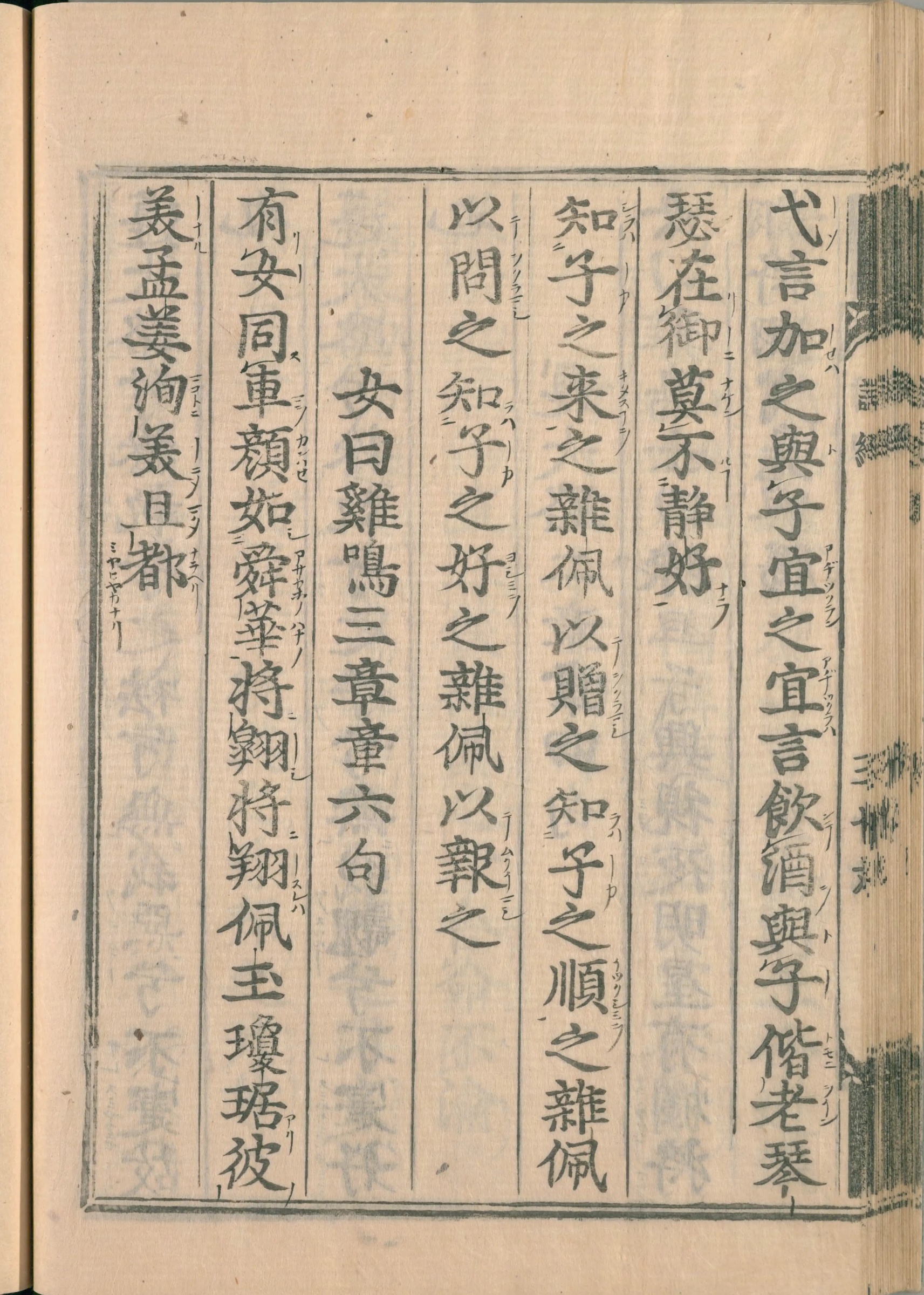
The photographs are of a copy of the Book of Odes in the National Diet Library, Tokyo (call no. WA7-183), printed with movable type in Japan in the Keicho era (1596-1615): main text only, seven columns of seventeen characters to the page, with Japanese reading marks added by hand. Each stanza begins a new column, and a line giving the count of stanzas and lines follows each ode. In this copy the ode runs from canvas 52, left-hand page to canvas 53, right-hand page of the first volume. Each section gathers the stanzas that begin on one page and links to that page and to any page the last stanza runs onto; the page boundaries were found by reading the first characters of every column on the photographs.
The Chinese is the Mao text from Wikisource. The English is James Legge's prose translation in The Chinese Classics, volume IV, part I (1871), Part I, Book 7, ode VIII (Neu yueh ke ming), page 134-136; his notes are not reproduced. Words in square brackets are Legge's own additions.
How was this verified? (Provenance)
Where on the image
National Diet Library WA7-183, vol. [1], IIIF canvas 52, left-hand page: 7 columns of up to 17 characters, main text only, with Japanese reading marks. Checked on the image: stanza 1 opens column 6 ‹女曰鷄鳴›. Other columns on this page: column 5 is the count line of 遵大路 (stanzas and lines). The Chinese shown is the Wikisource Mao text, not a transcription of this print; Legge's English translates the same text.
1女曰鷄鳴,士曰昧旦。子興視夜,明星有爛。將翱將翔,弋鳧與鴈。
1Says the wife, 'It is cock-crow;'
Says the husband, 'It is grey dawn.'
'Rise, Sir, and look at the night,—
If the morning star be not shining.
Bestir yourself, and move about,
To shoot the wild ducks and geese.
Where on the image
National Diet Library WA7-183, vol. [1], IIIF canvas 53, right-hand page: 7 columns of up to 17 characters, main text only, with Japanese reading marks. Checked on the image: stanza 2 opens column 1 ‹弋言加之›; stanza 3 opens column 3 ‹知子之來›. Other columns on this page: column 5 is the count line of 女曰鷄鳴 (stanzas and lines). The Chinese shown is the Wikisource Mao text, not a transcription of this print; Legge's English translates the same text.
2弋言加之,與子宜之。宜言飲酒,與子偕老。琴瑟在御,莫不靜好。
3知子之來之,雜佩以贈之。知子之順之,雜佩以問之。知子之好之,雜佩以報之。
2'When your arrows and line have found them,
I will dress them fitly for you.
When they are dressed, we will drink [together over them],
And I will hope to grow old with you.
Your lute in your hands
Will emit its quiet pleasant tones.
3'When I know those whose acquaintance you wish,
I will give them of the ornaments of my girdle.
When I know those with whom you are cordial,
I will send to them of the ornaments of my girdle.
When I know those whom you love,
I will repay their friendship from the ornaments of my girdle.
Notes
- English: James Legge, The She King, The Chinese Classics vol. IV part I (1871), Part I, Lessons from the States, Book 7, ode VIII (Neu yueh ke ming). Stanzas are numbered as in Legge and the Mao text.
- Transcribed for this library from the page images: lines read alike by two OCR programs were kept, and every other line was read on the image (data/sources/shijing/legge1871/). Legge's notes are left out.
Cite
Sources
- Source: National Diet Library WA7-183 (Keicho-era movable-type print of the Shijing, vol. 1) + Wikisource Mao text + James Legge, The She King (Chinese Classics IV, 1871) (holding institution)
- Critical edition: Mao text (Wikisource)
← previous · → next · v cycle view · l back to library