Book of Odes, Mao 9: Han guang 漢廣 (Keicho-era print)
Introduction
漢廣 (Han guang, Mao 9) is ode IX of 周南 Zhou nan ("the South of Zhou"), the first book of the Airs of the States (國風 Guofeng), the 160 songs of the regional states that open the Book of Odes (詩經 Shijing). The Airs are generally dated to the Western and early Eastern Zhou (about the 10th to 7th century BCE). It has 3 stanzas.
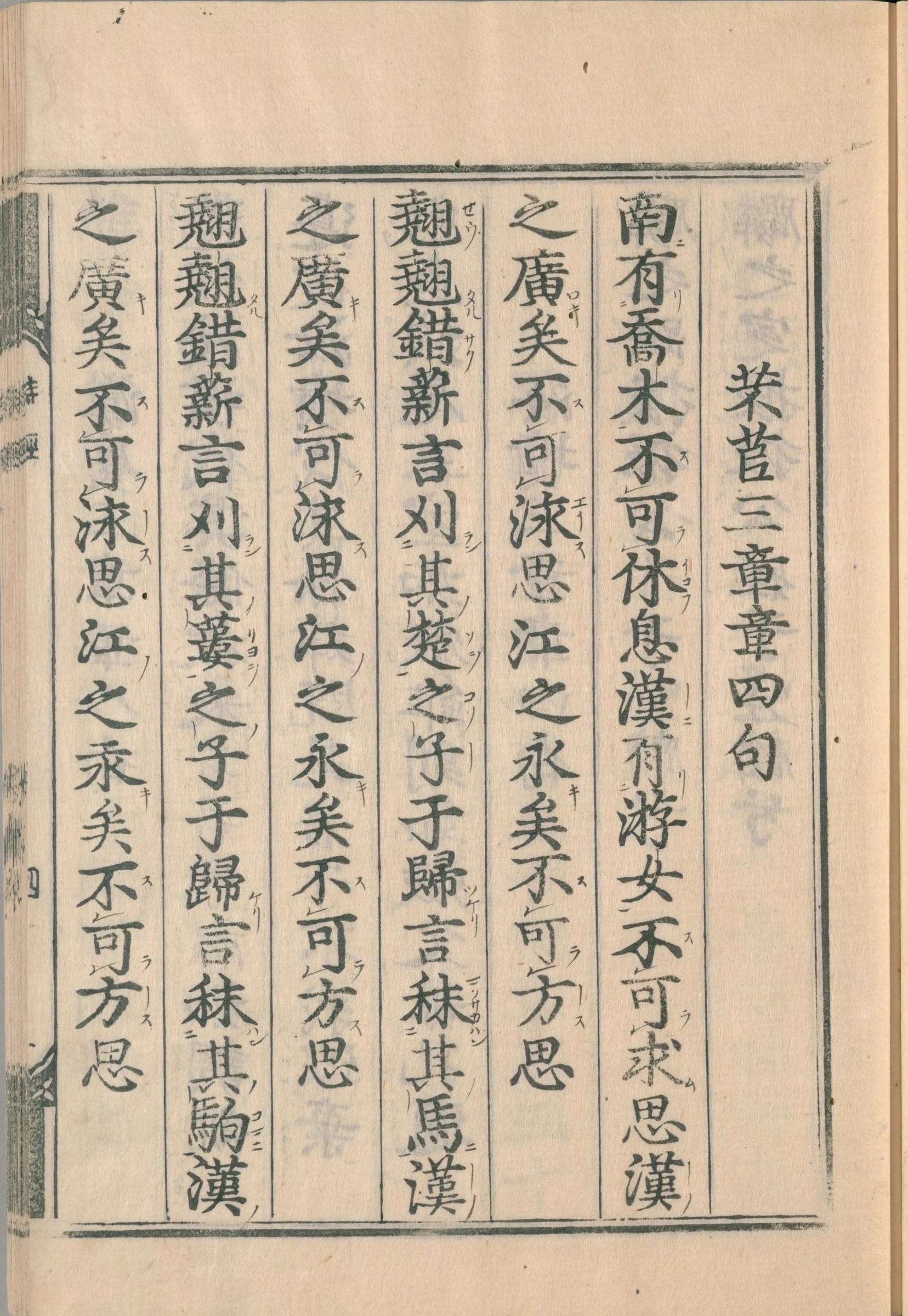
The photographs are of a copy of the Book of Odes in the National Diet Library, Tokyo (call no. WA7-183), printed with movable type in Japan in the Keicho era (1596-1615): main text only, seven columns of seventeen characters to the page, with Japanese reading marks added by hand. Each stanza begins a new column, and a line giving the count of stanzas and lines follows each ode. In this copy the ode runs from canvas 20, left-hand page to canvas 21, right-hand page of the first volume. Each section gathers the stanzas that begin on one page and links to that page and to any page the last stanza runs onto; the page boundaries were found by reading the first characters of every column on the photographs.
The Chinese is the Mao text from Wikisource. The English is James Legge's prose translation in The Chinese Classics, volume IV, part I (1871), Part I, Book 1, ode IX (Han kwang), page 15-17; his notes are not reproduced. Words in square brackets are Legge's own additions.
How was this verified? (Provenance)
Where on the image
National Diet Library WA7-183, vol. [1], IIIF canvas 20, left-hand page: 7 columns of up to 17 characters, main text only, with Japanese reading marks. Checked on the image: stanza 1 opens column 2 ‹南有喬木›; stanza 2 opens column 4 ‹翹翹錯薪›; stanza 3 opens column 6 ‹翹翹錯薪›. Other columns on this page: column 1 is the count line of 芣苢 (stanzas and lines). The Chinese shown is the Wikisource Mao text, not a transcription of this print; Legge's English translates the same text.
1南有喬木,不可休息;漢有游女,不可求思,漢之廣矣,不可泳思,江之永矣,不可方思。
2翹翹錯薪,言刈其楚,之子于歸,言秣其馬,漢之廣矣,不可泳思,江之永矣,不可方思。
3翹翹錯薪,言刈其蔞,之子于歸,言秣其駒,漢之廣矣,不可泳思,江之永矣,不可方思。
1In the south rise the trees without branches,
Affording no shelter.
By the Han are girls rambling about,
But it is vain to solicit them.
The breadth of the Han
Cannot be dived across;
The length of the Këang
Cannot be navigated with a raft.
2Many are the bundles of firewood;
I would cut down the thorns [to form more].
Those girls that are going to their future home,—
I would feed their horses.
The breadth of the Han
Cannot be dived across;
The length of the Këang
Cannot be navigated with a raft.
3Many are the bundles of firewood;
I would cut down the southernwood [to form more].
Those girls that are going to their future home,—
I would feed their colts.
The breadth of the Han
Cannot be dived across;
The length of the Këang
Cannot be navigated with a raft.
Notes
- English: James Legge, The She King, The Chinese Classics vol. IV part I (1871), Part I, Lessons from the States, Book 1, ode IX (Han kwang). Stanzas are numbered as in Legge and the Mao text.
- Transcribed for this library from the page images: lines read alike by two OCR programs were kept, and every other line was read on the image (data/sources/shijing/legge1871/). Legge's notes are left out.
Cite
Sources
- Source: National Diet Library WA7-183 (Keicho-era movable-type print of the Shijing, vol. 1) + Wikisource Mao text + James Legge, The She King (Chinese Classics IV, 1871) (holding institution)
- Critical edition: Mao text (Wikisource)
← previous · → next · v cycle view · l back to library