Book of Odes, Mao 93: Chu qi dong men 出其東門 (Keicho-era print)
Introduction
出其東門 (Chu qi dong men, Mao 93) is ode XIX of 鄭風 Zheng feng ("the Airs of Zheng"), the seventh book of the Airs of the States (國風 Guofeng), the 160 songs of the regional states that open the Book of Odes (詩經 Shijing). The Airs are generally dated to the Western and early Eastern Zhou (about the 10th to 7th century BCE). It has 2 stanzas.
The photographs are of a copy of the Book of Odes in the National Diet Library, Tokyo (call no. WA7-183), printed with movable type in Japan in the Keicho era (1596-1615): main text only, seven columns of seventeen characters to the page, with Japanese reading marks added by hand. Each stanza begins a new column, and a line giving the count of stanzas and lines follows each ode. In this copy the ode runs from canvas 56, right-hand page to canvas 56, left-hand page of the first volume. Each section gathers the stanzas that begin on one page and links to that page and to any page the last stanza runs onto; the page boundaries were found by reading the first characters of every column on the photographs.
The Chinese is the Mao text from Wikisource. The English is James Legge's prose translation in The Chinese Classics, volume IV, part I (1871), Part I, Book 7, ode XIX (Ch'uh k'e tung mun), page 146-146; his notes are not reproduced. Words in square brackets are Legge's own additions.
How was this verified? (Provenance)
Where on the image
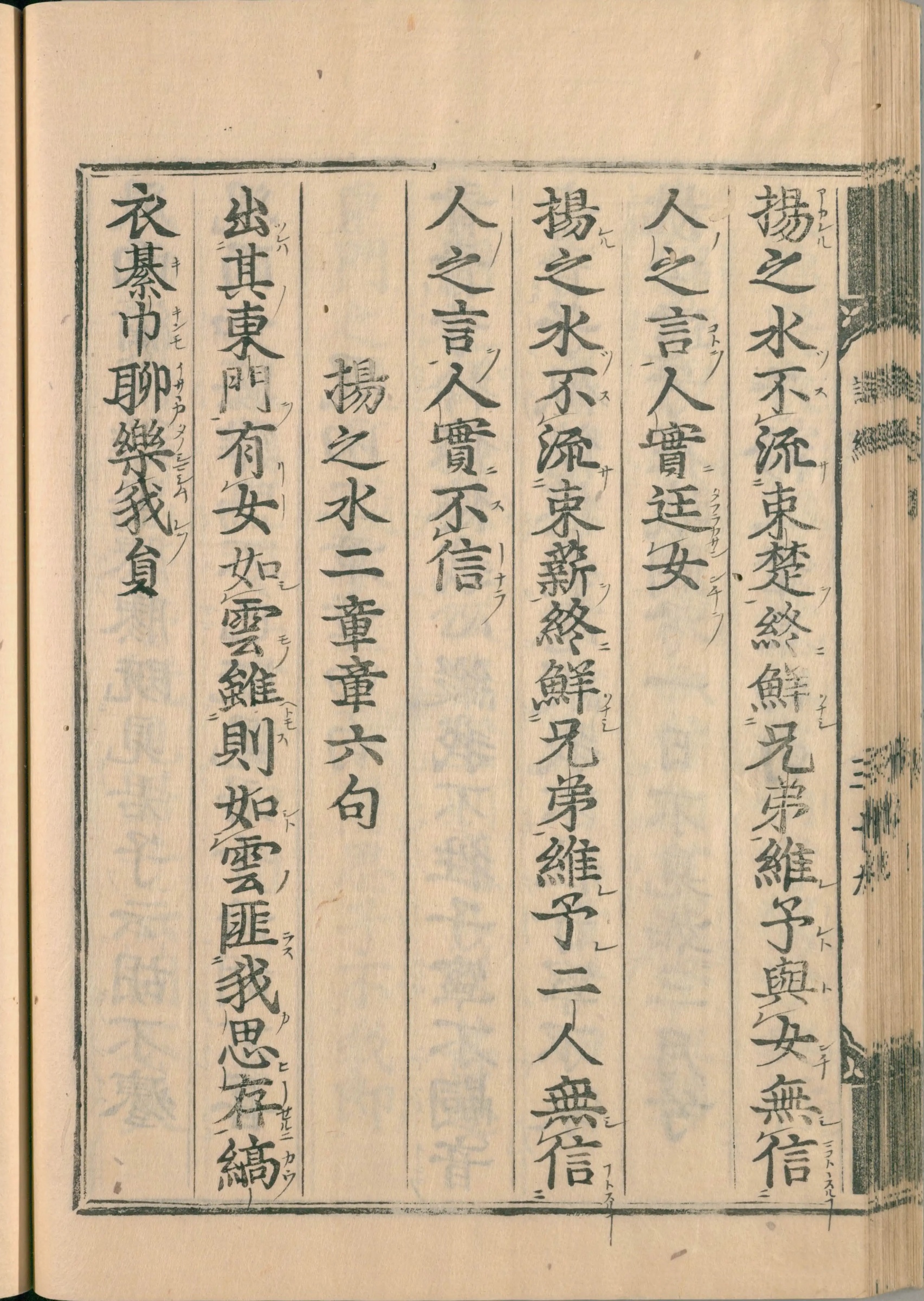
National Diet Library WA7-183, vol. [1], IIIF canvas 56, right-hand page: 7 columns of up to 17 characters, main text only, with Japanese reading marks. Checked on the image: stanza 1 opens column 6 ‹出其東門›. Other columns on this page: column 5 is the count line of 揚之水 (stanzas and lines). The Chinese shown is the Wikisource Mao text, not a transcription of this print; Legge's English translates the same text.
1出其東門,有女如雲。雖則如雲,匪我思存。縞衣綦巾,聊樂我員。
1I went out at the east gate,
Where the girls were in clouds.
Although they are like clouds,
It is not on them that my thoughts rest.
She in the thin white silk, and the grey coiffure,—
She is my joy!
Where on the image
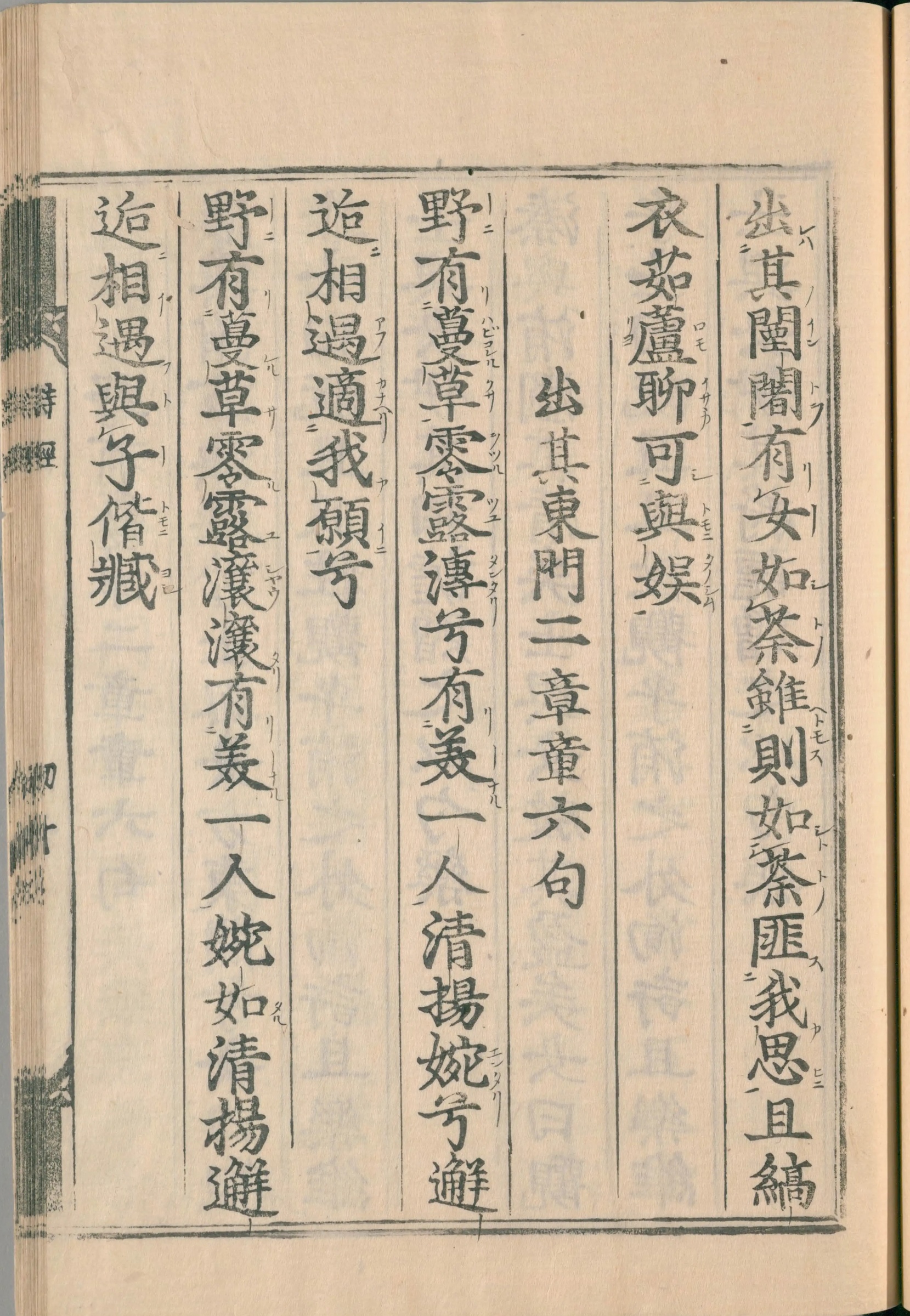
National Diet Library WA7-183, vol. [1], IIIF canvas 56, left-hand page: 7 columns of up to 17 characters, main text only, with Japanese reading marks. Checked on the image: stanza 2 opens column 1 ‹出其闉闍›. Other columns on this page: column 3 is the count line of 出其東門 (stanzas and lines). The Chinese shown is the Wikisource Mao text, not a transcription of this print; Legge's English translates the same text.
2出其闉闍,有女如荼。雖則如荼,匪我思且。縞衣茹藘,聊可與娛。
2I went out by the tower on the covering wall,
Where the girls were like flowering rushes.
Although they are like flowering rushes,
It is not of them that I think.
She in the thin white silk, and the madder-[dyed coiffure],—
It is she that makes me happy!
Notes
- English: James Legge, The She King, The Chinese Classics vol. IV part I (1871), Part I, Lessons from the States, Book 7, ode XIX (Ch'uh k'e tung mun). Stanzas are numbered as in Legge and the Mao text.
- Transcribed for this library from the page images: lines read alike by two OCR programs were kept, and every other line was read on the image (data/sources/shijing/legge1871/). Legge's notes are left out.
Cite
Sources
- Source: National Diet Library WA7-183 (Keicho-era movable-type print of the Shijing, vol. 1) + Wikisource Mao text + James Legge, The She King (Chinese Classics IV, 1871) (holding institution)
- Critical edition: Mao text (Wikisource)
← previous · → next · v cycle view · l back to library