Tale of the Shipwrecked Sailor: lines 24-50 (the shipwreck)
Introduction
The Tale of the Shipwrecked Sailor is a Middle Kingdom story told by an attendant to his master, an official returning from an expedition to the south: he once sailed for the king's mines, was wrecked, and was cast up alone on an island ruled by a great serpent, who told him his own story and sent him home with gifts. Its only copy is papyrus Hermitage 1115 in St Petersburg, 189 lines of hieratic of the 12th Dynasty (about 1990-1800 BCE), of unknown provenance, first made known by W. Golenischeff in 1881 and published in full facsimile by him in 1913.
This entry gives lines 24-50, the sailor's voyage and shipwreck and his first day on the island. They are the only lines of the papyrus with openly licensed photographs: two photographs of the roll in its display case, each showing one run of vertical columns. Lines 1-23 and 51-189 (the meeting with the serpent and the return home) are not given here.
The Egyptian is the transliteration of the Thesaurus Linguae Aegyptiae (edition by Peter Dils and Heinz Felber) with its line numbers; the TLA labels '30-31' and '40-41' mark words it places between two columns. Signs restored by the editor are in square brackets, signs the scribe left out in angle brackets, signs written in error in braces, damaged signs in half brackets. The hieroglyphic transcription is the TLA's. The English is W. M. Flinders Petrie's free translation of 1895/1899; it does not follow the lines, so each section takes whole sentences of Petrie and its note says where they run past the photographed lines.
How was this verified? (Provenance)
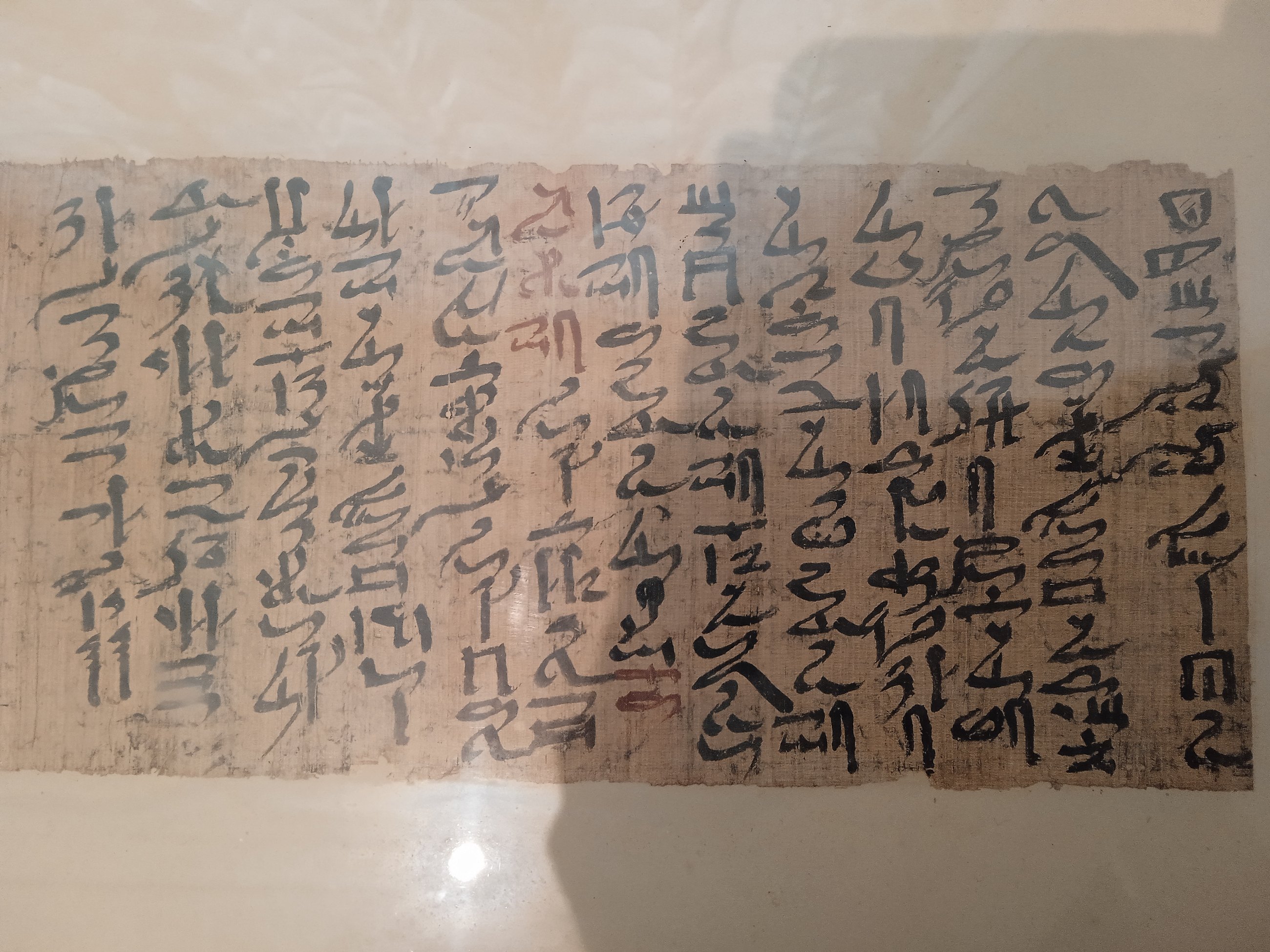
Where on the image
Lines 24-36 are the 13 columns of the first photograph, read from the right-hand edge (line 24, beginning n〈,j〉 jtj, 'of the sovereign') to the left-hand edge (line 36). Petrie's sentence 'I was going to the mines of Pharaoh' begins with the last words of line 23 (šm.kw r bjꜣ), in the column just to the right of the photograph. The last words of line 36 (jn ḫt ḥwi̯) begin the next sentence and are translated in the next section ('As for me, I seized a piece of wood').
24n〈,j〉 jtj hꜣi̯.kw
25r wꜣḏ-wr m dp,t
26n.t mḥ 120 m ꜣw =s mḥ 40 m sḫw =s
27sqd 120 jm =s
28m stp n〈,j〉 Km,t mꜣ =sn
29p,t mꜣ =sn tꜣ mꜥkꜣ
30jb =sn r mꜣ〈j〉.w.pl
30-31sr =sn
31ḏꜥ n jj.t nšnj
32n ḫpr.t =f ḏꜥ pri̯
33jw =n m wꜣḏ-wr tp-ꜥ
34sꜣḥ =n tꜣ fꜣi̯.t ṯꜣw
35jri̯ =f wḥmy,t nwy,t
36jm =f n.t mḥ 8 jn ḫt ⸢ḥ{ḥ}〈wi̯〉⸣
Compare: Hieroglyphic transcription (TLA, Unicode)
24𓈖 𓆊𓆊𓅆 𓉔𓄿𓂻𓎢𓅱𓀀
25𓂋 𓇆𓅨𓂋𓈘 𓅓 𓂧𓊪𓏏𓊛
26𓈖𓏏 𓎔𓂝 𓍢𓎆𓎆 𓅓 𓄫𓏲 𓋴 𓎔𓂝 40 𓅓 𓋴𓐍𓅱𓎺 𓋴
27sqd 𓍢𓎆𓎆 𓇋𓅓 𓋴
28𓅓 𓍉𓏛 𓈖 𓆎𓅓𓏏𓊖 𓌳𓁹𓄿 𓋴𓈖𓏥
29𓊪𓏏𓇯 𓌳𓁹𓄿 𓋴𓈖𓏥 𓇾𓈇𓏤 𓅓𓂝𓎢𓄿𓂝
30𓄣𓏤 𓋴𓈖𓏥 𓂋 𓌳𓁹𓄿𓅱𓄛𓏥
30-31𓊃𓂋𓃩𓀁 𓋴𓈖𓏥
31𓆓𓂝𓊡 𓂜 𓇍𓇋𓏏𓂻 𓈖𓈙𓈖𓏭𓃩𓀜
32𓂜 𓆣𓂋𓏏 𓆑 𓆓𓂝𓊡 𓉐𓂋𓂻
33𓇋𓅱 𓈖𓏥 𓅓 𓇆𓅨𓂋𓈘 𓁶𓏤𓂝𓏤
34𓃃𓏛 𓈖𓏥 𓇾𓈇𓏤 𓆑𓄿𓏏𓀋𓂝 𓊡𓅱
35𓁹 𓆑 𓄙𓅓𓇋𓇋𓏏𓀁 𓈖𓍇𓏌𓏲𓇋𓇋𓏏𓈗
36𓇋𓅓 𓆑 𓈖𓏏 𓎔𓂝 8 𓇋𓈖 𓆱𓏏𓏤 𓎛𓎛𓀝𓀜
I was going to the mines of Pharaoh, and I went down on the sea on a ship of 150 cubits long and 40 cubits wide, with 150 sailors of the best of Egypt, who had seen heaven and earth, and whose hearts were stronger than lions. They had said that the wind would not be contrary, or that there would be none. But as we approached the land the wind arose, and threw up waves eight cubits high.
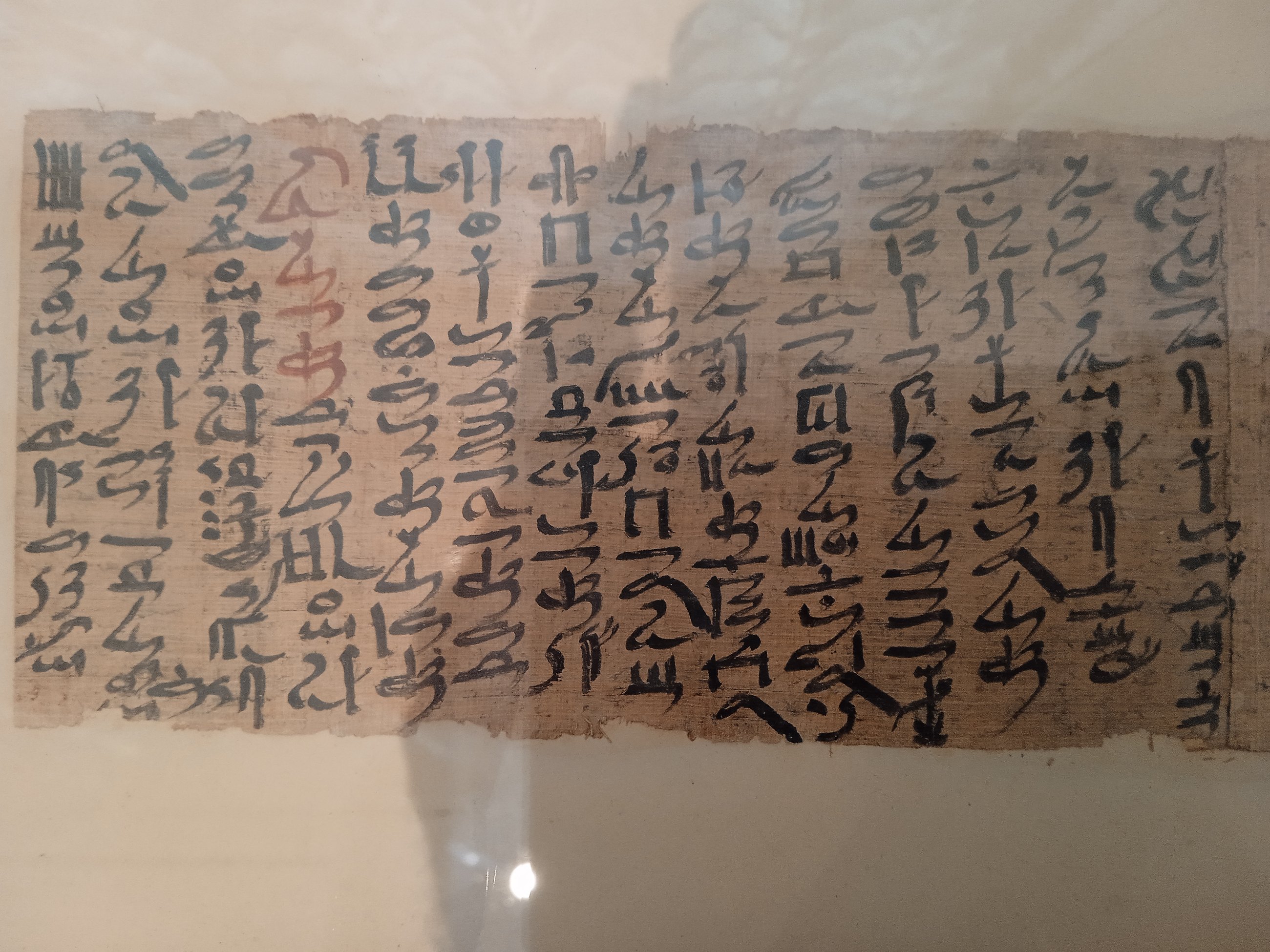
Where on the image
Lines 37-50 are the 14 columns of the second photograph, read from the right-hand edge (line 37) to the left-hand edge (line 50); the 11th column from the right (line 47, 'I found there figs and grapes') begins in red ink. 'As for me, I seized a piece of wood' begins with the last words of line 36, at the left edge of the first photograph; 'and birds' (ḥnꜥ ꜣpd.w.pl) is the beginning of line 51, in the column just to the left of this photograph.
37n =j ⸢s〈j〉⸣ ꜥḥꜥ.n dp,t
38m〈w〉t〈.tj〉 ntj.w jm =s n spi̯
39wꜥ jm ꜥḥꜥ.n =j rḏi̯.kw
40r jw jn wꜣw n〈,j〉
40-41wꜣḏ-wr
41jri̯.n =j hrw 3 wꜥi̯.kw
42jb =j m sn,nw.du =j sḏr.kw
43m-ẖnw-n kꜣp
44n〈,j〉 ḫt qnj.n =j šwy,t
45ꜥḥꜥ.n dwn.n =j rd.du =j
46r rḫ ḏi̯.t =j m rʾ =j
47gmi̯.n =j dꜣb.pl jꜣrr,t.pl
48jm jꜣq,t nb.t šps.t
49kꜣ.w.pl jm ḥnꜥ nq,wt.pl
50sšp,t.pl mj jri̯.t〈w〉 =s rm.w.pl
Compare: Hieroglyphic transcription (TLA, Unicode)
37𓈖 𓀀 𓋴 𓊢𓂝𓈖 𓂧𓊪𓏏𓊛
38𓅓𓏏𓏱 𓈖𓏏𓅂𓏥 𓇋𓅓 𓋴 𓂜 𓊃𓊪𓊗
39𓌡𓏲𓂝𓀀𓏤 𓇋𓅓 𓊢𓂝𓈖 𓀀 𓂋𓂝𓎢𓅱𓀀
40𓂋 𓈀𓈇𓏤 𓇋𓈖 𓍯𓄿𓅱𓈗 𓈖
40-41𓇆𓅨𓂋𓈘
41𓁹𓈖 𓀀 𓉔𓂋𓅱𓇳 3 𓌡𓏲𓂝𓏤𓅪𓎢𓏲𓀀
42𓄣𓏤 𓀀 𓅓 sn,nw.du 𓀀 𓊃𓇥𓂋𓁀𓎢𓅱𓀀
43𓅓𓄚𓈖𓏌𓏲𓉐𓈖 𓎢𓄿𓊪𓐡𓉐
44𓈖 𓆱𓏏𓏤 𓈎𓈖𓇋𓂘𓂝𓈖 𓀀 𓆄𓏲𓇋𓇋𓏏𓇳
45𓊢𓂝𓈖 𓂧𓃹𓈖𓂻𓈖 𓀀 𓂋𓂧𓂾𓂾 𓀀
46𓂋 𓂋𓐍𓏛 𓂝𓏏 𓀀 𓅓 𓂋𓏤 𓀀
47𓅠𓅓𓈖 𓀀 𓂧𓄿𓃀𓇭𓈒𓏥 𓇋𓄿𓂋𓂋𓏏𓁺𓈒𓏥
48𓇋𓅓 𓇋𓄿𓈎𓏏𓆰𓏫 𓎟𓏏 𓀻𓋴𓏏𓏛
49𓎢𓄿𓅱𓈒𓏥 𓇋𓅓 𓎛𓈖𓂝 𓈖𓈎𓅱𓏏𓈒𓏥
50𓊏𓊪𓏏𓈒𓏥 𓏇𓇋 𓁹𓏏 𓋴 𓂋𓅓𓏲𓆟𓏥
As for me, I seized a piece of wood; but those who were in the vessel perished, without one remaining. A wave threw me on an island, after that I had been three days alone, without a companion beside my own heart. I laid me in a thicket, and the shadow covered me. Then stretched I my limbs to try to find something for my mouth. I found there figs and grapes, all manner of good herbs, berries and grain, melons of all kinds, fishes and birds.
Notes
- Petrie gives the ship as 150 cubits long with 150 sailors; the TLA text reads 120 (mḥ 120, sqd 120) in lines 26-27.
- Petrie's 'mines of Pharaoh' renders bjꜣ n〈,j〉 jtj, 'the mine of the sovereign' (lines 23-24).
Cite
Sources
- Source: Papyrus Hermitage 1115 (photographs on Wikimedia Commons, CC BY-SA 4.0) + TLA transliteration and hieroglyphs (AED-TEI, CC BY-SA 4.0) + W. M. F. Petrie, Egyptian Tales I (1895/1899) (holding institution)
- Critical edition: Thesaurus Linguae Aegyptiae, ed. P. Dils and H. Felber (2018 data, AED-TEI)
← previous · → next · v cycle view · l back to library