Siloam inscription (Hezekiah's tunnel), Istanbul 2195 T
Introduction
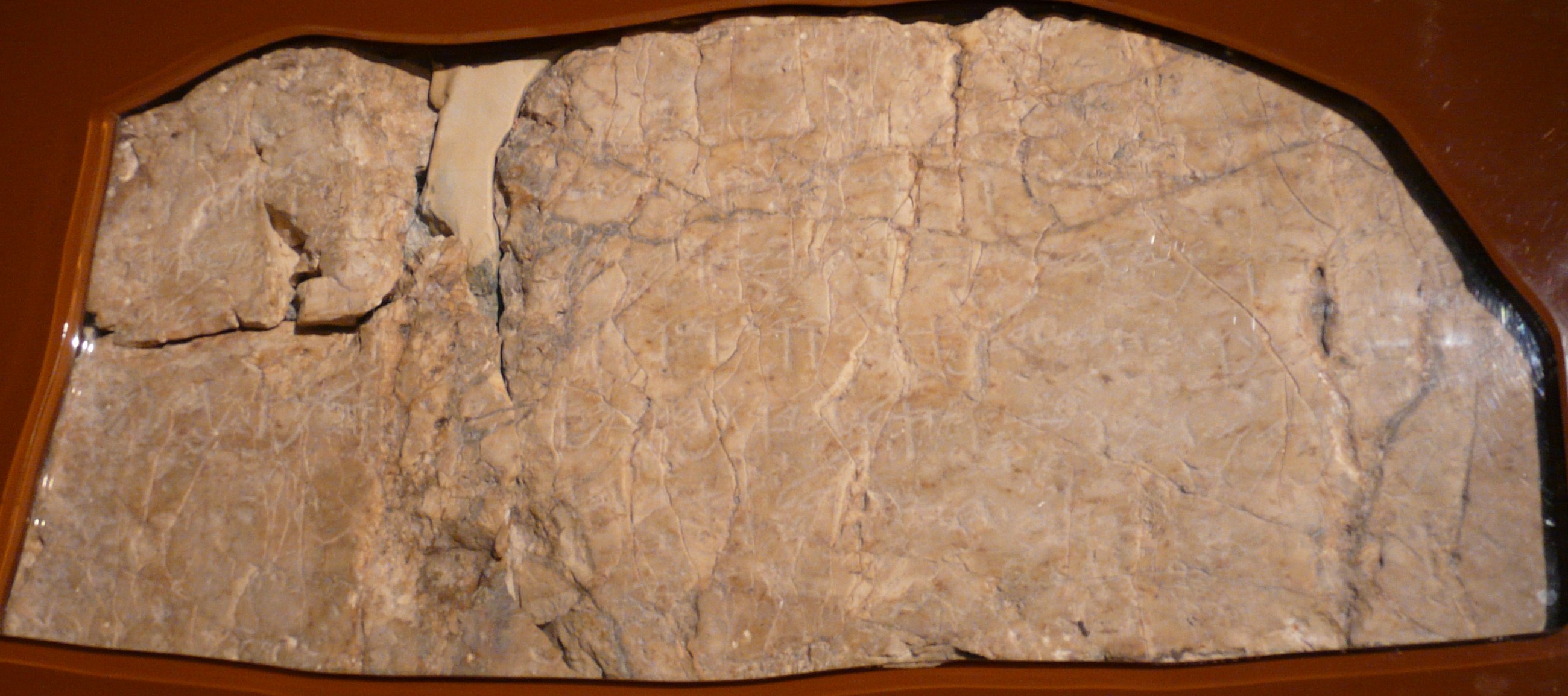
The Siloam inscription was cut into the rock wall of the water tunnel that brings the water of the Gihon spring under the City of David to the Pool of Siloam in Jerusalem. In six lines of Hebrew in the old Hebrew script it tells how two teams of miners, digging from opposite ends, heard each other's voices through the rock and broke through, and how the water then flowed 1200 cubits from the spring to the pool. The tunnel is generally identified with the work of Hezekiah, king of Judah (late 8th century BCE), recorded in the Old Testament: 'he made a pool, and a conduit, and brought water into the city' (2 Kings 20:20; compare 2 Chronicles 32:30).
The inscription was noticed in 1880 near the southern end of the tunnel. In 1891 it was cut out of the wall, breaking in the process, and it was taken to Constantinople; it is now in the Istanbul Archaeology Museums (inv. 2195 T).
The text is S. R. Driver's of 1913 in Hebrew square letters, with a letter-for-letter Latin transliteration of the same text and Driver's line-by-line English translation. Asterisks mark letters lost at the broken start of the inscription, square brackets Driver's restorations, and a line over a letter an uncertain reading. Driver's English carries words over the line ends as the stone does ('call-/ing', 'hun-/dred').
How was this verified? (Provenance)
Where on the image
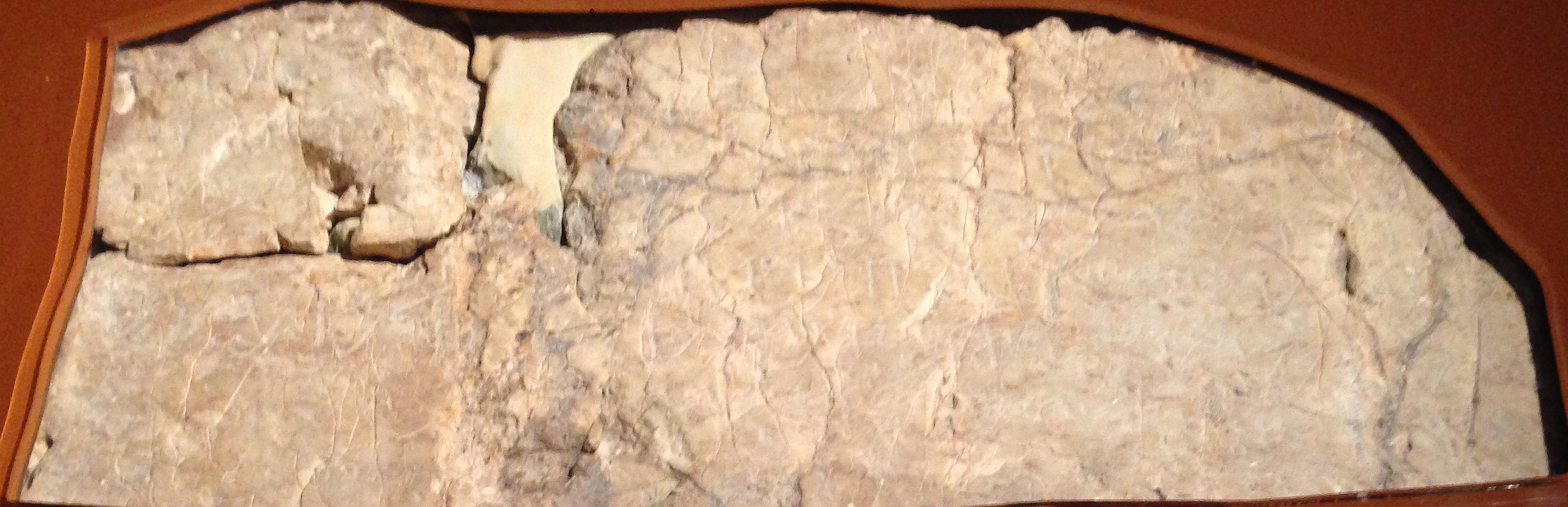
All six lines are on the one inscribed panel, which both photographs show whole (checked on the images: the smoothed panel cut from the tunnel wall in 1891, cracked and with pieces reset at its left end, and the incised letters running right to left across it). Line numbers are Driver's, who prints the text line for line with the stone. Where the text is on the photographs: the panel is the inscribed area itself, and the six lines run across its whole width, each beginning at the right-hand edge (the script reads right to left), line 1 at the top and line 6 near the foot. Line 1, the damaged line, runs through the network of cracks across the upper part of the panel, and its left-hand end is lost at the broken top-left corner; the plaster-filled gap at the top edge and the crack that runs down from it, a quarter of the way in from the left, cut through all the lines (compare the line-by-line facsimile from a squeeze published by the Palestine Exploration Fund, Library of Congress matpc.04121). The letters are shallow incisions on a light, cracked surface and are hard to see at this resolution; with the contrast raised they show as rows of short strokes in the middle of the panel, to the right of that crack. No sharper open photograph of the stone itself was found (Wikimedia Commons, searched 2026-11-12: the other open images show casts, the squeeze or drawings).
1 * * * ה̅נקבה . וזה . היה . דבר . הנקבה . בעוד * * * * * * * * * *1 * * * h̅nqbh . wzh . hyh . dbr . hnqbh . bʿwd * * * * * * * * * *2 ה̅גרזן . אש . אל . רעו . ובעוד . שלש . אמת . להנק̅[ב נשמ]ע . קל . אש . ק2 h̅grzn . ʾš . ʾl . rʿw . wbʿwd . šlš . ʾmt . lhnq̅[b nšm]ʿ . ql . ʾš . q3 רא . אל . רעו . כי . הית . זדה . בצר . מימן . * * * * * * ובים . ה3 rʾ . ʾl . rʿw . ky . hyt . zdh . bṣr . mymn . * * * * * * wbym . h4 נקבה . הכו . החצבם . אש . לקרת . רעו . גרזן . על . גרזן . וילכו .4 nqbh . hkw . hḥṣbm . ʾš . lqrt . rʿw . grzn . ʿl . grzn . wylkw .5 המים . מן . המוצא . אל · הברכה . במאתים̅ . ו̅אלף . אמה . ומא̅5 hmym . mn . hmwṣʾ . ʾl · hbrkh . bmʾtym̅ . w̅ʾlp . ʾmh . wmʾ̅6 ת . אמה . היה . גבה . הצר̅ . על . ראש . החצבם .6 t . ʾmh . hyh . gbh . hṣr̅ . ʿl . rʾš . hḥṣbm .
1[Behold] the piercing through! And this was the manner of the piercing through. Whilst yet [the miners were lifting up]
2the pick, each towards his fellow, and whilst yet there were three cubits to be pierced [through, there was heard] the voice of each call-
3ing to his fellow, for there was a fissure (?) in the rock on the right-hand ........ And on the day of the
4piercing through, the miners (lit. hewers) smote each so as to meet his fellow, pick against pick: and there flowed
5the water from the source to the pool, 1200 cubits; and one hun-
6dred cubits was the height of the rock over the head of the miners.
Notes
- Driver's line over a letter means 'the reading is not quite certain' (Notes, p. viii, note 2); it is shown here as a line over the letter.
- The Latin transliteration is a mechanical letter-for-letter rendering of Driver's square-script text (ʾ b g d h w z ḥ ṭ y k l m n s ʿ p ṣ q r š t); it adds no reading of its own.
Cite
Sources
- Source: Istanbul Archaeology Museums 2195 T, photographs on Wikimedia Commons (CC0) + S. R. Driver's 1913 text and translation (public domain) (holding institution)
- Critical edition: S. R. Driver, Notes on the Hebrew Text ... of Samuel, 2nd ed. (1913), p. ix
← previous · → next · v cycle view · l back to library