Tel Dan stele (House of David inscription), Israel Museum
Introduction
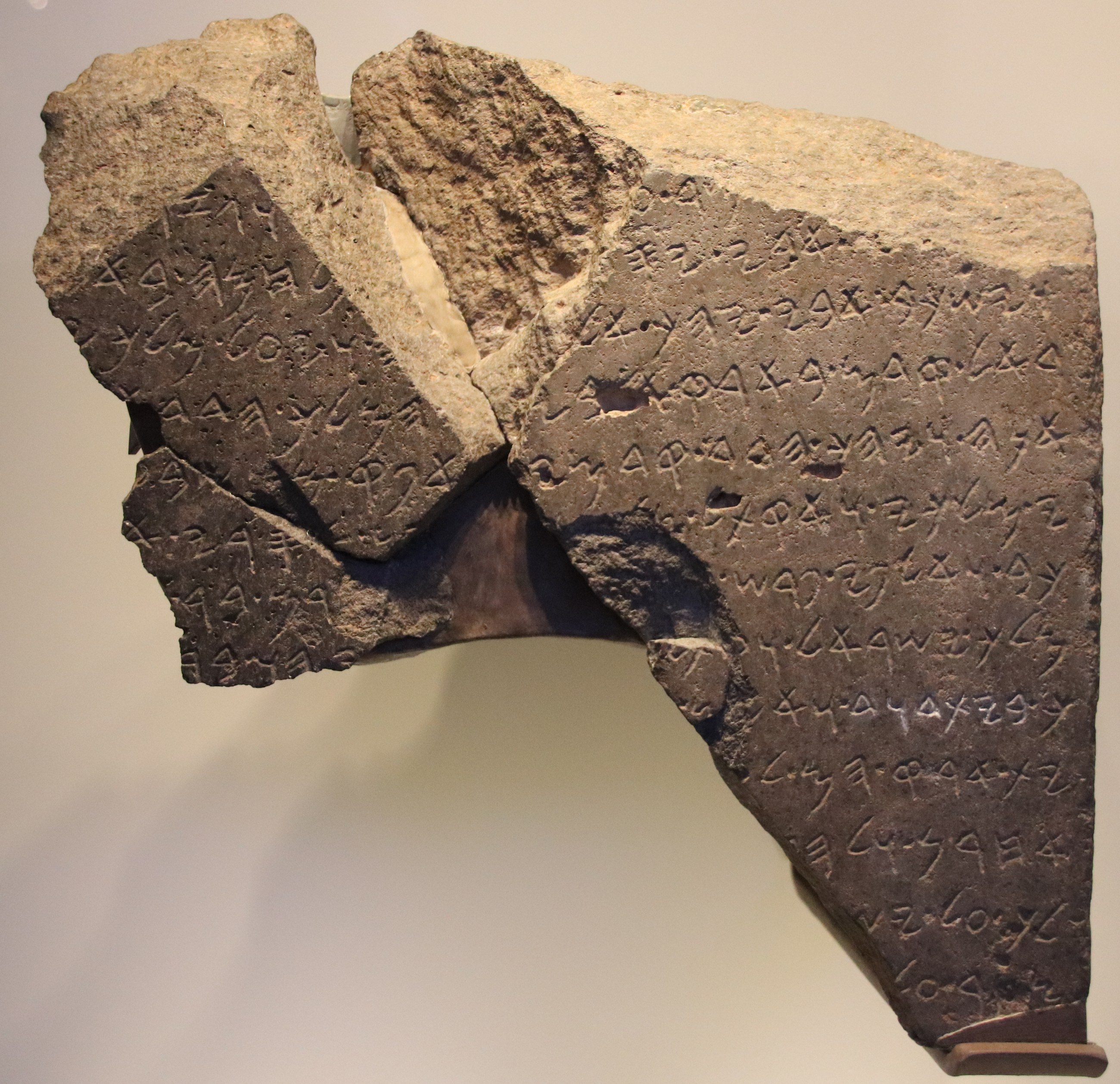
The Tel Dan stele is a broken basalt monument in Old Aramaic, set up at Dan in northern Israel in the second half of the 9th century BCE by a king of Aram-Damascus, usually identified as Hazael. Fragment A was found in 1993 and fragments B1 and B2 in 1994 in the excavations of Avraham Biran. The speaker says that the king of Israel had entered his father's land, that the god Hadad made him king, and that he killed the king of Israel and the king of the 'House of David'. The phrase bytdwd in line 9 is the oldest mention of the dynasty of David outside the Old Testament. Biran and Naveh restore the names as Joram son of Ahab, king of Israel, and Ahaziah son of Joram, of the House of David, the two kings killed by Jehu in 2 Kings 9; the restorations and the join of the fragments are debated. The stele is in the Israel Museum, Jerusalem.
Each line is given in three forms: the Phoenician (Old Aramaic) letters as transcribed by Biran and Naveh, the same letters in Hebrew square script, and a romanization. Dots divide words as on the stone; square brackets are restorations. The English is Biran's translation of 1995. Lines 10-13 survive only in their first few words.
How was this verified? (Provenance)
Where on the image
Lines 1-7 of the thirteen lines on the inscribed face, which the photograph shows whole with all three fragments: fragment A on the right carries the right-hand part of every line (the text runs right to left), fragments B1 and B2 on the left carry the left-hand ends of lines 1-8 in Biran and Naveh's join. Checked on the image: thirteen lines on fragment A, line 9 beginning k.bytdwd with the letters of bytdwd picked out in white by the museum. Square brackets mark Biran and Naveh's restorations, which are not on the stone; their join of fragment B to fragment A, followed in the museum display, is not accepted by every scholar.
1 [ 𐤀]𐤌𐤓.𐤏[ ]𐤅𐤂𐤆𐤓[ ]1 [ א]מר.ע[ ]וגזר[ ]1 [ ʾ]mr.ʿ[ ]wgzr[ ]2 [ ---].𐤀𐤁𐤉.𐤉𐤎𐤒[.𐤏𐤋𐤅𐤄.𐤁𐤄]𐤕𐤋𐤇𐤌𐤄.𐤁𐤀[ ]2 [ ---].אבי.יסק[.עלוה.בה]תלחמה.בא[ ]2 [ ---].ʾby.ysq[.ʿlwh.bh]tlḥmh.bʾ[ ]3 𐤅𐤉𐤔𐤊𐤁.𐤀𐤁𐤉.𐤉𐤄𐤊.𐤀𐤋[.𐤀𐤁𐤄𐤅]𐤄.𐤅𐤉𐤏𐤋.𐤌𐤋𐤊𐤉[ 𐤉𐤔]3 וישכב.אבי.יהכ.אל[.אבהו]ה.ויעל.מלכי[ יש]3 wyškb.ʾby.yhk.ʾl[.ʾbhw]h.wyʿl.mlky[ yś]4 𐤓𐤀𐤋.𐤒𐤃𐤌.𐤁𐤀𐤓𐤒.𐤀𐤁𐤉[.𐤅]𐤄𐤌𐤋𐤊.𐤄𐤃𐤃[.]𐤀[𐤉𐤕𐤉]4 ראל.קדמ.בארק.אבי[.ו]המלכ.הדד[.]א[יתי]4 rʾl.qdm.bʾrq.ʾby[.w]hmlk.hdd[.]ʾ[yty]5 𐤀𐤍𐤄.𐤅𐤉𐤄𐤊.𐤄𐤃𐤃.𐤒𐤃𐤌𐤉[.𐤅]𐤀𐤐𐤒.𐤌𐤍.𐤔𐤁𐤏[𐤕---]5 אנה.ויהכ.הדד.קדמי[.ו]אפק.מנ.שבע[ת---]5 ʾnh.wyhk.hdd.qdmy[.w]ʾpq.mn.šbʿ[t---]6 𐤉.𐤌𐤋𐤊𐤉.𐤅𐤀𐤒𐤕𐤋.𐤌𐤋[𐤊𐤍.𐤔𐤁]𐤏𐤍.𐤀𐤎𐤓𐤉.𐤀[𐤋𐤐𐤉.𐤓]6 י.מלכי.ואקתל.מל[כנ.שב]ענ.אסרי.א[לפי.ר]6 y.mlky.wʾqtl.ml[kn.šb]ʿn.ʾsry.ʾ[lpy.r]7 𐤊𐤁.𐤅𐤀𐤋𐤐𐤉.𐤐𐤓𐤔.[𐤒𐤕𐤋𐤕.𐤀𐤉𐤕.𐤉𐤄𐤅]𐤓𐤌.𐤁𐤓.[𐤀𐤇𐤀𐤁.]7 כב.ואלפי.פרש.[קתלת.אית.יהו]רמ.בר.[אחאב.]7 kb.wʾlpy.prš.[qtlt.ʾyt.yhw]rm.br.[ʾḥʾb.]
1[ ]...[...] and cut [...]
2[...] my father went up [against him when h]e fought at [...]
3and my father lay down, he went to his [ancestors (viz. became sick and died)]. And the king of I[s-]
4rael entered previously in my father's land, [and] Hadad made me king,
5And Hadad went in front of me, [and] I departed from the seven [...-]
6s of my kingdom, and I slew [seve]nty kin[gs], who harnessed th[ousands of cha-]
7riots and thousands of horsemen (or: horses). [I killed Jeho]ram son [of Ahab]
Where on the image
Lines 8-13 of the thirteen lines on the inscribed face, which the photograph shows whole with all three fragments: fragment A on the right carries the right-hand part of every line (the text runs right to left), fragments B1 and B2 on the left carry the left-hand ends of lines 1-8 in Biran and Naveh's join. Checked on the image: thirteen lines on fragment A, line 9 beginning k.bytdwd with the letters of bytdwd picked out in white by the museum. Square brackets mark Biran and Naveh's restorations, which are not on the stone; their join of fragment B to fragment A, followed in the museum display, is not accepted by every scholar.
8 𐤌𐤋𐤊.𐤉𐤔𐤓𐤀𐤋.𐤅𐤒𐤕𐤋[𐤕.𐤀𐤉𐤕.𐤀𐤇𐤆]𐤉𐤄𐤅.𐤁𐤓[.𐤉𐤄𐤅𐤓𐤌.𐤌𐤋]8 מלכ.ישראל.וקתל[ת.אית.אחז]יהו.בר[.יהורמ.מל]8 mlk.yśrʾl.wqtl[t.ʾyt.ʾḥz]yhw.br[.yhwrm.ml]9 𐤊.𐤁𐤉𐤕𐤃𐤅𐤃.𐤅𐤀𐤔𐤌.[𐤀𐤉𐤕.𐤒𐤓𐤉𐤕.𐤄𐤌.𐤇𐤓𐤁𐤕.𐤅𐤀𐤄𐤐𐤊.𐤀]9 כ.ביתדוד.ואשמ.[אית.קרית.המ.חרבת.ואהפכ.א]9 k.bytdwd.wʾšm.[ʾyt.qryt.hm.ḥrbt.wʾhpk.ʾ]10 𐤉𐤕.𐤀𐤓𐤒.𐤄𐤌.𐤋[𐤉𐤔𐤌𐤍 ]10 ית.ארק.המ.ל[ישמנ ]10 yt.ʾrq.hm.l[yšmn ]11 𐤀𐤇𐤓𐤍.𐤅𐤋𐤄[... 𐤅𐤉𐤄𐤅𐤀.𐤌]11 אחרנ.ולה[... ויהוא.מ]11 ʾḥrn.wlh[... wyhwʾ.m]12 𐤋𐤊.𐤏𐤋.𐤉𐤔[𐤓𐤀𐤋... 𐤅𐤀𐤔𐤌.]12 לכ.על.יש[ראל... ואשמ.]12 lk.ʿl.yś[rʾl... wʾšm.]13 𐤌𐤑𐤓.𐤏[𐤋. ]13 מצר.ע[ל. ]13 mṣr.ʿ[l. ]
8king of Israel, and [I] killed [Ahaz]iahu son of [Jehoram kin-]
9g of the House of David, and I set [their towns into ruins and turned ]
10their land into [desolation ]
11other [... and Jehu ru-]
12led over Is[rael and I laid]
13siege upon [ ]
Notes
- The square-script line is a one-for-one letter conversion of the Phoenician-letter line, without final letter forms; it adds no reading of its own.
- Wikipedia also quotes Andre Lemaire's translation (1998), which reads 'two powerful kings' with 'two thousand chariots and two thousand horsemen' in lines 6-7 where Biran reads 'seventy kings' and 'thousands'.
- Text and translation taken from English Wikipedia, 'Tel Dan stele', revision 1380893880 (https://en.wikipedia.org/wiki/Tel_Dan_stele), under CC BY-SA 4.0.
Cite
Sources
- Source: Israel Museum, Jerusalem: photograph by Gary Todd (CC0) + Biran and Naveh's text and Biran's 1995 translation as given in English Wikipedia (CC BY-SA 4.0) (holding institution)
- Critical edition: A. Biran and J. Naveh, IEJ 43 (1993) and 45 (1995), via Wikipedia
← previous · → next · v cycle view · l back to library