John, Chapter 21 (Codex Washingtonianus)
Introduction
John 21 from Codex Washingtonianus (the Freer Gospels, Gregory-Aland 032, Freer Gallery of Art F1906.274), a parchment codex of the four Gospels written in Egypt in the late 4th or early 5th century and bought by Charles Lang Freer from the dealer Ali Arabi at Giza in 1906. It is one of the oldest nearly complete Gospel books in existence. The Gospels stand in the so-called Western order, Matthew, John, Luke, Mark, and the text is famously block-mixed: the copyist drew on several exemplars of different textual character, so the text type changes in blocks within a single Gospel. After Mark 16:14 the codex carries the Freer Logion, a saying found in no other manuscript. Two passages are lost to damage: Mark 15:13-37 and John 14:26-16:6.
- Scan: each section is shown with the actual page of the codex that carries those verses, from the Freer Gallery's own photographs of F1906.274 served by the Smithsonian IIIF service (ids.si.edu). Which page holds which verse comes from the verse index of the Center for the Study of New Testament Manuscripts (CSNTM), whose photographs of the codex are the same shots; every CSNTM page was matched to its Smithsonian image by pixel comparison before use. Where a verse begins on one page and ends on the next, both pages are listed. For this chapter the page of each verse is taken from the transcription itself, which records where every page begins; CSNTM's index confirms which photograph shows that page.
- Greek: the manuscript's own text, from a diplomatic transcription (see Greek text below), with Tischendorf's 8th critical edition (1869) for comparison.
- English: the King James Version (1611, public domain), verbatim from bible-api.com. The KJV translates the later Byzantine text, so it will not always match the Greek shown or the reading of the codex.
Tischendorf's edition has no text for verse(s) 25; the KJV verse is given alone.
Greek text: a diplomatic transcription of Codex Washingtonianus made by the International Greek New Testament Project (IGNTP), transcription of John in GA 032, version 2.1 (2013), published under a Creative Commons Attribution 4.0 licence. It gives the letters as the first scribe wrote them: no accents or breathings, the scribe's own spelling, and the sacred names in their contracted form (θς for θεος, ις for ιησους, κς for κυριος; the overline is not reproduced). A stroke ¯ after a letter (for example μενω¯, το¯) is the scribe's abbreviation for a final ν, kept as the transcription gives it. Corrections by later hands are not shown. Letters in square brackets are not legible on the page and were restored by the transcribers, a dot under a letter marks an uncertain reading, and [...] marks text lost to damage. Beneath each section, for comparison, is Tischendorf's 8th critical edition (1869). Where the two differ, the transcription is what the manuscript says. Each section is shown with the page on which the transcription places its verses.
How was this verified? (Provenance)
Where on the image
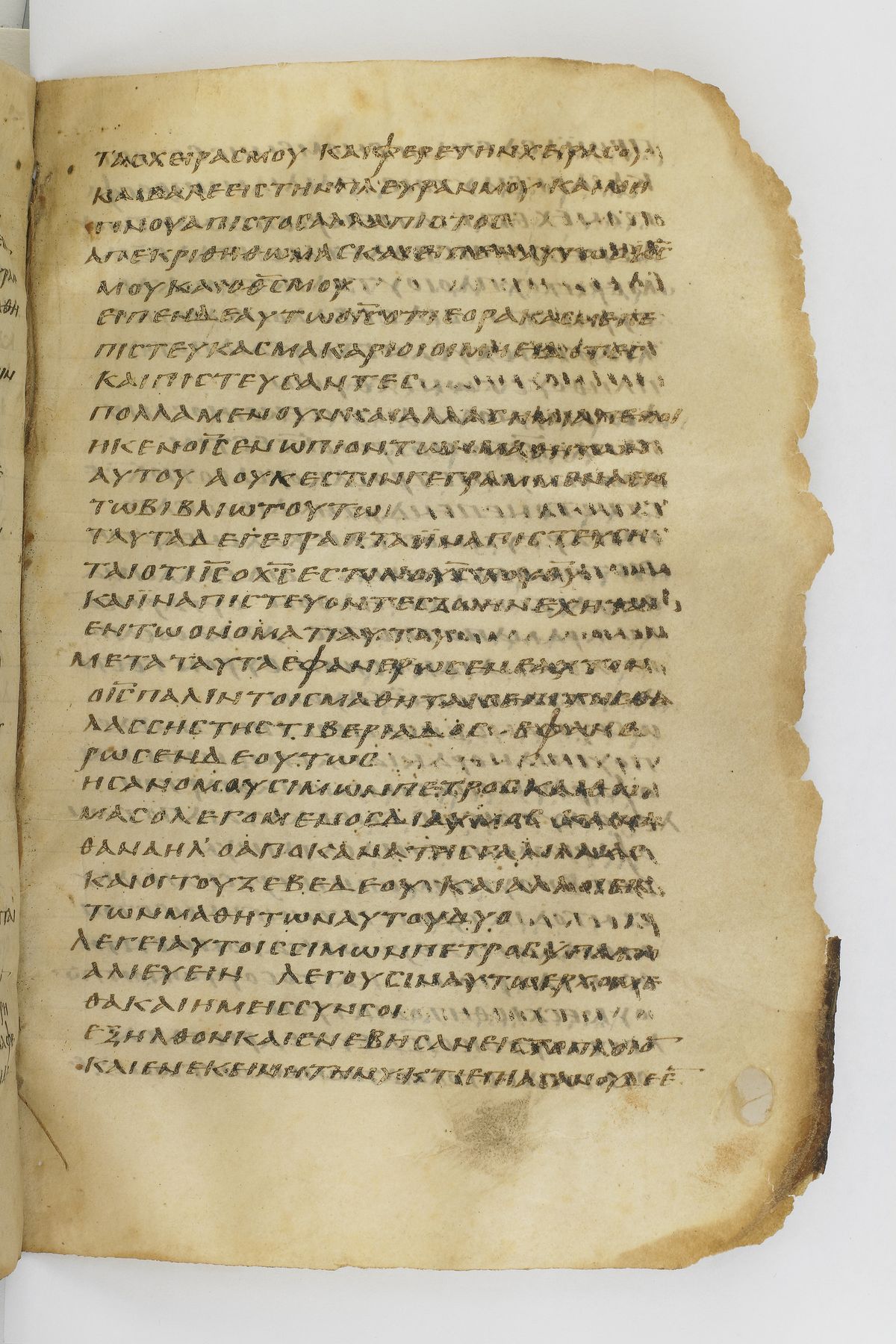
Page from the IGNTP transcription: verses 1-3 on fol. 96r, CSNTM GA_032_0191.
1Μετα ταυτα εφανερωσεν εαυτον ο ις παλιν τοις μαθηταις επι της θαλασσης της τιβεριαδος εφανερωσεν δε ουτως 2ησαν ομου σιμων πετρος και θωμας ο λεγομενος διδυμος και ναθαναηλ ο απο κανα της γαλιλαιας και οι του ζεβεδεου και αλλοι εκ των μαθητων αυτου δυο 3Λεγει αυτοις σιμων πετρος υπαγω αλιευειν λεγουσιν αυτω ερχομεθα και ημεις συν σοι εξηλθον και ενεβησαν εις το πλοιο¯ και εν εκεινη τη νυκτι επιασαν ουδε ε¯
Compare: Tischendorf 8th edition (1869)
1Μετὰ ταῦτα ἐφανέρωσεν ἑαυτὸν πάλιν Ἰησοῦς τοῖς μαθηταῖς ἐπὶ τῆς θαλάσσης τῆς Τιβεριάδος· ἐφανέρωσεν δὲ οὕτως. 2ἦσαν ὁμοῦ Σίμων Πέτρος καὶ Θωμᾶς ὁ λεγόμενος Δίδυμος καὶ Ναθαναὴλ ὁ ἀπὸ Κανᾶ τῆς Γαλιλαίας καὶ οἱ τοῦ Ζεβεδαίου καὶ ἄλλοι ἐκ τῶν μαθητῶν αὐτοῦ δύο. 3λέγει αὐτοῖς Σίμων Πέτρος· ὑπάγω ἁλιεύειν. λέγουσιν αὐτῷ· ἐρχόμεθα καὶ ἡμεῖς σὺν σοί. ἐξῆλθον καὶ ἐνέβησαν εἰς τὸ πλοῖον, καὶ ἐν ἐκείνῃ τῇ νυκτὶ ἐπίασαν οὐδέν.
1After these things Jesus shewed himself again to the disciples at the sea of Tiberias; and on this wise shewed he himself. 2There were together Simon Peter, and Thomas called Didymus, and Nathanael of Cana in Galilee, and the sons of Zebedee, and two other of his disciples. 3Simon Peter saith unto them, I go a fishing. They say unto him, We also go with thee. They went forth, and entered into a ship immediately; and that night they caught nothing.
Where on the image
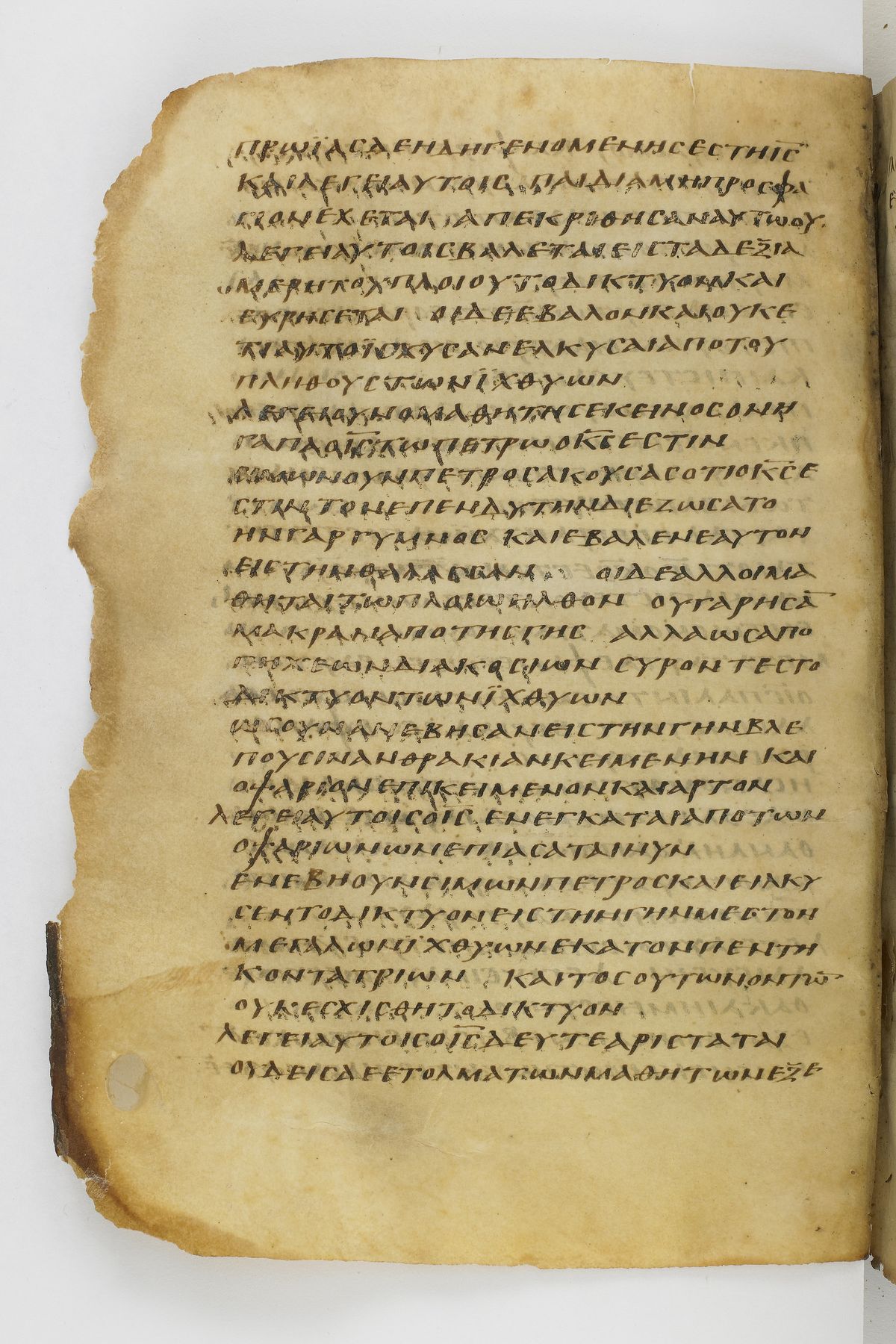
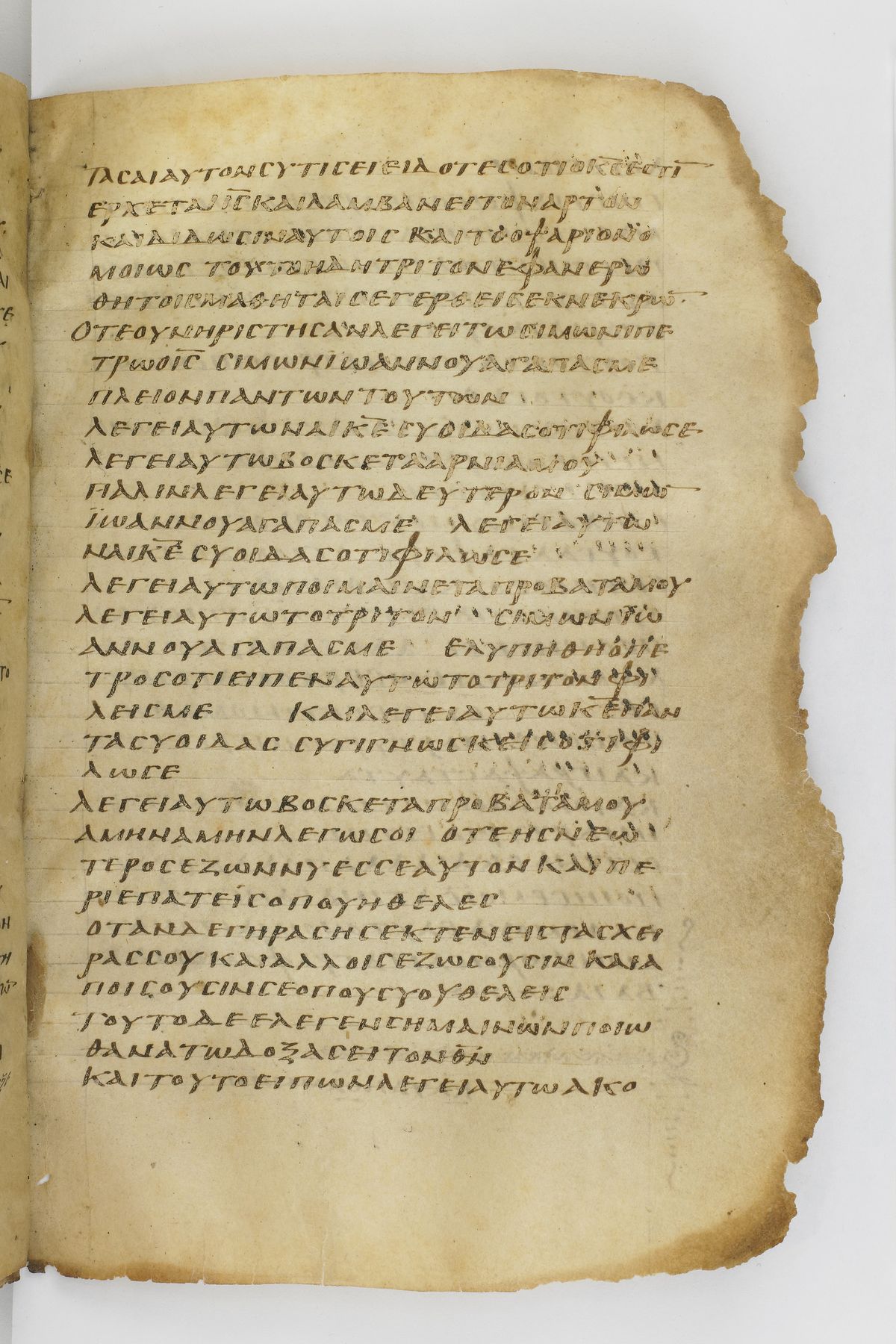
Page from the IGNTP transcription: verses 4-12 on fol. 96v, CSNTM GA_032_0192; verse 12 continues on fol. 97r, CSNTM GA_032_0193 (which begins 'τασαι αυτον συ').
4πρωιας δε ηδη γενομενης εστη ις 5και λεγει αυτοις παιδια μη προσφαγιον εχεται απεκριθησαν αυτω ου 6λεγει αυτοις βαλεται εις τα δεξια μερη του πλοιου το δικτυον και ευρησεται οι δε εβαλον και ουκετι αυτο ισχυσαν ελκυσαι απο του πληθους των ιχθυων 7λεγει ουν ο μαθητης εκεινος ον ηγαπα ο ις τω πετρω ο κς εστιν σιμων ουν πετρος ακουσας οτι ο κς εστιν τον επενδυτην διεζωσατο ην γαρ γυμνος και εβαλεν εαυτον εις την θαλασσαν 8οι δε αλλοι μαθηται τω πλοιω ηλθον ου γαρ ησα¯ μακραν απο της γης αλλα ως απο πηχεων διακοσιων συροντες το δικτυον των ιχθυων 9ως ουν ανεβησαν εις την γην βλεπουσιν ανθρακιαν κειμενην και οψαριον επικειμενον και αρτον 10Λεγει αυτοις ο ις ενεγκαται απο των οψαριων ων επιασαται νυν 11ενεβη ουν σιμων πετρος και ειλκυσεν το δικτυον εις την γην μεστον μεγαλων ιχθυων εκατον πεντηκοντα τριων και τοσουτων οντω¯ ουκ εσχισθη το δικτυον 12Λεγει αυτοις ο ις δευτε αρισταται ουδεις δε ετολμα των μαθητων εξετασαι αυτον συ τις ει ειδοτες οτι ο κς εστι¯
Compare: Tischendorf 8th edition (1869)
4πρωΐας δὲ ἤδη γινομένης ἔστη Ἰησοῦς ἐπὶ τὸν αἰγιαλόν· οὐ μέντοι ᾔδεισαν οἱ μαθηταὶ ὅτι Ἰησοῦς ἐστίν. 5λέγει οὖν αὐτοῖς Ἰησοῦς· παιδία, μή τι προσφάγιον ἔχετε; ἀπεκρίθησαν αὐτῷ· οὔ. 6λέγει αὐτοῖς· βάλετε εἰς τὰ δεξιὰ μέρη τοῦ πλοίου τὸ δίκτυον, καὶ εὑρήσετε. ἔβαλον οὖν, καὶ οὐκέτι αὐτὸ ἑλκύσαι ἴσχυον ἀπὸ τοῦ πλήθους τῶν ἰχθύων. 7λέγει οὖν ὁ μαθητὴς ἐκεῖνος ὃν ἠγάπα ὁ Ἰησοῦς τῷ Πέτρῳ· ὁ κύριός ἐστιν. Σίμων οὖν Πέτρος, ἀκούσας ὅτι ὁ κύριός ἐστιν, τὸν ἐπενδύτην διεζώσατο, ἦν γὰρ γυμνός, καὶ ἔβαλεν ἑαυτὸν εἰς τὴν θάλασσαν· 8οἱ δὲ ἄλλοι μαθηταὶ τῷ πλοιαρίῳ ἦλθον, οὐ γὰρ ἦσαν μακρὰν ἀπὸ τῆς γῆς ἀλλὰ ὡς ἀπὸ πηχῶν διακοσίων, σύροντες τὸ δίκτυον τῶν ἰχθύων. 9ὡς οὖν ἀπέβησαν εἰς τὴν γῆν, βλέπουσιν ἀνθρακιὰν κειμένην καὶ ὀψάριον ἐπικείμενον καὶ ἄρτον. 10λέγει αὐτοῖς ὁ Ἰησοῦς· ἐνέγκατε ἀπὸ τῶν ὀψαρίων ὧν ἐπιάσατε νῦν. 11ἀνέβη Σίμων Πέτρος καὶ εἵλκυσεν τὸ δίκτυον εἰς τὴν γῆν μεστὸν ἰχθύων μεγάλων ἑκατὸν πεντήκοντα τριῶν· καὶ τοσούτων ὄντων οὐκ ἐσχίσθη τὸ δίκτυον. 12λέγει αὐτοῖς ὁ Ἰησοῦς· δεῦτε ἀριστήσατε. οὐδεὶς δὲ ἐτόλμα τῶν μαθητῶν ἐξετάσαι αὐτόν· σὺ τίς εἶ; εἰδότες ὅτι ὁ κύριός ἐστιν.
4But when the morning was now come, Jesus stood on the shore: but the disciples knew not that it was Jesus. 5Then Jesus saith unto them, Children, have ye any meat? They answered him, No. 6And he said unto them, Cast the net on the right side of the ship, and ye shall find. They cast therefore, and now they were not able to draw it for the multitude of fishes. 7Therefore that disciple whom Jesus loved saith unto Peter, It is the Lord. Now when Simon Peter heard that it was the Lord, he girt his fisher’s coat unto him, (for he was naked,) and did cast himself into the sea. 8And the other disciples came in a little ship; (for they were not far from land, but as it were two hundred cubits,) dragging the net with fishes. 9As soon then as they were come to land, they saw a fire of coals there, and fish laid thereon, and bread. 10Jesus saith unto them, Bring of the fish which ye have now caught. 11Simon Peter went up, and drew the net to land full of great fishes, and hundred and fifty and three: and for all there were so many, yet was not the net broken. 12Jesus saith unto them, Come and dine. And none of the disciples durst ask him, Who art thou? knowing that it was the Lord.
Where on the image
Page from the IGNTP transcription: verses 13-19 on fol. 97r, CSNTM GA_032_0193; verse 19 continues on fol. 97v, CSNTM GA_032_0194 (which begins 'λουθει μοι').
13ερχεται ις και λαμβανει τον αρτον και διδωσιν αυτοις και το οψαριον ομοιως 14τουτο ηδη τριτον εφανερωθη τοις μαθηταις εγερθεις εκ νεκρω¯ 15Οτε ουν ηριστησαν λεγει τω σιμωνι πετρω ο ις σιμων ιωαννου αγαπας με πλειον παντων τουτων λεγει αυτω ναι κε συ οιδας οτι φιλω σε λεγει αυτω βοσκε τα αρνια μου 16παλιν λεγει αυτω δευτερον σιμω¯ ιωαννου αγαπας με λεγει αυτω ναι κε συ οιδας οτι φιλω σε λεγει αυτω ποιμαινε τα προβατα μου 17λεγει αυτω το τριτον σιμων ιωαννου αγαπας με ελυπηθη ο πετρος οτι ειπεν αυτω το τριτον φιλεις με και λεγει αυτω κε παντα συ οιδας συ γιγνωσκεις οτι φιλω σε λεγει αυτω βοσκε τα προβατα μου 18αμην αμην λεγω σοι οτε ης νεωτερος εζωννυες σεαυτον και περιεπατεις οπου ηθελες οταν δε γηρασης εκτενεις τας χειρας σου και αλλοι σε ζωσουσιν και αποισουσιν σε οπου συ ου θελεις 19τουτο δε ελεγεν σημαινων ποιω θανατω δοξασει τον θν και τουτο ειπων λεγει αυτω ακολουθει μοι
Compare: Tischendorf 8th edition (1869)
13ἔρχεται Ἰησοῦς καὶ λαμβάνει τὸν ἄρτον καὶ δίδωσιν αὐτοῖς, καὶ τὸ ὀψάριον ὁμοίως. 14τοῦτο ἤδη τρίτον ἐφανερώθη Ἰησοῦς τοῖς μαθηταῖς ἐγερθεὶς ἐκ νεκρῶν. 15Ὅτε οὖν ἠρίστησαν, λέγει τῷ Σίμωνι Πέτρῳ ὁ Ἰησοῦς, Σίμων Ἰωάννου, ἀγαπᾷς με πλέον τούτων; λέγει αὐτῷ· ναί κύριε, σὺ οἶδας ὅτι φιλῶ σε. λέγει αὐτῷ· βόσκε τὰ ἀρνία μου. 16λέγει αὐτῷ πάλιν δεύτερον· Σίμων Ἰωάννου, ἀγαπᾷς με; λέγει αὐτῷ· ναί κύριε, σὺ οἶδας ὅτι φιλῶ σε. λέγει αὐτῷ· ποίμαινε τὰ προβάτιά μου. 17λέγει αὐτῷ τὸ τρίτον· Σίμων Ἰωάννου, φιλεῖς με; ἐλυπήθη ὁ Πέτρος ὅτι εἶπεν αὐτῷ τὸ τρίτον· φιλεῖς με; καὶ λέγει αὐτῷ· κύριε, πάντα σὺ οἶδας, σὺ γινώσκεις ὅτι φιλῶ σε. λέγει αὐτῷ· βόσκε τὰ προβάτιά μου. 18ἀμὴν ἀμὴν λέγω σοι, ὅτε ἦς νεώτερος, ἐζώννυες σεαυτὸν καὶ περιεπάτεις ὅπου ἤθελες· ὅταν δὲ γηράσῃς, ἐκτενεῖς τὰς χεῖράς σου, καὶ ἄλλος σε ζώσει καὶ οἴσει ὅπου οὐ θέλεις. 19τοῦτο δὲ εἶπεν σημαίνων ποίῳ θανάτῳ δοξάσει τὸν θεόν. καὶ τοῦτο εἰπὼν λέγει αὐτῷ· ἀκολούθει μοι.
13Jesus then cometh, and taketh bread, and giveth them, and fish likewise. 14This is now the third time that Jesus shewed himself to his disciples, after that he was risen from the dead. 15So when they had dined, Jesus saith to Simon Peter, Simon, son of Jonas, lovest thou me more than these? He saith unto him, Yea, Lord; thou knowest that I love thee. He saith unto him, Feed my lambs. 16He saith to him again the second time, Simon, son of Jonas, lovest thou me? He saith unto him, Yea, Lord; thou knowest that I love thee. He saith unto him, Feed my sheep. 17He saith unto him the third time, Simon, son of Jonas, lovest thou me? Peter was grieved because he said unto him the third time, Lovest thou me? And he said unto him, Lord, thou knowest all things; thou knowest that I love thee. Jesus saith unto him, Feed my sheep. 18Verily, verily, I say unto thee, When thou wast young, thou girdedst thyself, and walkedst whither thou wouldest: but when thou shalt be old, thou shalt stretch forth thy hands, and another shall gird thee, and carry thee whither thou wouldest not. 19This spake he, signifying by what death he should glorify God. And when he had spoken this, he saith unto him, Follow me.
Where on the image
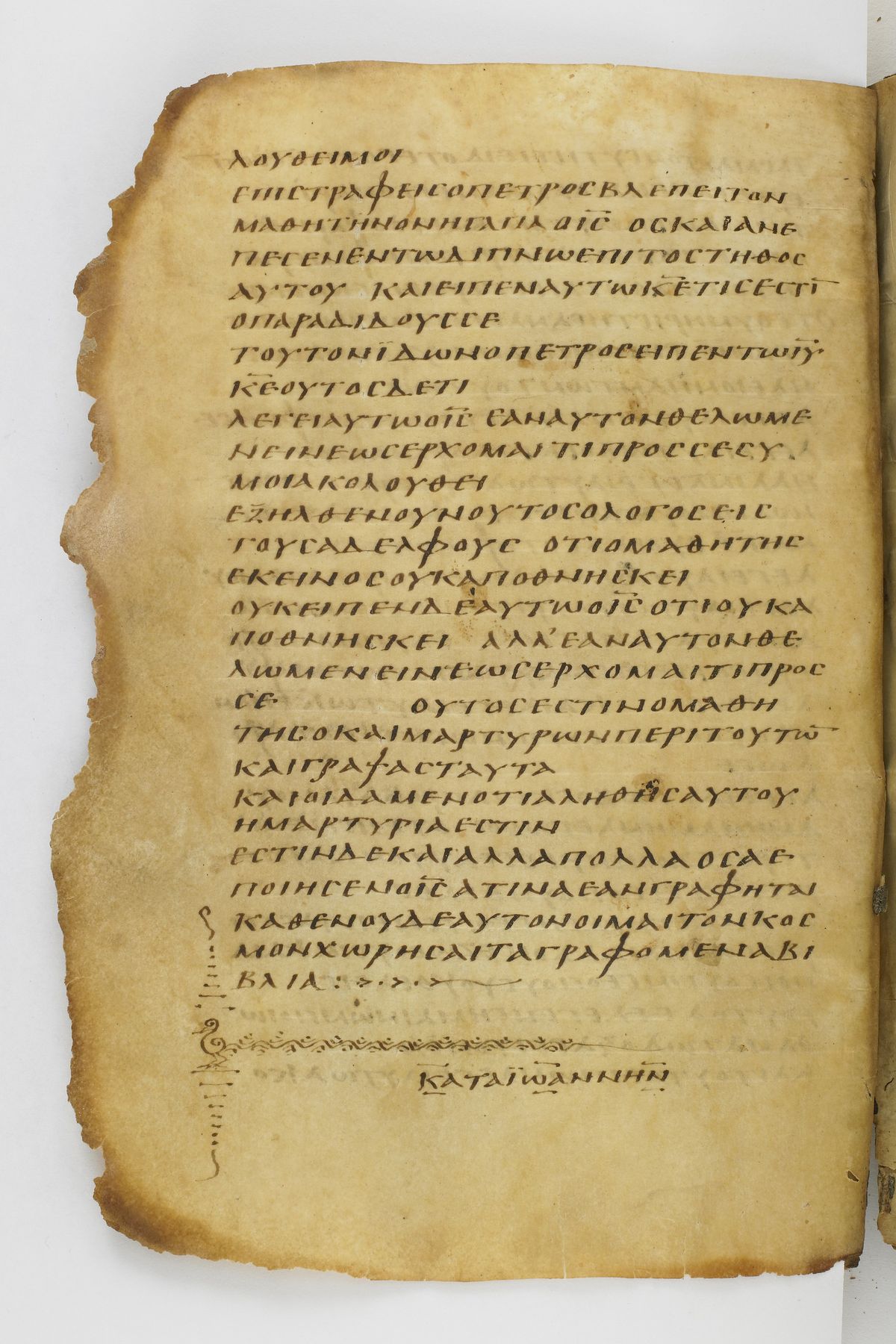
Page from the IGNTP transcription: verses 20-25 on fol. 97v, CSNTM GA_032_0194.
20επιστραφεις ο πετρος βλεπει τον μαθητην ον ηγαπα ο ις ος και ανεπεσεν εν τω διπνω επι το στηθος αυτου και ειπεν αυτω κε τις εστι¯ ο παραδιδους σε 21τουτον ιδων ο πετρος ειπεν τω ιυ κε ουτος δε τι 22λεγει αυτω ο ις εαν αυτον θελω μενειν εως ερχομαι τι προς σε συ μοι ακολουθει 23εξηλθεν ουν ουτος ο λογος εις τους αδελφους οτι ο μαθητης εκεινος ουκ αποθνησκει ουκ ειπεν δε αυτω ο ις οτι ουκ αποθνησκει αλλ εαν αυτον θελω μενειν εως ερχομαι τι προς σε 24ουτος εστιν ο μαθητης ο και μαρτυρων περι τουτω¯ και γραψας ταυτα και οιδαμεν οτι αληθης αυτου η μαρτυρια εστιν 25εστιν δε και αλλα πολλα οσα εποιησεν ο ις ατινα εαν γραφηται καθ εν ουδε αυτον οιμαι τον κοσμον χωρησαι τα γραφομενα βιβλια
Compare: Tischendorf 8th edition (1869)
20ἐπιστραφεὶς ὁ Πέτρος βλέπει τὸν μαθητὴν ὃν ἠγάπα ὁ Ἰησοῦς ἀκολουθοῦντα, ὃς καὶ ἀνέπεσεν ἐν τῷ δείπνῳ ἐπὶ τὸ στῆθος αὐτοῦ καὶ εἶπεν· κύριε, τίς ἐστιν ὁ παραδιδούς σε; 21τοῦτον οὖν ἰδὼν ὁ Πέτρος λέγει τῷ Ἰησοῦ· κύριε οὗτος δὲ τί; 22λέγει αὐτῷ ὁ Ἰησοῦς· ἐὰν αὐτὸν θέλω μένειν ἕως ἔρχομαι, τί πρὸς σέ; σύ μοι ἀκολούθει. 23ἐξῆλθεν οὖν οὗτος ὁ λόγος εἰς τοὺς ἀδελφοὺς ὅτι ὁ μαθητὴς ἐκεῖνος οὐκ ἀποθνήσκει· καὶ οὐκ εἶπεν αὐτῷ ὁ Ἰησοῦς ὅτι οὐκ ἀποθνήσκει, ἀλλ’· ἐὰν αὐτὸν θέλω μένειν ἕως ἔρχομαι. 24Οὗτός ἐστιν ὁ μαθητὴς ὁ μαρτυρῶν περὶ τούτων καὶ γράψας ταῦτα, καὶ οἴδαμεν ὅτι ἀληθὴς αὐτοῦ ἡ μαρτυρία ἐστίν.
20Then Peter, turning about, seeth the disciple whom Jesus loved following; which also leaned on his breast at supper, and said, Lord, which is he that betrayeth thee? 21Peter seeing him saith to Jesus, Lord, and what shall this man do? 22Jesus saith unto him, If I will that he tarry till I come, what is that to thee? follow thou me. 23Then went this saying abroad among the brethren, that that disciple should not die: yet Jesus said not unto him, He shall not die; but, If I will that he tarry till I come, what is that to thee? 24This is the disciple which testifieth of these things, and wrote these things: and we know that his testimony is true. 25And there are also many other things which Jesus did, the which, if they should be written every one, I suppose that even the world itself could not contain the books that should be written. Amen.
Cite
Sources
- Source: Codex Washingtonianus page images + IGNTP transcription (CC BY 4.0) + Tischendorf 8th edition + KJV (holding institution)
- Critical edition: Codex Washingtonianus transcription, IGNTP (CC BY 4.0); Tischendorf 8th edition for comparison
← previous · → next · v cycle view · l back to library