Classic of Changes, Hexagram 9: Xiaoxu 小畜 (Ming print of 1596)
Introduction
Xiaoxu 小畜 is hexagram 9 in the received order of the Classic of Changes (周易 Zhouyi, also called 易經 Yijing). Its figure joins the trigram 乾 Qian (heaven) below and 巽 Xun (wind) above. The text of each hexagram has two layers: a short statement on the hexagram as a whole (卦辭, which Legge calls the Thwan and ascribes to King Wen) and one statement for each of its six lines (爻辭, ascribed to the Duke of Zhou). The statements were used for divination and are generally dated to the Western Zhou period (roughly the 9th century BCE or earlier); the commentaries known as the Ten Wings were added later.
The photographs are of the first volume of a Five Classics printed in Nanjing with the main text only and punctuation circles, with a postface by Li Deng dated Wanli 24 (1596); the National Diet Library, Tokyo, holds the only known copy of these five volumes (call no. WA35-19). It follows the arrangement of Wang Bi's edition: after each hexagram figure come the statement, the commentaries on it (彖 Tuan and 大象 Great Image), and each line statement followed by its Small Image (小象). Those commentaries are not given here. In this copy the hexagram runs from canvas 27, right-hand page to canvas 28, right-hand page. Each section gathers the statements that begin on one page and links to that page and to any page the last statement runs onto; the page boundaries were found by reading the first characters of every column on the photographs.
The Chinese is the received text from Wikisource. The English is James Legge's translation in Sacred Books of the East, volume 16 (1882), The Text, hexagram 9 (Hsiâo Khû), pages 76-77; his notes are not reproduced. Legge adds words in parentheses to make the sense plain; they are his.
How was this verified? (Provenance)
Where on the image
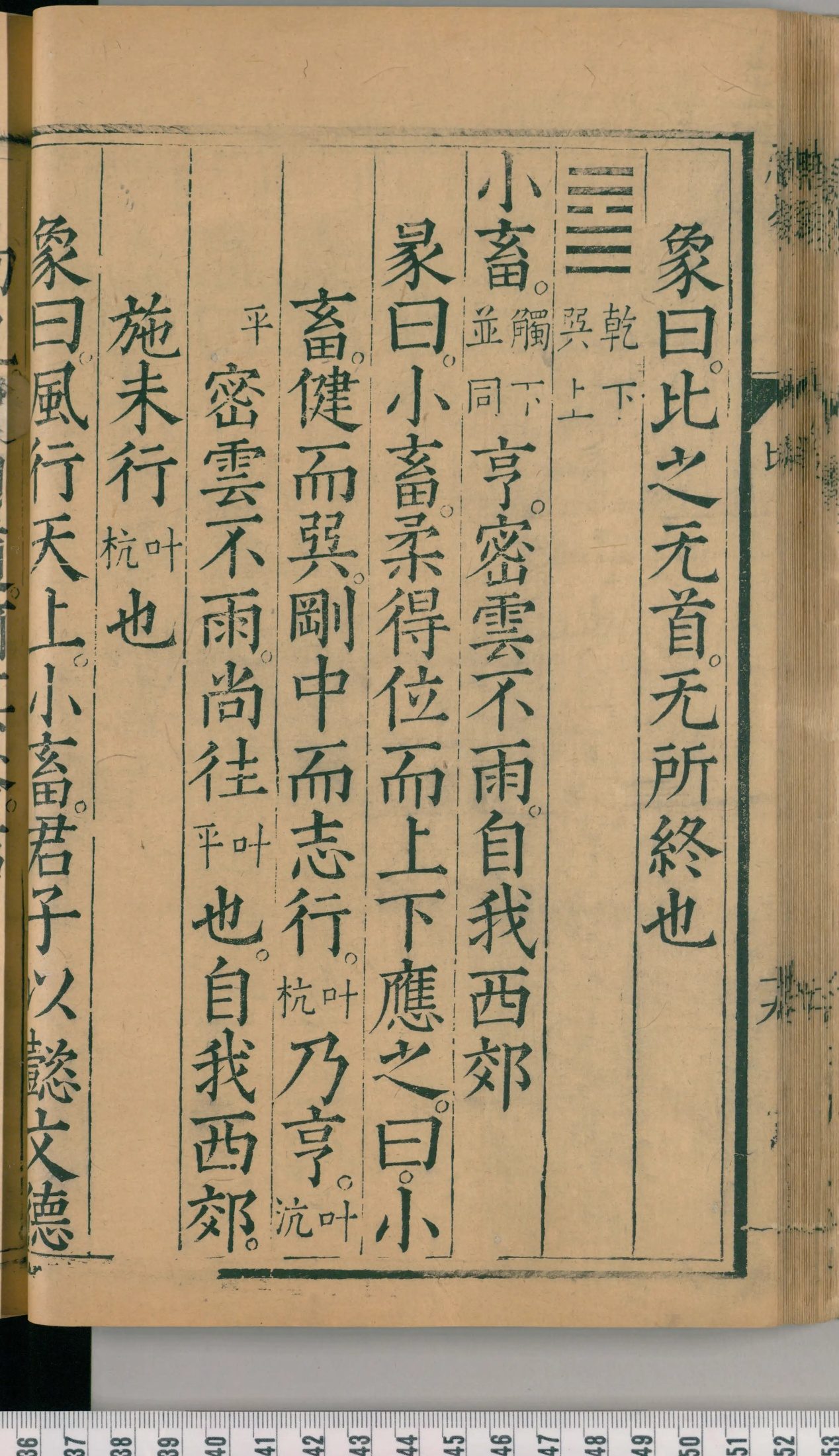
National Diet Library WA35-19 [五經白文], vol. 1 (周易), IIIF canvas 27, right-hand page: 8 columns, main text with punctuation circles and small sound glosses. Column 2 carries the hexagram figure with the trigram names 乾下巽上. Checked on the image: the hexagram statement opens column 3 ‹小畜亨密›. Between the statements the print gives the commentaries of the Ten Wings (彖曰, 象曰), which are not part of this section. The Chinese shown is the received text from Wikisource, not a transcription of this print.
小畜:亨。密雲不雨,自我西郊。
Hsiâo Khû indicates that (under its conditions) there will be progress and success. (We see) dense clouds, but no rain coming from our borders in the west.
Where on the image
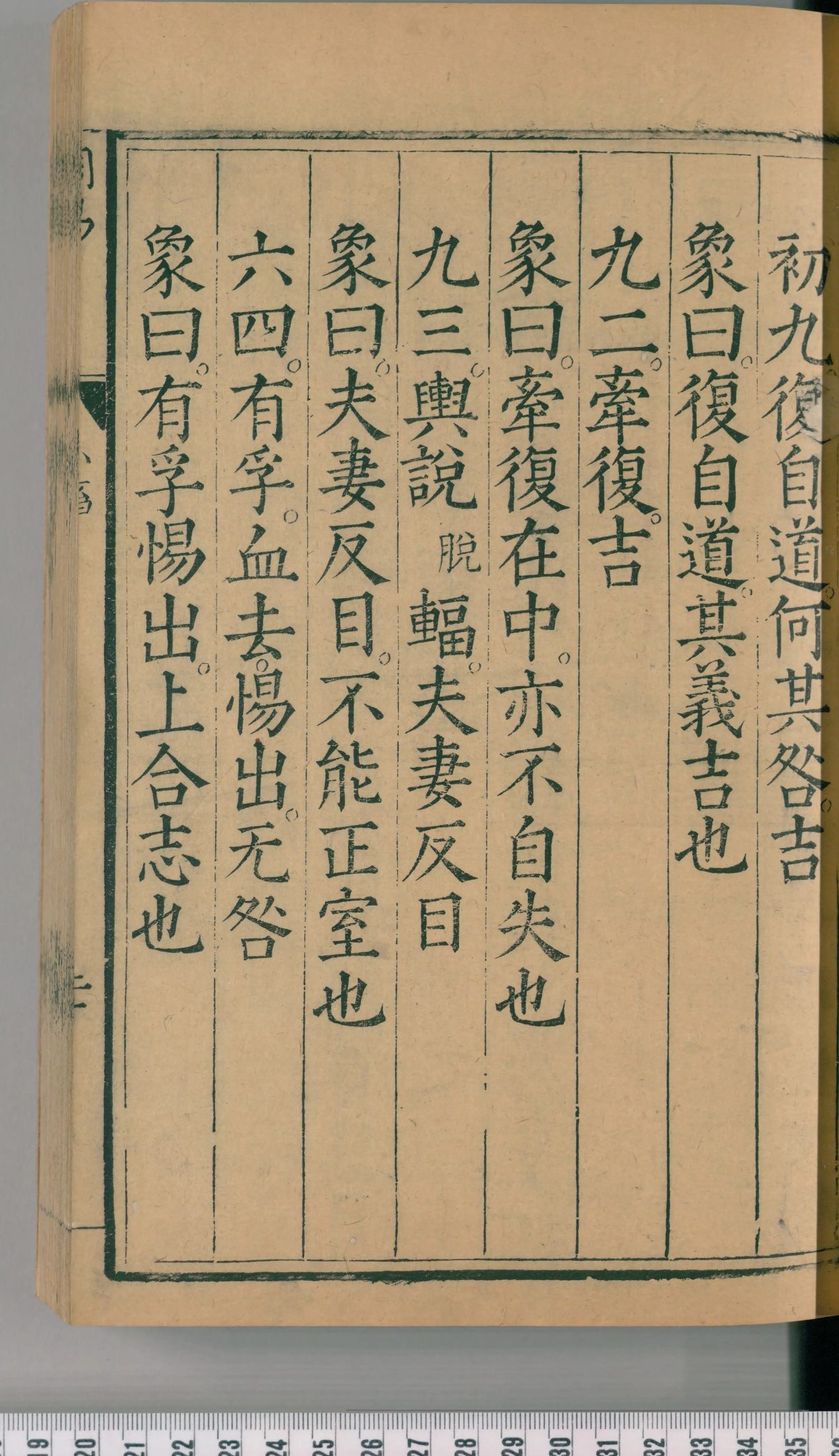
National Diet Library WA35-19 [五經白文], vol. 1 (周易), IIIF canvas 27, left-hand page: 8 columns, main text with punctuation circles and small sound glosses. Checked on the image: line statement 1 opens column 1 ‹初九復自›; line statement 2 opens column 3 ‹九二牽復›; line statement 3 opens column 5 ‹九三輿說›; line statement 4 opens column 7 ‹六四有孚›. Between the statements the print gives the commentaries of the Ten Wings (彖曰, 象曰), which are not part of this section. The Chinese shown is the received text from Wikisource, not a transcription of this print.
1初九:復自道,何其咎,吉。
2九二:牽復,吉。
3九三:輿說輻,夫妻反目。
4六四:有孚,血去惕出,无咎。
1The first line, undivided, shows its subject returning and pursuing his own course. What mistake should he fall into? There will be good fortune.
2The second line, undivided, shows its subject, by the attraction (of the former line), returning (to the proper course). There will be good fortune.
3The third line, undivided, suggests the idea of a carriage, the strap beneath which has been removed, or of a husband and wife looking on each other with averted eyes.
4The fourth line, divided, shows its subject possessed of sincerity. The danger of bloodshed is thereby averted, and his (ground for) apprehension dismissed. There will be no mistake.
Where on the image
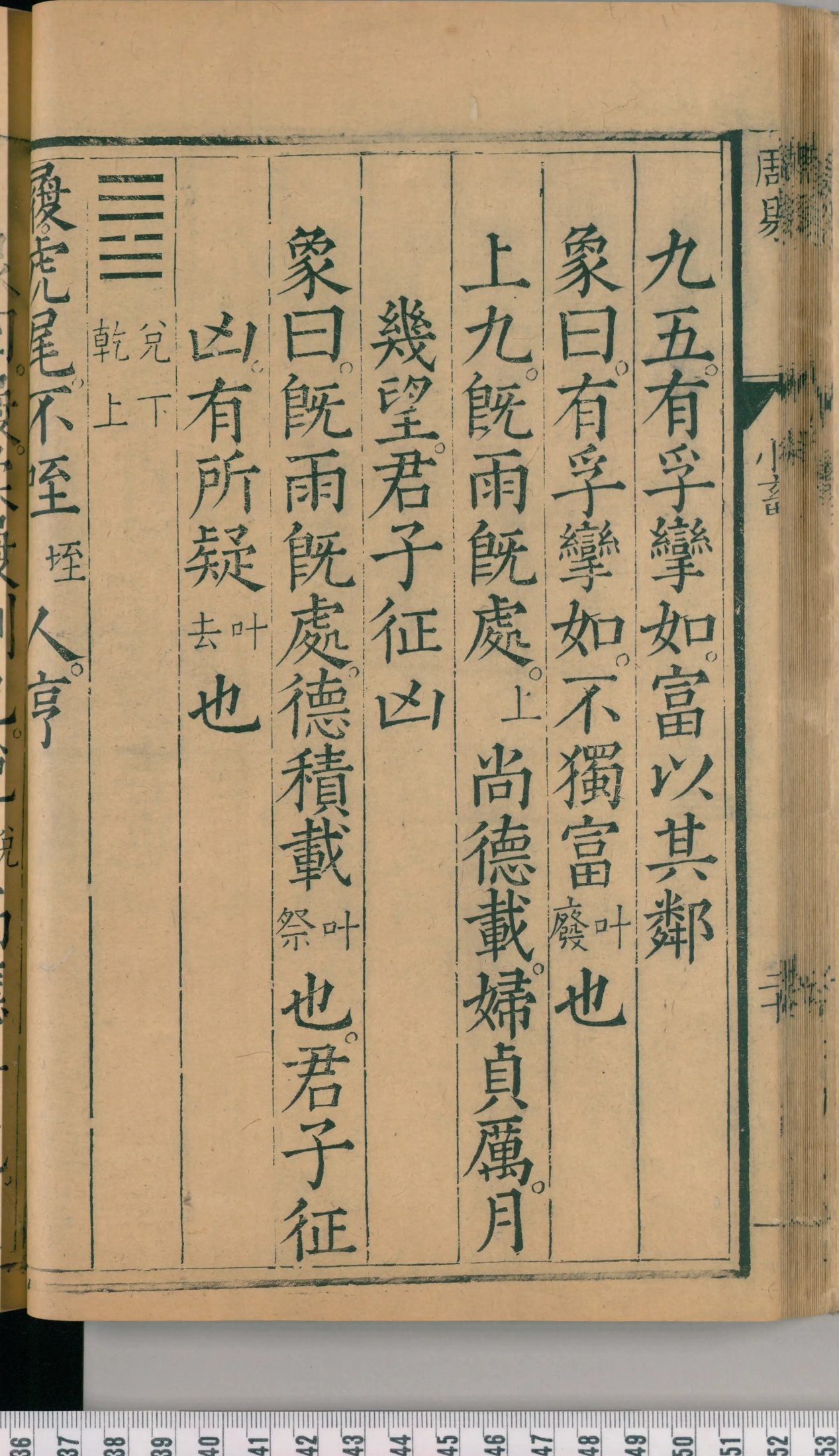
National Diet Library WA35-19 [五經白文], vol. 1 (周易), IIIF canvas 28, right-hand page: 8 columns, main text with punctuation circles and small sound glosses. Checked on the image: line statement 5 opens column 1 ‹九五有孚›; line statement 6 opens column 3 ‹上九既雨›. Between the statements the print gives the commentaries of the Ten Wings (彖曰, 象曰), which are not part of this section. The Chinese shown is the received text from Wikisource, not a transcription of this print.
5九五:有孚攣如,富以其鄰。
6上九:既雨既處,尚德載,婦貞厲,月幾望,君子征凶。
5The fifth line, undivided, shows its subject possessed of sincerity, and drawing others to unite with him. Rich in resources, he employs his neighbours (in the same cause with himself).
6The topmost line, undivided, shows how the rain has fallen, and the (onward progress) is stayed;—(so) must we value the full accumulation of the virtue (represented by the upper trigram). But a wife (exercising restraint), however firm and correct she may be, is in a position of peril, (and like) the moon approaching to the full. If the superior man prosecute his measures (in such circumstances), there will be evil.
Notes
- English: James Legge, The Yî King, Sacred Books of the East vol. 16 (1882), The Text, hexagram 9 (Hsiâo Khû). The hexagram statement is unnumbered; the line statements are numbered from the bottom line up, as in Legge.
- Legge's footnotes and his notes under each hexagram are left out.
Cite
Sources
- Source: National Diet Library WA35-19 (Ming Five Classics print with postface of 1596, vol. 1, Zhouyi) + Wikisource received text + James Legge, Sacred Books of the East 16 (1882) (holding institution)
- Critical edition: Received text (Wikisource)
← previous · → next · v cycle view · l back to library