Classic of Changes, Hexagram 11: Tai 泰 (Ming print of 1596)
Introduction
Tai 泰 is hexagram 11 in the received order of the Classic of Changes (周易 Zhouyi, also called 易經 Yijing). Its figure joins the trigram 乾 Qian (heaven) below and 坤 Kun (earth) above. The text of each hexagram has two layers: a short statement on the hexagram as a whole (卦辭, which Legge calls the Thwan and ascribes to King Wen) and one statement for each of its six lines (爻辭, ascribed to the Duke of Zhou). The statements were used for divination and are generally dated to the Western Zhou period (roughly the 9th century BCE or earlier); the commentaries known as the Ten Wings were added later.
The photographs are of the first volume of a Five Classics printed in Nanjing with the main text only and punctuation circles, with a postface by Li Deng dated Wanli 24 (1596); the National Diet Library, Tokyo, holds the only known copy of these five volumes (call no. WA35-19). It follows the arrangement of Wang Bi's edition: after each hexagram figure come the statement, the commentaries on it (彖 Tuan and 大象 Great Image), and each line statement followed by its Small Image (小象). Those commentaries are not given here. In this copy the hexagram runs from canvas 29, left-hand page to canvas 31, right-hand page. Each section gathers the statements that begin on one page and links to that page and to any page the last statement runs onto; the page boundaries were found by reading the first characters of every column on the photographs.
The Chinese is the received text from Wikisource. The English is James Legge's translation in Sacred Books of the East, volume 16 (1882), The Text, hexagram 11 (Thâi), pages 81-82; his notes are not reproduced. Legge adds words in parentheses to make the sense plain; they are his.
How was this verified? (Provenance)
Where on the image
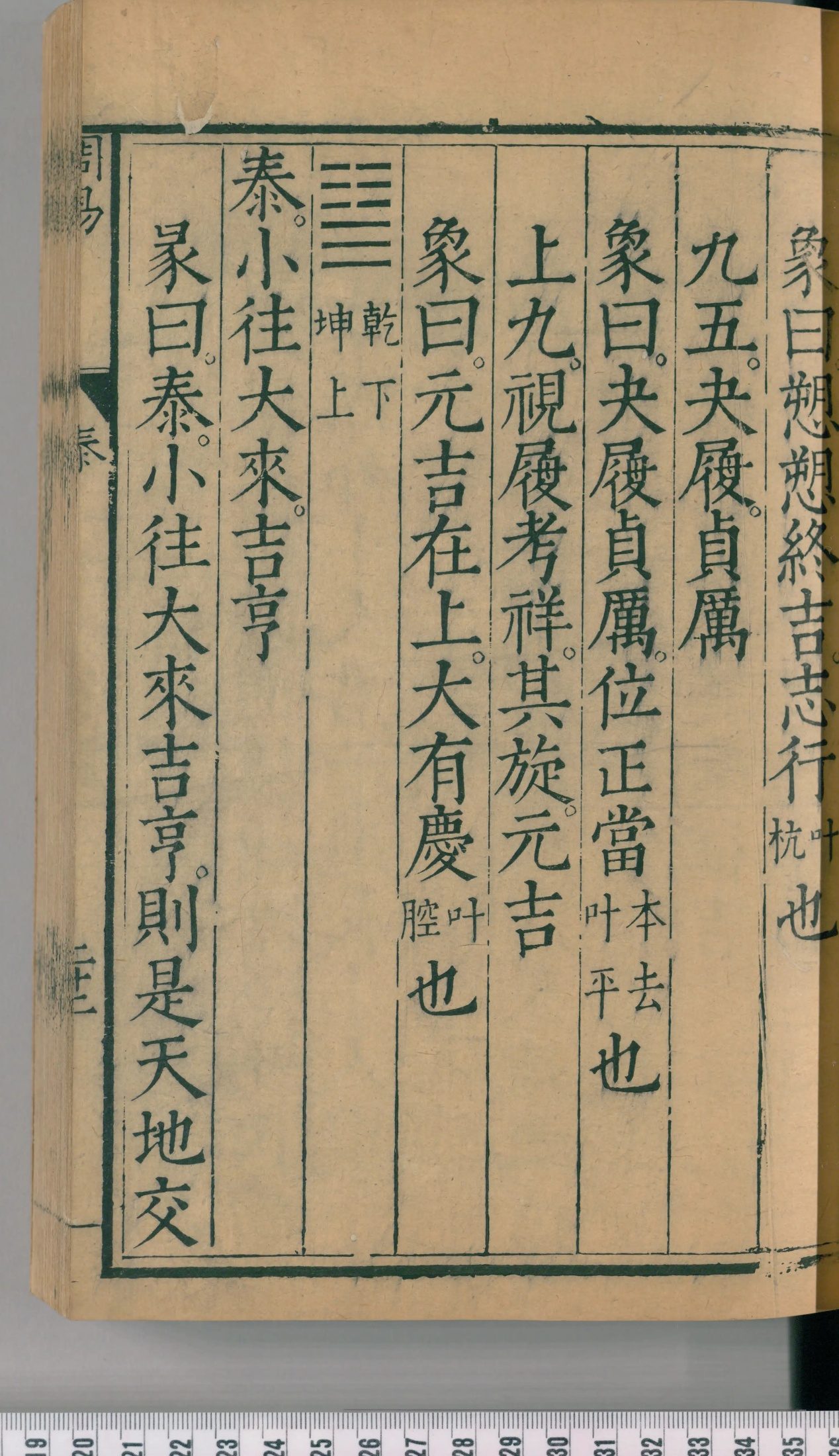
National Diet Library WA35-19 [五經白文], vol. 1 (周易), IIIF canvas 29, left-hand page: 8 columns, main text with punctuation circles and small sound glosses. Column 6 carries the hexagram figure with the trigram names 乾下坤上. Checked on the image: the hexagram statement opens column 7 ‹泰小往大›. Between the statements the print gives the commentaries of the Ten Wings (彖曰, 象曰), which are not part of this section. The Chinese shown is the received text from Wikisource, not a transcription of this print.
泰:小往大來,吉亨。
In Thâi (we see) the little gone and the great come. (It indicates that) there will be good fortune, with progress and success.
Where on the image
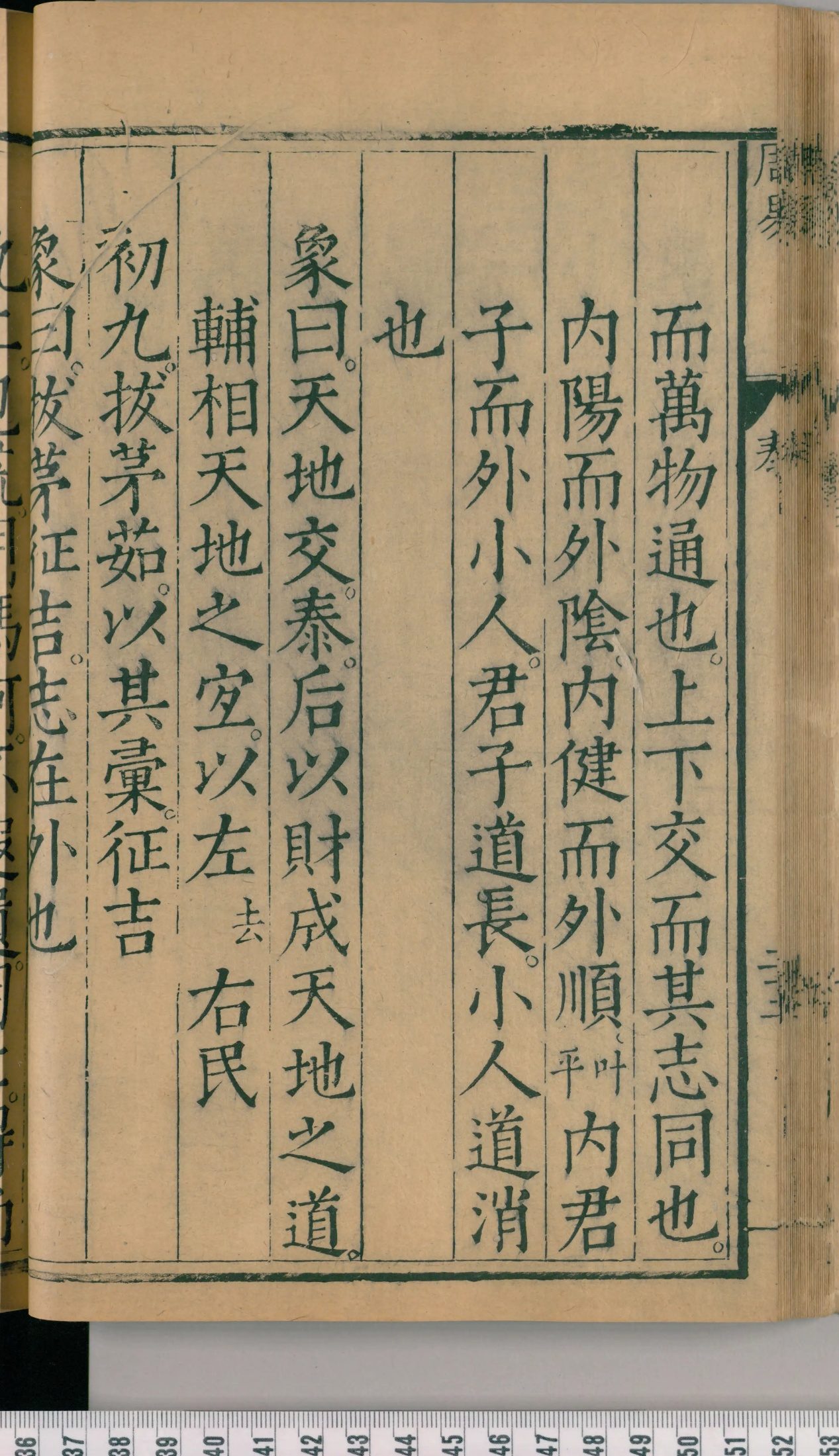
National Diet Library WA35-19 [五經白文], vol. 1 (周易), IIIF canvas 30, right-hand page: 8 columns, main text with punctuation circles and small sound glosses. Checked on the image: line statement 1 opens column 7 ‹初九拔茅›. Between the statements the print gives the commentaries of the Ten Wings (彖曰, 象曰), which are not part of this section. The Chinese shown is the received text from Wikisource, not a transcription of this print.
1初九:拔茅茹以其彙,征吉。
1The first line, undivided, suggests the idea of grass pulled up, and bringing with it other stalks with whose roots it is connected. Advance (on the part of its subject) will be fortunate.
Where on the image
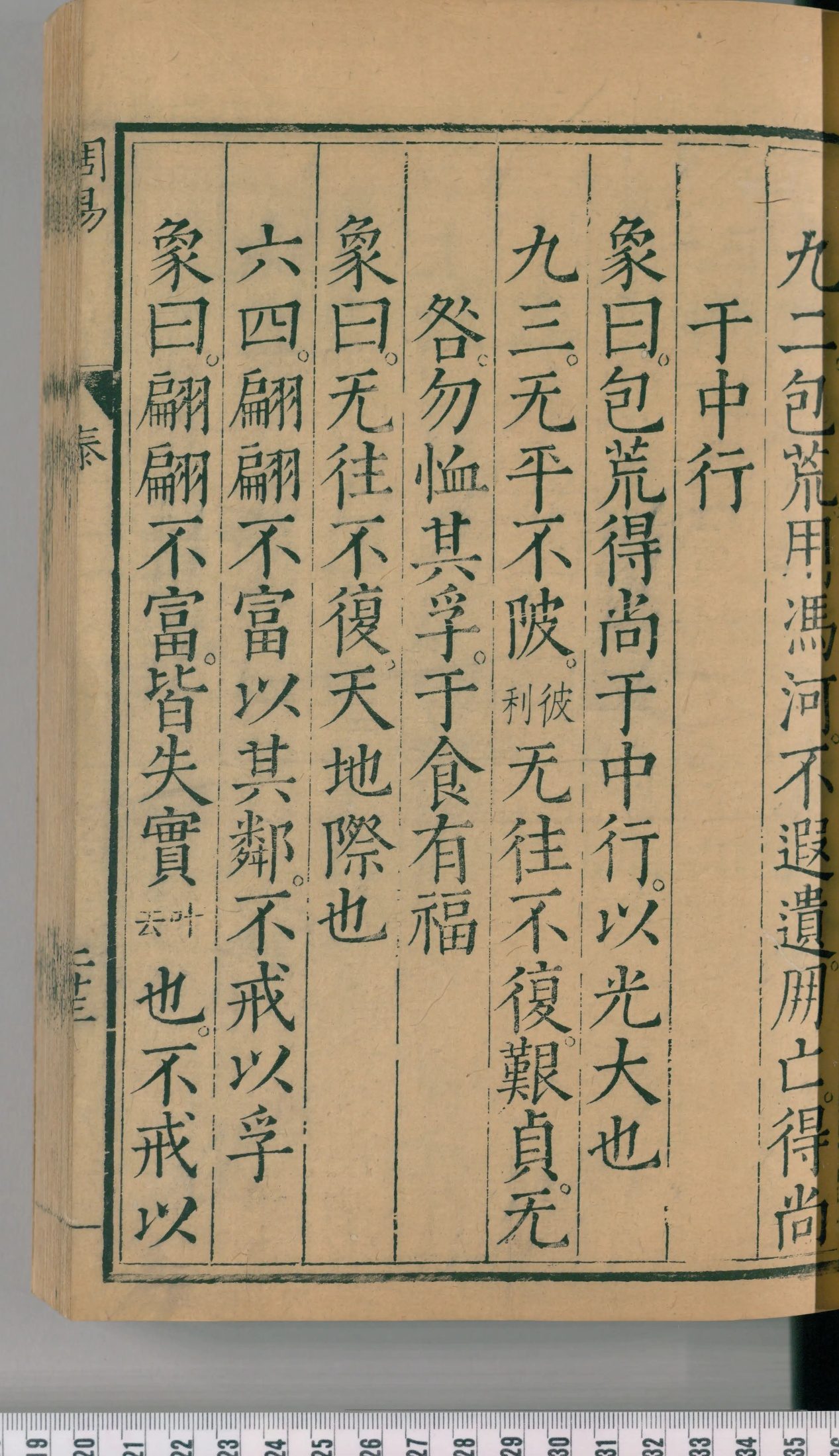
National Diet Library WA35-19 [五經白文], vol. 1 (周易), IIIF canvas 30, left-hand page: 8 columns, main text with punctuation circles and small sound glosses. Checked on the image: line statement 2 opens column 1 ‹九二包荒›; line statement 3 opens column 4 ‹九三无平›; line statement 4 opens column 7 ‹六四翩翩›. Between the statements the print gives the commentaries of the Ten Wings (彖曰, 象曰), which are not part of this section. The Chinese shown is the received text from Wikisource, not a transcription of this print.
2九二:包荒。用馮河,不遐遺;朋亡。得尚于中行。
3九三:无平不陂,无往不復,艱貞无咎。勿恤其孚,于食有福。
4六四:翩翩,不富以其鄰;不戒以孚。
2The second line, undivided, shows one who can bear with the uncultivated, will cross the Ho without a boat, does not forget the distant, and has no (selfish) friendships. Thus does he prove himself acting in accordance with the course of the due Mean.
3The third line, undivided, shows that, while there is no state of peace that is not liable to be disturbed, and no departure (of evil men) so that they shall not return, yet when one is firm and correct, as he realises the distresses that may arise, he will commit no error. There is no occasion for sadness at the certainty (of such recurring changes); and in this mood the happiness (of the present) may be (long) enjoyed.
4The fourth line, divided, shows its subject fluttering (down);—not relying on his own rich resources, but calling in his neighbours. (They all come) not as having received warning, but in the sincerity (of their hearts).
Where on the image
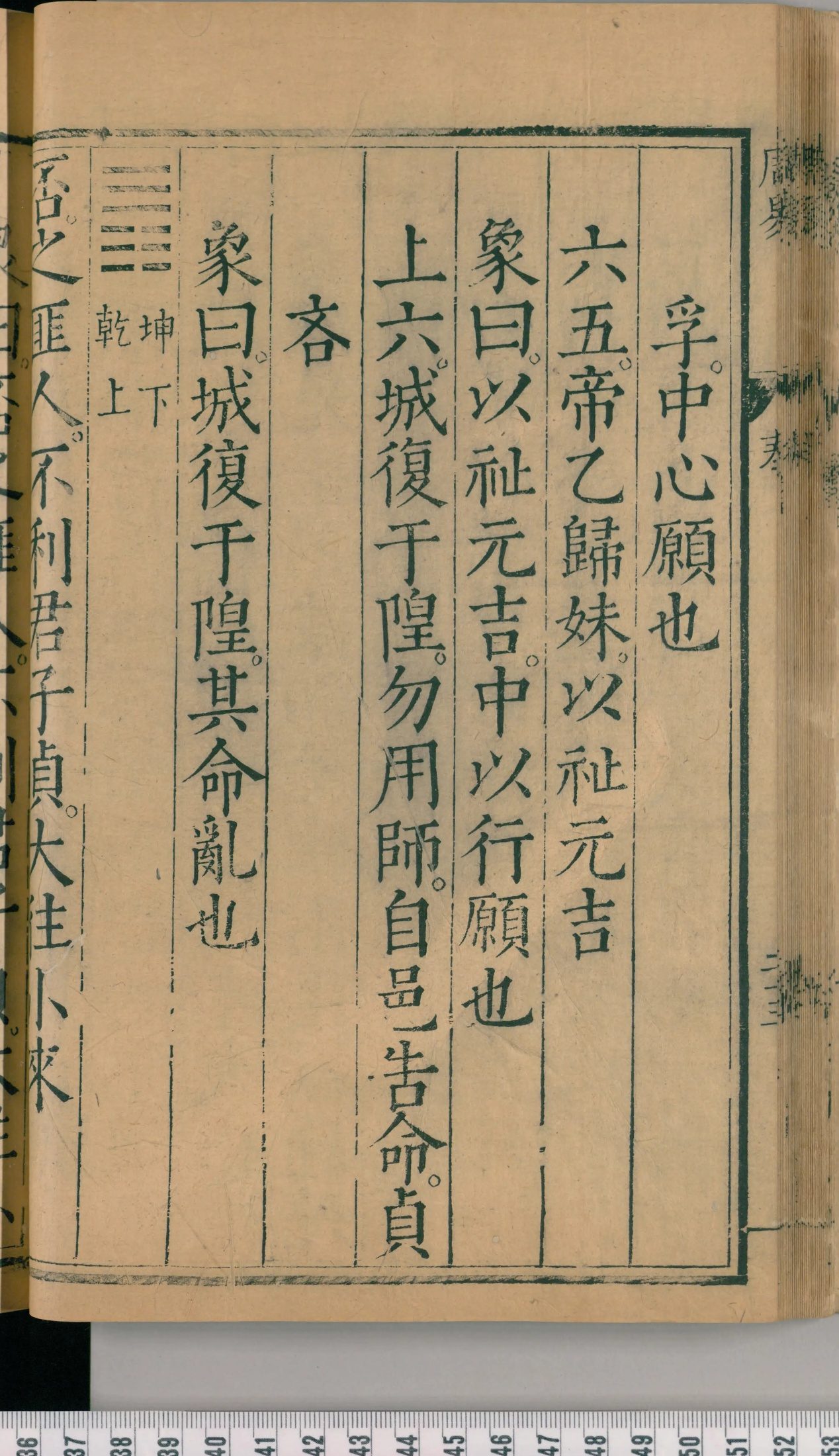
National Diet Library WA35-19 [五經白文], vol. 1 (周易), IIIF canvas 31, right-hand page: 8 columns, main text with punctuation circles and small sound glosses. Checked on the image: line statement 5 opens column 2 ‹六五帝乙›; line statement 6 opens column 4 ‹上六城復›. Between the statements the print gives the commentaries of the Ten Wings (彖曰, 象曰), which are not part of this section. The Chinese shown is the received text from Wikisource, not a transcription of this print.
5六五:帝乙歸妹,以祉,元吉。
6上六:城復于隍,勿用師,自邑告命,貞吝。
5The fifth line, divided, reminds us of (king) Tî-yî's (rule about the) marriage of his younger sister. By such a course there is happiness and there will be great good fortune.
6The sixth line, divided, shows us the city wall returned into the moat. It is not the time to use the army. (The subject of the line) may, indeed, announce his orders to the people of his own city; but however correct and firm he may be, he will have cause for regret.
Notes
- English: James Legge, The Yî King, Sacred Books of the East vol. 16 (1882), The Text, hexagram 11 (Thâi). The hexagram statement is unnumbered; the line statements are numbered from the bottom line up, as in Legge.
- Legge's footnotes and his notes under each hexagram are left out.
Cite
Sources
- Source: National Diet Library WA35-19 (Ming Five Classics print with postface of 1596, vol. 1, Zhouyi) + Wikisource received text + James Legge, Sacred Books of the East 16 (1882) (holding institution)
- Critical edition: Received text (Wikisource)
← previous · → next · v cycle view · l back to library